
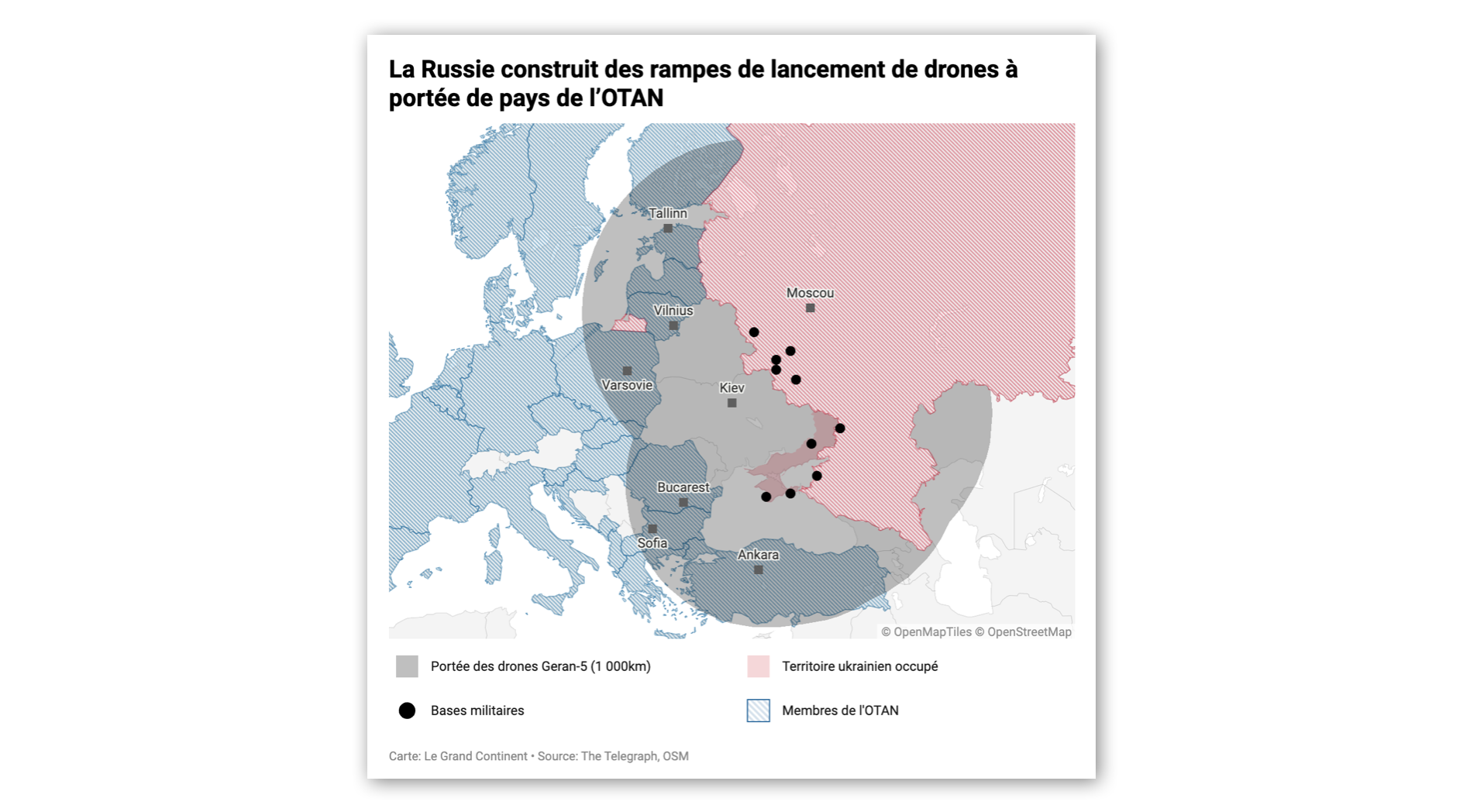
According to satellite images and leaked Russian official documents, Moscow has built new drone-launch ramps at 10 bases located near Europe. Some are already used to carry out strikes in Ukraine, but they could also serve to launch drones against NATO member countries.
- Three of these bases are situated on occupied Ukrainian territory: two in Crimea, at Kacha in the west and Cap Chauda in the east of the peninsula, and one in Donetsk in southeastern Ukraine.
- Those along the border with Belarus and Ukraine host at least 59 launch ramps, enabling the takeoff of fixed-wing drones without requiring a traditional airstrip.
- Some of these bases were built ex nihilo during the Russian campaign to be less exposed to satellites, while others were converted from existing civilian or military airfields.
These new bases notably allow the launch of the Geran-5, the new modified version produced by the Russian industry of the Iranian Shahed drone, which can cover a distance of 1,000 kilometers at a speed of 600 km/h, and which enables it to evade certain air defense systems.
In total, the territories of 11 NATO countries would be within range of these new sites.
- Russia, which continues to invest heavily in drones, would be capable of producing around 3,000 Geran-4 and Geran-5 units each month.
- If a large number of these drones are fired on Ukraine, satellite images also reveal extensive storage facilities capable of housing up to 1,000 drones, some of which would have been supplied by ammunition factories spread across Russian territory, notably the Alabuga industrial park, which alone produces 6,000 units per year.
At least 38 incidents involving Russian drones have occurred in Europe between March 2022 and May 2026, according to a review by RTBF. Nine of these crashes caused material damage, notably in Moldova, Romania and the Baltic states.
Russian drones continue to be regularly intercepted in the airspaces of European countries, particularly Romania, which to date has been the most affected nation.
- On Sunday, August 16, a Spanish fighter aircraft deployed under an NATO mission destroyed a drone believed to be of Russian origin a few kilometers north of Galați.
- It is the fourth drone destroyed by NATO over Romania since the beginning of the year.
- In the night of September 9 to 10, at least 19 Russian drones penetrated Polish airspace, prompting intervention by fighter jets from the Polish and Dutch air forces.
American intelligence considers that a “limited Russian attack” against a NATO country could take place as early as this autumn, in order to test the Alliance’s resolve. In earlier assessments, Washington believed that Putin would not provoke a NATO member while the war in Ukraine remained active.