
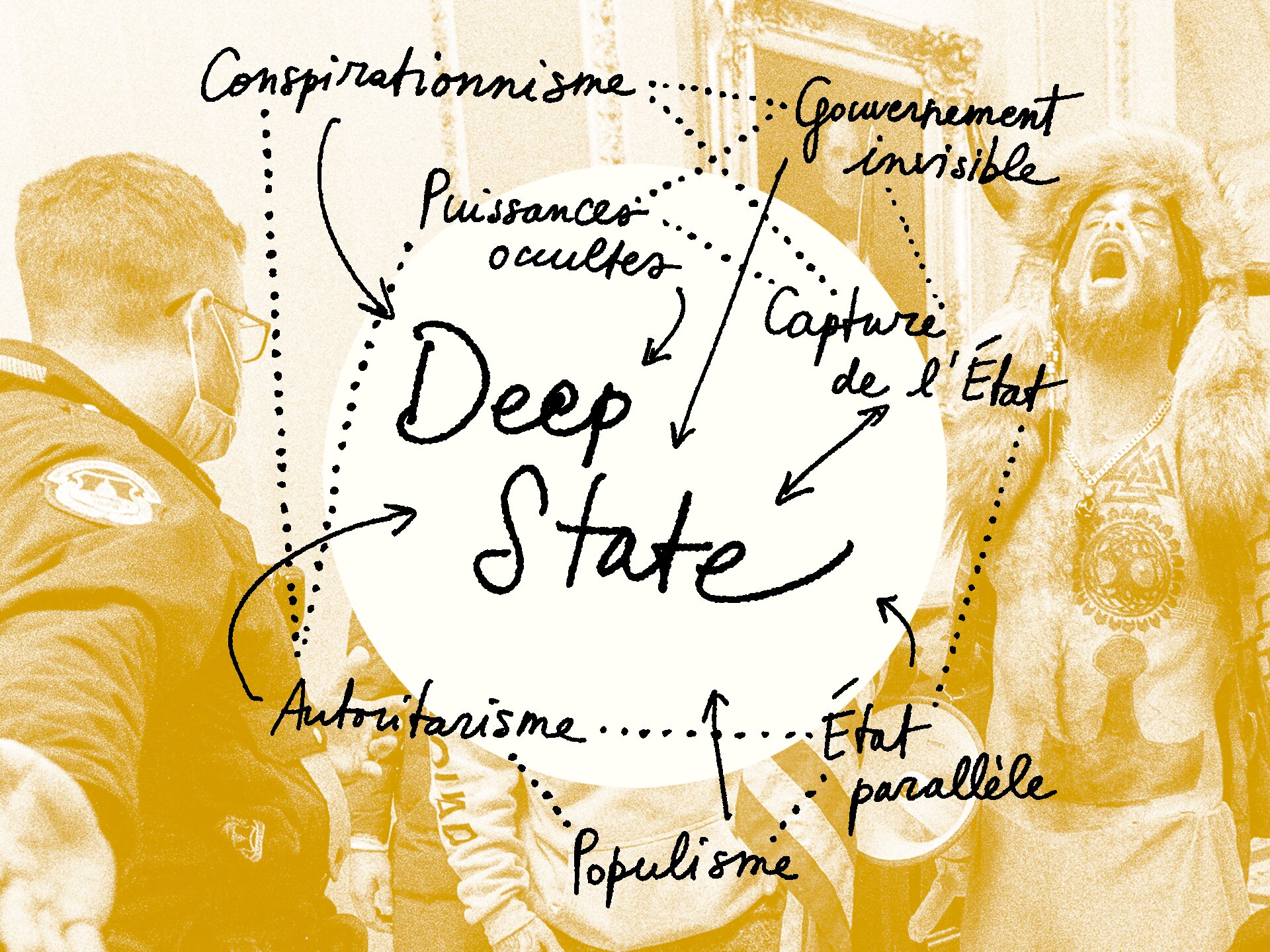
Throughout the month of August, the Grand Continent publishes in open access The Vocabulary of the Far Right, the result of the collective work of a group of researchers — sociologists, historians, political scientists, sociolinguists — from across Europe under the direction of Steven Forti. To receive each lemma in your inbox and support the work of an independent editorial team, subscribe
In the summer of 2014, Hungarian Prime Minister Viktor Orbán stated that the development model his country aspired to was that of the “illiberal democracy.”
This hybrid regime would be characterized by a dual movement.
On one hand, the concentration of power in the hands of a single authority and its perpetuation beyond any electoral competition or internal state rivalries. It involves consolidating the values of the ruling elite and building a stable hierarchy of partisans whose loyalty is guaranteed by the benefits they derive from their closeness to power.
On the other hand, the systematic takeover of state apparatuses, allegedly dominated by a surplus of “liberal” actors, in order to connect them with the apparently authentic expression of the people’s representations and true interests.
In Hungary, this internal regime shift touched administration, justice, the media, and education, extending even to research institutes and venues of art and culture. Consultations and referendums on immigration or the rights of sexual minorities were even organized to combat the “deep state” of the liberal elite.
The conspiracy has deep roots
Most critics of the use of the notion of the “deep state” see it as a pure construct — a conspiracy theory — that serves both as a pretext for profound transformations of the civil service and the state itself, and as a lever to delegitimize administration and institutions. Because the term now occupies a central place in political life, returning to its origins is essential to understand its contemporary function.
The “deep state” rests on the idea that occult networks, independent of the electoral process, wield power behind the scenes, in opposition to the directions and values of elected leaders. The term originates from the Turkish expression derin devlet, literally meaning “deep state,” which in the 1990s referred to the authoritarian practice by which the Turkish government used dubious methods to target the Kurdistan Workers’ Party (PKK). A rumor circulated: there would be a secret alliance between intelligence services, the army, the economic elite, and organized crime, steering the country from the shadows. It is the Susurluk car crash of November 1996, in which a senior police official and a notorious mafia figure killed each other and a deputy was injured, that brought the existence of these networks to public attention in Turkey. Since then, the notion has traveled far beyond the Turkish case. Jurist Eugénie Mérieau has shown that in Thailand the alliance of the monarchy, the army, and the Constitutional Court against elected governments constitutes a genuine, institutional, and documented “deep state.”
The notion of the “parallel state” — or the “secret state” operating out of public view — has a long history in the United States, where it has mainly been associated with the military and intelligence sectors. The intertwined interests of politicians, the military, and the defense industry have often been seen as a form of the “deep state.” In his 1961 farewell address, President Dwight D. Eisenhower warned about the growing influence of the “military–industrial complex.”
Following the numerous covert operations of the 1960s and 1970s, public debate focused on who truly weighed on American foreign policy. The assassination of President John F. Kennedy contributed to the spread of conspiracy theories. In 1964, journalists David Wise and Thomas Ross published the influential book The Invisible Government, which put forward an explicit thesis: “There are two governments in the United States today. One is visible. The other is invisible.” This formulation established the conceptual framework that would shape subsequent debates on the deep state.
However, it was recent American political developments that gave the concept its decisive push. Donald Trump popularized it starting in 2016, regularly asserting that officials or agencies acted against him and his program. For him and his allies, the “deep state” referred to the officials inherited from the Obama administration who would be trying to thwart the implementation of his policies. “Either the deep state destroys America, or we destroy the deep state,” he proclaimed in March 2023 at a rally in Waco, Texas. Although he repeatedly promised to dismantle it, once back in power he struggled to identify or pursue concrete actions against its alleged actors. Political scientists Stephen Skowronek, John Dearborn, and Desmond King have shown that the charge of a “deep state” is in fact the flip side of the theory of the “unitary executive.” This is because this president-centric current seeks to submit the entire administration to the president’s will, so the depth of the state, made up of expertise, continuity, and the professional discretion of civil servants, becomes in their view a scandal.
Marshes, sewers, and “strong powers”
The slogan drain the swamp, chanted by Donald Trump during the 2016 campaign to promise the eviction of Washington’s elites, gave the fight against the “deep state” its most enduring image and disseminated it well beyond the United States.
This rhetoric also gave rise to concrete political practices that gradually became institutionalized across the eastern flank of the European Union. The through-line was the idea of replacing administrative officials deemed unreliable. This approach has its roots in the painful democratization process and in the fear that former communist elites would block or slow political transformations.
In Poland, political leaders frequently refer to the “deep state,” but also to the “marsh” or the “capture of the state,” to accuse their opponents of placing loyalists in public institutions, the judiciary, and state media — with the opposition and Donald Tusk’s government now accusing each other in turn. In Slovenia, the term is commonly used by centre-right politicians to designate the networks of the former communist party, which allegedly persisted uninterrupted since independence in 1991. Journalists who have investigated these claims conclude that opaque and questionable connections actually traverse the entire political field, regardless of the ideological position of parties. In the Czech Republic, a broad debate emerged in 2025 around the “deep state” and the “Romanian scenario,” in reference to the cancellation of Romania’s 2024 presidential election following the detection of Russian interference.
In Germany, the Reichsbürger movement argues that the Federal Republic is an illegitimate entity and that the German Reich continues to exist, a narrative that has largely absorbed elements of QAnon. Born in 2017 in the United States, this deeply conspiratorial movement rests on messages from an anonymous figure, “Q,” who claimed to have access to classified government information. Its adherents believe that a secret group of powerful elites controls major institutions and engages in criminal activities. In QAnon discourses, the “deep state” is a vast secret network within government, the intelligence services, and the media, acting against the political leaders supported by the movement and to the detriment of the public interest. The AfD frequently uses the concept to discredit German institutions: its co-chair Alice Weidel stated on the Austrian far-right AUF1 channel that a “deep state” was spreading lies about the AfD and trying to discredit the party.
In Italy, the term Stato parallelo (Parallel State) commonly denoted institutions and networks organized as a state within the state. During the Cold War, it referred to a strategy of preparing for a Warsaw Pact attack or for a communist seizure of power. The Gladio operation aimed to establish a secret network tasked with organizing resistance in case of a Soviet occupation, and similar networks existed in several NATO member states, outside parliamentary control until their dissolution in 1990 following their revelation.
More recently, Italian far right has mainly used the expression poteri forti, nearly synonymous with the “deep state”: it refers to national political and economic actors closely tied to international institutions, the European Union, the IMF, markets, and the banking sector, against whom the new protest parties — beginning with the Five Star Movement, which popularized the term — claim to defend the citizens. “If the spokespeople of the poteri forti are against us, that means we are doing right by 60 million Italians,” Matteo Salvini stated in 2018. Prime Minister Giorgia Meloni, justifying the referendum on her constitutional reform, added that “this consultation does not concern me personally, but the reform, the future of the nation, to place it back in the hands of the citizens and not in the hands of the strong powers.”
In Spain, the expression “cloacas del Estado” (State sewers) is used by the left as well as by Catalan and Basque nationalists to describe the persistence of state apparatus inherited from the Franco era, particularly within the army, the police, and the judiciary. These networks have targeted social movements or left-wing parties — Podemos, or the PSOE today in power — through unfounded accusations.
What the conspiracy owes to reality
One of the main empirical pieces of evidence for the existence of opaque state actors was provided by the Pegasus spyware scandal, which shook Europe from 2021 onward. Sold exclusively to states, this software was used to monitor citizens, journalists, political activists, and lawyers in Hungary, Poland, Greece, and other EU countries. In Spain, intelligence services monitored political leaders and Catalan independence activists, while the phone of Spanish Prime Minister Pedro Sánchez was itself infected, an intrusion never officially attributed.
The “deep state” thus designates a network of formal and informal instruments whose aim would be to preserve power, even in the face of electoral defeat. Economically, the phenomenon can sometimes be clearly identified: the awarding of posts in exchange for political loyalty was a common practice of post-communist privatizations, and these business actors loyal to the old regime can effectively hinder the policies of the new decision-makers. When these companies operate in the media, their impact on citizens’ access to independent information can be considerable. The growing weight of lobbying by economic elites and their opaque connections with major political players has, moreover, fueled a rising awareness across the Union.
The rhetoric of the “deep state” maintains a peculiar relationship with the rule of law, inverting its logic. The counterpowers that define liberal constitutional order — independent judges, the career civil service, regulatory authorities, and constitutional courts — are recast as illegitimate obstacles placed in the way of the people’s will, which the elected leader would be justified in neutralizing. Jurist Kim Lane Scheppele described this mechanism as “autocratic legality.” The narrative of the “deep state” provides justification for this project. The purge of the judiciary or the administration is no longer framed as a violation of the rule of law but as its restoration, in other words, the reconquest of supposedly captured institutions. This is precisely the path followed in Hungary and later in Poland, where the subjugation of justice was argued as a belated de-communization between 2015 and 2023.
The notion of the “deep state” has proved to be a highly effective political instrument. While it rests on certain empirical observations and a number of real scandals, it has been mobilized predominantly, in its broad and generalized form, by populist political leaders — though not exclusively — to explain their actions and justify their political project. The claim of the existence of a “deep state” finds an even more favorable echo as disillusion with traditional parties and political elites grows. In contrast to this usage, Francis Fukuyama proposed embracing the term in order to turn it on its head. What populists call the “deep state” is nothing other than the professional, meritocratic bureaucracy, whose relative autonomy is a condition of the rule of law rather than its negation.