
On May 25, 2104, at 5 p.m., Tokyo time, translator Izumi Itô was declared missing. The first to report this strange case was Pierre Ménard, inspector of the Universal Organization for Education, Science and Culture, heir to UNESCO, sent from France to meet the woman who had been named a living treasure in 2062, at the young age of 36.
The daughter and granddaughter of a translator, it was not without anxiety that her father watched her follow in his footsteps, even though his life was devoted to passing on his knowledge. He himself had known his moment of glory in the 2010s with a translation of the first volume of In Search of Lost Time by Proust, a project he had labored on for nearly fifteen years. In order to create in the Japanese reader the same effect as the French reader confronted with the twists of a sentence stretched to its extreme, he had reduced Japanese syntax to an unusual brevity in the Japanese narrative of the novelistic form.
He was also responsible for the original, four-handed attempt with a French colleague to translate Matsuo Bashô’s haiku into the language still spoken in Molière’s time, with the aim of restoring not only all the nuances of this quintessentially elliptical form, but also making visible to the French reader the meaning concealed by every ideogram, by every component of each ideogram.
How to render the chromatic blur of ao, at once blue like the sea and green like the grass? How to convey all the beauty hidden in the character kumo, the cloud, which is formed of the key ame, rain, and of iu, meaning “to say”?
The cloud is, in its own name, the one that announces the rain. This initiative aroused so much curiosity that this translation was in turn retraced into Japanese to highlight the beauty sometimes overlooked by Japanese readers.
However, this activity was already out of step with the times. The profession’s death had been declared from the first stammers of dedicated software and other artificial intelligences: if there was any activity doomed from the outset, it was this one. It was desirable, even profitable, for the human brain to be replaced to enable the immediate passage from one language to another: end of misreadings, false readings, and other hesitations inherent to human beings.
In the 2040s, persisting in this path was simply suicide. It had been ten years since Globish had established itself as the world’s lingua franca, aiming to return to a mythical pre-Babel state where everyone could understand one another, removing the need for translation and gradually relegating the other languages to the status of dialects and fragmented, isolated speech. Speakers of so‑called literary languages had become rarer, counted among scholars, writers and other originals who sought refuge in specialized journals.
Books of the past were still translated then, but that task was now entrusted to machines resembling beverage dispensers placed at the entrances of supermarkets. In a few clicks and for a negligible sum, it was possible to translate any work and obtain a digital or audio file generated on demand and almost instantaneously. A few amusing successes marked the advent of this technology. A handful of playful pseudo-literary enthusiasts were responsible for the creation, a century later, of the American original of I’ll Spit on Your Graves, which Vian had published as a translation of the unattainable Vernon Sullivan. For the first time, it was no longer the translation that had to stay faithful to the original, but the original that conformed to its translation, perfect, henceforth, by construction, a unicum in the history of literature.
The first consequence of this rapid and easy passage from one language to another was the loss of the original version. The source text was then drawn from the corpus without regard to the version in which it had been written. At the moment of the request, Don Quixote could originate from Amharic, The Little Prince from Chinese, or One Thousand and One Nights from Finnish.
However, a few attentive readers had detected dysfunctions: entire batches of The Little Prince were recalled to be deleted because the fox had accidentally become a bottlebrush in all its versions. The error multiplied itself infinitely and, if not detected early, it ended up authoritative. Family names, aptonyms or foreign ones, had long posed difficulties for the software. Mis-translated and retraced into all languages, the Japanese poetess Murasaki Shikibu had become “ Violet Bureau of Ceremony” and the various Bakers, be they theologians, philosophers or painters, had turned into a fanciful variety of delicatessen meats.
Izumi, meaning “the source,” the young girl with a predestined name, did not falter, not out of defiance or ambition, but simply because it was what she did best. Driven by a conviction: language wields power, a hold on reality that it shapes and makes visible. As a philosopher friend of her father once told her, languages are like nets cast into a sea of fish, and each nets different catches. Thus languages do not overlay perfectly, and translation is a desperate attempt. Izumi knew this well, but it was precisely this awareness that grounded her resolve: to return again and again to the text, to rework her translation to infinity in pursuit of an unattainable perfection. In her secluded house, in the heart of the Yamanaka mountains, living a monastic life, she set to work, humbly, with stubbornness. Her translations were never fixed; they existed only in a single manuscript, produced on demand for a reader. Every new order yielded a new translation, slightly different from the previous one, sometimes by a single word. The whole body of translations formed a corpus of variations on the original, capturing the resonance of a text whose meaning shifted with historical time and personal sensibility: to translate 1984 by George Orwell at a moment when it was no longer a dystopia but a prophecy of plagiarism, with every passage to reality influencing the translation once barbarism had entered common speech.
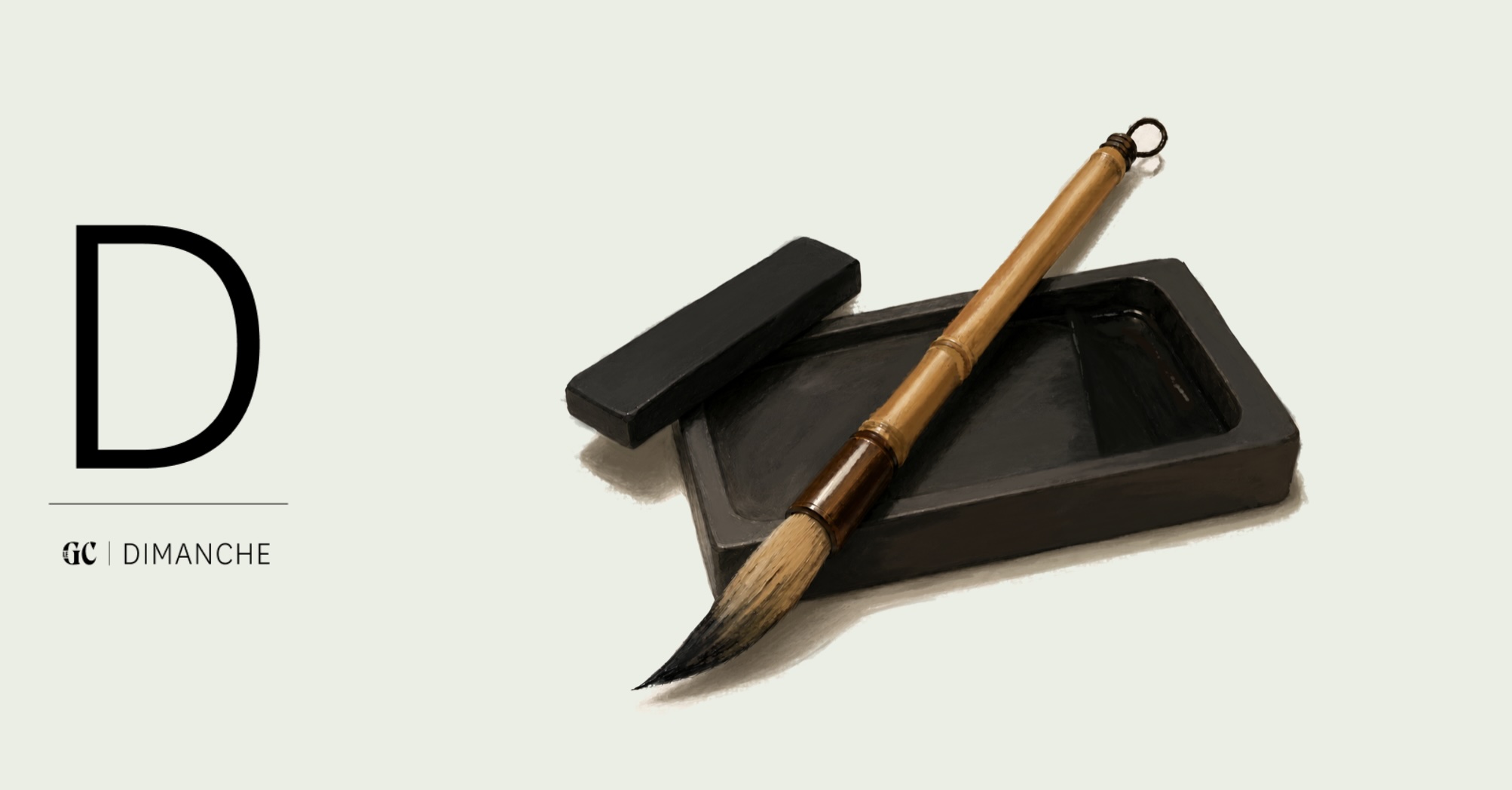
She had set aside the computer to work by hand—pen, brush, dictionary—the translation was an artisanal craft, blending mental deftness with manual dexterity. She had crafted her method as a genuine spiritual path, built on precise gestures, tools chosen with care for each text. She shaped the sentence in her mind as a potter’s hand expands the clay, and reality slowly stretched beneath her stroke.
Time was her ally; her output was rare: the longer the time taken to complete a translation, the better the result. Among her achievements was a brush-painted Japanese edition of The Name of the Rose by Umberto Eco, with meticulous characters drawn in dense ink on a single long scroll. Her love of art led her to provide as an appendix Aristotle’s treatise on laughter, written on papyrus she later allowed to burn in one of Sakurajima’s frequent eruptions, a dangerous gesture that completed her gesture as an artist.
After the Year 2050 Bug and the ensuing Grand Digital Erasure, literary works—already suffering from the disappearance of printed books—had nearly vanished. The Universal Organization then inscribed literature and languages as part of humanity’s intangible cultural heritage, to preserve languages by naming living treasures, a designation revived by the Organization, the last expert speakers, and by creating teams with the mission to restore lost original texts, digital palimpsests beneath multiple translations and retracings. It was at this moment that Izumi Itô was noticed by the Organization, not only for her skill and knowledge of languages but also for her personal library, home to more than 35,000 volumes in various languages, including a remarkable collection of The Little Prince in 375 languages and dialects. She had also carefully documented in a collection of genuine Moleskine notebooks long lists of words: ephemeral terms like youtubeur, googliser, caméscope, millennial, texto, dinguerie, and extinct ones such as the wonderful hues once evocative and now grouped under the simple color red: carmine, grenat, vermillon, caput mortuum, amarante, Andrinople, pompéien or coromandel. Under her brush, words found refuge, tucked between pages, ready to unfold again in the world.
Recognized as a living treasure, she—who had always practiced her craft without ceremony—suddenly found herself under the spotlight, elevated to the rank of supplier of unique, highly coveted items. The eccentric commissions multiplied, aided by the use of precious materials and elaborate techniques, for pseudo-readers unable to decipher handwriting that had become purely decorative.
She worked on a commission for a billionaire who had made his fortune with a low-cost interplanetary travel company. It was then that she vanished. On her desk, beside her brush, lay her latest creation: Inferno by Dante, calligraphed on a long paper roll, rolled and bathed in fine gold, a book that no one would ever be able to open.