
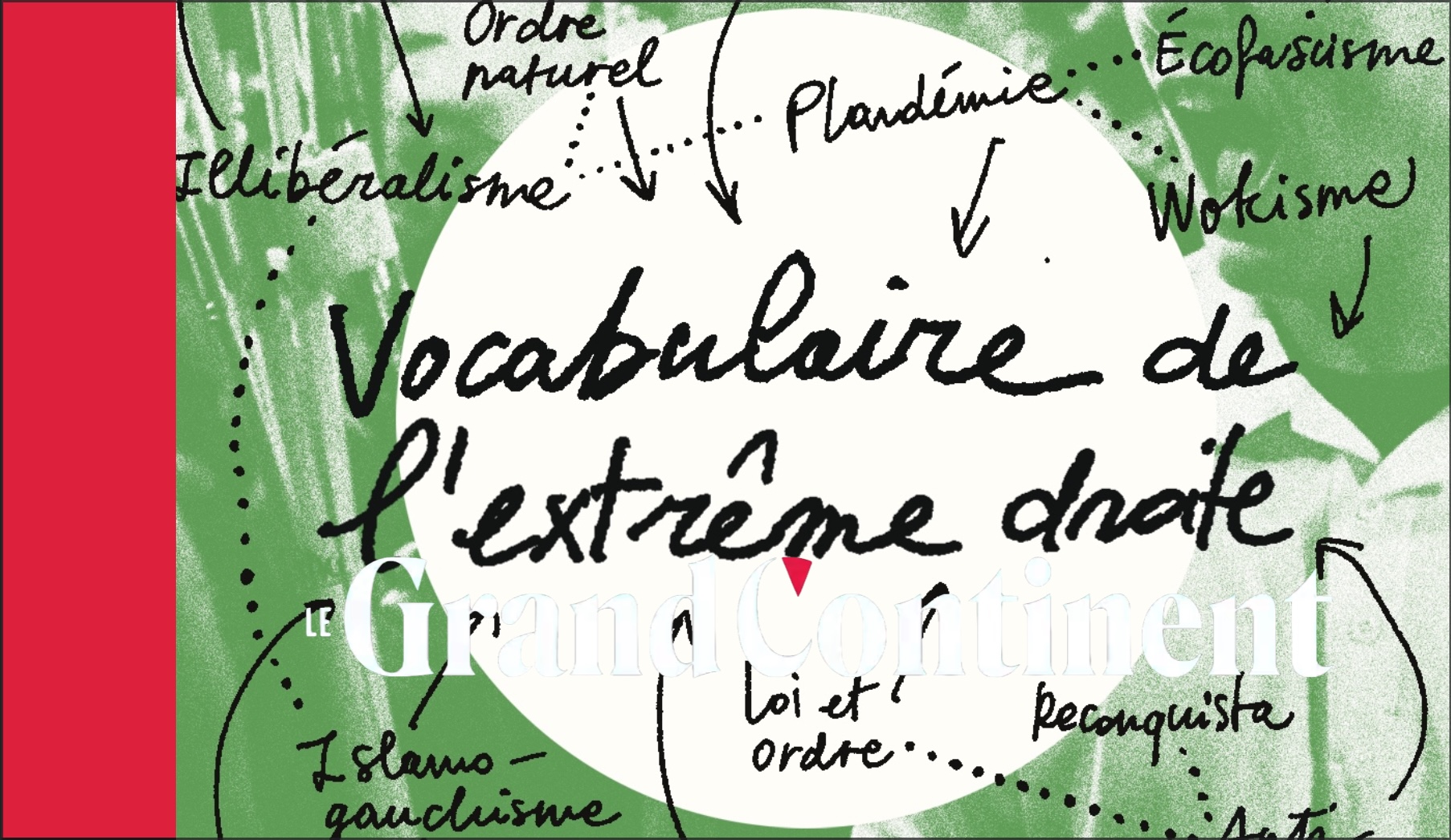
Starting Monday and until August 20, The Grand Continent will publish in open access The Vocabulary of the Far Right, the result of collective work by a group of researchers — sociologists, historians, political scientists, sociolinguists — from across Europe. To receive each lemma in your inbox and support the work of an independent editorial team, subscribe
You have devoted several studies to the 2.0 far right. With this The Vocabulary of the Far Right, which readers will be able to discover starting this Monday , you approach it this time through words rather than parties, electorates or programs. Why this detour into language?
Because language is the doorway into the far right and often the first alarm signal. The prerequisite for the social acceptance of far-right parties is the normalization of the ideas and proposals they disseminate. It is because of this normalization that many people come to view these formations as a legitimate political option, from the United States to Slovakia.
It is only after this groundwork is laid that fringe parties can aspire to become central actors. Yet this process begins with a battle on the field of words. As Cas Mudde reminded us, during the Cold War the far right was regarded as a normal pathology of Western democracy. Since the 1990s, it has become a “pathological normality.”
This shift is first readable at the level of language.
At the heart of this process lies the American counter-revolutionary experience. One of the key agents of reactionary acceleration, Peter Thiel, talks of an unprecedented opening of the “Overton window.” Is that the case?
Peter Thiel is right about the observation, and his celebration of it is precisely what should worry us. Ideas once deemed unacceptable are now treated as common sense, even finding their way into the legal order of states.
That the Overton window has opened dramatically is undeniable; but speaking of an “opening” risks sliding into a self-serving euphemism of the process. Where Thiel sees a liberation of speech, I see a nearly completed process of normalization: a word is first seen as transgressive, then banalized and, finally, codified into law.
In working on this vocabulary, don’t you risk policing language? Who decides that a word is “extremist”? Isn’t that a position of overreach by one camp over another?
That is a serious objection and I do not dismiss it. My answer is that the glossary does not claim to ban words, but to show what they conceal.
Behind seemingly innocuous terms—the “decline of the West,” the “natural order of things,” “globalism,” “cultural Marxism,” the “freedom of expression”—there can sometimes lie an extremist intent that is not immediately visible.
What do the representations conveyed by these words rest on?
All these narratives rest on a single structure: a clear division between an in-group morally superior, perceived as the sole legitimate one, and an out-group deemed inferior and threatening. When faced with the latter, the first would be justified in defending its interests at any cost, including through violence.
Making this mechanism visible is not censorship. The citizen remains free to act on it, but it is important that they can see it.
Take “freedom of expression”, which you classify among expressions mobilized by the far right. Wouldn’t the American administration see this as proof of bias: how can a fundamental democratic principle appear in a glossary of extremism?
Because what matters is not the principle itself but its hijacking.
What is problematic is not freedom of expression in itself. It has nothing to be suspicious about and it is, on the contrary, a foundation of democratic order. But what we observe is that the term is today mobilized, notably in the MAGA sphere, as a Trojan horse: freedom of expression is invoked to render sayable what belongs to hate speech, before turning the accusation of censorship against anyone who reminds us of the need to set limits.
Our work is not to say: “Beware of freedom of expression.” It aims to urge readers to vigilance: “Be attentive to when this word is used, by whom, and for what purpose.” It is very different. A word is almost never extremist in itself: it is its use, deliberate or implicit, that can be.
Among the words cited in this vocabulary, there are ancient terms (monarchy, apocalypse, decadence), and you speak of narratives that “never disappear” and resurface. Are we witnessing a return to the context of the 1920s-1930s?
Yes, but with a crucial nuance: I do not think these narratives are identical; I think they recycle. They have circulated for more than a century—sometimes longer, as with “Reconquista,” which moved from the Spanish far right to the name of Éric Zemmour’s party—adapting to each context.
To grasp this process of circulation, we employed, together with the collective of historians, sociologists, political scientists and sociolinguists who drafted the entries of this glossary, the notion of a “rhizome,” as conceived by Deleuze and Guattari.
The narratives of the far right have not vanished: they have spread, connecting with one another in a non-linear fashion. It is this circulation and these transformations that keep them relevant. Whether they concern the nation, gender, or science, these narratives morph and reappear, without yielding any of their essential core.
With this genealogical work, do you not risk disqualifying the whole of right-wing thought?
We are precisely striving not to fall into that trap. Our object is not right-wing thought in general, but the genealogy of an extreme, anti-democratic and anti-liberal imaginary, which is something entirely different.
What we describe is the plasticity of this imaginary. That is precisely what makes it effective. One can trace the origin of a word to detect its mutations, reappearances, and the vectors of diffusion.
Take the “great replacement” and its idea that globalized elites seek to substitute European populations with Muslim immigrants. Its genealogy can be documented from late 19th-century literature to its contemporary formulations. All of this is verifiable, datable, traceable.
Alongside this long-term plasticity, you place a strong emphasis on breaks in vocabulary. You say that technology, social networks and technical vocabulary have contributed to the emergence of terms like “memetic warfare” or “cuckservative”, little known in France, even though their effects are already very real, in your view.
Indeed it is essential to measure the scale of the arsenal available to the far right today.
In addition to transformations of the media system, there are manipulation tactics of all kinds: trolling, shitposting (literally “posting shit”) or shitstorms, following the teachings of Andrew Breitbart and Steve Bannon. It is to Donald Trump’s former adviser that one owes the famous strategy of “flood the zone with shit.” We could continue with hashtag hijacking or stuffing (the act of taking over opponents’ hashtags, a tactic that today seems almost prehistoric in digital terms), bots (automated accounts) and sockpuppets (fake profiles operated by real people) which, with the advent of artificial intelligence, now sustain conversations difficult to distinguish from those of a real person. Let us also mention astroturfing: campaigns funded and orchestrated by companies or parties that simulate spontaneous popular support.
Each of these tactics has its own term, and these terms remain confined to online communities’ English. This is where a decisive part of the battle is fought, precisely because it remains invisible to those who do not frequent these spaces.
The “memetic warfare” you mention is the spread of extremist ideas under the cover of humor: you laugh first, then, gradually, you come to believe. The insult “cuckservative,” forged by the alt-right against conservatives deemed too soft, illustrates the purge of the center-right by radical fringes. These terms may seem anecdotal from France, but it is essential to know them to understand how the American far right operates.
For example, when Vox broke onto the Spanish electoral scene in 2018, the party labeled the Popular Party as “derechita cobarde” (cowardly little right). That was the Spanish adaptation of the American term “cuckservative.” What is invented there migrates, with a delay of a few years, into our public debates. Learning this vocabulary is to recognize what is already at stake and to anticipate what will come tomorrow.
But by insisting on language and tactics, don’t you risk losing sight of deeper dynamics? Doesn’t the far right advance first because real problems—inequality, migration, the crisis of representation and recognition—are treated as issues of mere form by the center and progressives?
I think an effective strategy must be rooted in existing forces or contradictions.
The normalization of the far right results from material factors and a demand to regain control in the face of dizzying changes, such as migratory flows.
However, these conditions never act directly: they translate politically only through narratives that give them shape and meaning. A single inequality does not push people toward extremist voting, but a narrative that exploits that inequality does.
Specific material causes gave rise to the American far right, and other kinds of problems or dissatisfactions nourish similar forces elsewhere. That is not where the difference lies. What matters is who wins the battle of the narrative. That is why neglecting the study of words and the representations of the far right prevents us from understanding why, at bottom, some tilt to one side rather than the other.
What would you say to those who think that by analyzing the words and tactics of the far right you risk amplifying its reach and inadvertently publicizing it?
That is the dilemma of any philological work on propaganda, and I do not take it lightly. But I believe ignorance protects less than knowledge.
All these tactics share one thing: they work best when they are invisible. The troll does not announce that it trolls, while astroturfing presents itself as a spontaneous movement and the racist meme advances its theses under the cover of humor. Algorithms do the rest: online, filter bubbles and echo chambers, aligned with our confirmation biases, produce herd-like behavior and a double movement of polarization. This polarization is ideological and affective when it concerns opinions, but also networked when it touches the very structure of our interactions. All of this has culminated in a true media ecosystem, not only digital, rightly called the “fachosphere.”
The power of these methods lies in their concealment. It is thus description that weakens them, not the other way around. A manipulation that has been named as such—and to name it one must resign oneself to relaying it—has already lost part of its power.
Let us focus on the through-line that runs through this vocabulary: for you, regime change begins with a lexical change. Has the far right won the battle of words by adopting the French Nouvelle Droite’s strategy?
If it hasn’t already, it is in the process of winning it, precisely because it has adopted, consciously or not, the strategy conceived in the 1970s by Alain de Benoist and the Nouvelle Droite: first seize cultural hegemony, a prerequisite to political hegemony, which is achieved in the battle of ideas. And it is at the level of language that this battle takes place.
Newer tactics have been added: emotional storytelling, which pits affect against facts; humor, irony, provocation, memes; the central focus on objects of cultural wars — abortion, homosexuality, multiculturalism. Studying the words is thus studying the battlefield itself. This is where the game is played.
But if the far right wins “the battle of words,” isn’t it also because its opponents have deserted the center of the field, or occupy it awkwardly? Doesn’t the far left also have its screen words and its narratives?
Of course. Every political family produces frames, narratives, slogans. The far right is not the only one to tell stories. What sets it apart is the structure of its narratives: that us/them dichotomy I mentioned, pushed to the legitimization of violence.
When far-right members of the Israeli government call the Palestinian population “animals” or “monsters,” when MAGA influencers publicly claim that women should not vote, when a president describes social justice as an “aberration” or a “cancer” to be eradicated, we have left the ordinary political frame: we are in a logic that can lead to forms of violence that can be extreme.
That said, you are right on one point: deserting terrain is part of the problem. If far-right words occupy the debate, it is also because democratic counter-narratives are weak, defensive, often purely reactive. A glossary can help unmask, but it will never replace the narrative that one should oppose to it.
A vocabulary presumes that knowledge can disarm error. But in the age of slopaganda, is knowing still enough? Are we not fooling ourselves by pitting definitions against a phenomenon that, precisely, mocks critical reasoning?
That is a limit I acknowledge. We live in an era when memory is increasingly short and where truth depends on each person’s feelings. It is no accident that in 2016, the Brexit year and Trump’s first victory, the Oxford English Dictionary named “post-truth” as word of the year.
A glossary does not, by itself, overturn this affective economy, I do not pretend otherwise. But I maintain that it is a necessary prerequisite, though not sufficient.
Only informed citizens can defend democratic principles. Knowing is the first step to unmask extremist ideas — the first, not the last. But without it, everything else is impossible.
One last word. Of all the entries in this vocabulary that our readers will discover starting tomorrow and until August 20, which one worries you the most?
“The natural order of things.” Precisely because it is neither the most spectacular nor the most well-known. The “Great Replacement” presents itself as what it is: a racist conspiracy theory, just like “white supremacism.” But the “natural order” does not resemble a far-right slogan: it seems to appeal to common sense.
It is the perfect mask, the one under which the hierarchy between sexes, between peoples, between “civilizations,” is presented as an obvious truth that only dangerous ideologues would question.
That is what I hope the forthcoming entries—on “accelerationism” to “eco-fascism”—will show: learning to read the double underside of familiar words so as to equip ourselves with a map, even provisional, to navigate these troubled times.