
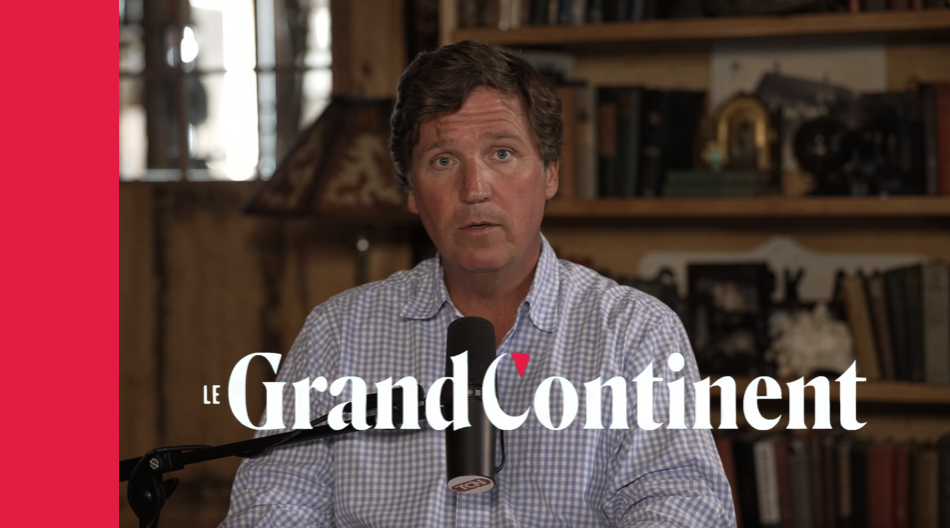
On August 5, 2026, ninety days ahead of the midterm elections, Tucker Carlson broadcast on his platform a roughly two-hour monologue, titled simply “It’s Time to Save America,” accompanied by the publication of a ten-point manifesto.
This anticipated address had been announced four days earlier by the former Trump-aligned representative Marjorie Taylor Greene, photographed at a meeting with Carlson, Kentucky representative Thomas Massie, and Joe Kent, the outgoing director of the National Counterterrorism Center.
“We had said: no more foreign wars, and we meant it. We backed Donald Trump because he had made that promise. But he betrayed us all. Our allegiance is America First, for all Americans, on the right, on the left, and in the center. The movement has begun.”
The speech aims to mark a rupture with Donald Trump’s national-populist base and the broad outlines of his second term.
In Washington, the response was immediate. The White House mocked “an embarrassing gathering of whinging renegades who greatly overestimate their influence and relevance,” while reminding that Trump remains the “undisputed leader” of the Republican Party. The president himself has been reiterating since spring that Carlson “has lost his way” and that he is “not MAGA.” Carlson, for his part, now openly embraces the rupture: “We need options… I will help build a third party.”
It is around this diagnostic that Carlson, a figure on the far right, seeks to fuse several strands of critique that run through American society. He contends that the system is captured by a “Epstein class,” dominated by two parties that are “identical” on the essential questions (war, budget and taxes), and incapable of facing two existential threats: a nuclear war triggered by the fusion of conflicts in Ukraine and Iran, and the explosion of artificial intelligence. He also argues that the Iran crisis is merely a symptom of a broader betrayal; Epstein’s affair and Israel’s role in American policy are used to sow division on a backdrop of rising antisemitic sentiment among segments of the right fed on Nick Fuentes and AI-propagated disinformation.
Carlson’s aim is systemic change. He calls for an internal regime change achieved through the creation of a third party that would split the conservative vote and deprive the president of a majority by November, given that 43% of voters express dissatisfaction with the two major parties.
Carlson’s ten-point program seeks to inaugurate a new phase of American national-populism by redefining Trumpism for a post-Trump era. To accompany our analysis of the reconfiguration of the American political landscape, we translate and comment on this significant, often incoherent and scattered speech, offering a nearly line-by-line interpretation.
The aim of any system is to protect the interests of the people it serves and governs. That is simply its nature. So, what is the role of a preacher? It is to care for the souls of his followers. And what is the role of a president? It is to safeguard the interests of his citizens and to protect them. It is really as straightforward as that. It is inherent in the very definition of those duties.
Thus it has long been obvious that our system does not function as intended, because those responsible seem to chiefly—though not exclusively—look after their own interests. We see it all around us: civil servants earning more than the average American. That says a great deal. We observe at every level of American institutions that many of them seem to operate primarily for the benefit of those who run them. And that is serious. And they are no longer discreet about it. They build private islands and presume they are above the rules that apply to you. That has bred enormous frustration and deep resentment among ordinary people: “Wait a minute, you don’t follow your own rules. I should stay home during the COVID crisis while you go to the French Laundry… Who do you think you are—a king?” The answer is, indeed, yes.
We are therefore witnessing a very evident decline of a system that grows more corrupt with time, with those in power using it for their own gain, as well as for the benefit of their families and friends. It has come to be known as the “Epstein class,” because that is exactly what it is.
It is a group of selfish individuals acting in their own interests, at your expense. This is, without a doubt, deeply damaging, but it can endure for a long time because it is the very nature of systems. It resembles the Ottoman Empire, which conquered half the world and then dissolved into a pathetic state, having become fixated on its harem. Eventually, it collapsed.
Something different has happened to our system. It has grown increasingly evident: it is one thing to have a system run by people who look after their own interests rather than yours—we have known that before; it is another to have a system that is utterly incapable of reacting to reality, practically paralyzed. Unfortunately, and in a highly troubling way, this is the system we have today. We know this because the two greatest threats, arguably in the entire history of humanity, nuclear war and AI, loom just ahead of us.
And no one in positions of authority in our society seems able to react, or even to acknowledge that this is happening. It is as if they are frozen, their eyes fixed on the tree charging toward the windshield at 70 miles per hour. That is precisely the impression—if you listen closely, that is where we stand.
So we are heading, if this trajectory persists, toward a nuclear conflict, as two conflicts—one in the Middle East and the other in Europe, Ukraine and Iran—are currently merging in one way or another.
What does that mean? It means a world war.
And you have two camps with utterly inflexible positions. Without delving into details, if you follow this news, if you are among the small percentage of Americans who do, you know there is no obvious resolution to either conflict in the near future, and yet the stakes could not be higher. Of course, the principal actors in these two now-merged wars possess nuclear weapons. They consider it, in a stock phrase, an existential question for them. So unless our angle of attack and the trajectory we are on change very rapidly, we will inevitably witness the use of weapons of mass destruction. One participant, the President of the United States, already openly threatens on Truth Social, online for all to see: “We will erase your civilization.” You cannot do that with Tomahawks, obviously, but you can do it with nuclear weapons. The President of the United States, regardless of what you are told, openly threatens to employ nuclear arms in a conflict that has no immediate or obvious resolution.
So where does that lead? Toward a nuclear strike. What happens next, only God knows.
But if you can at least live with that fact, if you can even say or simply acknowledge—without qualifying—that it could lead to people launching nuclear weapons at civilian populations, you have already lost your mind. You have shown yourself unable to lead, because that would be madness. It is far more than recklessness. It is… it is literally… suicidal and murderous. And at the very least, you are paralyzed. You are unable to act to defend yourself, not only to defend your country or your civilization, but even to defend yourself. That is where we are.
The same goes for AI. Of course, just like the wars in Ukraine and Iran, we do not know where AI will lead us. Perhaps it is merely a huge bubble. Think of the tech bubble of 2000—Pets.com times a hundred. Perhaps the predictions of the technologists who develop this technology turn out to be true: it could be the end. Best case, we surrender our ability to make important life decisions to machines; we entrust our lives to machines. Worst case, machines decide to kill us all and carry it out, with no recourse for us. That is what they say. Not the apocalypse prophets on Twitter, but the people who develop this technology: “Oh, by the way, this thing we’re building could kill everyone, and at minimum, it will render your children, your grandchildren, and probably you, jobless.”
We will, I suppose, do something to address this. But we do not know exactly what, and it will come in about a year or so. What is remarkable is not only that those who handle it admit it, or that they genuinely try to grab our attention by telling us: “This is what we are doing.” It is that no one does anything. Everyone seems simply hypnotized, eyes fixed on this thing that could spell the end of everything. Who behaves that way? Normal people do not. Functional systems do not. So, without belaboring the point, what does that tell us? It tells us that the system has reached its limits. It is not, in fact, a system that serves anyone’s interests. It is a system doomed to near-certain destruction. It is therefore going away. It seems obvious that any system that relies on electing octogenarians to lead a country, cynical octogenarians, does not have long to live.
Such a system cannot reproduce, in the same way that octogenarians do not reproduce. It’s the end: it’s indeed the case and it is sad. We have certainly spent a great deal of time complaining about it. But at this stage, it is simply obvious.
It is therefore worth considering what will follow, assuming we are all still here—start from that premise, because that is certainly what you want, and even if that is not the case, we must still prepare for it, for one never knows. Something will come next, something that will replace the system. We can hope that replacement, whatever it is, will be the result of a gradual process that people have time to internalize, accept, and endorse, so that there is no abrupt shift. Abrupt shifts in political direction are… well, they are revolutions. And revolutions do not typically improve what they replace. They have their own drawbacks. So we hope it will evolve in some way into something less insane, closer to the original mission of a system, which is to serve the people who live here, to be more humane and more favorable to human beings, etc. That is what we hope. But one thing is certain: we are heading toward something different. The question is: what will it be? We do not know.
We know that technological changes or shifts in the balance of power on a global scale, all these empirical facts on the ground, come with political changes.
Political changes arise from these evolutions. They do not cause them, but they are responses to them. We are thus witnessing political shifts, likely to find political expression. Will it be a third party? Probably. The most radical assessment of American politics in the last century, which we confirmed on February 28, is that the parties share similar positions on the big questions.
Trump enters into the only thing he had said he would never do: a regime-change war in the Middle East targeting Iran, a country much larger and more powerful than during our previous failed attempt at regime change. There were no protests against this decision because, of course, the other party’s leaders—its so-called enemies—were completely in agreement with him, just as they were on the essential of his budget, and certainly on the tax code that the party approved. What does that teach us? One thing at least: when it comes to the big issues—foreign policy, the budget, and the tax code—the two parties are aligned. They are identical. They push this farce to make us believe we are sworn enemies. But are they really? No, they are not.
To reiterate an obvious point—one cannot repeat it enough—if the Trump opponents truly opposed what he did, there would be people in the streets, it’s well known. The party whose identity rests on people taking to the streets for various causes, especially peace, would march for peace and against that war. But that is not the case. Why? Because they do not oppose it.
That is the reasoning. Not to complain, but simply to lay the groundwork for the next stage of our lives as American citizens. We know that parties are aligned on the issues that matter… against the people. How do we know it is against the people? Because we have public opinion polls, and even if they aren’t perfectly accurate, over time they give a fairly clear picture of people’s priorities. The major measures the U.S. government—supported by both parties—puts in place, such as greater surveillance of you, transferring an ever-larger share of GDP to an ever-smaller slice of the population, invading other countries, spending $1.5 trillion a year on a military that cannot win a war, etc., etc., etc.—the population does not want these moves. It cares, despite all the admonitions of its leaders, about the price of burritos.
One could tell it: “It’s really petty of you not to eat $20 burritos.” But perhaps people want to choose what they eat and do not want to pay 30% more for a burrito over a year, or some such figure. It’s a sharp rise, and if you truly care about what people want, you would take that seriously. But as noted, not only do those in power ignore what you want, they are actively hostile to what you want. And the fact that you want it is for them proof that it is illegitimate. “How dare you demand that, you pompous little brat.” “Are you a student? Either way, those who will find work in the AI era are already in on it.” The disconnect is too great for this to continue.
We will likely end up with a third party, perhaps several.
Is that the best system? I do not know. It’s better than what we have. The question is whether that will be enough. The answer—the hard one—is no. When people say: “There is no political solution to this,” it does not mean they do not hope there is a political solution. The alternative is something kinetic, as they say, and we do not want that. But we also know that there is no political solution to anything in reality, for society behaves coherently over time according to the values and concerns of the people who live there. In other words, if you want to change human behavior, laws against that behavior will not get you there. What will get you there is persuading people that it is the right thing to do. Obviously, there is probably no law prohibiting shouting the F-word at your toddler in Walmart, or at least in the parking lot. You cannot be arrested for that. No law bans using vulgar language with your children. But who does that? Very few people. You might try to give the middle finger to an elderly woman at a crosswalk—likely not illegal—but no one does it. Why? Because if you try, people will say, “What are you doing? That’s disgusting.” You do not do it.
In other words, if you want to change a society, you absolutely need more choices on the ballot. You need leaders who want to serve the citizens of this country because they care about them. Service stems from that concern. If you love someone, you want to serve that person, obviously. But above all, you need a population with clear goals and a sense of what the program should be. Do not flip off the elderly women at a crosswalk. Just don’t do that. We should all agree on that. There must be a consensus on what we do here. What is the purpose of all this? That is where you start. It turns out that if you achieve this consensus, many problems will gradually resolve themselves over time, not immediately. Some problems are, if not insoluble, at least very complex. But if you lay the right foundations, they tend to improve over time. If not, they worsen inexorably. That is known. Thus any attempt to solve systemic U.S. problems through technocratic means is, by definition, doomed to fail. For it does not address the deeper causes that brought us here.
How did we end up with a debt of trillions of dollars? Thousands and thousands of billions, an unpayable debt. Because we have kept electing people who have been inflating it, including the current occupant of the White House. But why have we acted this way? Because we hold a fairly faulty understanding of what debt is and what its consequences are for individuals and nations. We do not set ourselves the right objectives. We do not think it important to avoid being in debt. If we had paid attention, we probably would not have accumulated, over many decades, an unpayable debt that now controls us. All of this returns us to one of those things that no one in politics will admit aloud, but which is simply true: the single most important thing you can do if you want to change a world, a region, a civilization, a nation, a neighborhood, a person, is to tell the truth aloud. Always. Words are the thing. They are not the solution by themselves, but they are the beginning of change. Speak the truth aloud. Say what is true. There are many ways to prove it, but the only meaningful remnants we have of any past civilization are the ideas it defended, the words it spoke, and, to the extent they survived, they shaped and influenced the generations that followed. The most durable legacy of the Roman Empire is not its aqueducts—some of which still stand because their architects and builders used stone rather than reinforced concrete—but rather Christianity, which under Constantine became a state religion and remains today the largest religion in the world.
So it is the words that matter above all. That is why tyrants, as is well known, and all governments, in fact, attempt to restrict what you can say. It is the first thing they do before attempting to disarm you. They try to dictate what you may say. We thought it would be useful to simply define the objectives of what will come next, and it will take many forms. Let us hope it will be better than what we have now, but we know it will be different from what we have, because what we have simply does not work. It cannot protect us against the greatest threats in human history.
Here are the ten principles to which America should adhere. It has probably adhered to them in the past, but it should certainly adhere to them again today. If you can implement them, if you can adhere to them—which should not be difficult since almost everyone agrees with these principles—then we can truly hope that the system becomes more responsive. It will certainly not be suicidal, and the country itself will be dynamic and alive, not fading away. It will not rely solely on its cultural heritage, which is already waning. When the finest achievements of your society, from foundational texts to architecture, are all pre-World War II or earlier, that is a problem. That is the end. So, what is a renaissance? The renaissance begins with defining what we want to become. What should America be? The issue of child trafficking is one of those topics no one wants to discuss because it is simply horrific. There is a lot of news on the subject, but it is so grave that some people choose to look away, including us, to be fully transparent. It is a sordid, depressing topic, but it matters and it must stop. That is why the documentary Hidden War, now streaming on Angel, is worth watching. The film follows infiltration operations that begin in Ukraine and spread across continents. You will see real rescue missions, investigations, traffickers brought to justice, and the extraordinary risks taken by compassionate people to save the lives of these children. This documentary is not fiction. It is a real documentary. It is entirely real, and even if the subject is dark, the film is ultimately hopeful: it shows that evil does not always prevail. Lives can be saved. Children can survive trafficking and, in some cases, thrive afterward. Globally, this is the kind of story few filmmakers will want to tell. That is why we support Angel. They are never afraid to tackle subjects Hollywood tends to ignore. Angel does not seek glamour. What matters is the truth. Join the Angel Guild today to watch Hidden War in streaming and explore Angel’s vast film library, a growing collection of films and documentaries tackling issues that truly matter. Visit angel.com/carlson to sign up.
1— America Must Be Just
The first thing America must be is just. America should be fair. Not only should America be just, but it was founded to be so. That is the very essence of America. Okay, it has never fully been just. Yes, agreed. But that does not change the fact that it has always been the objective. When we stop striving toward that objective, we lose all hope of attaining it. So this country needs, above all, a renewed commitment to equity, which, I remind you, is your inalienable right. Equity is promised to you by God. How do we know? Because we know God created every person. The Founding Fathers knew it, whether they were Orthodox Christians or not. Not a single one doubted that the aim of this project was to guarantee equity, which stems from the inherent equality of all peoples, since they share a common origin—in God. That means you have the right to be treated according to objective, immutable principles and standards, standards that do not change depending on who is judged. That is the key to everything. It is, of course, the keystone of our judicial system. It was also, at one time, a guiding principle of our economic arrangements: some people would be better compensated, others less, according to their abilities or labor. That has always been the aim. But in the end, each person was a human being and deserved dignity. There was a form of equity there, and it was deemed wholly unacceptable to live in a system where outcomes were determined by backroom deals, by who you know, or by the place of birth. Of course, that has always existed to some extent, people being what they are, but it can never be acceptable. Equity must be the objective. Equity. And equity, again, flows from the certainty that all people are, at a fundamental level, equal. That means we can judge actions by exactly the same criteria. No one is spared. Because no one is spared, we can be united despite our differences. We know this because we know the quickest way to divide people, whether intentionally or not, is to treat them unequally. If you want your children to hate each other, practice favoritism. If you want your children to get along and love you after you’re gone, treat them equally. Treat them in the same way, with the same amount of love. That is the key to ensuring that your children love each other: to love them equally, treating them according to the same criteria. And if you think about it, the fact that we do not do this, or even fail to acknowledge that this is the objective of society—the equity—lies at the root of almost all our frustrations.
Why is Jeffrey Epstein so exasperating? Why does this case enrage a whole population? Of course, there are the crimes or alleged crimes: a sexual deviant, perhaps a pedophile, clearly implicated with Mossad and who knows what other foreign intelligence agencies, and involved in arms trafficking.
There was much about this man that plainly marked him as a criminal. But what irritates people most about the Epstein affair? It is not that he was bad. It is that he escaped punishment because of who he was. The rules did not apply to him. People cannot tolerate that. It makes them insane, and that is natural, because it contradicts the claim that we live in a just society. When people live in unjust societies, they begin to behave in very different ways: if you want to push people not only to hate one another, but to become criminals, to seek special treatment, to engage in corruption, then simply fail to punish Jeffrey Epstein and all those like him, or let human resources in the United States manage admission to universities or the recruitment system. It is exactly the same thing as in the Epstein case. Some people benefit from special treatment because of their background or connections. That drives everyone insane and undermines the justice system, but not only that: it harms the entire system.
So we must remind the population daily that we are all equal in the most fundamental sense, not in terms of abilities, income, appearance, or origin, but in terms of value and fundamental human rights. That is why they are called “human rights”: because they belong to you as a human being. Let us remember: you are just as equal to an American senator, for example, or, when the FBI shows up at your door, you have exactly the same rights as those agents. They embody equity and justice. They wield that authority, but they do not have more rights than you. You have the same rights. You do not have to shrink before authority because, in the end, you are their equal. That is the entire promise of the system. When that disappears, what do you get? Epstein, cryptocurrency scams that go unpunished, endemic corruption, and the collapse of society. That is what we are witnessing. To restore this, simply enacting anti-corruption laws will not suffice—we know what that yields; Ukraine has anti-corruption laws.
There must be a consensus that no one should be granted special rights. This includes the President of the United States as well as, indeed, Jeffrey Epstein. Equity. It is the heritage America has inherited from the Anglo-Saxon world. It is what distinguishes the West from the East. That is why the East is rigidly hierarchical and there is no chance for a poor person to benefit from the same treatment or the same justice as a wealthy person. Yet in the West, that used to be the case. That is why people settled here. We must first restore this: equity.
2— America Must Be Sovereign
The second thing America needs is sovereignty. What does it mean to be sovereign? To be sovereign is to be free from outside influence, to have the right to decide for your nation or in your own name without others dictating your conduct. Sovereignty is synonymous with liberty. The opposite of sovereignty is slavery, where you have no choice. Thus, when your nation is not sovereign, it inevitably leads to situations such as a war against Iran, driven by corruption or threats—or both—from Israel, which is exactly what happened.
Everyone knows it. We are not sovereign in such a case. But more to the point, people lose faith in their own country. What is my country worth if we cannot even make our own decisions? Of course, this contradicts the very idea of representative democracy. They do not represent me. They represent lobbies, and not only those of Israel, by the way, but all the major sectors in the United States—from technology to pharmaceuticals to telecommunications, and all the rest. It is certainly the case in Israel: this is happening in real time. Shouting at you while calling you a Nazi for noticing it is not really the right response. But it does not answer the question: why is this acceptable? Because it is not acceptable, and everyone knows that it is not acceptable. Sovereignty is therefore essential, otherwise what is the point of having a country? Even a monarchy, perhaps especially a monarchy, is sovereign. Indeed, the monarch is called “sovereign,” meaning they can make decisions on their own, hopefully with the nation’s interests in mind. But in a democracy, sovereignty is absolutely at the heart of the project. It matters not only for the state but for the individual. As people, we possess sovereignty. We did not choose our lives, but we are responsible for them as long as we are here, despite our many ties to others. In the end, the promise is that a free man has the right to make free choices. You cannot be forced, for example, to take an experimental drug you do not want. No one can compel you. How could they compel you? That would mean you are not master of yourself. You do not belong to yourself. If you do not belong to yourself, to whom do you belong? Sovereignty is therefore at the heart of the country, of any country, but particularly ours.
This is not merely a question of the individual’s relationship with government. It is the relationship of the individual with banks, for instance. How can a sovereign person be crushed by debt? When you owe more than you can repay immediately, you effectively belong to the person you owe money to. Debt is, therefore, a violation of sovereignty. It is important to emphasize, because no one ever does. We move through society and hear people talk about their credit scores as if they were a meaningful indicator of something. “You must have a good credit score.” What do you really mean by that? That you must be worthy of losing your sovereignty to a bank, a lender. Debt, of course—and this has been observed in ancient societies since time immemorial—is a form of slavery. You have no control over your life when you owe money to someone. And that is almost inevitable in the United States, unless you are very wealthy or supremely disciplined, far beyond what a typical person can muster. We will inevitably go into debt. One cannot practically do anything without debt. But is that good? Why participate in it? Why accept this as the natural order of things? It is the most unnatural thing ever imagined, and it is bad. That is why all major religions recognize that debt is not only useless, it is a sin. So perhaps a good starting point would be to say that a society organized around debt—sovereign debt and personal debt alike—is unhealthy, for it enslaves people. It is interesting that, when you say this, when you even mention the word starting with “U”—usury, the practice of lending money at interest, which has been prohibited and outlawed in many countries throughout history because it is harmful—when one merely mentions it, you are put on a list, at least in the minds of your interlocutors, as if you were among the crazy, even dangerous. Maybe that is the true “third rail”: debt, complaining about debt, pointing out that a 25% interest rate is utterly immoral. For generations, members of the mob have been imprisoned for lending money at such rates. That practice is called “usury,” and it was illegal, but suddenly it has become commonplace. This rate approaches the average interest rate on credit cards. The card is in your wallet. If you do not pay every month, this is the rate you will be charged. Not only is that legal, but it is more than legal: it is encouraged in the name of your credit score. And our system is so distorted that our tax code penalizes you for not having debt.
How does this work? Take your mortgage, for example. Suppose you have fully paid off your mortgage. You will then owe higher taxes each year, meaning you will be penalized by the U.S. government for the “privilege” of no longer owing money to a bank. Who conceived this system? Is it real? It is real. Not only is it real, but it is again a reality that almost no one talks about, though it is a form of slavery. Over time, it gives people the impression, unfortunately rooted in reality, that they do not truly control their lives. If you apply this to an entire population, it can be useful to you if you want to control what they do, but it is utterly degrading for them. There is no reason for this to continue. It does not mean you are against capitalism. After all, what role do high-interest loans play in free-market capitalism? Is one a socialist if one opposes it? No. The danger of socialism, of course, is not that it is an inefficient economic system. The danger of socialism is totalitarian control. And if the entire country and each of its residents are so indebted that they can no longer make free choices, how is that not totalitarian control? Of course it is. So stop with those communist talks. Debt is a form of slavery, and our leaders are so involved in it that they will come for you if you remark on it. It’s true, and everyone knows it. It is therefore crucial to say that the objective is sovereignty. No more foreign lobbyists. None. No more government-driven debt to high-interest lenders. All of this goes hand in hand.
3— America Must Be Productive
Thirdly, productivity. A country worth its name is productive. Being productive means manufacturing things that are worth owning, that bring you joy, that improve others’ lives, or that are simply beautiful in themselves. There used to be something called “art,” valued for its beauty alone. It did not serve a practical purpose, but it elevated people’s spirits. It was an end in itself. All these ideas have, in a sense, been erased step by step over the last century. Probably in the last two decades, the notion that it is your duty and your pleasure to produce something worthy of ownership has been lost, replaced by the notion that the purpose of work is to earn money to pay the interest on all these things. This is part of the debt cycle, and you are expected to contribute to it. You should even give up marriage and children to repay your debt. We can debate the perversity of all this. Obviously, it is deeply unhealthy, but we cannot dodge the fundamental premise: what you make matters. If you doubt it, think of how we judge past civilizations. We judge them by what they produced: there are many civilizations we know nothing about—no name, no language, nothing. All we have are the remnants, the material traces of the objects they made, and that is how we name these civilizations: by the tips of their stone knives or the bowls they crafted. For archaeologists, an entire civilization is defined by its products, by the fruits of its labor, by the handiwork of its hands. But that logic extends to all civilizations, and we judge them—rightly—by the quality, ingenuity, and yes, the beauty of the objects they created.
If you wake up one morning and your country actually only produces armaments systems and surveillance technologies—two areas probably used for ill—… That is where we are. Yet those two domains cannot endure in the long term.
Military technology, by definition, is consumable. Surveillance technology is simply a line of ones and zeros. You are on the wrong track if your main economic engines are these two elements, in addition to real estate—where property is endlessly re-sold—and finance, which lends money at interest. Ultimately, what does that yield? Nothing to boast about. People sense it well. There was that long debate about the manufacturing sector. It was not really a debate, but a few oddballs like Ross Perot and Pat Buchanan insisted: “Wait, we must make things.” “Oh, be quiet. You don’t understand capitalism,” retorted the parents of Ben Shapiro or those who participated in the discussions at the time. No, you don’t understand capitalism. It is all about efficiency, and it costs less to manufacture overseas. Then we reap the rewards. Buchanan and his ilk replied: “But don’t we lose something? We don’t make anything anymore.” “Oh, be quiet. You don’t understand the economy.” But no need to understand the economy to know they were right: you are judged by what you make, but you also judge yourself by what you make. In other words, your dignity and self-esteem stem from creating something useful and/or beautiful, something worth possessing.
In the height of the Cold War, say the 1970s, why was the Soviet Union famous? It possessed a larger nuclear arsenal than ours. It controlled a territory larger than ours. It was colossal. But the one thing they did not produce, and that we did, was beautiful, useful, well-made things. American craftsmanship, perhaps, was at or near its apex. The Soviet Union, by contrast, produced mass-produced junk. No one wanted a Soviet car that ran on kerosene and stalled at red lights. It was a real joke, because the system itself was a joke. We knew the system was a joke because of what they produced. So what about a system whose profits come from loans, real estate speculation, surveillance cameras, and Tomahawk missiles? Is that all there is to a great nation’s production? It is shameful and very hard to fix otherwise. There have been well-intentioned efforts to fix it, but the problem is they started from a technocratic solution rather than a fundamental principle. The fundamental principle is that we must manufacture beautiful, durable, well-made things to respect ourselves and to have a nation worth defending. That is a fact.
Let us start there. What to do about it? Reindustrialization is difficult. We could begin with our natural resources, the most important of which are what we call farmland. The United States owns the vastest and most productive arable land in the world. What do they produce there? Food. Why do we need food? To survive. This is not a minor fact about the United States. It is the essential fact about the United States. “America the Beautiful” refers to our fruit plains. What does that mean? Land that produces fruit. It was considered very important. It is something to be proud of. To such an extent that the song nearly replaced the national anthem. Owning fruit plains was a source of great pride for people. Today, those fruit plains are no longer places to cultivate orchards; they host data centers and wind turbines, and they produce ethanol. In other words, they have become land to be exploited by the rest of the world.
That is what America is becoming. Our resources serve as collateral for our debt. And if we ever default, we will see whether we can keep the Great Lakes—the world’s largest freshwater reserve—or if those lakes themselves become collateral. That is where we are headed unless Americans refocus on what truly matters, by returning to what we have been given. What we were given first and foremost is America—the landscape—not the abstract idea, the free-market capitalism, the defense of democracy. No, the mountains, Big Sur, the fertile plains, and the rest—the continent given to us. It is the most beautiful and productive land in the world.
So we could start with the farms. We could start by growing the finest food in the world, something we largely no longer do for the mass market. But we could. It would not be so difficult. It would be socialistic if we had a federal agricultural policy. But that is already in place, and has been for nearly 100 years at a large scale. Almost no major farmer could exist without the Department of Agriculture. But what does this department do? It encourages them to do things utterly disconnected from its core mission, which is to grow excellent, healthy foods. This is not some MAHA priority for Marin County yoga moms.
This is not some esoteric thing reserved for the rich. It is food. It is a fundamental need that, along with water and energy, constitutes one of the three indispensable pillars for any society to exist. So if you reframe your thinking around reality, you conclude that the Great Plains are far more important than BlackRock. BlackRock should not own the Great Plains. At a fundamental level, they are more important. We cannot live without them, and they could be magnificent. Why is it so hard to take pride in farms? Why should it be considered the work of immigrant labor? We can mechanize farms, we can make them efficient, but why not grow good produce? Why not take pride in it? Why not speak of it without sentimentality? Not like the proud American farmer fleeing the Dust Bowl to California, nor like a nostalgic Steinbeckian journey, but in concrete terms. It is amazing. Nobody has what we have. And what do we do with it? We grow ethanol? We install wind turbines that do not work? Are you kidding? Shame on you. You profane what we hold most precious: our land. Why do we act this way? Because those who act this way are not attached to the land, nor even to the nation. They view it, once again, not as a farming enterprise but as a resource extraction. We let it happen, when we should not. And it starts simply by saying it out loud. No, we cannot do this to a farm, to a ranch. We cannot do this to the most beautiful thing we have, namely what God created—the natural environment. It is forbidden.
Home ownership has always been at the heart of the American dream. It is a real asset, a place that people strive to build their entire lives, a haven of stability, security, and real value. Today, however, too many homeowners are forced to rely on their credit cards to pay their groceries. It is, in fact, a “survival tax” at a 20% or higher interest rate. So why keep giving your money to banks when you could keep it for your family? It is the interest that ruins you. Our friends at American Financing offer a better solution. They help homeowners tap into their hard-earned home equity and support Americans who want to achieve the dream of ownership with mortgage rates currently around 5%. American Financing helps their clients save an average of $800 per month. That’s about $10,000 a year. It isn’t just a loan; it is a real new financial start. We recommend American Financing. They are known as “America’s Home for Home Loans” for a reason. So, get rid of your credit card debt. Frankly, it is completely crazy to borrow money. If you want to get out of it, call 800-685-5696, 800-685-5696, or visit americanfinancing.net/tucker.

4— America Must Return to Beauty
That brings us to the next trait that has always defined America and should continue to define it: its beauty. If you had left the United States 40 years ago, in 1986, and gone somewhere very far away—like Uzbekistan—and you came back, the first thing you would notice, besides the population being larger, is that the country is less aesthetically appealing than it was 40 years ago. It used to be one of the great attractions of this country. It didn’t matter what the political system was or who led it at the time, because America was fundamentally a wonderful place, populated by appealing people. There were charming small towns, pretty little buildings, pitched roofs. People put in the effort. It was clean. I recall visiting in the 1980s a town called D’Lo, Mississippi, one of the poorest per capita in the United States—though I did not check, since Wikipedia did not exist then. D’Lo, in Mississippi. Who even knows what that means? But I spent a good portion of that summer there. The first thing I noticed was that the poor people of D’Lo, Mississippi—this is not a condescension, merely a fact—went to great lengths to keep their little houses tidy and pretty. And they were, with front yards and old tires painted white to outline paths. It was truly remarkable. It was there that I first realized that a little self-respect and determination could preserve the beauty of the environment that surrounds us, our birthright, because that is what truly matters.
Why is that important? The thing is hard to quantify. I’m not sure the Department of the Treasury can give you a clear answer about the importance of beauty, but I will tell you what you already know: beauty ennobles. Being surrounded by beautiful things makes you better. Being surrounded by ugly things, by things that are ugly, by a barren landscape filled with “all-in-one-dollar” stores, poor architecture, disposable bric-a-brac everywhere in your home, your life, and your office, does not make you better. It demoralizes you. It disconnects you from what is true because beauty is truth.
This is a total lack of respect for what we have inherited, for what has been given to us, and it has no justification. Of course, you do not need to be a connoisseur of conspiracy theories to wonder why some of America’s most beautiful buildings were razed across the country in the span of a decade in the 1960s, replaced by some of the ugliest structures in brutalist concrete architecture?
Look up old Penn Station or Madison Square Garden on the Internet. You will be shocked to learn that someone decided to demolish them and replace them with what you see today, and this happened in cities all across the United States.
It was called “urban renewal,” but in reality it was an “ugly-making” of the country.
Again, there was clearly an intention behind it. Urban planners and architects did not wake up one morning and think: “A federal building in concrete is just more beautiful than the one it replaced.” No, of course not. They knew it was ugly. That was the point.
Who knows what that aim was? It is probably not even worth speculating. All one can say is that being surrounded by beauty makes you a better person, and that is up to you. It should certainly be at the top of your list of requirements. This also includes cleanliness. There is something in calls for cleanliness that puts some people on edge. As if to say: “Only Nazis care about cleanliness.” Really? Travel the world. Once, when you went to a country like Pakistan, for example, people would say: “I want to go to the United States.” Why? Because it is clean. People understand that cleanliness is better than filth. If you let your city be covered in graffiti, if you let people relieve themselves on sidewalks or you do not pick up the trash, it is bad. It is even a sign that everything is going to hell, and perhaps that is the message you want to convey. I do not quite understand why you would want to convey that message, but it is bad for the people who live there, not only for public health reasons, not only because it spreads disease, but because it is bad for their souls. That is why you make your bed in the morning. And not only is there nothing wrong with that, but it is important to say it.
No, you are not Albert Speer for caring about beautiful architecture and clean streets. Why would you not? If you love your country, your neighbor, and yourself, the very first thing you would do is clean all of this up. It would even be the first action to take.
This also applies to crime, which is optional. We live in a panopticon, a totally omnipresent surveillance state. Nothing you say is hidden. If you have a phone in the room, you can be monitored, and you probably are. You cannot go anywhere without being followed. Your face appears in every federal database. Biometrics are real. If you haven’t flown recently, let me reassure you: there is nothing you do that authorities cannot know about, ever.
This raises the obvious question. Why is there still rape? Why do people get assaulted in the street? Why is there crime in general? Since you live in an East Germany—more efficient—why not eliminate crime? It is called “Flock Safety,” so why isn’t it safe? Good question. We are simply speculating, but we can certainly observe it.
The fact is all this is optional. Not every country has dirty cities. Not every country has people living on the streets or using drugs in playgrounds. You do not have to live this way. You could fix it in a day. There are many complex problems. How to make Social Security solvent? I do not know. It’s a difficult question. It might be possible if one tried. But one can be absolutely sure that there should not be so much rape, murder, armed robbery, carjackings, or drug addicts living on the street. It is not good for drug addicts, nor for anyone else. And you certainly do not need graffiti on your buildings. No, this is not art; it is sacrilege of art. It is done on purpose, and anyone who tolerates it is part of the problem.
It is a basic prerequisite. If you go to someone’s house and there is a pile of excrement on the floor, you would leave. I would not eat in someone’s house in such a state; it is disgusting. Yet we tolerate it, and we intimidated anyone who complains by labeling them a white supremacist, without really understanding why. How is that wrong—to demand order? It is not fascism; it is the opposite of fascism. Order, and cleanliness. No crime.
The rest of the world watches all of this with total incomprehension. Why do we tolerate this? Why do our leaders tolerate this? We should not, and we should say it loudly, without shame. That does not mean we should behave like a fascist with the population. In reality, tolerating disorder, rape, murder, and carjackings is, in itself, a form of fascism. It is the oppression of the population. What is it but letting your public transit, your subways, fill with urine and graffiti if not an attack on your population. Calling for a remedy for this is therefore to free ourselves from what our leaders have inflicted on us, and that should be a fundamental principle, a basic demand.
Build no more ugly public buildings, end of story. Never again use disposable materials to clutter our landscape with trinkets that destroy the soul, for we are humans who need beauty. It nourishes the soul. You do not need to hold a liberal arts degree from Bennington to believe this. It is true for every human being, at all times. Beauty is essential, and a society that does not produce beauty is unlikely to survive, whereas ours must endure.

5— America Must Be Healthy
The next thing America needs, and it is worth saying aloud, is to be healthy. And that means physical health, but also mental clarity, lucidity, and alertness. There is no shame in wanting this. There was a time when health was treated as a baseline objective, where one was somehow expected to be physically robust and mentally sharp. Of course, not everyone met those criteria, including me, but those were indeed the standards. At some point, within the general decline and perversion of society, health was redefined into something that no longer resembles health. And the targets have shifted. It is therefore important to reaffirm them.
What does health mean? It means being physically strong, able to be active as much as one can, and it means having a clear mind. It actually means sobriety. And we are far from both, because no one seems to have the courage to say it aloud. What is health? Health is, in fact, sobriety and physical vigor. So we can begin—and Bobby Kennedy, to his great credit, expressed it well—by a better diet.
We should not have to eat poison. We should know what foods contain. The government certainly has a role to play in regulating food, dating back to 1912, but it has not done a good job in recent decades. It could be easily corrected. Of course, all sorts of manufacturers of toxic foods oppose this, but why should we listen to them? We should call them out again and again and again.
Yet it would be a simplification to say that health is solely about that. Health encompasses much more. Health is the joy of living, the happiness of being here, and, above all, the clarity of mind. It means being glad to be here because you understand what is happening. There is enormous social pressure to pretend not to notice and to yield to the idea that some things are so difficult that one must be dissociated by a pharmaceutical product.
With cannabis, one claims to relax; the same is true for alcohol and other substances, but they are not the most insidious precisely because they are the most obvious. You can easily spot people who are drunk. Cannabis has a strong odor. Benzodiazepines, by contrast, hide entirely, and their effects are not obvious either, and they are prescribed at will for anything and everything: for flying, for meetings.
The same goes for amphetamines, to pass exams. There is almost no natural human activity in the United States that does not seem to require a pharmaceutical product, whether it is for sex or sleep. The most elementary functions require pharmaceutical products. Of course, the result is that the overwhelming majority of Americans take something. Is that a net benefit? Obviously not. It is measured by life expectancy, hospital stays, the cost of Social Security, by all the usual indicators. But it is also measured by how we interact with others. If someone takes SSRIs, benzodiazepines, Valium, Xanax, amphetamines, or Adderall, is that person fully themselves? No, obviously not any more than someone who has had ten vodka drinks is the same person you saw this morning at breakfast. No, it is a different person. So if an entire society is under the influence of substances, if everyone is taking something, what does that yield? Well, it is no longer quite the country you once knew, and it is a country less humane, because the truth is that some things are unpleasant and we are meant to endure them to learn, to grow, to become better, and, hopefully, to survive. Suffering is part of all this, and no one wants to admit it, but it is a fact.
People are not ready to admit that sobriety is no longer the objective, even though it should be. It is not esoteric; it is not strange; it is not as if the desire to be sober were a quirk. Everyone should always be sober; there is nothing wrong with that. What is wrong is the current situation, where everyone is barely seeing straight. When you speak to your boss at work, as I have experienced, you see that empty, shark-like look, betraying no real human emotion. What is that? It was Xanax. It leaves a physical dependence and one can die if you stop taking it. Yet doctors have prescribed it for years. Same with Adderall. It makes you crazy, it causes mental disorders if used for a long time, but people still take it. Why is that acceptable? And why is there a social sanction against saying so aloud? Once again, you can chart your own motives. Something is clearly happening here, you cannot guess what. It almost seems like a deliberate attempt to destroy a population. The fact is we participate and should not. It does not make you a weirdo, a health freak who eats chia seeds, or someone who refuses medications, even for serious illness. Maybe all that is unnecessary; I do not know; let us discuss it.
So how to fix this? Again, by repeating that it is not good. Health is the objective. The closer we align with the natural design, the closer we come to health. We were not built for these products, and it is not because someone tells you there is a new product that will supposedly improve life, that it actually improves life. It may be new, but that does not mean it is better.
When you reflect and assess the situation, and this is obvious, you begin to realize that we have been manipulated as citizens, but especially as consumers. If you wake up and your primary role in society is as a consumer, that is a problem because you are diminished by nature. Citizens have rights and are treated with respect. Consumers, on the other hand, are pawns meant to be manipulated. It is therefore important to note that we have been manipulated and that health is the objective. A healthy society is a genuine objective. You go to the airport or to Walmart, and you see many people overweight, tattooed, looking somewhat depressed. And you ask yourself: which came first? Are you overweight and tattooed because you are depressed, or are you depressed because you are overweight and tattooed? It may be the latter.
Living with self-respect improves you and all those around you, and no one loves us enough to tell us that. Instead, we are told: “Be yourself.” You walk around in pajamas, with tattooed faces, at Walmart, and it does not matter. But it does matter. And you know it matters. No one truly believes it is acceptable, and those who tell you it is do not love you. In fact, it is probably the opposite.
6— America Must Be Honest
Another quality you would like to see in Americans, and one we should demand, is honesty. Lying is part of the human condition—we lie, hopefully less than we would wish—but lying is wrong, and it is always wrong. It is one of those universal principles we mentioned earlier that never changes. Lying is always wrong. You may have excuses for doing it, and they may be valid or appear valid, but it is never a good thing. You can never tolerate it, at least officially. We must always affirm that lying is wrong, and that must, indeed, be written into the penal code. So, if it is a crime to lie to the government—which it is; you cannot lie to a federal agent and many people have ended up in prison for it, Martha Stewart, for example, whose case is famous—it should be a crime for the government to lie to you.
But is it a crime for the federal government to lie to you? No, it is even encouraged. Every undercover operation, every FBI ruse, rests on a lie. Is it a safe country? Do you feel safe? Are there fewer frauds? Of course not. It does not work, it never has, but that is the law. The law reflects the reality as it is today, namely that it is totally acceptable for your leaders to lie to you. Conversely, it is a crime for you to lie to your leaders.
That must be corrected to restore balance, because it is absurd and sends exactly the wrong message—that it is their country, not yours. Well, of course, it is ours.
Lying is wrong, it is an unacceptable and disqualifying sin in a leader. If you discovered that your spouse was lying to you by claiming to be on a business trip when she was actually in Barbados, that would affect your relationship profoundly. Yet, for some reason, when our leaders tell us obvious lies—“it is because of the Iranian nuclear program. No, really, it is the Iranian nuclear program”—we do not stop and say we will not continue this conversation until you admit you are lying and explain why. Similarly, if you caught your spouse lying by pretending to be in Scottsdale when she was actually in Barbados, you would say: “I will not let this go. What were you doing in Barbados?” We do not treat our leaders this way. We allow them to lie to us and we punish ourselves for lying. And that is at the heart of much of the injustices and corruption we suffer, which have eroded most people’s trust in their government, even in their nation.
Again, it is realistic to accept that people lie when they are under pressure. They tend to lie, and that will never change. It is our acceptance of that lie that must change, and it is possible. The main area of our relationship with the federal government and the state governments where this can change is classification. So, what is classification? Classification is the lie that the bulk of major government actions are too important to discuss with you. You do not have the right to know, because if you did, somehow, we would all be less safe. That is a lie.
Of course, the main reason more than a billion federal documents are classified is to give government leaders the ability to do whatever they want, including enriching themselves, stealing, diverting your money, and depriving you of the right to react because you do not know what is happening. That is a fact that all sensible people constantly acknowledge. Evil thrives in the dark, and the sunlight is, as we know, the best disinfectant. Yet no effort is made to “disinfect” our leaders. On the contrary, they have created, and it is not an exaggeration to say, a Byzantine system of classification rules with the sole objective not of ensuring our security, not of ending the Iranian nuclear program, not of defeating Hamas, but of enabling them to engage in naked corruption by exploiting the double standard that secrecy grants them. That is the truth. This is why, 63 years after the assassination of our president in Dallas, we still cannot know all the available facts relating to that assassination. Why can we not know these facts? National security sources and methods. All of this is just a lie, and the situation will not improve until people stop lying, and the only way for them to stop lying is to reveal the truth to us.
This may well be a kind of trap into which we all risk falling. If something happens, a historical turning point like 9/11, and certain aspects of that event seem self-evident, such as the crashes of airplanes into buildings, other aspects, like Building 7, which collapsed for reasons still not fully understood 25 years later, remain completely puzzling to this day.
What was that? People ask these questions, because why wouldn’t they? Anyone with eyes open looks at it and thinks something is odd. And then that person is labeled a “conspiracy theorist,” a “crazy person,” an “antisemite,” “you must be a Nazi if you question Building 7.” There is a very quick way to settle this debate: declassify documents that could illuminate what actually happened, but that never happens for either side. People who ask questions, denounced as conspiracy theorists, mutter in silence, while those who keep hiding the truth, assuming there is some other truth, keep doing so.
To restore honesty—and this is truly essential, because much of what we observe today could not occur in an honest system; corruption, at least, would be impossible—the first step is to claim ownership of what constitutionally belongs to you already, namely the results of government work. Those who conceal this information have no legal right to do so, except the rights they themselves invented but which are in fact false. How can you, as a federal official, have the right to lie to me? On what basis do you act this way? No one has ever asked them that, so they continue to do it. And that is not all: all the corruption we observe and the frustration you feel when you see it arise from this. What they do is concealed under the pretext of “national security,” but ask anyone who has lived in Washington or worked in government; it is all a lie. There is certainly a very small percentage of government activities that, in theory, must remain hidden from the public because there are sources and methods, or because a operation is ongoing. Fine, that is legitimate, but it accounts for barely 1/100 of 1% of what the government has done and continues to do that remains classified. Let us end it. It could end tomorrow, but they will not do it, though we should demand that they do.

7— America Must Be Optimistic
The next quality you would want America to embody, and which we should demand, is optimism. But why optimism? People misunderstand this term. Optimism is not simply a matter of will, a person choosing to be cheerful no matter what. You can do that, and you should do it if you can, but optimism is also the product of systems. The way things are structured encourages optimism or guarantees pessimism. Why are people optimistic? Obviously because they hope for a better future. But why do they think about the future? That places them in stark contrast to our leaders, who, given their age, do not really have a future in chronological terms. People think about the future, plan for the future, hope for something better to come, prepare for the possibility that the future may bring something worse. They live ahead of themselves, and think about a time when they will no longer be here. Why do they act this way? It is very simple: they have children.
Countries that place value on children, not just the little ones who run and play, but those who envision future generations and ask what could exist after they are gone, who think in terms of a continuity of history—“I come from here; my descendants will be there”—these people are, by definition, optimistic.
The first thing one notices about those who lead our country, and increasingly about some people in responsible positions across the country, especially in the economic realm, is that they have no long-term vision. Everything centers on the next quarter. They are essentially day traders. And there is a lot in the financial economy that encourages this kind of thinking, this way of thinking that looks at one quarter’s results against the next, because it is a result-oriented mindset. That does not mean it is not important; it is to a degree, but it is not the basis on which a society is built, because it is too narrow. It is too focused on the here and now. If enough people in responsible positions begin thinking this way, what do you get? You get what we have now: a plundering, because people do not believe that any of this will exist tomorrow. They obtain a New Zealand passport and try to grab as much as they can while they can. That is literally happening right now, unfortunately.
The true promise of cryptocurrency has been diverted somewhat by people of this sort.
It is a pump-and-dump scheme, of course: tout the benefits, take the money, and run. It is not that they are bad people per se, but their time horizon is extremely short. What will happen tomorrow does not matter to them. You would not push your country toward a plausible risk of nuclear strike if you were 80 years old. Would a fortysomething with four children push his country to the brink where there is a plausible risk of nuclear annihilation, where everyone would be incinerated in a fireball? You would not even contemplate doing such a thing if you had young children at home, because you have young children at home and you care about them, which means you care about something beyond yourself.
Thus, many debates on birth rates and family become either desperately abstract, as if one must reach replacement rate to exist, which is too difficult to imagine, or they are too colored by a specific moral code. That is something I certainly feel as a Christian. As a Christian, I have all sorts of views on family that I hold dear, but they do not necessarily apply to everyone, because not everyone shares my religious beliefs. What applies to everyone is how we perceive ourselves relative to what came before and what will come after us, and the only thing that anchors you in this kind of thinking is having children. This has rarely been obvious until many leaders stopped having children or became so old that their children’s concerns no longer matter, as they are in their fifties. It is their absence that has made this obvious.
A country that does not place children at the center of its concerns ignores the future. A country that does not care about children does not care about the future. And in every sense, this country, as painful as it is to say it, does not care about children. You can measure it as you like: the number of children who would have been abducted, raped, or abused, the Epstein affair, to name just one example among many, the state of our educational system, the fact that AI will obliterate any future for an entire generation of young people, while baby-boomers continue to ruminate on how to redo the roof of their house in Sea Island. That generation has a mindset, not to be cruel, that they are the only thing that matters and that children have no significance.
This attitude is not only repugnant and arguably immoral, but it also leads to a situation where everything in your society is distorted, because people live only for themselves, here and now, and not for tomorrow. No wonder no one builds beautiful buildings. No wonder people do not take the time to reflect on the aesthetic dimension of anything, because does it really matter? Of course not. At this point, everything is fast-food.
It is therefore important to understand that there have not been many societies like ours in this regard. Even today, whenever we venture beyond our borders, one of the first things we notice is that there are little children everywhere, because in a healthy society, people have children, not out of religious obligation or sentimental attachment to children, but because it is the biological imperative of every person. Reproducing is, somewhere, the main occupation when one is alive. It is really only in the United States, Western Europe, Canada, and Australia that it is somehow considered rude to say this aloud. It is viewed as bizarre or vulgar, as if you were an Amish person or trying to deprive women of their rights. “You are a monster if you think that.” No, all over the world, normal people place the highest value on their children. They have as many as they can and derive immense joy from their presence, because they know what everyone has always known: it is the primary source of happiness, fulfillment, and joy in this life, and in the end, they are the strongest bonds you will have as a human being. Your children are much more likely to care for you than your employer, the federal government, or Senator Tom Cotton of Arkansas, who is trying to rescue you from Islamic jihad. Your children are probably a bit more important.
It is therefore important to say this without shame, without the sense of being a religious fanatic, an Orthodox Jew, an Amish person, or a member of a religious minority that has far too many crying children on airplanes. There is absolutely nothing shameful about it; it should be the case for all of us. Why not? Any economic system that makes this harder is, by definition, wicked. If you deprive people of their main source of joy and satisfaction, their genetic heritage, their ability to pass on their genes to another person, are you their friend? Are you their benefactor or their sworn enemy? You are the sworn enemy, it is important to say. No need to be Mennonite to do so. We pray for an end to war with Iran, but the truth is that it does not seem to be happening. If you are a head of a household, you must consider what this could mean for you and the people under your care. Do not wait for a catastrophe to strike to ensure you have the essentials: food, water, light, energy.
That is exactly why we created a company called Last Country Supply. It is our shop. It offers the same emergency-preparedness products as those we have in this barn. Products that bring peace of mind to every head of a family, ensuring that in the face of a grave event they can look after those in their care. So keep praying that war and violence end, but also make sure your family is prepared. Fill up on the products we trust at lastcountrysupply.com/tucker.

6— America Must Be Honest
Another quality you would want Americans to possess is honesty. Lying is part of the human condition—of course we lie, hopefully less than we would like—but lying is wrong, and it is always wrong. This is one of those universal principles we mentioned earlier that never changes. Lying is always wrong. You may have excuses for doing it, and they may be valid or seem valid, but it is never a good thing. You can never tolerate it, at least officially. We must always affirm that lying is wrong, and that ought to be written into the penal code. Thus, if it is a crime to lie to the government—which it is; you cannot lie to a federal agent and many people have ended up in prison for it, Martha Stewart, for example, whose case is famous—then it should be a crime for the government to lie to you.
But is it a crime for the federal government to lie to you? No, it is even encouraged. Every undercover operation, every FBI ruse rests on a lie. Is it a safe country? Do you feel safe? Are there fewer frauds? Of course not. It does not work, it never has, but that is the law. The law reflects the reality as it is today, namely that it is perfectly acceptable for your leaders to lie to you. Conversely, it is a crime for you to lie to your leaders.
It must be corrected to restore balance, because it is irrational and it sends exactly the wrong message: that this is their country, not yours. Well, of course, it is ours.
Lying is wrong, it is an unacceptable and disqualifying sin in a leader. If you discovered that your spouse was lying to you by claiming to be on a business trip when she is really in Barbados, that would seriously affect your relationship. Yet, for some reason, when our leaders tell us obvious lies—“it’s the Iranian nuclear program. No, really, it’s the Iranian nuclear program”—we do not stop and say we will not continue this conversation until you admit you are lying and explain why. Similarly, if you caught your spouse lying by pretending to be in Scottsdale when she was actually in Barbados, you would say: “I won’t tolerate this. What were you doing in Barbados?” We do not treat our leaders this way. We allow them to lie to us and we punish ourselves for lying. And that is really at the heart of much of the injustices and corruption we suffer, which have eroded most people’s trust in their government, indeed in their nation.
Again, it is realistic to accept that people lie when under pressure. They tend to lie, and that will never disappear. It is our acceptance of that lie that must change, and it is possible. The main area of our relationship with the federal government and the state governments where this can change is classification. So, what is classification? Classification is the lie that the majority of major government actions are too important to tell you about. You do not have the right to know, because if you did, somehow we would all be less safe. That is a lie.
Of course, the main reason more than a billion federal documents are classified is to give government leaders the latitude to do whatever they want, including enriching themselves, stealing, misappropriating your money, and depriving you of the right to react because you do not know what is happening. This is a fact that all reasonable people continually acknowledge. Evil prospers in the dark, and sunlight is, as we know, the best disinfectant. Yet no effort is made to “disinfect” our leaders. On the contrary, they have constructed, and it is no exaggeration to say, a Byzantine system of classification rules with the sole objective not of safeguarding our security, not of ending the Iranian program, not of fighting Hamas, but of enabling them to indulge in naked corruption by exploiting the double standard that secrecy affords them. That is the truth. This is why, 63 years after our president was assassinated in Dallas, we cannot know all the available facts relating to that assassination. Why can we not know these facts? National sources and methods. All of this is merely a lie, and the situation will not improve until people stop lying, and the only way for them to stop lying is to reveal the truth to us.
It might well be a trap in which we all risk falling. If something happens, an event that changes the course of history like 9/11, and certain aspects of that event seem self-evident, such as the crashes of planes into buildings. But other aspects, like Building 7, which collapsed for reasons still not fully understood, remain entirely puzzling 25 years later.
What was that? People ask these questions, because why wouldn’t they? Anyone with eyes open looks at that and thinks something is odd. And then that person is labeled a “conspiracy theorist,” a “crazy person,” an “anti-Semite,” “you must be a Nazi if you question Building 7.” There is a very quick way to settle this debate: declassify the documents that could illuminate what actually happened, but that never happens for either side. People who pose questions, smeared as conspiracy theorists, merely mutter in silence, while those who continue to hide the truth, assuming there is some other truth, simply keep doing so.
To restore honesty—and this is essential, because many things we observe today could not occur in an honest system; corruption, at least, would be impossible—the first thing to do is reclaim ownership of what you already constitutionally own, namely the results of government work. Those who conceal this information have no legal right to do so, except the rights they themselves invented but which are actually false. How can you, as a federal official, have the right to lie to me? On what basis do you act this way? No one has ever asked them that, so they continue to do it. And that is not all: all the corruption we observe and the frustration you feel when you see it arise from this. What they do is concealed under the pretext of “national security,” but ask anyone who has lived in Washington or worked in government; it is all a lie. There is certainly a tiny percentage of government activities that, in theory, must remain hidden from the public because there are sources and methods, or because an operation is ongoing. Okay, that is legitimate, but it accounts for barely 1/100th of 1% of what the government has done and continues to do that remains classified. Let us put an end to it. It could end tomorrow, but they will not do it, though we should demand that they do.
7— America Must Be Optimistic
The next thing you would want America to be, and which we should demand, is optimism. But why optimism? People misunderstand this term. Optimism is not simply a matter of will, whereby someone chooses to be cheerful whatever happens. You can do that, and you should do it if you can, but optimism is also the product of systems. The way things are structured encourages optimism or guarantees pessimism. Why are people optimistic? Obviously because they hope for a better future. But why do they think about the future? That places them in sharp contrast to our leaders, who, given their age, do not truly have a future in chronology. People think about the future, plan for the future, hope for something better to come, prepare for the possibility that the future may bring something worse. They live ahead of themselves and think about a time when they will no longer be here. Why do they act this way? It is very simple: they have children.
Countries that place value on children, and not merely the little ones who run and play, but those who anticipate generations beyond them—who see themselves as coming from here and their descendants will still be here—those people are, by definition, optimistic.
The first thing you notice about those who lead our country, and increasingly about some people in responsible positions across the country, especially in the economic sphere, is that they have no long-term vision. Everything revolves around the next quarter. They are essentially day traders. And there is a lot in the financial economy that encourages this way of thinking, this quarterly-results mindset, because it is a perspective grounded in what the stock price reflects. That does not mean it is not important; it is to some extent, but it is not the foundation on which a society is built, because it is too narrow. It is too focused on the here and now. If enough people in responsible positions begin thinking this way, what do we get? We get what we have now: a plunder, because people simply do not believe that any of this will exist tomorrow. They obtain a neo-Zealand passport and try to grab as much as they can while they can. It is happening right now, in fact, unfortunately.
The true promise of cryptocurrency has, to some extent, been diverted by people of this kind.
It is a pump-and-dump scheme, of course: you hype the virtue, you pocket the money, you run. This is not because they are bad people, but because their time horizon is enormously short. What happens tomorrow does not matter to them. You would not push your country to the brink of a plausible nuclear strike if you had eighty years behind you. Would a forty-something with four children push his country to a point where a nuclear strike could occur, where everyone would be incinerated in a fireball? You would not even contemplate doing such a thing if you had young children at home because you care about them, which means you care about something beyond yourself.
Thus, many debates about birth rates and family become either despairingly abstract, as if one must reach a replacement rate or risk not existing, which is too difficult to imagine, or they are too colored by a particular moral code. This is something I certainly feel as a Christian. As a Christian, I have a lot of views about family that matter to me, but they do not necessarily apply to everyone, because not everyone shares my religious beliefs. What applies to everyone is how we see ourselves in relation to what came before and what will come after, and the only thing that anchors you to that line of thought is having children. It has rarely been so obvious until many leaders stopped having children or became so old that their children’s concerns no longer matter, since they are in their fifties. It is their absence that made this clear.
A country that does not place children at the center of its concerns ignores the future. A country that does not care about children does not care about the future. And in every sense, this country, as painful as it is to say, does not care about children. You can measure it however you like: the number of children who would have been kidnapped, raped or abused, the Epstein case, for example, the state of our educational system, the fact that AI will annihilate any future for an entire generation of young people, while the baby-boomer generation keeps thinking about re-roofing their Sea Island home. This generation has a mindset, not to be cruel, that they are the only thing that matters and that children have no significance.
This mindset is not only repugnant and probably immoral, but it also leads to a situation where everything in your society is distorted because people live only for themselves, here and now, and not for tomorrow. No wonder no one builds beautiful buildings. No wonder people do not take the time to consider the aesthetic dimension of anything, because does it really matter? Of course not. At this point, everything is fast-food.
Thus, it is important to recognize that there have not been many societies like ours in this respect. Even today, when you go beyond our borders, one of the first things you notice is that there are little children everywhere, because in a healthy society people have children—not due to religious obligation or sentimental attachment to children, but because it is the biological imperative of every person. Reproduce is, somewhere, the principal occupation when you are alive. It is really only in the United States, Western Europe, Canada, and Australia that it is somehow considered improper to say this aloud. It is viewed as bizarre or vulgar, as if you are Amish or trying to deprive women of their rights. “You are a monster if you think that.” No, everywhere in the world, ordinary people place the highest value on their children. They have as many as they can and derive immense joy from their presence, because they know what everyone has always known: it is the main source of pleasure, of fulfillment, and joy in this life, and ultimately, these are the strongest bonds you will have as a human being. Your children are far more likely to care for you than your employer, the federal government, or Senator Tom Cotton of Arkansas, who is trying to save you from Islamic jihad. Your children are probably a bit more important.
It is therefore important to say it without shame, without the sense of being a religious fanatic, an Orthodox Jew, an Amish person, or a member of a religious minority who has too many crying children on airplanes. There is absolutely nothing embarrassing in that; it should be the case for all of us. Why should it not be? Any economic system that makes this more difficult is, by definition, wicked. If you deprive people of their main source of joy and satisfaction, their essential heritage, their ability to transmit their genes to another person, are you their friend? Are you their benefactor or their sworn enemy? You are the sworn enemy, it is important to say. No need to be Mennonite to do so. We pray for an end to war with Iran, but the truth is that this does not appear to be happening. If you are a family head, you must consider what this could mean for you and those you have under your care. Do not wait for a catastrophe to strike to ensure you have the basics: food, water, light, energy.
That is precisely why we created an enterprise named Last Country Supply. It is our shop. It offers the same emergency-preparedness products as the ones we keep in this barn. Products that bring peace of mind to any head of a family, guaranteeing that in the face of a grave event, they can care for those under their responsibility. So keep praying that war and violence end, but simultaneously ensure that your family is prepared. Stock up on the products we trust at lastcountrysupply.com/tucker.
8— America Must Be Wise
Now, if you were to place children at the center of your thinking, that is to say place the future at the center of your contemplation of the present, while keeping in mind the past and being mindful of the present but thinking of the future, with its consequences, one of the first things you would want to do would be to teach your children something useful so that they can participate meaningfully in the future and help them. What would you want to do for your children? Educate them? Certainly not. You would want to make them wise. Wisdom, therefore, is the objective. Living in a wise country is the objective. How does that differ from education? We already have education, a certification-system through which an exempted institution issues a document certifying that you have been, in the words of the time, “educated.” This process no longer reliably verifies whether you have actually learned anything of value or understand anything of true worth.
More and more, with a few exceptions, it is clear to everyone that this system is fundamentally failing. It produces people who lack practical skills, who do not understand how things work, and who cannot make sensible decisions, which is what we also call wisdom.
It simply does not work. And yet this would be deemed an emergency in a normal society because, of course, the only way to sustain this system is to teach the next generation. Forgive me for stating the obvious, but we rarely explain today how things actually function, not just how systems function, though this matters greatly for teaching children a sense of physical reality. How do we obtain energy? What is energy? Where does it come from? When we switch on the light, what is the process that makes the bulb glow? How do you light a fire? How do you prepare a meal? Where does the water come from? No one learns any of this. Instead, this knowledge is entrusted to a specialized class, which effectively becomes a caste—a blend of working-class whites and Central American subcontractors who answer all these questions for you, in English or in another language. But the consequence is that most middle- and upper-class Americans have no idea how things actually work. And that has long-term implications because, for example, if we want to expand the electrical grid, who will take charge? Who understands electricity? People will go to trade schools, but that is not enough.
People must understand what surrounds them, the physical reality that does not run on a screen but rests on immutable facts, such as the need for water, food, and electricity. But what must be taught to the next generation above all are things that do not change. You know this well because every attempt to follow a technological fashion has proven to be a ridiculous and catastrophic failure. There was a wave about 15 years ago when tablets appeared—the iPad—where every child was supposed to have an iPad to learn on the iPad. Of course, the results fell within a decade and were entirely predictable: children who spent too much time on their iPads were actually less intelligent and less informed than those who read books. But none of the “educrats” who pushed that approach and demanded funds apologized or even admitted they were wrong. Every educational mode—like the “new mathematics” 60 years ago—promises in a wholly different and revolutionary way to do things, and your children, without really hard work, will learn a great deal. Of course, every successive generation has become increasingly ignorant, and the Internet has only accelerated this trend.
What is the antidote to this? How do we remedy it? If it is your children, then this is a truly important topic, even if practically no influential figure on Capitol Hill or the White House ever talks about education anymore, except in terms of funding and who will control that funding. The real process of taking a child and turning them into an adult, guiding them toward a productive and happy life, is completely abandoned because one could simply import people from abroad to do that work, or because AI or other forces make these jobs unnecessary, or simply because it is too complicated. What we tried did not work. Our assumptions were wrong, and they do not want to admit it. So, no effort is made to educate the next generation, except perhaps in engineering or computer programming. Oh, but wait, these fields are now obsolete because of AI. This demonstrates the limits of trying to predict what will be the next major trend. It is nearly impossible to find examples of Americans, say university administrators, who have correctly anticipated the next major trend.
It might then be better to return to the eternal objective rather than pursuing a fleeting wisdom—or rather, fleeting knowledge. Instead of trying to understand how to program, perhaps it would be better to teach your children the things that do not change, such as human nature. Human nature is immutable. The behavior of people described, for example, in the Book of Chronicles, written 3,000 years ago, is still familiar to us. The Code of Hammurabi, the earliest written law, deals with human behavior by looking at how people behave today, thousands of years later, which means that despite what you may have been told, these are timeless human realities that should not change in the future, even with Neuralink.
So why not teach these to children so they can benefit from this wisdom, so they can understand the world around them and make good decisions based on what they see? Isn’t this the whole point of the exercise? Because there is a well-funded lobby, a lobby that has existed for 60 years, designed to prevent anyone from telling children the truth about human nature. I do not want to sow discord by naming them, but in short, the entire educational system, one of the best-funded systems in America, exists to lie to your children, to its students, about human nature, and it assumes that everyone is born as a blank page and that we are all the product of our society’s or our systems’ imprinting on our minds.
It is a serious lie, and if you truly believe this, if you believe, for example, that men and women are identical and that we simply call them “men” or “women” because their parents decided to name them so three weeks after birth, depending on their mood at the moment, you will not have a happy marriage. You will not succeed in your professional life. You will not be happy because that is not true.
If you spend your life at war with reality, at war with nature, you will not win, because it is not within your power to reverse it.
So perhaps it would be worth returning to the eternal objective rather than pursuing ephemeral wisdom—or rather, ephemeral knowledge. The next generation should be taught the unchanging truths: the nature of human beings. The human nature is immutable. The behavior of people described in ancient texts, such as Chronicles, remains familiar. The Code of Hammurabi remains relevant in its approach to human conduct. This suggests that, despite what you may have been told, these are universal constants that should not be altered by a new technology. And it is not just about what you can do with Neuralink; it is about what you ought to do with your life.

9— America Must Be Decent
Next to last, America must be decent. Decent, humane, pro-people, placing the needs of others ahead of those of systems, machines, or abstract concepts. Decency is about concern for individuals. It has always been evident that the United States was a decent country. There is no other country in the world where one can stop in the middle of the road to ask for directions and be given more quickly by a larger group of strangers who want to help. There is no country that loves dogs more. There is no country that is, in some respects, more endearing than the United States. But in recent years, decency has been undermined. And not only sexual decency, or the “decency police,” but human decency—kindness, respect for others. When you see your Minister of War leaping about like a disturbed, bloodthirsty monkey, calling for the murder of innocents, and no one says anything about it, you know we have taken a path that no one can be proud of. The very idea that there exists a Ministry of War in itself is a violation of decency, for what is war for? To defend oneself. Only a country that is indecent wages wars without being forced to.
The only valid reason for waging war, for killing people, is to defend oneself. That is why we have always called it the Ministry of Defense, at least for the last 80 years. The Ministry of Defense: we defend ourselves. If we cannot say that we defend ourselves, it is because we do not do so, because we are indecent. And if, in the course of this defense, we murder people—and that is indeed murder who have committed no crime, posed no threat to us, who are non-combatants, women, children—we will apologize and call it what it is, namely a crime against international law; more importantly, it is a question of decency.
When another country commits genocide against a population, kills tens of thousands of children, as our closest ally has done, as countries tend to do—this is a recurring theme of history, Israel is not the only country to have committed genocide, no more than Nazi Germany did—, we will not assume responsibility because it is revolting.
It is not difficult to say. It is a relief to say it, because everyone knows it. If you blow up a girls’ school, you will go and apologize, and even pay damages, because no child, no schoolgirl deserves to be pulverized by a Tomahawk missile or shot with two bullets. Whether we did it or the Iranians did it or Israel or Sri Lanka, it is all the same: it is unacceptable. We defend this principle not only because we care about the students of a girls’ school in Iran, but because we are above that sort of conduct. We will not tolerate a Minister of War, and if we have a Minister of War, we will certainly not tolerate him cavorting like a hyena, or talking about assassinating people, not because we dislike him, but because this is our country and we are worth more than that. Others may behave this way, but they are savages, and that is why they are not like us.
When you tolerate this kind of conduct, you lose your self-respect, your ability to respect yourself, and you risk a sort of eternal punishment for tolerating such behavior. Perhaps some of these metaphysical notions are real, and perhaps there is a punishment for those who blow up girls’ schools. It is only a supposition. But if there were one, would you want to take that risk? Even if you do not believe in any of this, you might have a wholly materialist worldview and still know, deep down, that it is wrong to kill children. They have done nothing wrong. If you can kill people who have done nothing wrong, then what is our system of justice? It rests on the idea that we punish only the guilty. If we punish the innocent, that is, by definition, not justice. So, if we become involved in something like this, we risk it all. In the long run, why fight for that? The only reason, besides the Ukrainian-style conscription under arms, for which people go to war in the West, in countries without conscription, is that they believe in that cause. But who could possibly believe in this? Decency matters, and it should be expressed not only in wartime but in every government function and in every aspect of our lives.
Thus, if you have a tax code, to cite just one example, that imposes workers at more than twice the rate of investors, what do you say? You say it is twice as virtuous to invest money or to inherit money and let it ride in the markets than to go to work in the morning. That is what you are saying, because every tax code penalizes impious acts, the wrong actions, the vices. Cigarettes cost $18 a pack because we are against smoking. So if a simple wage earner who commutes from the suburbs to earn $80,000 a year is taxed twice as heavily as a private equity magnate, what are we saying? That it is twice as virtuous to be a private equity magnate, to inherit money, or to invest? This is not only a distorted view; it is indecent. It is revolting. And why is it revolting? Because it does not take into account the well-being of your own citizens. It is literally indecent, and if you continue in this way, even if there is no revolution, even if the Bastille does not get stormed for this reason—though they probably won’t, because most people do not even realize this is happening, though they sense something is not right—no one will trust this project anymore. You cannot believe in something you do not respect. So it is not simply about not waging wars; it is about not doing anything to improve the country, and it will cease to be a country. It is therefore absolutely essential to demand that our leaders and ourselves act with decency toward others. This is not mere rhetoric on the road to wealth. It is the heart of it all. It is the only reason we can ultimately be proud to say we are American. We are proud to be American because we have a more efficient economy, more fast-food chains than any other country. What is the point of being proud to be American? It is a beautiful country and one that exhibits decency, and that is, in a sense, all that matters, because economies rise and fall—the economic cycles are real—we lose wars—many things will happen in the next 500 years—but the things we can control, beauty and decency, those are lasting and matter more than anything else. So if we give up on that, we have given up everything.
10— America Must Be United
The final thing—perhaps the most important—that this country needs is unity. It must become a nation, and Americans must form a single people by definition. The country cannot endure without this. It is too large. No country can endure without a sense of being a nation, and those that collapsed did so for lack of it. It is not easy, because this nation does not have a cohesive majority on nearly anything—on race, on religion, on ethnic origin, on history, on culture. If it continues on this path, it will inevitably fall apart. You will find that some regions of the country simply have nothing in common with others. So why would an interstate highway network continue to exist? Why would you be able to fly from one city to another without a visa? You may scoff at the possibility of that ever happening here, but it has happened elsewhere. So why could it not happen here?
But this is not fate. A large portion of American disunion is already encoded in the nation’s genes. Thus, debates on immigration, while relevant, will not determine the composition of America, which is, I repeat, a country without a single overwhelming majority in any domain. In the absence of that, in the absence of an organic, obvious identity, one must be created to preserve national cohesion. It is worth doing. There are several measures that can be taken to achieve it.
The very first is to put an end to mass immigration into the United States because, at this stage, nothing justifies it. No, this is not a racist position. It is the stance of many nonwhite voters in the United States. But it is also common sense for two reasons. First, it has been excessive. It was not justified by economic needs. In reality, there was no desperate need for labor, and it is not the case that we brought 50 million people from other countries here for such reasons. It is not true. A very large number of Americans will soon find themselves looking for work. So that is not reality. Second, it happened too quickly. Even if every person who has come to the United States in the last sixty years turned out to be extraordinary—and many of them are—the pace of change would still be something people cannot sustain. People cannot cope with that rate of change; it makes them crazy and uproots them.
It unsettles their sense of belonging with neighbors or with the nation, which is a serious matter because when the country is under pressure—when it default— and there is nothing to bind the population together, it disintegrates. So it is truly a national security issue to have a certain national cohesion, a kind of shared culture. Culture is not race. It can sometimes arise from racial identity, but it is not a necessity. Culture is a shared set of values that binds a large group of people.
The second reason we can no longer accept any form of immigration is AI.
So you cannot claim both that you will remove a third of all American jobs in the next five years, while arguing that many more people should come to this country to work. That makes no sense. So it is not a stance against another country or group to say: “I am sorry, we do not know what will happen in this country. There will be 100 million unemployed. It is probably not the right moment to welcome newcomers. In fact, it would be folly to welcome newcomers, and that would not be good for those people either.” But that is not the question. Running a nation means protecting it, as well as the people who live there. There is therefore no justification for immigration into the United States, in any form, until we understand the effects of AI.
So, how should one reform the immigration system now? One thing that no one has yet tried is simply to take tax money and give it to American citizens rather than to people who are not American citizens. It is really, really simple. It is neither racist nor mean to tell people: “If you come to our country for a better life, for promises or whatever reason you claim for your presence here—and perhaps you are indeed here for those reasons—we will not subsidize you while you are here.” Why would we? Do the United States have an obligation to pay social benefits to the rest of the world? And if yes, where does that obligation come from? Of course, the answer is no. The situation was somewhat more confusing ten years ago, when most Americans felt they lived in the richest country in the history of the world and this prosperity would never end. But now that it is very clear that the United States has reached its absolute limit in expenditures, that they have essentially spent all their money by sowing chaos around the world, nothing justifies spending a single dollar for anyone to enter this country illegally, not one.
Thus, if simply ending welfare and verifying Social Security numbers were enough, there would be no need for raids or gunfire. Simply: “We do not pay you to be here illegally.” It is not complicated. In fact, it is the simplest solution there is, which makes one wonder why no one thought of it. Indeed, some people would still stay and fend for themselves, and they could even be an asset to your country. One never knows. But you would never in a million years pay people to come here illegally, you would never do that. Anyone who disagrees could explain why you would—no one can, of course, so you are treated as racist. But this is not racism. This is simply obvious.
The second thing you would do if you truly wanted to unite the country would be to choose one language, and that language is English. There is no cultural element more important than the language people speak. In a way, language is culture. It is what unites people from different backgrounds and different religions and races. They share the same language. They read the same books. Language shapes how one thinks. So people who think in one language think in a certain way. If you have not traveled much, you may not know this. But when you go to certain countries—if you go to Finland or Hungary, whose combined population is about 15 million—you will notice that people think somewhat differently. Language thus unites.
But one thing is certain: languages greatly divide.
That has always been true. It was true in the Roman Empire, and it is true today. It is true in Canada. It is true in Belgium. It is true everywhere. If you truly wish to maintain the cohesion of your country—and bear in mind that if the country does not stay united, it will disintegrate, which implies violence, in other words, a civil war, so the stakes are very high—you must dedicate yourself first and foremost to making everyone speak the same language. Why not do that? Because you were intimidated by someone who labeled you a racist? Really? If that scares you, you are not cut out to lead. I do not know what you are made for, but you certainly are not cut out to lead a nation if you let a false accusation—that you are racist because you love English—deter you. By the way, there are more English speakers in Nigeria than in Miami. So this is not a race issue, obviously, but it is directly tied to the survival of a country.
There are many reasons to forbid the printing of any federal document or ballot in a language other than English. There are also many reasons to oppose multilingual announcements, road signs, or in-flight announcements written in other languages.
What about those who do not speak English? That could be an admirable national project. Any American who does not speak English could be offered free English courses by the federal government, the state governments, or charitable associations to which most decent people would contribute. If you want to learn English, we will help you learn it. In most of the world, in business, in aviation, and in science, everyone speaks English. Therefore it is hard to believe that there are people in the United States who do not speak English is not a voluntary choice. But whatever the cause, we can fix it, just as we can provide identification for everyone. The fact is that if we do not do this, the current trend will continue. And if the current trend is clear—it could be nuclear war, replacement by machines in the context of AI development, or the disintegration of the United States into multiple entities—this trend, if not addressed, is obvious. That is where we are heading.
So someone must immediately address the question: what unites us all? This will probably not be too difficult, because most of the divisions we believe are irreparable are not real abysses. “It’s impossible that I have anything in common with that person. If my daughter married him, I would panic.” Most of these divisions are artificial. They have actually been imposed on us by our leaders, whose incompetence and corruption require cover. There are intelligent people who have been saying this for a long time. That does not mean there are no natural differences between people. Of course there are, including between races. Of course there are. But are they more important than what we have in common? No, they are not. Yet they have been amplified, stirred, and deliberately showcased as part of a long-term project to divert our attention from what is now obvious.
Namely that the two parties have agreed against the population to improve their own lot and make ours worse. It is hard to dispute that this is a fact at this stage. And sadly, they have exceptionally succeeded. So if you want to remedy this situation, rebuild this country and make it a place where your grandchildren, whom you hope to have, can inherit and flourish, you must address the urgent question of American identity.
What does it mean to be American? It can be fixed. It is enough to try, and we will try. We will keep you posted as we pursue this process.
Thank you for listening.