
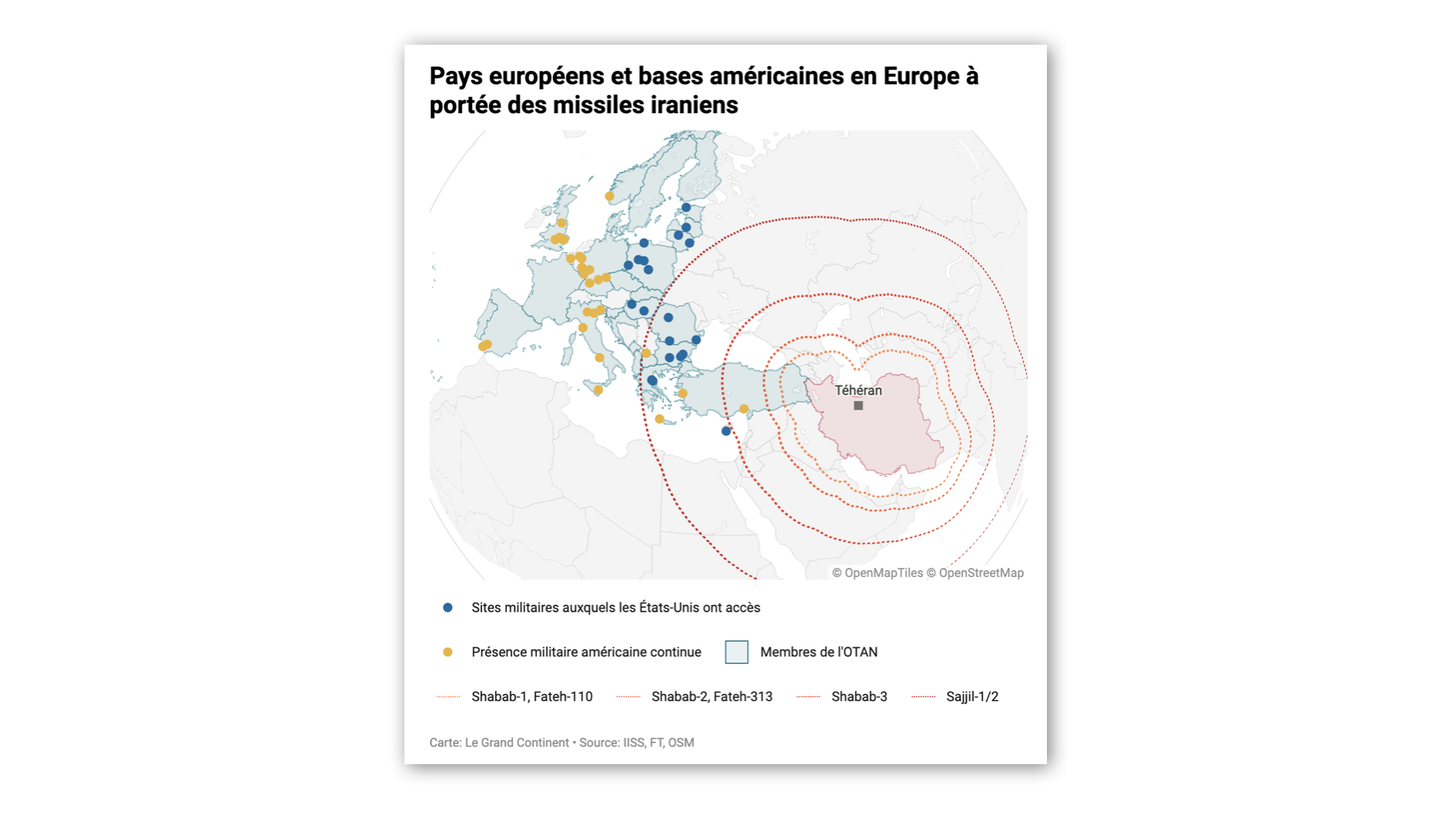
According to sources close to the Iranian regime, Tehran had considered targeting American military bases in Europe in the event of an escalation of the conflict. The southeastern part of the continent would be the most exposed to this threat, given the reach of Iranian missiles.
- Several systems, including the Sejjil and Khorramshahr missiles, as well as the Sumar cruise missile, could reach targets located on the continent.
- Bulgaria appears to be the most exposed country, notably because the U.S. military uses Bezmer Air Base to support the operations of its refueling aircraft.
- Other European countries, including Greece, Romania, North Macedonia and Albania, are also within range of Iranian attacks, as well as Camp Bondsteel, a NATO U.S. military base located in Kosovo.
At the end of July, the Islamic Revolutionary Guard Corps had issued a warning to the United Kingdom, stating that any British military base used by the United States in the context of the war would become a “legitimate target.” In early March, RAF Akrotiri, a British sovereign base located in Cyprus – which is not a member of NATO – had been targeted by drone strikes, though launched from Lebanon by Hezbollah, and not from Iran.
- If Tehran reportedly has the capacity to strike targets located thousands of kilometers from its borders, it seems unlikely that the projectiles would reach their targets.
- Since the start of the conflict, NATO defenses have intercepted four ballistic missiles launched from Iran above Turkish airspace.
- According to the alliance spokesperson, less than ten minutes elapsed between the detection of the first launched missile and its destruction.
Yesterday, Thursday, August 20, the Alliance’s Secretary-General Mark Rutte reaffirmed during a call with Bulgarian Prime Minister Rumen Radev that any attack on a NATO member would be considered an attack on the alliance, in accordance with Article 5 of the North Atlantic Treaty. He also confirmed “the availability of alliance forces and defense capabilities in the region” to intercept potential projectiles aimed at the country.
- In addition to its arsenal of missiles, Iran possesses a large number of Shahed drones whose flight range sits between 2,000 and 2,500 kilometers – i.e., a range theoretically sufficient to reach Bulgaria, Greece or Romania.
- These devices are harder to detect than missiles: their low flight altitude hides them in the radar noise reflected off the ground and terrain, while their small size limits their radar signature.
The Ukrainian campaign against Russian refineries and energy sites demonstrated the potential for conventional air defenses to be penetrated by swarms of drones. It remains uncertain, however, whether Iran possesses the capacity to conduct coordinated and sustained attacks targeting targets located thousands of kilometers from its borders.