
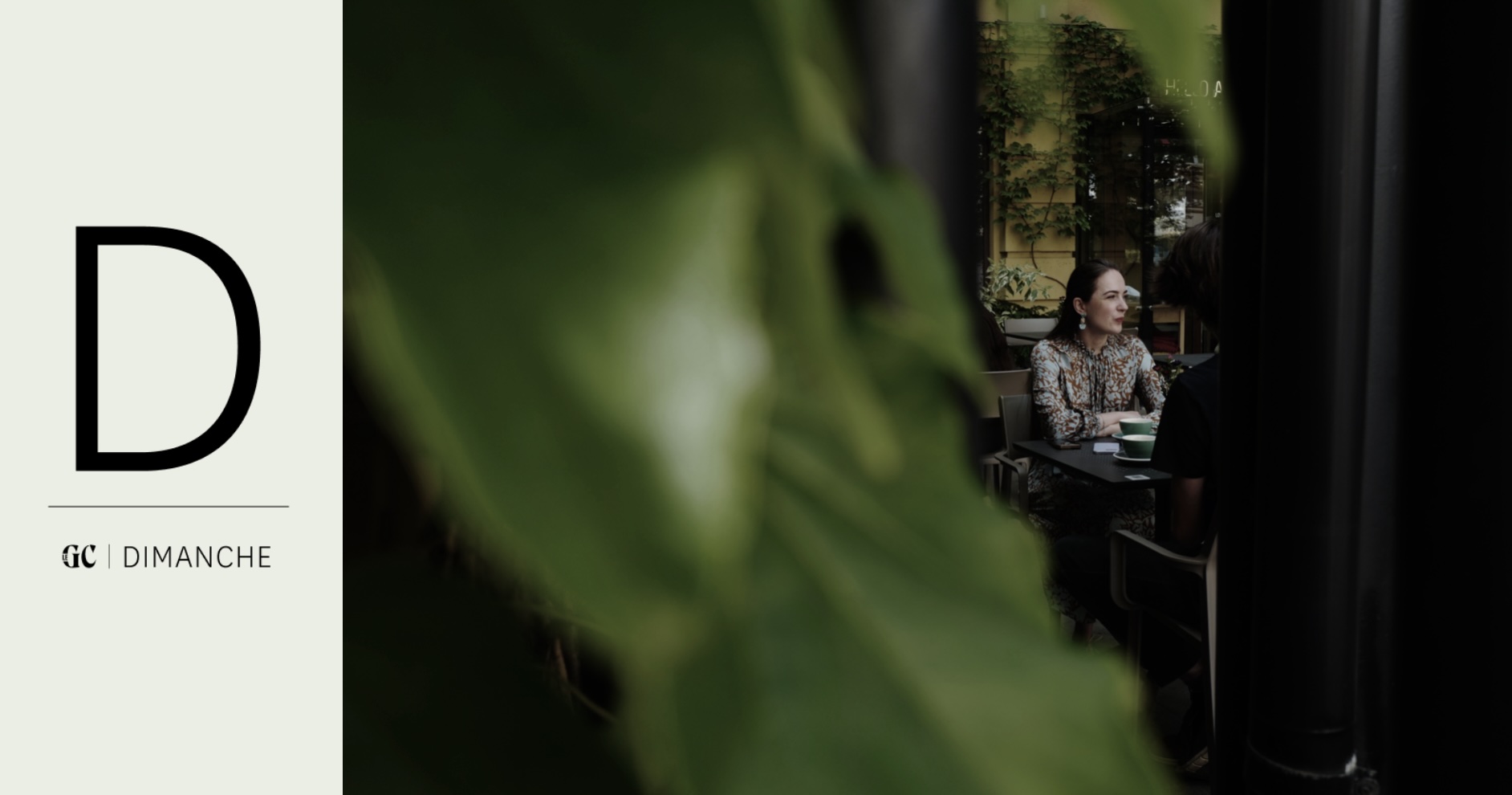
Oleksandra Matviichuk arrived at our meeting with a tired, drawn face. Not surprising: many residents of Kiev were, that day, arriving at their own appointments with the same weary air. The 74 missiles and 284 drones launched overnight by Moscow had spread across eight regions of the country, from Poltava in the East to Lviv near the Polish border. But Kyiv and its surroundings were also targeted, and a volley of explosions echoed in the sky around one in the morning. Why does it always seem to strike around one o’clock in the morning?
A fortunate coincidence, the restaurant whose address was given to me by the press secretary of the world’s best-known Ukrainian lawyer sits just a short walk from my apartment, in the Podil district, a basse ville of Kyiv loved by artists and intellectuals of the capital. We meet at Supra, a cafe-restaurant attached to Bursa, itself a chic but intimate hotel where passing foreigners reluctant to endure the opulence of the InterContinental, situated a bit higher up, stay. I wait at a table in the basement, but on arriving, she suggests, in a voice barely above a whisper, that we move to the hotel’s library on the first floor. We go there: the place is designed with studious intention, the armchairs are thick and comfortable. I step out for a moment to grab a coffee, at which moment the decision is made to go down to the terrace on the ground floor. The weather is nice after all, and there is life near this busy street where one sometimes has to raise one’s voice to drown out the intermittent rumble of the antique trolleys of Podil.
We stick to two black coffees, plus a small pot of frothed milk. Oleksandra Matviichuk has slept poorly. She knew, as did everyone in Ukraine, that the prior night would be turbulent: Volodymyr Zelensky himself had warned in the evening of an imminent “massive combined strike,” a warning relayed by specialized Telegram channels that have long since become routine to consult. The human rights defender knew what lay ahead, but has long since decided that she would no longer leave her fourth-floor apartment to spend hours in an shelter. “I don’t want to encourage that kind of attitude, but it’s my way of reclaiming a bit of control over my life,” she justifies.
She resembles, in this, many Ukrainians who have chosen (perhaps odd from an external vantage) to privilege sleep over security. A profoundly personal decision, made according to a multitude of conscious and unconscious factors: the frequency of strikes in the neighborhood, the height (an apartment on the 20th floor will be far more likely to be hit), responsibility for children or pets, the fatigue of the moment… Each has long since decided, between descending immediately to shelter or to the nearby metro station, sprinting to the bathroom (usually far from windows, hence safer) or forced indifference. Oleksandra Matviichuk chose the latter option, but stayed awake for hours after this round of explosions ripped through Kyiv’s sky yet again.
Almost four years ago, the 43-year-old lawyer received the Nobel Peace Prize on behalf of the Center for Civil Liberties, a Ukrainian NGO involved in protecting human rights and documenting Russian war crimes. It was in October 2022, only a few months after the shock of the invasion and the discovery by Oleksandra and her teams of bodies of civilians shot by the Russian army in the villages and towns around Kyiv. The Nobel Prize announcement – awarded jointly to Belarusian human rights activist Ales Bialiatski and to the Russian NGO Memorial – arrived a few weeks after a rapid Ukrainian counteroffensive had pushed Russian troops back by nearly 50 kilometers in eastern Ukraine.

When Oleksandra Matviichuk delivers, in December, the traditional acceptance speech in Oslo for the prize, Ukraine had seen shortly before the euphoric moment of Kherson’s liberation and its scenes of residents breaking into tears in the arms of Ukrainian soldiers. There is, at that time, little of that euphoria in the Nobel speech. Instead, there is a message, a lucid and somber, yet hopeful, observation distilled in this sentence: “Yes, the law is no longer operative today, but that will not last forever.”
Four years later, what remains of that moment, of that realization? Oleksandra Matviichuk first speaks of the surreal aspect of receiving a Nobel Prize in times of war. Then the human-rights professional returns to the Supra terrace, and lays out, with numbers to back it up, the depiction of Ukraine’s slow descent into hell since her prize. The war has continued, of course, with the horrors of Bucha or the siege of Mariupol giving way to missile and drone strikes against buildings, funeral sites, a playground. 2025 “was the deadliest year for Ukrainian civilians since 2022, rising 31% compared to the previous year,” she notes. The UN’s numbers corroborate this: 293 dead and 1990 wounded in 30 days. Among them were sixteen people from the Dnipropetrovsk region killed on June 2, five Kiev residents killed on June 15 in a missile strike, and a 76-year-old woman killed in Kherson in early June.

The numbers come from the UN, and the trend has only worsened this year: Moscow launched in winter a campaign of strikes on the country’s power stations that placed Ukraine on the brink of a humanitarian catastrophe, before replying in spring by intensifying missile and drone strikes across the country. Ukraine was also experiencing a severe shortage of air-defense missiles capable of shooting down Russian ballistic missiles, and the consequences were immediate: June, Oleksandra continues, became the worst month for Ukrainian civilians since 2022. The statement also comes directly from the UN: 293 dead and 1990 injured in 30 days. Among them were sixteen people from the Dnipro region killed on June 2, five residents of Kyiv killed on June 15 in a missile strike, and a 76-year-old woman killed in Kherson, in the south of the country, in early June.
The strike campaign in recent months has focused especially on the capital, hit by Russian missiles at an unprecedented frequency, often leaving only a few days of calm between assaults. It is no longer unusual to see at dawn clusters of residents emerging from the metro, with floor mats or foldable beds under their arms.

Not everyone is equal in facing these strikes, and the Podil district where we are today remains among the safest in the capital (perhaps with the exception of the government quarter, ringed by military roadblocks, and the Golden Gate district, favored by diplomats and staff of foreign NGOs). But the notion remains relative: we drink our coffee 270 meters from the National Chernobyl Museum, ravaged on May 24 by a Russian strike that most likely targeted a building next to it belonging to Ukraine’s emergency services.
Oleksandra Matviichuk had not yet touched her coffee. She follows her thought, noting that this deterioration coincided at the start of 2025 with Donald Trump’s arrival in the White House and the start of a string of unsuccessful negotiations between Ukraine, the United States, and Russia. Donald Trump had emphasized more than fifty times that he would end the war even before the end of the transfer of power. And if many in Ukraine believed it at the time, the prospect of a second Trump term had raised hopes in the country, that the American president, exasperated by Vladimir Putin’s evasions, would end up firmly on Ukraine’s side. The hope was dashed but repeatedly revived after exhausting diplomatic wrangling that always seems to end in a half-measure by the American president.
In 2025, the negotiations thus coincide with a resurgence of civilian casualties. The explanation, according to Oleksandra Matviichuk, is simple: “From the very start of Trump’s peace negotiations, the Americans spoke of minerals, Russia’s territorial demands, geopolitical interests, but never of people; we completely lost the human dimension. When negotiators talk about occupied territories, I feel they are talking about empty spaces. But that is not the case; millions of Ukrainians live there. And when the Russians realized that human beings had no significance in these peace talks, that was a signal to them that they could do whatever they wanted.”
Have Ukrainian or American negotiators, during these months of work, tried to consult the Nobel Peace Prize laureate on what could lead to peace in Ukraine? Oleksandra Matviichuk nods from side to side. She herself had attempted to approach American emissaries, spending “a lot of time in Washington” to do so, before terminating those visits. “I am a human-rights lawyer, I speak about the human dimension, whereas the language of those who discuss this issue is transactional.” Case closed.

The Nobel laureate does not mince words with Donald Trump, whom she sees as having a vision “similar to that of Putin,” that is, a world governed not by the rule of law but by force. And if her disillusionment has come in small steps, one event in particular seemed to herald a new world: on February 24, 2025, for the third anniversary of the Russian invasion, the United States joined Russia and North Korea in opposing a United Nations General Assembly resolution condemning the invasion. “You look at that and you wonder, what could possibly be similar between North Korea and the United States? A similar view of the world order, unfortunately.”
I then wonder what this human-rights defender and Ukrainian citizen thinks about how Volodymyr Zelensky has been trying since 2025 to manage the Trump hurricane, the snubs and the pride that the Ukrainian president had to swallow to, if not win over his counterpart, at least keep him from turning too much toward Moscow. “He must do it, it’s his duty,” she simply answers. “The United States are producing a weapon of critical importance for Ukraine’s defense, the Patriot air-defense systems. If you had been there last night, you know we experienced a massive bombardment, several cities in the country were attacked, and we do not have the tools to stop those missiles because we lack this American weapon.”
Perhaps this is where Oleksandra Matviichuk most clearly diverges from the traditional image of a human-rights defender. It is when one speaks of the human, of Russian crimes, and of justice that words come most easily. But the 2022 Nobel Peace Prize laureate also talks about armed forces, Patriot air-defense systems, and the importance of “reducing the ability of the Russian economy to fund the war.” How else to respond, she retorts when I remark on it: “I am a lawyer specializing in human rights; I want to be able to use legal mechanisms, but I cannot. I find myself in a situation where the law does not work.” An observation made in 2022 and unchanged four years later.
Oleksandra Matviichuk has, in many respects, followed the classic path of a rising star in human-rights advocacy. Born in the late years of the Soviet Union in the Kiev region, a contact with Soviet dissidents at the age of seven, which she would later recount as pivotal in her decision to dedicate herself to human rights. An enthusiastic student, she then entered Taras Shevchenko National University’s law faculty, found a livelihood as a lawyer with the Ukrainian banks association, and joined the Center for Civil Liberties at its creation in 2007—juggling both for several years before dedicating herself entirely to human rights advocacy. Then came the Maidan revolution and legal aid to protesters, then the annexation of Crimea, the onset of the war in the east, and that first work documenting Russian war crimes.
But her more recent trajectory is that of a human-rights lawyer trying to exist as the pillars of international law on which her concepts rest crumble. The period between 2014 and 2022 was an opportunity for a first disappointment, a first realization of the impotence of major international bodies like the UN or the OSCE. The 2022 invasion, followed by the return to power of Donald Trump, seems to have confirmed a trend.
If the cafe where we meet has the advantage of proximity for me, the choice was purely utilitarian for the lawyer: a quiet place near her next appointment. Oleksandra Matviichuk has lived at a frantic pace since the start of the Russian invasion, and even more since the Nobel Peace Prize, combining advocacy work with a close look at the minutiae of human-rights work. Before our meeting, she had already attended in the morning a gathering of the “Group of December 1,” an association of Ukrainian intellectuals and human-rights defenders. Then a working group meeting considering the best way to reform Ukraine’s penal system to bring it into line with international criminal law. There would be several more meetings before, in the evening, a book club gathering. They would discuss this time a book by American business consultant Adrian Slywotzky: “David Wins: The Discipline of a Disproportionate Victory.”
It seems, I sense, through this blend of technical and somewhat austere work and passionate advocacy that she and many other human-rights defenders are trying to push forward in an international system that appears to be collapsing. Oleksandra Matviichuk has adapted, taking advantage of a Nobel Peace Prize that opens the doors to rooms where political decisions are truly made, far from UN or OSCE committee meetings that are increasingly emptied of substance and influence. “It is important to have access to those rooms when the law does not work and you can only rely on political decisions to restore the legal order,” she insists.
There is also a need to rethink the idea of justice, not necessarily synonymous with a prison cell for the perpetrators. Through the Center for Civil Liberties, the Nobel Peace Prize-winning organization that Oleksandra Matviichuk represents, she has been able to listen to and engage with countless victims of Russian crimes, from torture survivors who escaped Donbas under Russian control before 2022 to, just a few weeks ago, residents of Kherson. Residents of this southern Ukrainian city, occupied for nearly eight months by the Russian army in 2022, have for two years been the target of drone pilots, a campaign described as a “human safari” in Ukraine and deemed by the UN as crimes against humanity.
From these conversations emerged for the lawyer a complex image of justice concepts that are sometimes different and even contradictory. “For some who have lost everything, justice is financial compensation; without it, even seeing their torturers behind bars will not satisfy them… For others, justice is knowing the truth, knowing what happened. That’s it. That’s all they need. For others still, justice is to be heard, to have the opportunity to publicly express their pain.” Financial compensation for victims and the deprivation of the perpetrators’ freedoms are not mutually exclusive and would ideally go hand in hand. But the ideal is no longer sufficient, and it is now sometimes simply (extremely complex, in truth) documenting Russian war crimes that the Center for Civil Liberties uses to safeguard the idea of justice.

The lawyer emphasizes several times during our conversation the importance of distinguishing long-term goals from “intermediate results,” in which the documentation of crimes sits: if it is not possible to convict the manager of a Russian penitentiary in which Ukrainian prisoners were tortured for long periods, it is at least possible to take testimonies and document the abuses in such a way that, later, perhaps, they can be used as evidence in court.
Ukraine — with Oleksandra Matviichuk at the helm — has not, however, given up on the use of traditional international-law tools. In May, she celebrated the signing by 36 countries (including France) along with the European Union of a document formalizing the creation of a Special Tribunal for the crime of aggression against Ukraine. The tribunal, the Council of Europe explains on its site, will “have a mandate to prosecute the principal political and military leaders for the crime of aggression against Ukraine.” The image of a twenty-first-century Nuremberg, with Vladimir Putin, Sergei Lavrov, or Valery Gerasimov lined up in a courtroom before the world’s cameras, continues to dominate in Ukraine. This despite the strong probability that Russian leaders will never be brought to justice by an international court. Do we call this process a waste of time and effort?
Oleksandra Matviichuk does not think so, not naïvely, nor by ignoring the state of the international system. And it is surprisingly in the sequence of the 2025 negotiations that she found proof that international justice can still produce effects, even when they do not lead to a formal conviction. We are in November 2025, and Trump has just approved a peace plan developed with direct support from Moscow. The plan’s 28 points notably require Ukraine to cede all Donetsk and Luhansk regions to Russia, limit its army to 600,000, and renounce joining NATO or hosting alliance troops on its soil. The revelation of the peace plan shocks Ukraine, which sees in it nothing but a capitulation demand.
But it is the second-to-last point of the plan that particularly captures the attention of the human-rights defender: “All parties involved in this conflict shall be granted full amnesty for acts committed during the war and commit not to file any future claims or pursue any grievances.”
“They are afraid,” she says. “They are afraid of justice.” International justice decisions may not, or may not yet, lead to the imprisonment of those accused. But they “shrink the world” for Russian figures who have never hesitated to lecture the West while spending their holidays in Courchevel. The activist points to the fury of Maria Lvova-Belova, Russia’s commissioner for children’s rights, upon the announcement of the international arrest warrant issued against her (and Vladimir Putin) for involvement in the deportation of Ukrainian children. Condemnations in absentia also have, she notes, the merit of deterring regime changes: a government can fall, and the condemnation will remain.

Oleksandra Matviichuk, for some time now, has finished her coffee, and begins to glance discreetly at her phone. I know she has not much time left, but I still want to ask how she thinks and handles this disintegration of the international system: how does she deal with powerlessness? Earlier in the year she spoke of Ukraine’s return to the “European civilizational space and its values” as an essential component of any Ukrainian victory over Russia. Is there not a particularly uncertain objective there, given that many European countries may swing to the far right in the coming years? If that happens, “we will have lost freedom, because Europe is unique,” she lets drop. Ukraine simply has no alternative.
But Oleksandra Matviichuk rejects the idea of powerlessness. Her hope, and Ukraine’s hope, is not a “wishful thinking,” a pious wish that a desired future will realize itself. Hope arises “from a deep understanding that your efforts matter,” she insists. If Oleksandra Matviichuk continues to believe and act, it is because she has forged herself as Ukrainian and as a human-rights defender by the example of those Soviet dissidents once, they thought, engaged in a wholly futile quest.
“The dissident movement began in the 1960s. And if you looked at its impact in the short term, you would have seen it as a failure, because those dissidents stayed on the margins, they did not transform Soviet society.” She falls silent for a moment. “But I have the privilege of viewing this in a historical perspective, and I know that those dissidents were winners, because the idea for which they fought in the 60s has become my reality.”