
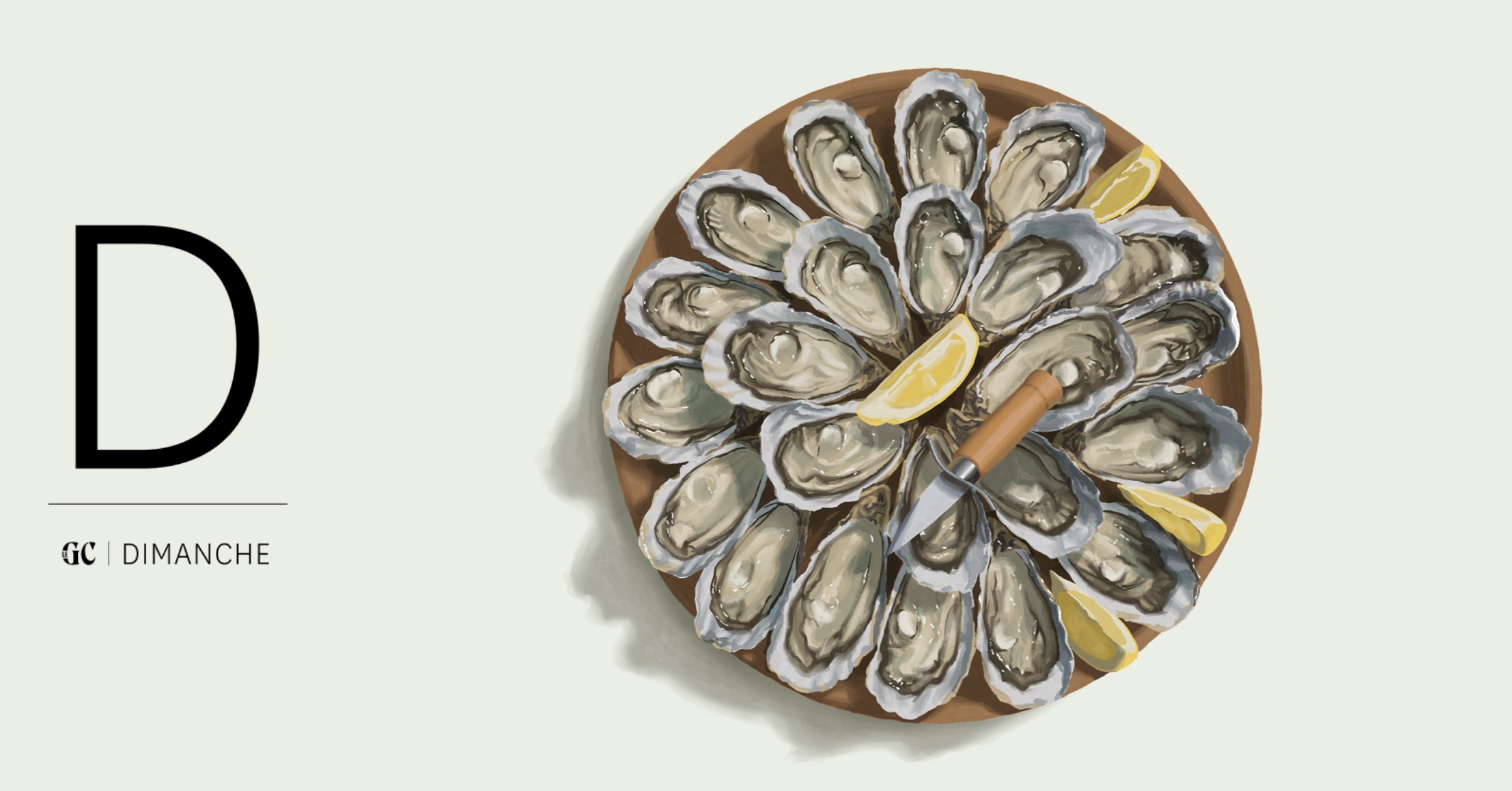
At a time when transatlantic relations are deteriorating rapidly, it is worth remembering that the Atlantic Ocean offers us at least one undeniably positive thing: the oyster. On the Cap Ferret peninsula, one can savor the delicate and invigorating flavors of this small mollusk, which feeds assiduously on the phytoplankton of the Bay of Biscay. Thanks to these bivalve mollusks that filter up to 190 liters of water per day, the waters of the Arcachon basin, bordered by dunes, take on a crystalline turquoise color rarely seen outside the tropics. All that remains is to taste the delicious fruits of this gigantic feeding frenzy.
My personal story with Cap Ferret began thanks to my wife’s paternal ancestors, a Bordeaux family of glassmakers and lawyers, who built a small holiday house there in 1936. At the time, this long sandy spit protecting the Arcachon basin was a favored destination for local families fleeing the city’s summer heat. The peninsula was then scarcely urbanized, offering little more than sand, pine forests, and seafood.
During the war, German officers occupied the family house, for it stood right behind the dune. A short walk gives access to the vast ocean beach where strong tides and a constant breeze provide the backdrop to the slow erosion of the coastline. As Sebald wrote so well in Austerlitz, all great fortifications eventually get overwhelmed by the elements and thus become monuments to human hubris; the German casemates of Cap Ferret are proof, slowly sliding from their perch atop the dune, transforming first into stranded concrete whales, then into involuntary breakwaters, before ultimately being swallowed by the sea. Hitler’s Atlantikwall thus constitutes an indispensable indicator of 21st-century climate change.
A short stroll in the other direction transports us to a very different universe, where the wild beauty of the ocean yields to the calming green of the Arcachon basin. The tides surging into this bay make it one of the world’s best oyster-farming sites. From March to June, water temperature rises rapidly by almost 10 °C, thus promoting rapid growth of the mollusk population. The flat oysters characteristic of the basin, called Ostrea edulis, already graced the tables of the Roman elite of Gaul in Aquitaine in the 4th century. But for a long time, harvesting remained a small-scale foraging activity: under the Ancien Régime, oysters were gathered among the damp sand and rocks, as one would pick a fine fruit or a precious gem.
It was Napoleon III, an inveterate sybarite, who introduced a system of oyster farming, thus giving birth to modern Aquitaine oyster farming. A year after establishing the famous Official Classification of 1855 that regulates the different crus of Bordeaux, the emperor created the first imperial oyster farms in the Arcachon basin. The wild growth of the edulis, known locally as gravette, was now strictly planned and carefully supervised. The oyster farmers of the basin then developed artisanal solidarity. Just as the French vineyard had been devastated by phylloxera in the 19th century, an epidemic struck the gravette population in the 1970s.
The salvation came from the East: the Pacific oyster, Magallana gigas, was introduced and today represents the majority of Arcachon’s production. Successful crosses have produced oysters less milky, a major flaw of summer oysters, and which can be enjoyed year-round.
The Arcachon Basin is far from the largest producer: the Marennes-Oléron basin is the largest producer in France. But as in all sectors of production, China dominates the world market: about 86% of global oyster production comes from that country, notably from the Maowei Sea in Guangxi province, which produces 230,000 tonnes per year, more than twenty times Arcachon’s production.
If that needs to be said more clearly, Cap Ferret is no longer a weekend escape off the beaten track, but a vacation destination highly sought after by the Parisian elite and international travelers weary of the Côte d’Azur. Yet the island’s most beautiful pearl is still savored in the simplest way possible.
For me, the most sublime oyster is the one enjoyed with your feet in the sand, whether on the beach or in one of the many shacks along the basin.
Few accompaniments are necessary, for the oysters are so fresh that they can stand alone. The earthy taste is perfectly balanced by a hint of acidity brought by a drizzle of citrus or a pinch of shallot and red wine vinegar. But a solid background note is just as important, such as a basket of fresh bread and butter to cleanse the palate and reconnect us to the grains of the earth.
To crown it all, a good bottle of white wine is indispensable. In the Basin, the classic pairing is a light and supple Bordeaux, such as Château Graves-Lacoste. The more adventurous can accompany their oysters with a wine bearing buttery and creamy notes, such as a Pouilly-Fumé or, my favorite, a Château Carbonnieux from Pessac-Léognan, crisp and floral. Those who have made fortunes in artificial intelligence and wish to contribute to increasing Europe’s trade surplus may opt for a Puligny-Montrachet 1er cru.