
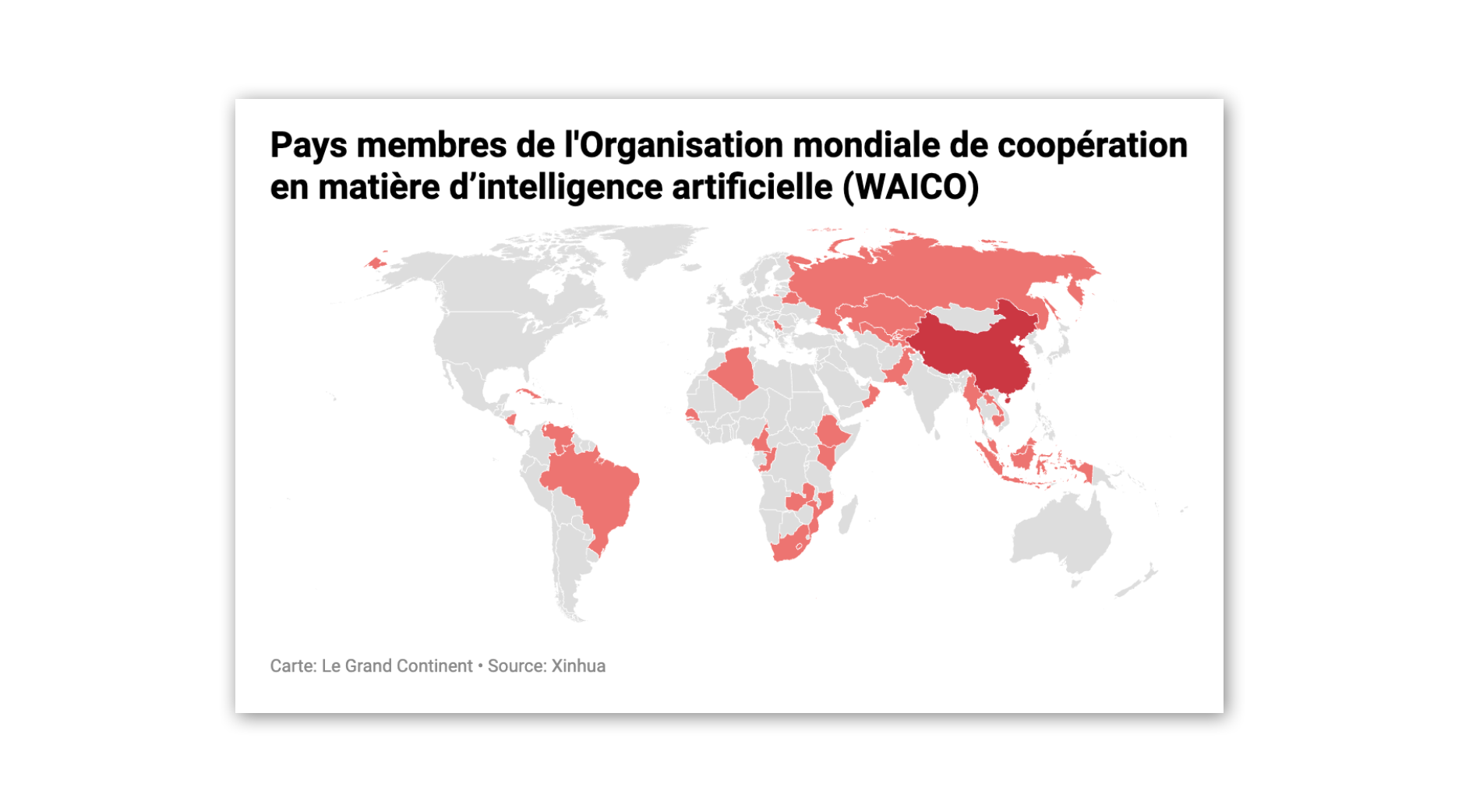
The World AI Cooperation Organization (WAICO) is an initiative launched by Beijing on July 16, on the margins of the Shanghai Global AI Conference. It has brought together 29 countries to date, including China.
- According to Chinese state media, the organization “aims to promote international cooperation and global governance in AI, ensuring that it is beneficial, safe and fair, thereby fostering its healthy and orderly development for the benefit of humanity as a whole.”
- In its current form, however, it reads more as a platform primarily oriented toward Southern countries, and in particular participants in the New Silk Roads, than as a truly global initiative.
- WAICO thus counts only two European countries (Belarus and Serbia), a single Middle Eastern country (Oman), and no North American country. The majority of its members are located in Southeast Asia, Central Asia, and Africa.
Unlike Pax Silica, the American initiative aimed at strengthening cooperation in AI supply chains and high-tech technologies, WAICO has no country that occupies a strategic position in AI.
- Pax Silica brings together the Netherlands, which holds the monopoly on extreme ultraviolet lithography machines, South Korea, which controls the majority of high-bandwidth memory chip production, the United Kingdom, which plays a key role in ARM chip architecture, and two Gulf states, Qatar and the United Arab Emirates, which possess large capital and cheap energy to power data centers.
- Taiwan, which manufactures more than 90% of the world’s advanced semiconductors, also participated in the second summit held at the end of June in Washington as a non-signatory country.
The Chinese initiative is presented by Beijing not as a China-centered platform, but as a forum where different countries can work on training programs, joint projects, and AI governance topics. In his July 17 address, Xi Jinping framed the organization as a response “to the call of the Global South,” and announced the creation by 2031 of 5,000 places for “specialized training and upskilling in artificial intelligence” aimed at developing countries.
- Beijing intends to welcome dozens of new members into WAICO, in order to raise the initiative’s size to 40 or even 50 countries.
- It could especially open to BRICS members that did not sign the founding agreement, including Iran and Egypt.
- The remaining two BRICS members, the United Arab Emirates and India, have already joined the American Pax Silica, which could complicate a future WAICO accession.
- Kazakhstan, a founding member of the Shanghai Cooperation Organization, is currently the only country that belongs to both Pax Silica and WAICO.
During the signing ceremony of the WAICO agreement in Shanghai, the presence of António Guterres, the UN Secretary-General, was noted.