
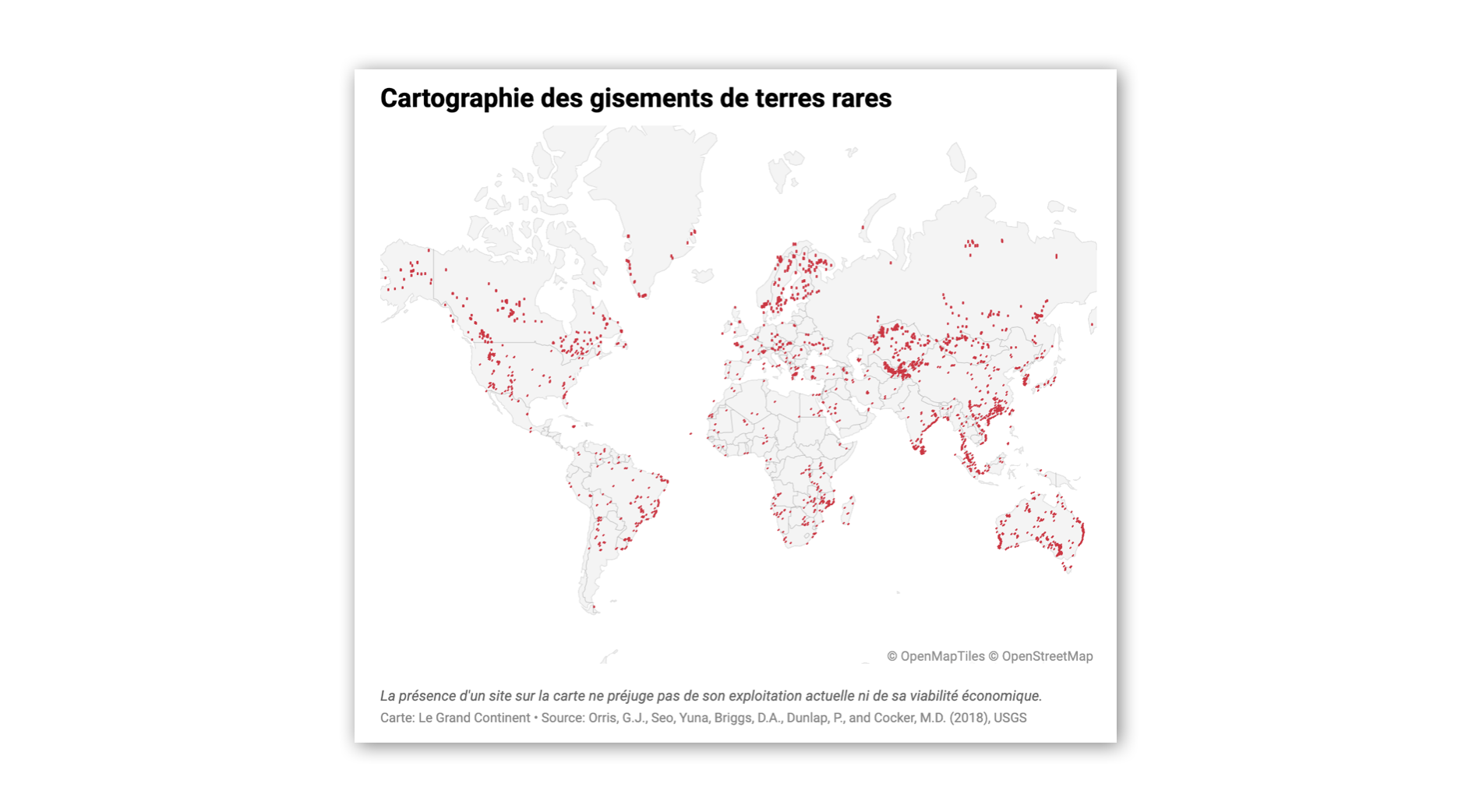
The American administration has made diversifying its supply of rare earths one of the structural axes of its geopolitical strategy. The government has notably acquired stakes (finalized or contingent) in around thirty companies since 2025, including nine specialized in the extraction, refining, or processing of minerals, including MP Materials, with whom the Pentagon signed last summer a contract worth several billions of dollars, and Lithium Americas.
- The Republican administration also entered into a partnership with Korea Zinc to build a complex for smelting and refining critical minerals in Tennessee, and invested $150 million in preferred shares in Atlantic Alumina Co.
- The American president has also signed several decrees to strengthen the supply chains for rare earths, notably by accelerating environmental assessment processes for mining projects.
- In early August, Washington finalized a conditional loan commitment of $400 million to Sunrise Energy, an Australian company developing a scandium mine.
The American strategy nonetheless shows cracks.
- Investments remain primarily concentrated in light rare earth elements – neodymium, praseodymium, cerium, lanthanum – whose strategic importance is less than that of the so-called “heavy” rare earths, such as dysprosium and terbium.
- These latter elements are particularly essential for high-temperature permanent magnets used in electric vehicles, offshore wind turbines, and advanced defense systems.
- If MP Materials has announced plans to increase its separation capacity for heavy rare earths at its Mountain Pass site in California, those capabilities will still depend on raw materials imported today almost exclusively from China or Myanmar.
According to Washington, the most promising investment to reduce this dependency concerns the American company USA Rare Earth, which in April signed a $2.8 billion deal to acquire the Serra Verde mine, located in the state of Goiás, Brazil.
- It is the only mine outside Asia that commercially operates a deposit of ion-adsorption clays capable of producing all four magnetic rare earths (neodymium, praseodymium, dysprosium, and terbium), including the heavy elements.
- A parallel agreement establishes a bespoke vehicle – in which the Pentagon is one of the main investors, with $750 million – that will purchase for a planned 15-year period the entirety of Phase I production from the mine, with guaranteed floor prices.
- However, it will take several years for USA Rare Earth to develop a vertically integrated supply chain capable of rivaling Chinese companies.
These ion-adsorption clay deposits, necessary for the formation of these elements, have long been considered nearly exclusive to southern China and the neighboring Kachin region in Myanmar. A study published last year, however, lists these same geological formations in several other countries, notably Brazil, Madagascar, Australia, Uganda, and Chile .