
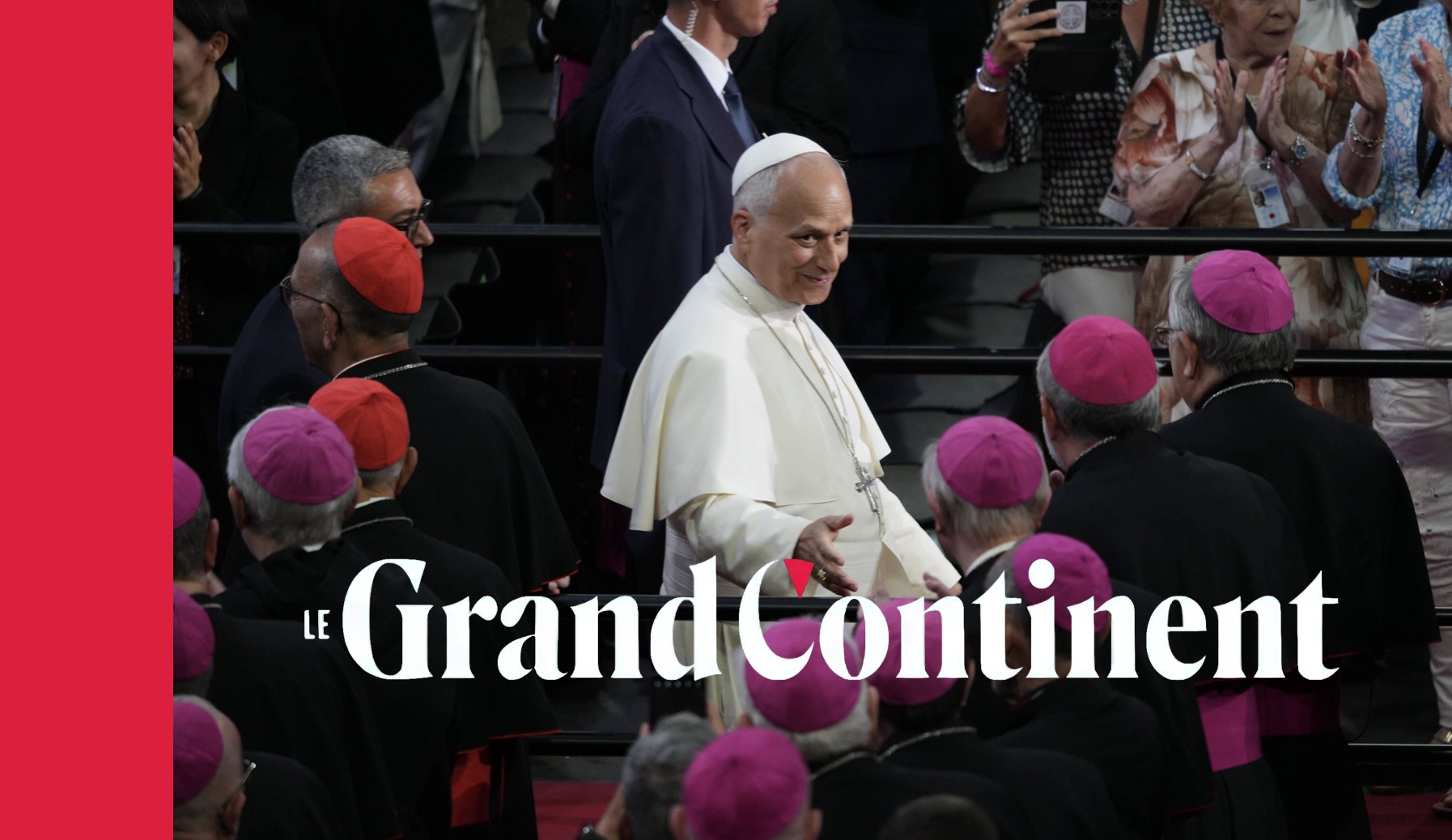
Today, Saturday, August 22, Pope Leo XIV is undertaking his fifth apostolic journey outside Italy, traveling to the Republic of San Marino, an enclave at the heart of the Italian peninsula. The pope responds to the invitation of the two Captains Regent, Alice Mina and Vladimiro Selva, who serve jointly as the heads of state of the Republic.
- The visit is expected to be brief—morning in San Marino, afternoon in the neighboring port city of Rimini in Italy—with a simplified protocol, similar to that used for pastoral visits on the peninsula.
- Arriving by helicopter, he will be welcomed at the Palazzo Pubblico, then will have a private audience with the two captains regent.
- Pope Leo XIV will deliver a speech before the Grand General Council, just as he had done before the Spanish Congress, then he will greet the crowd from the balcony of San Marino’s Town Hall and bestow his apostolic blessing upon them.
The trip’s more explicitly religious phase will then follow, with Eucharistic adoration inside the eponymous basilica, which also serves as the co-cathedral of the diocese of San Marino-Montefeltro.
- In the afternoon, back in Italy, the pope will meet the contemplative Augustinian nuns of Pennabili, who follow the same rule as the Augustinian religious order from which he hails.
- This monastery is noted for its aid to displaced people and refugees during World War II.
In Rimini, where a “Meeting for Friendship Among Peoples” is organized by the Catholic lay movement Communion and Liberation, close to the historic Christian Democracy and very influential in Northern Italy, the pope will visit two exhibitions:
- one dedicated to Saint Augustine, whose thought the pope has deeply absorbed;
- another devoted to Léon Harmel (1829-1915), a devout layman close to Leo XIII who, alongside deputy Albert de Mun, stands as a model in applying the social doctrine of the Church through Northern Christian entrepreneurship.
- Pope Leo XIV will conclude the day with a meeting in Rimini Cathedral with the sick, organized by Caritas Italia, followed by Mass.
Why did the pope decide to travel to this tiny republic—the fifth smallest and least populated state in the world, with 34,000 inhabitants across 61 square kilometers—which stands as a survivor of the pre-Westphalian European city-states?
- First, one should note that Leo XIV is not the first pope of the modern era to visit San Marino: John Paul II (in 1982) and then Benedict XVI (in 2011) also visited.
- The trip to San Marino can also be seen as a sign of the pastoral solicitude that popes extend toward the Italian peninsula, a region where they travel far more frequently than anywhere else.
But there is likely more: San Marino and the Vatican City State share many similarities.
- Both trace their origins to the Roman Empire in the first century: for papal authority, to the martyrdom of Saint Peter under Nero; for San Marino, to the establishment, in a mountainous region, of a small Christian community of free men gathered around Marinus, a hermit deacon and former stonemason from Dalmatia, martyred around 366, who gives his name to the Republic as he fled the persecutions of Diocletian.
- Even if this origin narrative is steeped in legend, the Republic marks its official beginning on September 3, 301 and claims the title of the oldest state in the world to have endured continuously.
As far as one can tell, San Marino’s legal independence is largely the fruit of the Italian commune movement of the 12th-13th centuries.
- San Marino’s motto, Libertas, still proudly proclaims this tradition of municipal autonomy.
- It is nonetheless undeniable that San Marino is the oldest republic in the world, and also the republic whose constitution, unchanged since 1600, has been in force the longest—426 years.
- The Republic of San Marino, which, like Venice in the past, claims to be “Serene,” appears both as a relic of old Europe and the weight of history, and as a paradoxical sign of “modernity,” or rather of the timelessness of democratic values.
In the 19th century, the attitudes of the Holy See and San Marino toward Italian unification appeared almost diametrically opposed. While Pius IX, though once considered to lead an Italian confederation, insisted on defending the Papal States and his temporal power, San Marino, whose independence had already been respected by Napoleon, offered Garibaldi hospitality in 1849, pursued by Papal troops.
- In gratitude, supporters of Italian unification abandoned any annexationist ambitions toward the small Republic, which signed in 1862 a friendship-preserving treaty with the new Kingdom of Italy, proclaimed the previous year.
- San Marino also stands out as the first and only country in Western Europe where a communist government was able to take power through free elections, governing from 1945 to 1957.
- With the exception of the fascist period, when the Republic equipped itself with a government that superficially aligned with Mussolini’s orientations to avoid annexation, left- and center-led governments dominated throughout the 20th century.
Pope Leo XIV’s interest in San Marino also stems from their shared status as micro-states of Europe.
- At the Vatican, the blending of temporal and religious powers is singular, the role of head of the Catholic Church bestowing the pope with a global reach that is inversely proportional to the size of his state, which serves as a formal guarantee and territorial support for its total independence.
- But for day-to-day functioning, San Marino and the Vatican are both dependent on the Italian Republic, which is the internationally recognized guarantor of their independence—Italy is thus charged with defending the Vatican.
- Although neither is formally a member of the Union nor the euro area, the two micro-states are allowed to use the euro as their national currency. The Sanmarinese population is not hostile to European integration, as shown by the 2013 local referendum on accession (the yes vote won 50.8%).
- Yet the prospect of membership remains distant, especially since San Marino already enjoys a customs union, free movement with Italy, and most benefits of the Union without being a member.
- Like the Vatican, San Marino has a tradition of diplomatic neutrality, enabling it to maintain good relations with both the United States and China on its own scale. Faithful to its tradition of defending national independence against a more powerful neighbor, the republic has firmly condemned Russia’s invasion of Ukraine.
From the standpoint of the Italian government, relations with the Vatican as with San Marino are viewed, if not as internal affairs, at least as matters over which Italy retains a special prerogative of oversight.
- The Vatican’s nuncio to Italy, who plays a key role in episcopal appointments, is also accredited to San Marino, whose 6,000 inhabitants are moreover Italian citizens.
- There is a similar arrangement between France and Monaco, with the French Republic guaranteeing independence at the price of a say in the principality’s internal affairs (for example in the appointment of the Minister of State, the head of government of Monaco).
- It seems natural that these micro-states strengthen their already good relations with one another, as their size exposes them to similar governance challenges.
- Unlike Monaco, San Marino cannot be seen as a tax haven in any case—the price differences with Italy are checked by numerous agreements to prevent unfair competition.
From the Pope’s perspective, the main interest of these European micro-states could also lie in the significant role the Catholic Church holds there. In San Marino, unlike Malta, Monaco, Liechtenstein, and of course the Vatican, Catholicism is no longer the state religion, but it still represents the faith of more than 90% of the population, predominantly practitioners, and the Church remains highly present in social life.
- For the Holy See, San Marino’s situation likely represents a favorable compromise between protecting freedom of religion recognized for all citizens in the constitution and the imprint of Catholicism on social and cultural life, even as the lines evolve: in 2022, abortion was legalized by the Grand General Council.
- In Monaco, by contrast, Catholicism remains the only official religion under the Constitution, and Prince Albert recently vetoed a law liberalizing access to abortion.
- In Liechtenstein, the prince has threatened to do likewise if abortion is legalized by referendum or by Parliament.
- Andorra, where the Constitution recognizes a special collaboration between public authorities and the Catholic Church—without making it a state church—has tensions on the same issue between the Andorran government and the Holy See. One of the two co-princes, heads of state of Andorra alongside the French president, is statutorily a cleric: the Bishop of Urgell in Spain. On this issue, he has shown more openness than the Roman Curia to negotiations with the Andorran government.
- Malta presents a particular configuration: the largest of the micro-states on the continent is also the only member of the Union, Catholicism remains the state religion there, and abortion remains highly restricted despite the stricter framework of European treaties.
- Moreover, the interest of modern popes in Malta is also keen: John Paul II (1990 and 2001), Benedict XVI (2010), and Francis (2022) have visited, and it would be surprising if Leo XIV, who has shown a fondness for apostolic journeys, did not go there as well.
The Vatican’s gestures toward European micro-states (as well as toward other small states, and even certain Pacific island nations like Nauru and Tuvalu, which have become emblematic of the fight against climate change) will thus be closely watched in the coming months.
- In a sense, this diplomatic interest extends and reorients Francis’s pastoral concern toward the “peripheries,” even though the Argentine pope tended to favor more distant countries where the Church’s situation was most precarious, which is no longer the case here.
- Gradually, Leo XIV appears to be sketching the outlines of a genuine diplomatic strategy directed at micro-states. Beyond the common problems these states share, the pope’s interest in these interstitial spaces of globalization shows that, in an era of predation, there are still strategies of influence and visibility that do not rely on asserting brute power.
- In this configuration, San Marino is not only the micro-state that shares the most cultural traits with the Vatican. While acknowledging the tensions inherent in running a pluralist democratic life, the republic also represents, in the Holy See’s eyes, an example of balance between tradition and modernity—between embracing European values on one hand, and the advantages of voluntary marginality on the other. It is this logic of accompaniment rather than full membership that the Holy See precisely intends to adopt within European and international bodies.
- If San Marino has survived Napoleon and Garibaldi, then the Vatican can surely endure Trump, and take its time for it: their permanence, amid the landscape of Europe’s history ruins, is in itself a constant and scathing denial of the logic of brute power.