
- 1 feuille de pâte feuilletée
- 1 bulbe de fenouil moyen
- 2 cuillères à soupe de beurre salé
- 2 cuillères à soupe de vinaigre de vin blanc
- 1 cuillère à café de feuilles de thym frais
- tomates cerises
- 1 cuillère à café de sel
- Poivre noir
- 1 cuillère à soupe de moutarde de Dijon
- 1/2 tasse de parmesan ou de gruyère
In my childhood, the savory version of Tarte Tatin was the customary one. My mother loved preparing a simple rendition, frequently featuring tomatoes. Unlike the United States, France offers in shops very good ready-made doughs that you can pair with a few ingredients, without needing elaborate steps. It is one of the first dishes I made when I left home, and it is for that reason also a dish I reserve for home. I enjoy it at room temperature, often as a simple lunch accompanied by a salad.
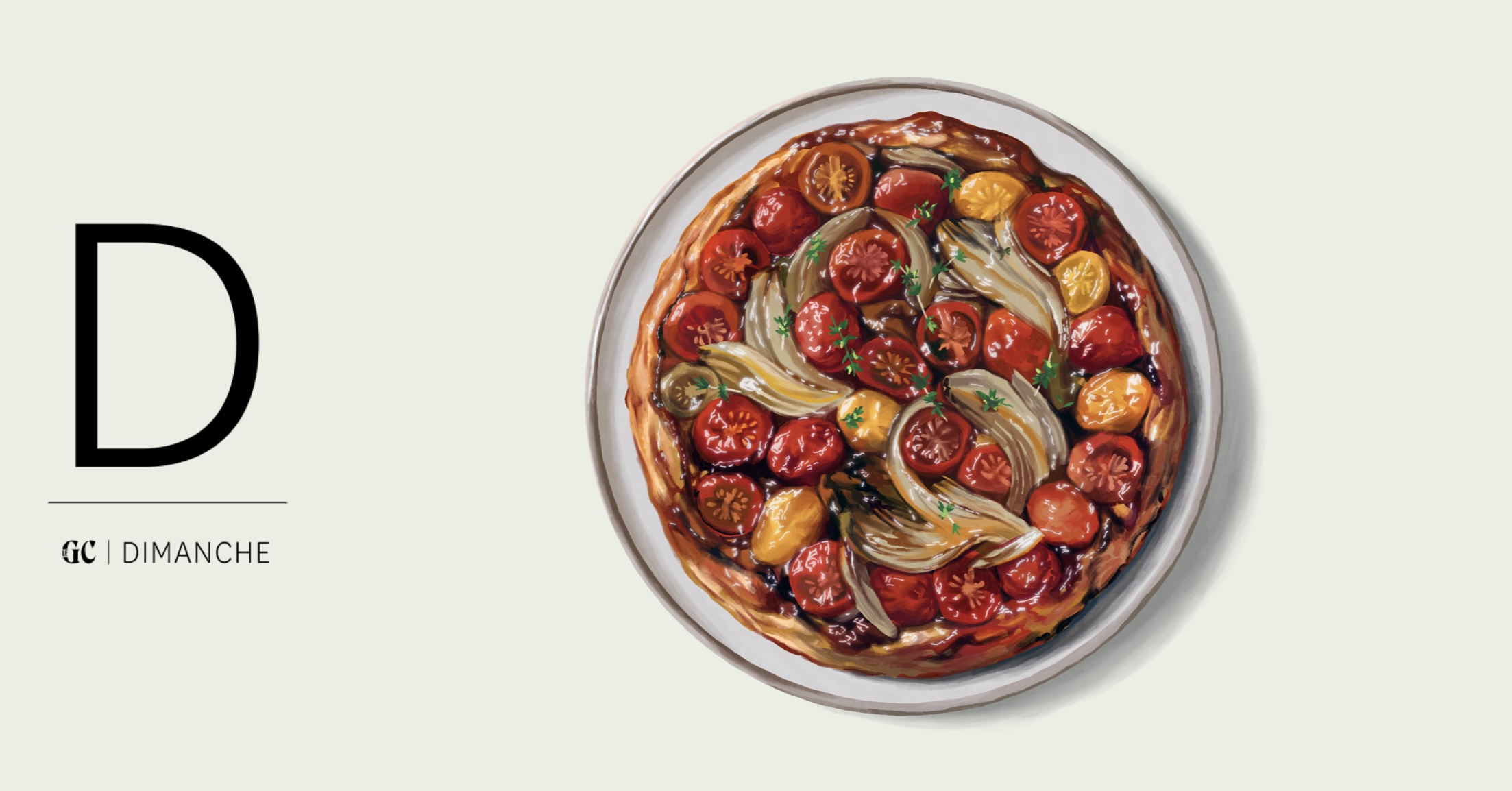
In this savory version, fennel and tomatoes melt beneath a buttered puff pastry, accented with Dijon mustard. You need: one fennel bulb and cherry tomatoes, butter, white wine vinegar, fresh thyme, a touch of mustard, and a bit of Parmesan or Gruyère grated cheese, plus salt, pepper, and a pure-butter puff pastry.
Start by preheating the oven to 350°F, then lightly flour your work surface before rolling out the pastry to form a square. Place a skillet on the pastry, flip it over to trace a perfect circle. Put the pastry in the refrigerator while you prepare the rest of the ingredients.
Slice the fennel very thinly; it should almost melt with the tomatoes as they cook. In a non-stick baking dish that can go into the oven, whisk together the butter, the vinegar, and the thyme over medium heat until the butter has melted. Arrange the fennel slices in a uniform layer at the center and fill the edges as well as any gaps with the halved cherry tomatoes. The vegetables should be packed tightly. Season with salt and pepper. Cook on the stovetop for about 5 minutes, until the fennel begins to soften and the juices caramelize.
Brush the fennel and tomatoes with mustard and scatter with cheese. Cover everything with the pastry, folding the edges inward. Cut three slits in the pastry to allow steam to escape. Bake for 35 to 40 minutes, until the pastry is nicely golden and puffed.
Let it cool for 5 minutes. Run a knife along the edge of the pastry to detach any pieces that may have stuck. Place a large plate on top of the non-stick pan, wrap the plate and the pan in a towel to keep them together, then quickly invert the tart. Remove the pan and rearrange on the plate any pieces that have come away. Sprinkle the top with thyme and a pinch of salt, then serve warm or at room temperature.

The method is straightforward: about 15 minutes of prep and roughly forty minutes of baking. Use a non-stick pan, or if you don’t have one, ensure there’s enough fat so the vegetables don’t cling. The unmolding can be impressive, but it’s simpler than it looks. If you combine several vegetables, vary the cuts: for instance, slice fennel into fairly thin pieces so everything cooks at the same pace.
The concept lends itself to nearly all seasonal vegetables that soften during cooking and pair with a generously buttered pastry: onions or shallots in winter, leeks in spring, eggplants in summer. They caramelize, are covered with pastry, baked, then inverted.
The secret is to let it brown well. I prefer it to be more caramelized than most people: color equals flavor.
The Tatin can be prepared several hours in advance. If you have seasonal produce and refrigerated dough, you’re already halfway there. It can be served as a main course in summer, typically with tomatoes, and as a starter in winter. It adapts to almost every season and will never truly disappear from your table.