
On August 29, 2126, we learn through a dispatch from the National Icelandic Radio (RÚV.IS) of the disappearance of writer and activist Edda Sæmundardóttir at age 100.
Born on August 29, 2026 in Reykjavík, daughter of Saga Snorradóttir and Sæmundur Halldór Hagalín, Edda — a name that is also the title of two major works of medieval literature (the Prose Edda by Snorri and the Poetic Edda) — spent a carefree childhood and adolescence in the old Icelandic capital, before the great eruption of May 2046 which erased the city from the map. This catastrophe proved to be even more apocalyptic than the one described in the prophetic Eruptions, Love and Other Cataclysms by her aunt Sigríður Hagalín Björnsdóttir. It was thanks to her political and literary foresight that she was elected President of the Republic of Iceland in 2047.
In 2039, when she was not yet thirteen, Edda published her very first poetry collection, titled Heima (At Home / In the Homeland), paying homage to her favorite album of the dreamlike rock band Sigur Rós. In this volume, she already expressed, with a touch of humor, her anxieties about the future of the Icelandic language and culture, as well as her love for her homeland, its volcanoes, its glaciers, its lava fields, and its wild, untamed, and unpredictable nature. It is worth recalling that Icelandic had hardly evolved since the Middle Ages, yet the early twenty-first century was characterized by a growing influence of English, propelled by social networks and Netflix series. Horrified by the many anglicisms and Americanisms among her peers, Edda gathered in this collection the great figures of language defense, which she would later set to music, such as the very famous The Lamentation of Snorri (Sturluson), in which the great thirteenth-century writer and historian resurrects and intends his young compatriots of today to mistreat the Icelandic language to the point of making it incomprehensible to the medieval man who, in despair, prefers to go back underground, like an inverted Lazarus.
A different poem, The Wrath of Guðrún Ósvífursdóttir, features the heroine of the Saga of the People of the Salmon Valley, herself resurrected, whom readers find distributing slaps and spankings to her compatriots who commit all sorts of anglicisms in the streets during the wild bacchanals held every Saturday night when the temperature was judged mild and exceeded 7 degrees Celsius in Reykjavik. It goes without saying that the act of slapping or spanking was accompanied by the recitation of Guðrún Ósvífursdóttir’s emblematic line, well known to all Icelanders, however Anglicized: “Þeim var ek verst er ek unna mest”, that is, “It is the one I harmed the most whom I loved the most,” a phrase that acted as enchantment on linguistic delinquents, who suddenly spoke in gullaldarmál, a classical Icelandic devoid of any trace of foreign influence. To sum up her message, Edda boldly announced in the preface: “Our language is our only true monument, our only treasure, it is inconceivable that we allow English, even if Americano, to spoil it.”
This very first collection was crowned with the Grand Prize of the Vigdís Finnbogadóttir Foundation, a writer and former President of Iceland from 1980 to 1996.
Edda continued to publish poetry at a yearly pace, exploring and illustrating the playful possibilities offered by the numerous homonyms of her language, while drawing inspiration from classic authors such as Halldór Laxness, Jón Kalman Stefánsson (Nobel Prize in Literature 2055, at the age of 91), Hallgrímur Helgason, Auður Ava Ólafsdóttir, Fríða Ísberg, Arnaldur Indriðason, Ragnar Helgi Ólafsson, Kristín Eiríksdóttir, and many others. The opus that created the loudest buzz, published at the beginning of May 2046, was the collection titled Á á á á á (pronounced ao ao ao ao), meaning: The Farm of Á (River) Owns a Sheep on the River (or in another farm also named Á (River)), a phrase worthy of appearing in an Assimil manual, but which can also be translated as Ouch, ouch, ouch, ouch, ouch. It should be noted, however, that understanding this statement requires advanced grammatical analysis. A number of pranksters turned this title into ridicule on Facebook and X, claiming they eagerly awaited the next volume by Edda, presumably titled Í í í í í, to which Edda replied that Í í í í í made no sense and that when one knows nothing about Icelandic grammar, one has the elegance to remain silent and to pick up a few books.
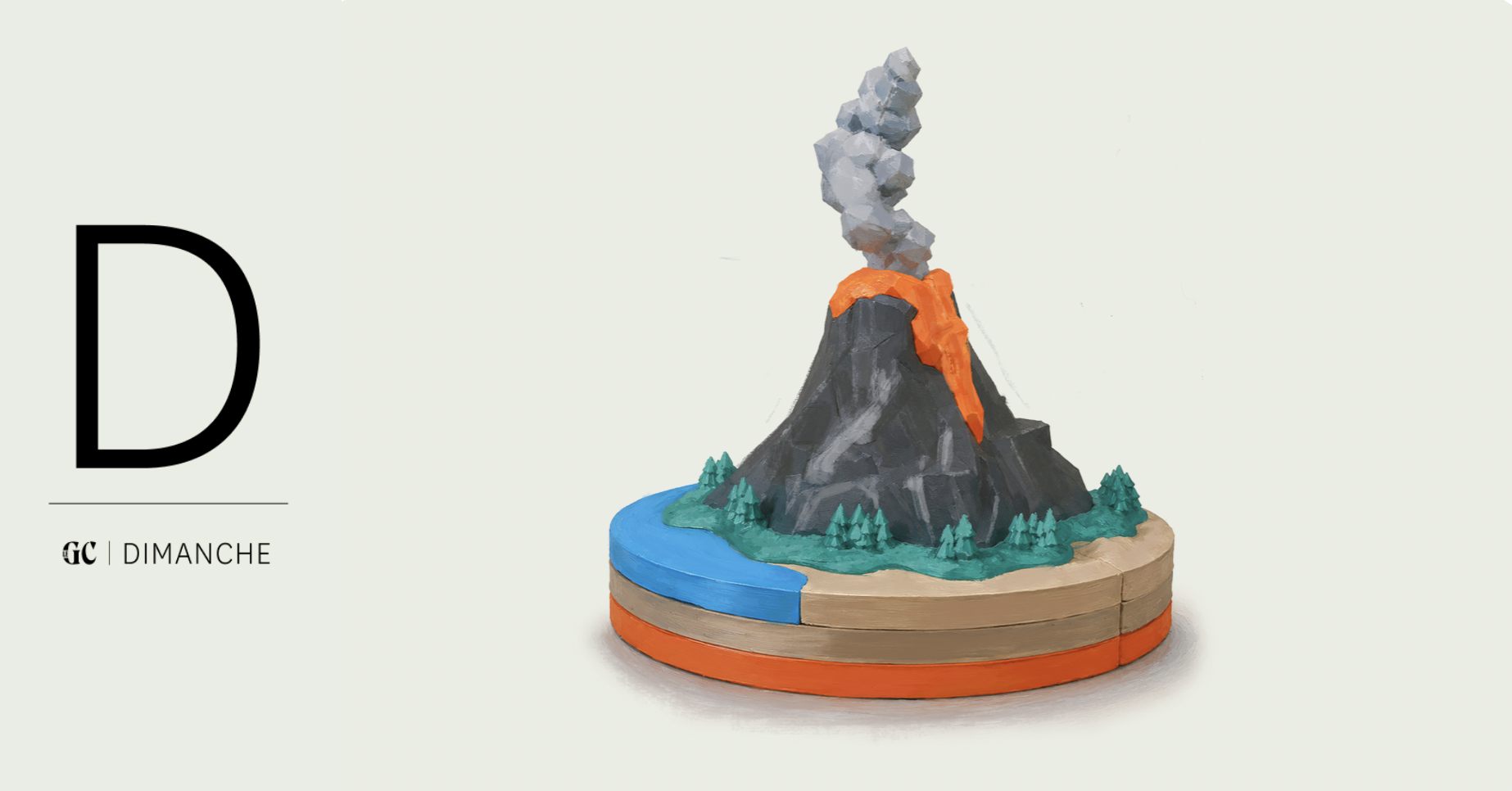
But the controversy suddenly faded when the Rauðavatn lake volcano erupted, promptly nicknamed by locals Rauðhetta (The Little Red Riding Hood), triggering the cataclysmic eruption of May 2046 that lasted six months, caused countless earthquakes, and poured vast quantities of lava over Reykjavik and nearby towns housing two-thirds of the island’s population, prompting the civil defense and the government to order a full evacuation of the Reykjanes Peninsula. Edda Sæmundardóttir, then under twenty, emerged as a true leader. Arguing that the southwest of Iceland enjoyed a relatively mild but overall calamitous climate with around 300 days of rain per year (she had a flair for hyperbole!), she asserted that the population must truly wake up. She proposed that, in contrast to the nineteenth-century Americans, the Icelanders should launch themselves not toward the Conquest of the West, but toward the East. Defying her aversion to Americanisms, she launched the bilingual slogan: Farðu austur, maður! / Go east, young man! In her view, the logic dictated that the new capital should be Egilsstaðir, a modest, flat town then barely 3,000 souls, located 30 kilometers from Seyðisfjörður, the port that ferries arrived at from Denmark, Norway, and the Faroe Islands.
In a lengthy televised debate, she directed at one of her opponents — whom she teasingly called a blonde dummy — the remark: “You are not the only one living in the Southwest; most people have had enough of freezing their behinds for eleven or twelve months a year under the horizontal rain. Egilsstaðir enjoys a much more continental climate, and besides, the town is located in a zone free of any volcanic activity: there, yes, we will freeze in winter, but at least we will be a little warm in summer!” A quick online referendum was organized, and a few days later the vast majority of the population relocated to Egilsstaðir, arriving by car along National Route 1, the lone road that encircles the island. What followed were, of course, a host of economic uncertainties that would later be thoroughly documented by Edda Sæmundardóttir, who became a novelist after her long political career.
Fidele to her relentless optimism, Edda proclaimed that the Icelanders had endured far worse during the Laki eruption of 1783–1784, and that since Reykjavik had lost everything, there was nothing left to lose. And this proved true. Elected president in 2055 with 95% of the votes, she was celebrated by the population for having achieved the feat, as Minister of Development, of rebuilding an Iceland that was self-sufficient in food, a country inclusive and open to the world, rooted in humanist values. Edda spent the next twenty years of her life promoting a lifestyle respectful of nature and a traditional habitat built of stone, wood, and peat, thus breaking with a sometimes strikingly unsettling Icelandic architecture of concrete and glass. Reports regularly showed her fishing cod in fine company on a boat with eight oars, as in old times, or tagging migratory birds and counting them.
In 2075, believing she had done enough for her fellow citizens, she left politics and refused a nomination as UNESCO ambassador for sustainable development with the laconic remark: “Sorry, but I have other things to do.” Other things to do? What else could there be? Writing. And she did write. She wrote about the land and the soul of Iceland, its immensities, its grand and modest beauties, crafting a body of work marked by benevolence and never sliding into sentimentality. A work in which she made the Icelandic language shine with all its nuances. A contemplative oeuvre in which she kept to the roughly two or three hundred terms available to describe snow, wind, and rain, most often mingled, so that her compatriots would not forget them. Among her writings translated into French, we note: The Call of the Golden Plover in the Summer Night, a pinnacle of lyric literature, and Egilsstaðir, My Love, which records the emergence of the new Icelandic society after the 2046 eruption.
Under her guidance, the population made a concerted effort to care for their language; the use of anglicisms declined, as did the hours spent in front of the television watching series. The line with which Edda declined the UNESCO ambassadorship became iconic: whenever someone asked whether they had seen a certain program on television, the response was often with a wry smile: “Sorry, but I have other things to do.” Fishing, reading, tending my garden, conversing, maintaining my home, knitting, watching, observing, helping, attending reading evenings, or eating aged shark cured with aquavit.
The announcement of her death, on the day of her hundredth birthday, sparked processions and spontaneous demonstrations across Iceland. Even now, the great runway at Egilsstaðir International Airport is swarmed by a population forming a long inscription visible from space: TAKK FYRIR ALLT EDDA! MERCI POUR TOUT EDDA!