
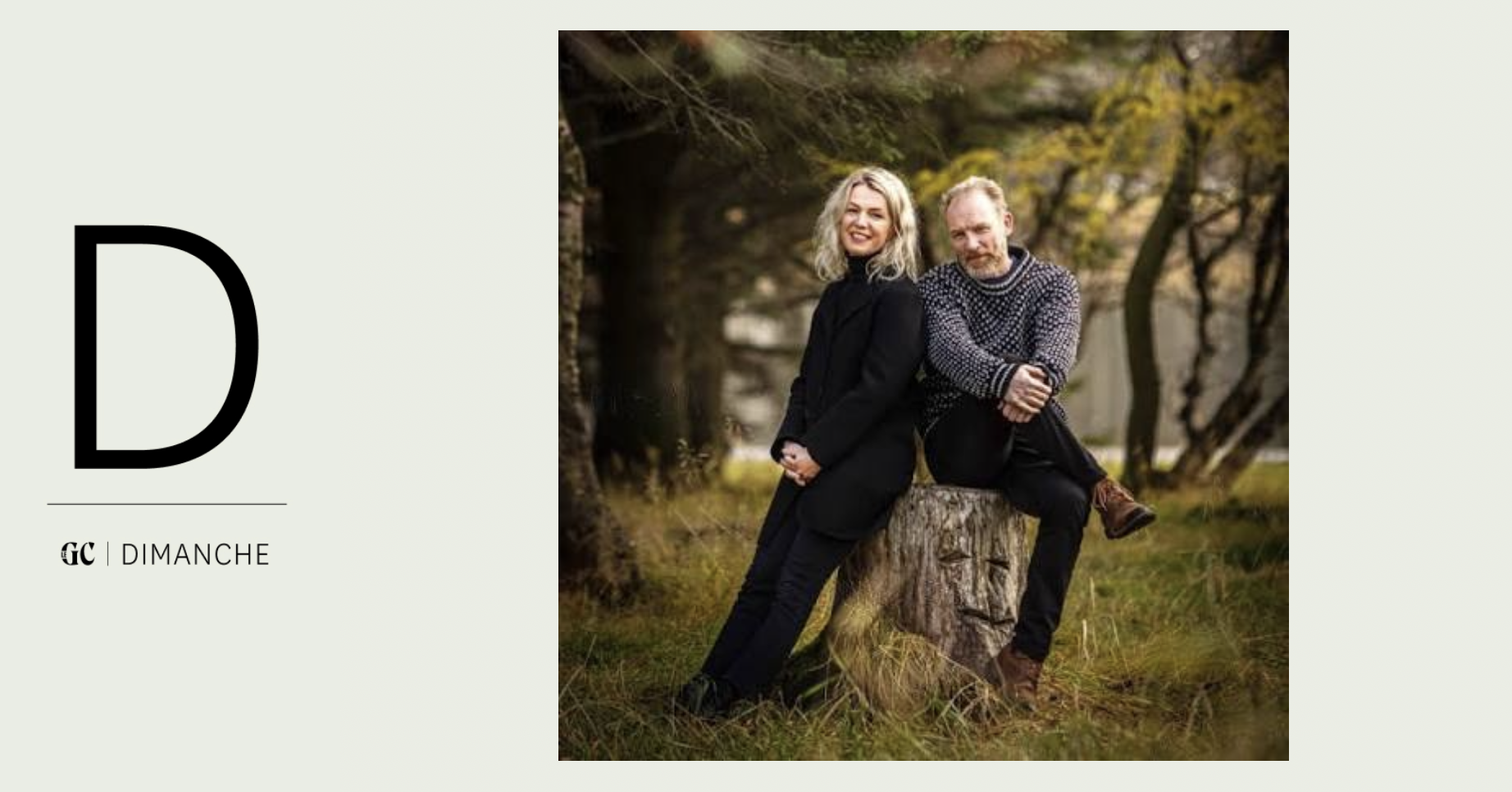
They are husband and wife, and two of the most listened-to voices in contemporary Icelandic literature. We discussed with them the referendum of August 29 on restarting negotiations for accession to the European Union.
The snow peels itself from the ground to lash my face, the wind gusts unforgiving. How many times have I heard here that in Iceland, “there is no bad weather, only bad clothes”? The sole pedestrian on Surðurgata (the street of the south), I shuffle along in Stan Smith sneakers on deserted sidewalks. A few motorists look at me, astonished. The chill of early March offers no mercy. And when melted snow blends with fresh snow, the whole creates an odd marmalade that Icelanders, who possess dozens of words to describe snow, and even more to talk about the wind, surely know how to name with a precision I envy.
Sigríður Hagalín Björnsdóttir and Jón Kalman Stefánsson live on the western edge of central Reykjavík, in Vesturbær, near the University of Iceland. The main building of the University, completed in 1940 on the plans of Guðjón Samúelsson – the state architect who also designed Hallgrímskirkja and the National Theatre – stands there, right next to Hólavallagarður, Reykjavík’s old cemetery. I think of it on my way: yes, it is indeed the cemetery Steinunn Sigurðardóttir described in The Life Thief, published by Flammarion in 1998 in Régis Boyer’s translation. The story of Alda, a professor of German and English, secretly smitten with a married colleague, which had moved me when I read it. Boyer, who died in 2017, held for decades the chair of Nordic languages and literatures at the Sorbonne: it is largely through him that France learned to read the sagas, then the Scandinavians Andersen, Ibsen, Strindberg, and then Halldór Laxness, the Icelandic Nobel laureate.
One does not necessarily imagine Jón Kalman, the former librarian of Mosfellsbær, living in such a stately home. Opening the door in an elegant black dress, Sigríður apologizes “for the dreadful weather.” It’s hardly her fault. She smiles when I mention the vast array of words available to describe snow and wind. A journalist at RÚV, the Icelandic public television, for about twenty years, Sigríður notes that she is now less present there, that the writer has begun to outpace the journalist. In 2016, she published Eyland, translated into French as L’Île (Gaïa, 2018). A tale imagining what would happen to an island abruptly deprived of imports and left to itself. Whether dealing with external threats, the United States, or others, the temptation for Iceland to rely only on itself returns like a bad prophecy.
The hallway to the entrance opens onto a wide, warm living room. There, an enormous library, a desk, a grand piano, and sofas. Jón Kalman Stefánsson arrives a little later. I had met him two years earlier here in Reykjavík. He had led me to 12 Tónar, the downtown record store and label, founded in 1998 on Skólavörðustígur, which over the years became a gathering place for the Icelandic music scene – Björk and Sigur Rós are there regularly – and crowned in 2013 “best record shop in the world” by Gramophone magazine. That evening we had talked about Yellow Submarine, his hybrid work, neither memory nor novel, in which he revisits a displaced childhood in the northern countryside after his mother’s death, and how that childhood later forged the writer he would become. Today, he is among the greats. The trilogy Between Heaven and Earth, The Sadness of Angels, The Heart of Man, then Moreover, the Fish Have No Feet, Ásta, Your Absence Is Only Darkness, has built him a reputation in France through prizes: Millepages in 2015, Folio des libraires in 2020, Le Point / France Inter Foreign Book in 2022. Eric Boury has faithfully translated him for years. He was also among the nominees for the “New Nobel” awarded in 2018 outside the Swedish Academy circuit, alongside other more commercial authors – a mark of solid international recognition.
Island, Europe, America
Despite the promise of the title of this series, and the Icelanders’ reputation for coffee consumption (nine kilograms per person per year), we will opt for tea. The Icelanders are about to ask themselves whether they want to resume negotiations with the European Union. Do they really feel European? I launch straight away. “The answer has evolved a bit in recent times…” Sigríður’s allusion is cryptic. In what sense?
“We are first and foremost islanders,” interjects Jón Kalman, remaining standing. His English carries a beautiful Icelandic accent with clear vowels. “Our island maintains a special relationship to the continent. Like the English, who feel European, but also apart, because they live on an island. We are in the middle of the Atlantic, far from everything. For a long time we felt on the margins of the world. Since World War II, we have thought of ourselves as more European, but American influence here has been stronger than in many European countries.” He speaks of the weight of America on eating habits and on culture, traits that the Norwegians or Danes noticed with surprise fifty years ago when they came to Iceland. “The wealthy and modern Iceland might not exist without the United States,” the writer adds. “After the war, the Americans helped us to develop. Then they wanted to return to install a military base. For a country independent since 1944, accepting a foreign army was difficult. It sparked fierce debates.” He recalls the 1951 agreement within NATO. “The United States acted as they always do: when they cannot use force, they find other means. Since we had no army, they bought us, in a sense. Marshall Plan aid intended for devastated European countries benefited Iceland greatly, just as Sweden did. In per capita wealth, no European country received as much aid as we did.” Thousands of Icelanders subsequently worked with the Americans. “That is why we are more American than one might imagine, but perhaps that is changing.”
Seated opposite me, Sigríður lifts her tea to her lips, before attempting synthesis: “Because we are a very small nation, long isolated and lacking defense, we have always had to manage. We trade with those who come to us. We present ourselves as more European when it suits us, more American when it suits us. We take advantage of circumstances, while liking to complain: ‘No one knows that we exist, our life is so hard…’” Irony lights her eyes. A cat comes to demand attention, bell around its neck, clinking from chair to chair. “She wants to be at the center…,” Sigríður explains. I tell them that talking about cats, and the love one can feel for such creatures, is dangerous: we could be at it all day. They smile.
In front of this library and in their company, another wealth comes to mind: immaterial wealth, Iceland’s perennial cultivation against poverty. Books. Here, I am often told that Iceland’s farmers have always read; it keeps striking me. I do not overlook either that, in the face of American influence, Icelanders chose to forge their own words to name modernity rather than always borrow from English. It is almost the first thing I learned when I brought Iceland into my life more than ten years ago. Isn’t that a way of being, despite everything, less American than they claim?
“Language is capital,” agrees Sigríður. “It must be said that the Icelandic climate lends itself to reading: there is not always much else to do. Our cultural heritage crystallized in language and literature.” Here, indeed, you will not find cathedrals or Versailles-like castles, not fortifications, not even train lines. “But we have the sagas!” asserts Jón Kalman, leaning against the library shelves. “If you dive into the archives of old periodicals, whether from the early or late twentieth century, you are confronted with the repeated worry: the language would be threatened, the young would speak poorly, Danish and then English would influence them… This recurring fear shows how much our language matters. Many Icelanders have always believed that without it there would be no nation.”
Because the language has only a little over three hundred thousand speakers, we know Icelandic is threatened with extinction. And do they themselves feel like members of a vanishing species? “Yes,” assures Jón Kalman, “the two go together. If you erase the language, you erase the identity.”
Isolation Breeds Megalomania
Sure, Iceland is a small nation, but its cultural influence – sagas, music, environmental engagement – goes far beyond its demographic heft. “If we were a tiny nation in the center of Europe, surrounded by large countries, we would probably have been absorbed,” explains Jón Kalman. “But we have endured here for more than a thousand years, isolated, against the elements. For centuries, from October to March, no one came to meet us. That gave us the sense that we had to do everything ourselves. Unlike the Danes, who see themselves as small before Germany, we have no human neighbors: our neighbor is the ocean. No one has ever come to tell us what we could or should do.” “That leads to a form of collective megalomania,” Sigríður quips, amused. “Unlike the United States, we are objectively very insignificant. We can weigh in the world only if we believe in ourselves.”
That has shown up in Icelandic music, too. Jón Kalman revisits the boom it experienced fifteen to twenty years ago. In Britain, a young musician of the 1970s or 1980s already had the Beatles, the Smiths and many others behind him; he could tell himself he would never do better. “In Iceland, there has never been that crushing inheritance. You can try everything, believe you are brilliant. Isolation can confine, but it can also liberate.”
Greenland, Seen From Iceland
In January, when Donald Trump rekindled his provocations about Greenland, how did they experience it, they who share with the Danes a common history? “Two feelings mingled,” recalls Jón Kalman: concern for the Greenlanders and, at the same time, a certain ironic mockery of the Danes. We almost wanted to tell them: “This was bound to happen…” Their history with Greenland is not glorious. Both of us have lived in Copenhagen and seen how the Danes viewed people from over there.” Sigríður is harsher still: “The Danes have always had a lot of contempt for the peoples of the North Atlantic, for the Greenlanders, the Faroe Islanders, the Icelanders… The Greenlanders have long been seen as a burden, because of the subsidies Copenhagen pays them. On Danish newscasts, the maps show Northern Europe, but not Greenland, nor the Faroe Islands, nor Iceland. Greenland is, most of the time, out of sight. And suddenly the Danes discover a passion for it: they issue declarations, begin selling jewelry and T-shirts bearing its image… It is quite comical.”
They tell me that one of their friends travels regularly to Greenland for twenty years, and returns with very concrete accounts to measure the degree of the colonizer’s contempt: in some shops, they sell expired products.
Iceland, for its part, has never been a colony in the classic sense. Sigríður notes: “There has never been a Danish aristocracy installed here to exploit the country directly. There was mainly a commercial monopoly. Many of the most toxic aspects of colonialism were absent.” And its language, the Danes have always respected it, adds Jón Kalman, even if the old Icelandic history books, written under the regime of the struggle for independence, tended to darken the picture. “Over time, we understand that a very small nation would have found it difficult to stay alone for centuries. A great power would have ended up taking it. We were lucky that it was Denmark, not England! If the English had taken Iceland, we would probably no longer speak Icelandic…” He fears, he says, that one day someone will unearth in the archives everything the United States did for Iceland – the Marshall Plan, the welcome of hundreds of Icelandic workers in the early 1960s – and that Trump might use it, declaring “You must pay us back,” or demand broader access to their territory. “Fortunately,” notes Sigríður, in a cheerful taunt, “these people aren’t very good at history. Nor geography. It’s already good that they know where Greenland is.” Jón Kalman adds, amused by his wife’s last remark: “Our luck is also that Iceland is geologically a very young country. We have neither oil nor rare metals in quantities comparable to Greenland’s. Perhaps that will mean they won’t think of us too much…”
Continue the Conversation Where We Left It
Yet Iceland remains strategic in the Arctic – there is a question about defense against hybrid threats, about Russian ships prowling nearby. I suggest the idea that Icelanders might agree to discuss with Brussels without being ready to join the Union. “No one knows what negotiations would yield,” wedges in Sigríður. “We often present the European Union from a practical angle – fishing, energy, economy – but here the question is deeply emotional: it touches identity. Our independence dates from 1944; people alive still remember it, or remember parents involved in the struggle. For many, it still has a romantic dimension: decide alone, in the middle of the ocean. Some would prefer to stay poor and isolated rather than join the Union! But many, especially among the young, find it absurd to refuse even to examine what it might offer.”

Jón Kalman goes further: “The debate is very emotional and saturated with propaganda. I find it strange to refuse to resume the discussion where we left off ten years ago. Return to the negotiating table would harm no one. For twenty years we have argued about an outcome that no one knows. Opponents and supporters imagine a final agreement, then fight against their own assumptions. It would be better to negotiate and see.” He reviews the opposition: politicians more attached to independence, parties openly hostile to the Union, and some far-right groups that keep fear alive, not to mention the major fishing companies, fearing they will lose their leverage in a more constraining European framework.
“That is also tied to how we understand the European Union, she continues. It was built to guarantee peace on the continent. But in Iceland we have not known war since the 16th century. We do not share the European memory of men sent to the front, of troops crossing countries, of destructions. Our sense of security is more abstract, perhaps more naïve. Many do not see the point of joining an organization born from that fear, simply because it is not written into our history.”
But some want to move to the next stage. Jón Kalman insists: “We have been locked for years in a debate whose outcome everyone assumes. Let us resume discussions! We would at least have a draft agreement to study, as the Norwegians did, before saying no. We can negotiate, look at the result, then refuse. Today we do not know what we would gain or lose. That is the same problem for all islands: they often feel they must win everything without losing anything.”
America, a Difficult Divorce
This reminds me of Eyland, Sigríður’s novel, this dystopia about self-sufficiency. “Sigríður’s book offers precisely a meditation on this temptation to survive outside the world,” nods Jón Kalman. “But we now understand that yesterday’s world will not return. For a long time, looking toward America conjured positive images. For seventy years, American culture has fed us: how many times have we seen an American hero save the world in cinema? This idea has penetrated our imaginary. In the twentieth century, the United States learned how to touch the hearts of other peoples through culture. Hollywood changed our perspective. In Iceland, mentioning America recalled the possibility of studying there, traveling, and personal experiences… Thousands of Icelanders went there. Today, with Trump, the image of the United States has become negative. Many say they do not want to go back. In a few months, our worldview has shifted; our thinking still has to adapt.”
Sigríður has picked up the cat in her arms. She strokes it to soften the harshness of her remark. “This feels like betrayal or a difficult divorce, if you will. The body still remembers the beloved, and you must remember that this person betrayed you, and you cannot trust them as before.”
Jón Kalman concludes, almost gravely: “That feeling is all the stronger because the American presence counted for so much here. The American army and navy had their own radios and televisions in our country. At the time, Iceland did not even have television, only a national radio. Suddenly, one could receive American programs. Those stations heavily influenced the Icelandic music scene. This culture is in us, it is part of our history. It is therefore odd to see the United States evolve in such a way that displeases us. And the most worrying thing is that it isn’t just about Donald Trump; it goes deeper. Even with another election, even with another president, trust will not return overnight.”
A Power
One last request, before we leave. From my still-damp and cold backpack I pull out Jón Kalman’s book, the novel Between Heaven and Earth, the story of that nameless boy and the death of his friend Bárður, swept away by the cold at sea after he forgot his jumper on shore, too absorbed in his reading of Milton’s Paradise Lost. To Jón Kalman, I recount how, for my friend, that book had taken on a crucial importance. A close friend gave it to him, and she died years later. Later still, he would come across the book again, which he had never opened. He finds in its pages a note from her, slipped between the pages, like a posthumous letter. The two writers are moved. Sigríður places her hand on Jón Kalman’s shoulder: “You see, I told you, there are always crazy stories with this book. Every time, readers arrive with an incredible story. This book has a power, truly.”
A warmth, then the cold again, the wind biting, the gliding in improvised little white sneakers along Surðurgata. Sigríður walks me to the door. In the evening, on television, I will see her again in the same black dress, with a gravitas that will impress me, informing her fellow citizens of the persistence of road closures in the east of the island due to the snow. Without, however, apologizing for the bad weather, as she did when welcoming me.