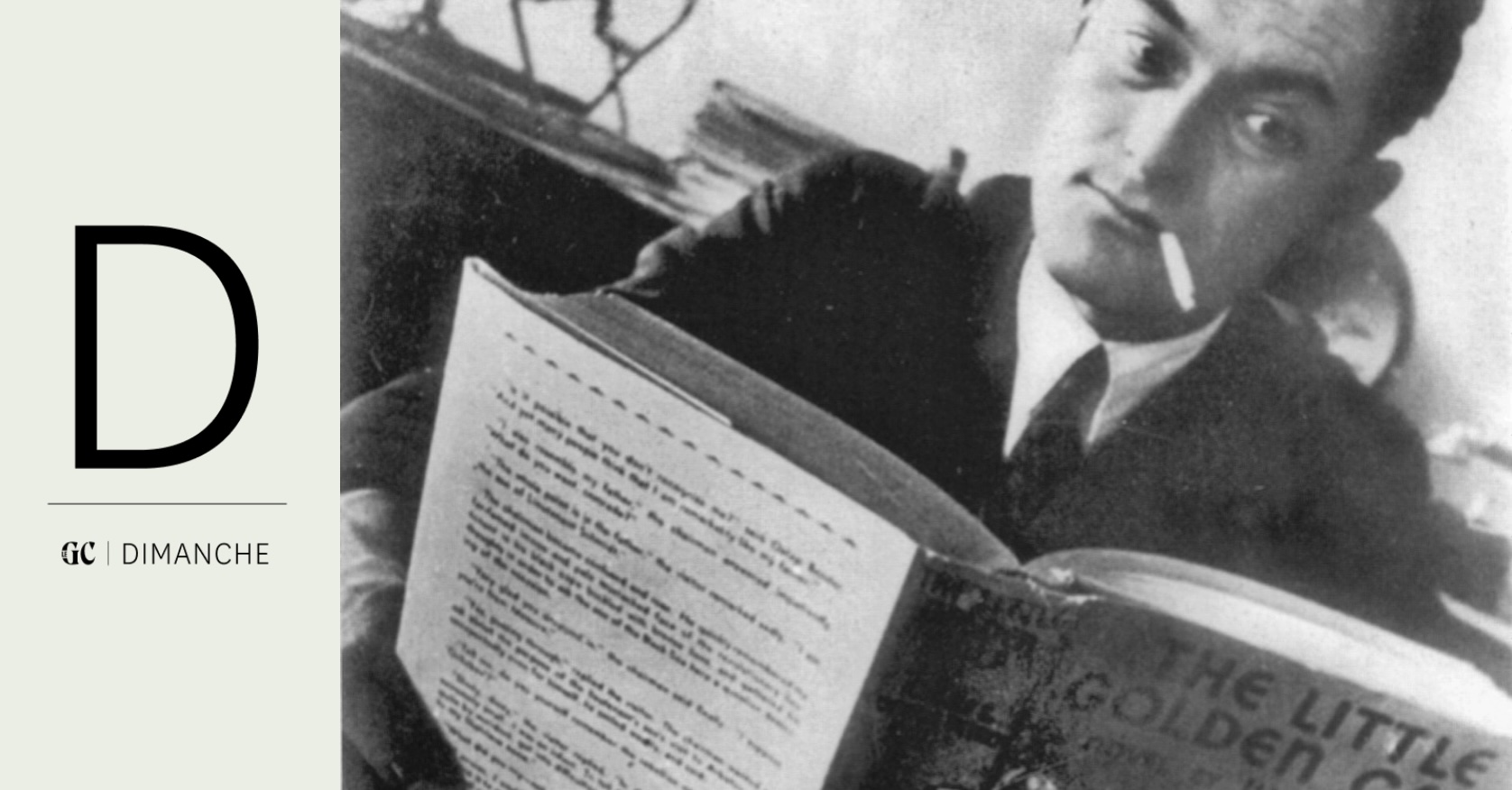
The Golden Calf, by Ilia Ilf and Yevgeny Petrov, published in 1931, is the fruit of a remarkably original editorial adventure: the novel first appeared as a serialized feature in a popular magazine. Soviet censorship was outrun by the speed with which the excerpts circulated: the success was immense, to the point that containment and control became impossible. Publication in book form was therefore inevitable, and the two authors remained untouchable. Sales reached millions of copies.
Ilf and Petrov had already made a name for themselves with their previous novel, published in 1928, The Twelve Chairs, which recounted the picaresque adventures of Ostap Bender, an irresistibly sly trickster whose sharp wit and brash confidence mirrored the satirical pen of its authors. The work rested on very short chapters and a notably loose narrative structure, in the service of adventure and freedom, which propelled the hero to the four corners of the USSR. Ostap Bender has since become one of the most popular fictional figures in Russia: a worthy representative of the people, whose misdeeds ultimately contribute to mending injustices. In The Twelve Chairs, Ilf and Petrov’s style embodies the journalism they were then, specialized in sarcastic portraits and incisive reportage, which mocked the flaws of the pre‑communist world and the old aristocracy in a state of decay.
The Golden Calf, by contrast, was written at a moment when Stalinist power was strengthening, notably with the suppression of the NEP, the new economic policy introduced by Lenin in the 1920s. The return to stronger economic and political control is brutal. Ostap Bender remains the novel’s central figure: he embodies more than ever the Odessa gangster who thrives on small and large scams in a city granted a unique status in the USSR of the time. Odessa is a very young city, founded in the same year as the École normale supérieure, in 1794, by Catherine II, who gave it its name. It is the city of commerce par excellence, where people from all over the world mingle and where enforcing the law is more difficult than elsewhere. Ostap Bender is, in fact, reminiscent of the character Benya Krik, a distinguished gangster, in Isaac Babel’s Odessa Stories.
What distinguishes Ilf and Petrov from Babel, however, is their distance from the Soviet world, which they examine and probe in a much more frank way. The two writers did not take to socialist realism. They avoided signing petitions or supporting any form of Russian literature Jiánovisation, which would come later. Ilf and Petrov preferred to bet on humor. They give Ostap Bender a nickname: the Grand Combinateur, that is, the man who knows how to exploit the naïveté and the stupidity of his contemporaries and who can extricate himself from every tight spot thanks to his showmanship. From Swift to Dickens, via Jerome K. Jerome, they situate themselves in a satirical literary tradition. Gogol’s influence is also evident, with a character who constantly uses masks to extort great wealth from others. The humour and the picaresque lightness, they borrow to a large extent from Mark Twain.
In The Golden Calf, Ostap Bender’s quarry is none other than a wealthy Odessan who tries to mask his fortune by feigning the austerity and orderly life of a modest Soviet functionary. This double identity is meant to help him dodge the regime’s political police. Ostap will do everything to steal his million, determined to fulfil his dream: to vanish and head for Brazil, its beaches, its sun, its coconuts, its white suits…
The Golden Calf thus contains a critique of the new Soviet administration that came into being after the end of the NEP, but without moralizing: the story unfolds in an Odessa that also embodies a certain languor and a certain art of making do, in opposition to any productive-doctrine.
For a long time there was a street named Ilf and Petrov in Odessa, in the Kyivskyi district. It was renamed Glodan, in homage to this Ukrainian family who perished in a Russian bombardment in 2022. The husband, the sole survivor, later joined the Ukrainian army and took part in the counter-offensive at Bakhmout, before dying on the front. This initiative responds to the new requirements of the Ukrainian government regarding “national sovereignty”: streets are renamed and become objects of “derussification.” Thus Moscow’s Pushkin Boulevard was given back a name it had previously borne, Boulevard des Italiens, even though the great writer is inextricably linked with Odessa’s history: he spent several years in exile there and dedicated whole passages of his Eugene Onegin to the city.
But these renamings perhaps reflect the image of this city as a crucible, a receptacle of many cultural inheritances, linguistic tendencies and fantasies. Does Balzac’s PèreGoriot not, at the end of his novel, say that he dreams of going to Odessa to reconnect with fortune and to allow his daughters to continue living in luxury? Not long after its founding, the city drew to it many émigrés, adventurers, merchants, pirates, but also victims of persecution. If, over the years following Odessa’s founding, people dream of going there—as if the city held all the promises of paradise—it is also idealized as the city of origins. The list of those who claim Odessa ancestry is endless: from Serge Gainsbourg to Bob Dylan, including Sylvester Stallone and Leonardo DiCaprio… Odessa was, in fact, a bit like Los Angeles or Hollywood, the Mecca of Soviet cinema for many years. Initially for outdoor shoots, made easier by the Odessa sun, and later for shoots in its famous studios. Odessa, or the mythical city from which everything comes and where everything is possible.
It is thanks to translator Alain Préchac that Ilf and Petrov were rediscovered in France, starting in the 1990s, and for whom he also wrote a doctoral thesis. It is to him that we owe the translation of the following extracts.
The Golden Calf
FIRST EXTRACT
“And with a smile that had become useless on his face, the Grand Combinateur burst out running. He hurriedly turned a corner, only to remember that atop his head sat an official Kiev militia cap, utterly incongruous in Chernomorsk. He did not come to his senses and begin weighing pros and cons until he found himself in the middle of a group of respectable elderly gentlemen chattering in front of the terrace of canteen No. 68.”
“While he paced back and forth in front of the canteen, absorbed in his reflections, the old men went on with their daily concerns.”
“These were strange and even ridiculous men for our time. Almost all wore white pique vests and straw boats. Some even sported tarnished panamas. And all, of course, wore stiff, yellowed collars from which protruded their shaggy chicken-necked throats. It was at this place, in front of canteen No. 68, where once stood the famous Floride café, that the wreckage of pre-revolutionary commercial Chernomorsk gathered: uneducated brokers, moneyless intermediaries, former grain brokers, gaga accountants, and other petty folk. They had once gathered there to do business. What drew them now to this sunny corner was this ingrained habit, as well as the need to ply their tongues. They read Moscow’s Pravda every day, with scorn for the local press, and saw everything happening in the world as a prelude to restoring Chernomorsk to the status of a free port. At one time, several centuries earlier, Chernomorsk had indeed been a “free port,” and that era had been so joyful and profitable that it cast a golden reflection on this sunny corner of “Floride.”
“Have you seen the disarmament conference?” asked a pique-colored vest to another pique-colored vest. “The intervention of Count Bernstorff?”
“That Bernstorff is a big brain!” replied the questioned vest, speaking as one who had spent many years in the count’s company. “And have you read Snowden’s speech at his Birmingham campaign rally, that British conservative stronghold?”
“Did you read it! Snowden is a big brain! Listen, Valiadis, what do you say about Snowden?”
“I’ll tell you frankly,” answered the panama-wearing elder, “Snowden is better left alone. I—personally—wouldn’t try to handle him.”
And without the least agitation at the thought that Snowden might have allowed Valiadis to explore the inside of his mouth, the old man continued:
“You can say what you like, but Chamberlain is also a big head.”
The pique-colored vests shrugged their shoulders. They did not deny that Chamberlain was a big brain. But Aristide Briand, more than anyone else, comforted them.
“Briand!” they exclaimed with passion. “There goes a big head! With his plan for a European federation…
“I’ll frankly tell you, monsieur Fount,” whispered Valiadis, “that everything is going very well. Beneš has already accepted the United States of Europe.”
“But do you know under what condition?”
The pique vests drew closer and craned their necks.
“On the condition that Chernomorsk be declared a free port. That’s a big brain, this Beneš. They’ll need buyers for their agricultural machinery, eh? Well, we’ll be the ones to buy them.”
This declaration brightened the old men’s eyes. They had long desired to buy and sell.
“Briand is a big brain!” they sighed. “And Beneš, too, is a big brain.”
Ostap was just coming out of his reverie when he realized he had been grabbed from the back by an unknown old man in a crushed straw hat with a greasy black braid. His already knotted necktie slid to one side; a cufflink flashed copper on Ostap’s face.
“And I’m telling you,” cried the old man next to the Grand Combinateur, “that MacDonald will not bite at this hook! He will not bite! Do you hear me?”
Ostap brushed the excited old man off his shoulder and carved his way through the crowd.
“Hoover is a big brain!” he heard behind him. “And Hindenburg is a big brain too.”
Ostap had made up his mind. He had exhausted four hundred legitimate ways to seize someone else’s money, and although they still wore pearls such as forming a joint-stock company to salvage a ship loaded with gold wrecked during the Crimean War, or a Mardi Gras carnival to benefit capital prisoners, or a concession for removing old shop signs, none of them fit the moment. Ostap invented a new, four-hundred-and-first method.
“I didn’t manage to storm the fortress,” he thought. “I must take it by a proper siege. The most important thing has been arranged: our client has the money. And considering he made the sacrifice of ten thousand roubles without flinching, he possesses a huge sum. Therefore we declare, because the parties disagreed during the session, that the meeting continues.”
Ostap returned home after purchasing one of those yellow shirts trimmed with laces that are used to hold folders.
“Well?” Balaganov and Panikovski asked in chorus, their voices drained by desire.
Without replying, Ostap approached the bamboo desk, laid the shirt in front of him, and inscribed in large letters:
AFFAIRE ALEXANDER IVANOVITCH KOREÏKO
COMMENCED JUNE 25, 1930
FINISHED …
The Blue‑Eyed Brothers peered over his shoulder.
“What’s inside?” Panikovski asked curiously.
“Inside? Inside, there’s everything: palm trees, young women, blue express trains, the Black Sea and a white steamer, a Japanese servant, a peculiar billiard table, platinum teeth, a barely worn tuxedo, full-length stockings, meals with fresh butter, and above all, my friends, the glory and power that money brings.”
And, to the astounded Antelopes, he opened the shirt, still empty.”
SECOND EXTRACT
“Once there was a poor private merchant. He was fairly rich, owner of a haberdashery located, somewhat askew, opposite the cinema “The Capitol.” He traded in lingerie, lace trimmings, ties, buttons and other modest but solid goods. One evening he came home with a worn look. Without saying a word, he opened the sideboard, took out a cold chicken and, pacing the room, ate it entirely. Then he opened the sideboard again, took out a whole round of Krakov sausage, sat down on a chair, and, with his eyes fixed blankly, slowly gnawed the sausage. When he reached for the hard-boiled eggs on the table, his wife began to grow anxious:”
“What happened, Boria?” she asked him.
“A misfortune!” he replied, shoving a hard-boiled egg into his mouth. “They’re squeezing me with terrible taxes. You cannot imagine.”
“And why are you eating so much?”
“I need to keep myself amused,” the merchant answered. “I’m afraid.”
And all night long the merchant walked, moving between his eight scavengers, eating everything in the house. He was afraid.
The next day, he yielded half the store to a papetier. One could now see in one of the two display windows ties and suspenders; in the other, a huge yellow pencil suspended by two strings.
Even more dramatic days followed. A third co-owner appeared, a watchmaker who pushed the yellow pencil into a corner and occupied a half‑display with a bronze statue of Psyché, but without a minute hand. Opposite the poor haberdasher, who kept grinning ironies, there now stood besides the odious man with the pencil the watchmaker with a black loupe embedded in his eye.
Two more times misfortune and hardship visited the haberdasher.
He watched as a plumber entered his shop, lit a kind of welding stove, and then a truly original merchant who had decided that in the year 1930 of our era the population of Chernomorsk would rush to his goods: starched collars. And the haberdasher’s once proud and tranquil sign took on a repellent look:
GALANTPROM
Trading in haberdashery
B. Kulturträger
WATCHMAKING
Repairs of watches and clock-work of the old P. Bourré brand
Glazius-Schenker
STATIONERY SHOP
Everything for the painter and the Soviet employee
Liev Sokolouski
PLUMBING
Repairs of pipes, sinks and sanitation
M.N. Fanatiouk
SPECIALTY
Starched collars of Leningrad
Karl Paviainen
Customers and clerks now entered the shop with horror, in a shop once fragrant and peaceful. Surrounded by wheels, springs and pince-nez, the master watchmaker Glazius-Schenker sat beneath a clock and a heap of clocks. Alarm clocks began to scream with shrill sounds. A group of college students in the back tried to determine when notebooks would be for sale. Karl Paviainen, while wasting time in waiting, cut his collars with scissors. And the amiable Kulturträger could hardly offer his services to a customer before the plumber Fanatiouk gave a great hammer blow to a rusty pipe and spread the soot of his welding lamp over his delicate haberdashery goods.
That strange association of diverse trades eventually disintegrated: Karl Paviainen fainted in the night with his old-fashioned goods, followed by Galantprom and Bureaupapier pursued by riders. Fanatiouk fell into alcoholism. Glazius-Schenker was hired by the collectivized watchmaking “Les Temps Modernes.” The corrugated iron gate crashed down with a thud. Even the picturesque storefront vanished.
Yet soon, however, the curtain rose again. The former beacon of private trade now bore a neat little placard:
ARBATOVIAN COMPANY
FOR SUPPLYING HORNS AND SHOES
(Chernomorsk Branch)
THIRD EXTRACT
“At that very moment someone shook the door handle. Outside, a venerable man in a broad velvet jacket, a white pique vest, and a patched Panama stamp stood stamping his feet.”
“Closed, closed!” Ostap cried in a rush. “The stocking operations for the clogs are temporarily suspended.”
The old man continued to signal anyway.
If Ostap had not opened the door to the man in the white vest, the main line of our tale might have diverged, and we would not have witnessed the astonishing events that followed for the Grand Combinateur, his irritable courier, the carefree delegate for the clogs, and a great many other characters including a sage from the East, the granddaughter of the riddle-maker, a famous public figure, the director of “Hercules,” and a great many other Soviet and foreign citizens.
But Ostap opened the door. The old man stepped behind the railing with a sad smile and sat down. He closed his eyes and remained seated in silence for about five minutes.
One could hear only the brief whistling from his pale nose from time to time. When the corpus of horn-and-boot specialists had convinced themselves that their visitor would not speak and began to confer discreetly on the most convenient way to carry the body of the old man into the street, he opened his heavy eyelids, and spoke in a low voice:
“My name is Fount. Fount. I am ninety years old.”
“And is that, in your view, enough to burst into closed offices at lunchtime?” Ostap asked cheerfully.
“It amuses you, perhaps, but my name is Fount. I am ninety years old.”
“What do you want?”
The Mr. Fount fell silent for a long moment.
“You have an office,” he finally said.
“Yes, yes, a desk—go ahead,” Ostap urged to coax him to continue. But the old man simply ran his hand along his knee.
“Do you see the pants I’m wearing now?” he spoke after a long pause. “Those are my Easter pants. Once I wore them only on Easter, but now I have to wear them every day.”
And despite Panikovski giving him a shove to allow the words to flow, Fount fell silent again. When he spoke, he uttered the words quickly, but he paused between sentences for as long as three minutes. For those not used to Fount’s peculiar speaking rhythm, talking with him was unbearable. Ostap already prepared to grab Fount by the starch‑fed collar and guide him to the exit when the old man reopened his mouth. The rest of the conversation took on such an interesting character that Ostap had to yield to the fount-like manner.
“Do you have a president?” Fount asked again, “an official head for your company?”
“What sort of president?” Ostap exclaimed.
“An official one. A boss for your company.”
“I am the boss.”
“Then you will go to prison yourself? You could have said so at once, instead of making a fool of yourself for two hours!”
The old man in Easter pants really looked angry, but his pauses between sentences did not shorten at all.
“My name is Fount,” the old man continued with emotion. “I have spent my whole life in prison for others. That is my profession, to suffer for others.”
“Ah, so you are a figurehead?”
“That’s right,” the old man replied, nodding with dignity. “I am Fount, the prisoner president. I have always been in prison. I was in prison under Alexander II the Liberator, under Alexander III the Pacific, under Nicholas II the Bloody, and under Alexander Fyodorovich Kerensky.”
And the old man began slowly bending his fingers, enumerating the tsars.
“Under Kerensky I also was in prison. Under the war socialism, indeed, I was not in prison. Dignified commerce had disappeared, it was impossible to work. But how much prison I endured during the NEP! How much I endured! That was the most beautiful period of my life. In four years I did not enjoy more than three months of freedom.
“I married Golconda Evsieivna, my granddaughter, and gave her a concert piano, a silver bird, and eighty roubles in ten‑rouble gold coins. And now, as I walk through the streets, I no longer recognize our Chernomorsk. Where has all that gone? Where is private capital? Where is the first mutual credit society? Where is the second mutual credit society? Where are the partnership firms? The joint-stock companies with mixed capital? Where has all that gone, I ask you, that it should be so shocking?”
This brief speech did not last more than half an hour. Panikovski was moved listening to Fount. Taking his colleague Balaganov aside, he whispered with respect:
“It’s obvious he is a man from the old times. There are almost none left now, and soon they will have completely disappeared.”
And he kindly offered the old man a cup of sweet tea.
Ostap moved the President‑Prison to his own office, ordered the door shut, and began to listen patiently to the eternal prisoner, who had “lived his life for his friends.” The President‑Prison spoke with notable vigor. If he paused between phrases as little as he did, one might have said it was a true mill of words.
“Do you know a certain Koreïko, Alexander Ivanovich?” Ostap asked, his nose hidden in the lace collar of his boot shirt.
“Never heard of him,” replied the old man. “I know no one by that name.”
“And the Hercules firm, you’ve dealt with them?”
At the name “Hercule,” the President‑Prison shivered imperceptibly. Ostap did not notice this slight movement, but if one of the pique‑vests from the Floride—someone who has known Fount for a long time, such as Valiadis—had been there, he would have thought: “Fount is in a fever. He is simply out of his mind.”
Who, if not Fount, could know “Hercule,” when his last four stays behind bars were directly tied to that institution! Several private joint-stock firms thrived on “Hercule,” in its immediate orbit. There was, for instance, “The Intensifier.” People had asked Fount to be its president. The company “The Intensifier” had received a substantial advance from “Hercule” for timber provisions. The president‑prison did not know which goods, that did not fall within his duties. And it had immediately gone bankrupt. Someone had lined their pockets, and Fount had spent six months in prison. After “The Intensifier,” there was the limited partnership “The Working Cedar,” always under Fount’s presidency. Same scenario: an advance from “Hercule” for treated cedar and, of course, a sudden bankruptcy, someone getting rich, and Fount earning his honest salary behind bars. Then “The Friend of the Saw.” An advance from “Hercule,” bankruptcy, pockets full, a sentence. And a fourth time: an advance from “Hercule” to the “Southern Bush‑Whacker,” Fount in prison and for someone a neat little fortune.
“But for whom, then?” Ostap kept asking as he walked around the old man. “Who is really running all this?”
Fount contented himself with sipping his tea and slowly raising his lids.
“Who knows?” he said with bitterness. “Everything was kept from Fount. All I had to do was go to prison, that is my profession.”
“I’ve done prison under the Tsars, under socialist rule, under the ataman, and under the French occupation. Briand is a big brain.”
There was nothing more to squeeze from the old man. But what he had revealed allowed Ostap to begin a search.
“One can feel Koreïko’s signature here,” Ostap thought.
The head office of the Chernomorsk branch of the “Arbatovian Society for Cornes and Hoofs Supply” sat down to transcribe the President‑Prison’s discourse, omitting the isolated remarks about Valiadis and Aristide Briand’s mutual relations.
The first page of the secret inquiry into the millionaire’s clandestine activity was carefully numbered, pinned in place where appropriate and stitched into the file.
“So, you take me as president?” the old man asked, adjusting his patched Panama. “I see your office needs a president. I won’t go easy: one hundred twenty roubles a month in freedom, two hundred forty in prison. One hundred percent bonus for the squalor of work.”
“Very well then,” Ostap replied. “Go see the delegate for clogs and file a request.”
FOURTH EXTRACT
“Comrade Skoumbriévitch appeared on the beach with, under his arm, a large portfolio bearing his name. A silver card imitating a business card with a curled corner was attached to the portfolio and announced, in stretched italics, that Yegor Skoumbriévitch had already celebrated five years of presence at “Hercule.” His face was as neat, regular and virile as an Englishman shaving in front of a poster. Skoumbriévitch paused in front of the chalked temperature panel, then, with difficulty, he peeled his feet from the hot sand and looked for a favorable spot.”
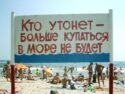
The beach’s section reserved for bathers was crowded. His frail structures appeared in the morning and disappeared at sunset, leaving on the sand the traces of urban life: dried melon rinds, eggshells, and torn scraps of newspapers, which then led a mysterious private life through the night, whispering something we can’t quite hear, and skirting the rocks at the water’s edge.
Skoumbriévitch insinuated himself among the improvised tents using bath towels, parasols, and sheets stretched over stakes, beneath which young women in bathing skirts hid. The men, too, wore swimsuits, though not all of them.
Some wore only grape leaves, and even those did not hide the biblical place, but the noses of the gentlemen from Chernomorsk who sought to keep their private parts from showing. After this, the men laid themselves down with a perfect sense of ease. From time to time, a hand covered the private parts, they would go toward the sea, dip briefly, and hurry back to the spot their bodies had carved in the sand, so as not to lose a single cubic centimeter of the beneficial sunbath.
The inadequacy of their attire was compensated, and beyond, by a gentleman of an entirely different sort, wearing boxing‑boots with buttons, striped trousers, a tightly buttoned jacket, a detachable collar, a tie, a watch chain, and even a felt hat.
Thick mustaches and cotton pads in both ears completed the outward appearance of this man. A glass‑knobbed cane stood planted upright in the sand beside him. The heat pressed upon him. His collar swelled with sweat. His armpits burned so fiercely that one could melt ore, as in a smelting furnace. And yet he remained lying there, motionless.
On all the beaches of the world, one can meet a character like this. Who he is, why he came there, why he lies there in a grand uniform—these are questions without answers. But these characters exist. There is one on every beach. They could be members of a mysterious league of fools, or survivors of the once‑mighty Rosicrucian order, or perhaps a handful of a few eccentric singles—nobody knows…
Yegor Skoumbriévitch settled beside the representative of the league of fools and quickly undressed. Skoumbriévitch naked bore little resemblance to Skoumbriévitch dressed. His somewhat bony head, giving him the look of an Englishman, rested on a pale, emaciated body with drooping shoulders and a wide pelvis. Yegor moved toward the water, tested it with his foot, and cried out sharply. Then he plunged the other foot in and cried out again. He took a few steps forward, blocked his ears with his thumbs, closed his eyes with the inner joints of his fingers, pinched his nose with the middle finger, and uttered a scream that split the air, then plunged himself four times in the water. Only after that did he begin to swim, pushing his hands forward and turning his head with each stroke. The shallow wave welcomed him as a model of a Herculean employee and a peerless social activist. Five minutes later, while the model employee floated on his back to rest, his round belly bobbing like a globe on the surface of the water, from the cliff above the Antelope’s call could be heard the Antelope matchiche.”
Ostap Bender, Balaganov, and the accountant Berlaga, their faces reflecting a complete submission to their fate, stepped from the car. All three descended toward the beach and, openly staring at the bathers, began to search for someone.
“There is his pants,” Berlaga finally said, stopping in front of Skoumbriévitch’s belongings, still ignorant of everything. “He must have gone out to sea.”
“That’s enough!” cried the Grand Combinateur. “I am not going to wait any longer. Operations will take place on land and at sea.”
Ostap shed his suit, his shirt, and, in his swim trunks, entered the water with grand gestures.
The Grand Combinateur’s chest bore a bluish tattoo representing Napoleon in a bicorne, with a beer mug at the end of a too-short arm.
“Balaganov!” Ostap shouted. “Undress and prepare Berlaga! We may need him.”
And the Grand Combinateur, cutting through the water with his bronze shoulder, swam on his side toward the N.N.-E., where the nacreous belly of Yegor Skoumbriévitch emerged.