
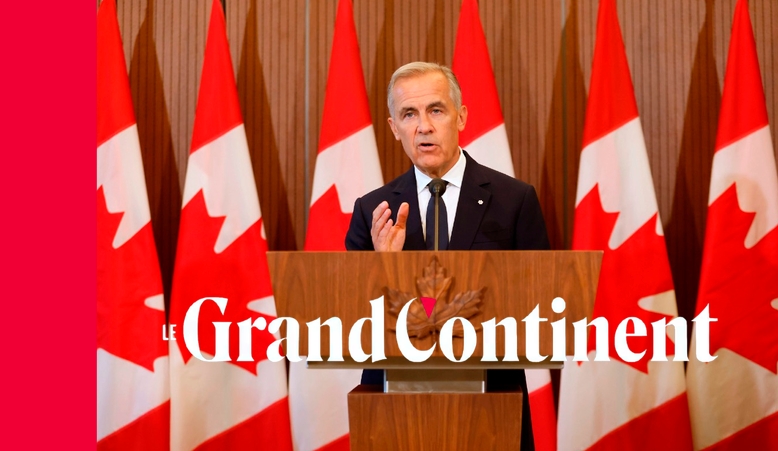
The Prime Minister of Canada, Mark Carney, delivered this speech on Saturday, August 22, 2026 at 11:00 a.m., at a press conference in Ottawa, convened just hours after the Canadian negotiators returned from Washington in the night and a few hours after the United States’ 50% tariff went into effect.
The United States had declared that the negotiations had failed due to Canada’s last‑minute demands. In this speech, Carney traces the history of the talks and dismantles the American argument.
The American demands were not consistent with the relationship between two independent states, yet they pursued one of Donald Trump’s stated objectives: to make Canada the 51st state. They included the American right to supervise the agreements Canada signs with third countries, the complete dismantling of the dairy supply management system enshrined in Canadian law, changes to Quebec’s language regulations, the opening of public markets, the automatic alignment of Canadian tariffs with Washington’s trade policy, and even American control over the exploitation of critical minerals and the targets for defense spending.
The cumulative impact of this list, as disclosed by the Canadian prime minister, is formidable. When examined side by side, these demands outline less the contours of a free-trade agreement and more the features of a guardianship regime touching nearly every realm of Canadian sovereignty: the economy, culture, language, resources, and defense.
That is precisely the point on which Carney chose to react.
Rather than scrutinizing these demands one by one, he redefines them as an affront to sovereignty and turns the announcement of a rupture in trade relations into a call for unity of unprecedented scale for a Canadian prime minister.
First, in the vocabulary Carney uses, which echoes the expression “masters in our own house” from Quebec’s Quiet Revolution (“In Canada, we are masters in our own house, from sea to sea”), and elevates the defense of the French language to the status of a vital interest of the Federation.
Next, in his audience, since he speaks simultaneously to the provinces, to businesses, to consumers invited to “choose Canada,” and even to the Americans, described as collateral victims of a war they “didn’t want,” as well as to Europeans with whom the prime minister calls for building a new agreement.
Finally, presenting without mincing his diagnosis that American tariffs aim to “sow discord” and that unity is therefore the nation’s first line of defense, Mark Carney places himself at the vanguard of a Western front of resistance to the Trump‑era attempt at vassalage.
In his initial reaction to this speech, Donald Trump responded by stating that Canada would seek to “benefit from the advantages of being a state without being one.”
I want to inform Canadians of the latest developments in our trade negotiations with the United States, to explain why we reject a bad deal, and to discuss what happens next.
For a long part of our history, Canadians could count on favorable winds in trade: a stable relationship with the United States, increasingly open access to the American market, and rules that both countries understood and respected.
These winds did not merely change direction: the climate has changed as well.
We cannot control the storm blowing in from Washington.
We can chart a new path by strengthening our domestic capacity and diversifying our trade relationships abroad.
We are masters in our own house and the premier partner abroad.
For more than a year, Canada has worked relentlessly and in good faith with the United States to negotiate a new trade agreement.
We have been pragmatic, patient, and persistent. We have explored every possibility of reaching an agreement that would protect Canadian workers and their families, strengthen our two economies, and respect Canadian sovereignty.
We did not entertain any illusions.
We understood from the outset that the United States had changed.
At the start of last year, I observed that the process of growing integration between our economies, which had been underway for decades, had been interrupted.
Our government knew before many others that the United States would transform the entire landscape of its trade relationships. That they would levy a series of tariffs on their closest allies and that they would weaponize economic integration. That their signature was no longer a guarantee.
It is in this context that we have worked to try to conclude a fair deal that Canadian businesses and workers can rely on.
Our objective has always been to achieve the best possible agreement for Canadians. It has never been a case of signing a deal at any price or within a fixed deadline.
Last month, when the United States announced a new round of unjustified tariffs, I entrusted our negotiating team with the mandate to seek, in good faith, an equitable agreement.
I am convinced that people on the ground on both sides of the border want this relationship to work. The ties between Canadians and Americans remain strong. A mutually beneficial agreement is possible. An agreement that respects our sovereignty. That leverages our complementary strengths. That reduces costs for families on both sides of the border. That creates jobs for our workers.
The goal has never been to compromise Canada’s sovereignty or to harm our key sectors.
We were not prepared to compromise on our sovereignty, the protection of the French language, and our culture.
To our American colleagues, let us be clear: for my government and for Canada, these issues were never on the agenda, even though the United States tried until the last minute to include them.
In recent weeks, we have made notable progress toward concluding a potential agreement that would strengthen Canada’s position as the country with the best deal in the world with the United States, notably by securing the best terms in each of the most important strategic sectors for Canada and by bringing greater certainty to our future trade relations.
While earlier this week we thought we were nearing a mutually beneficial agreement, in the last few days the United States proposed new, unprofitable and inequitable conditions that reduced Canada’s net benefits, calling into question the reliability of any potential deal.
In short, the United States asked for too much and offered too little.
As a result, last night I suspended the trade negotiations with the United States and asked Canadian negotiators to return to Ottawa. They worked tirelessly, in good faith, up to the last minute to defend Canadians’ interests.
Canada will apply tariffs that are equivalent, dollar-for-dollar, to those imposed by Washington to protect Canadian workers, farmers, families, and businesses.
These measures will primarily target sectors such as steel, dairy products, appliances, agricultural equipment, pulp and paper, as well as electronics. They will also apply to products currently subject to unjust tariffs under sections 232 and 338. This is a targeted response aimed at protecting and defending our industries, and enabling them to compete with American products on the Canadian market.
In the coming days, we will publish the details of these new tariff measures, which will take effect on the Tuesday after Labour Day.
It is with reluctance that we take this step. Reluctant, because we know it will raise costs and reduce choices for Canadians. Reluctant, because we understand that some Canadian businesses and some American states are collateral victims of a dispute they did not want. Reluctant, because this trade dispute prevents Canada and the United States from achieving all the good they could accomplish together.
Nevertheless, we take this decision with the confidence that it best serves Canada’s interests. And that by rejecting a bad deal, by defending Canada’s interests, and by focusing on what we can control, we will build a stronger Canada for all.
Strengthening our domestic footing and diversifying our foreign trade relationships is not Plan B.
It has been Plan A from the start.
Canada will stay the course and continue to build a strong Canada because it is the right thing to do and because it yields results.
We are making rapid progress in building large-scale infrastructure.
We have put forward 27 national-interest initiatives to the Major Projects Office — from ports, mines, and energy corridors to every corner of the country — representing $500 billion in new private-sector investment. These projects will help Canada build more, act faster, export more, and engage in more trade with the rest of the world.
Through Homes Canada, we are accelerating the construction of affordable housing. In just a few months, this new agency has committed to building nearly 17,000 housing units in 17 partnerships.
We are building the local infrastructure that Canadians rely on daily through the new Strong Communities Fund, representing a $51 billion investment. More than 100 projects have already been announced nationwide, including new hospitals, new community centers, and new public transit lines, under agreements with Yukon, the Northwest Territories, Nunavut, Ontario, and Quebec.
We will also double the capacity of our electricity grid by 2050 so that Canadians have access to affordable and sustainable energy for generations to come. Because mastering our energy is mastering our destiny.
Last Monday, in St. John’s, the governments of Canada, Quebec, and Newfoundland and Labrador launched the North American continent’s largest clean-energy project in history. A second James Bay project.
It will generate enough clean electricity to power all of Canada’s vehicles.
We are building our economy while safeguarding our security, investing $500 billion in our defense, expanding shipyards, growing our aerospace industry, and increasing our cyber capabilities.
We are fully tapping Canada’s potential as an energy superpower, whether in nuclear, LNG, renewable energy, or low-emission oil and gas.
These initiatives represent the future of our country.
Canada is now the world’s most connected economy.
Over the past year, we have signed more than 20 trade and security agreements across five continents. We concluded our latest deal, with the United Arab Emirates, in a record 47 days.
Canadian businesses now enjoy tariff-free access to 1.5 billion consumers.
In the next six months, we will double this figure with new trade deals, including with the ASEAN countries and India.
This autumn, we will begin discussions with the European Union, the world’s second-largest economy, to deepen and strengthen our security and economic partnership.
Canada is building unprecedented market access because we are trusted, because we are reliable, and because we have what the world seeks.
That is why the whole world is knocking on our door.
In three weeks, we will host the first Canadian Investment Summit in Toronto.
This Summit will attract the world’s largest investors, who collectively manage more than $100 trillion in assets.
They will discover an economy in Canada that has never been more connected and more ambitious.
We are cutting taxes, removing barriers, and accelerating the transformation of our economy.
We have lowered the tax rate on new business investments to just 13%, four and a half percentage points lower than the United States and roughly half the G7 average.
We are speeding up approvals and making them more predictable, while investing alongside the private sector.
We are building a unified Canadian economy. Over the past year, we have removed all federal obstacles to interprovincial trade. We have relaxed conditions so that Canadians can use their skills across the country. We are also working with provinces and territories to remove barriers that have divided our economy for generations.
We are taking steps so that Canadians can buy Canadian, hire Canadian workers, and build with Canadian-made materials more easily.
This fall, as part of Budget 2026, we will continue our efforts to make Canada one of the most competitive and attractive destinations in the world for businesses and strategic sectors that want to invest, grow, and prosper.
The new tariffs imposed by the United States aim to harm our economy and sow division among us.
That is a misjudgment, because Canadians will always look out for one another.
We know we are stronger together.
Over the past year and a half, the Canadian people have faced this situation with resolve, with willingness, and with strength.
We vacation in our national parks. We buy Canadian products. We choose Canada.
Small acts of solidarity that, repeated millions of times, send a clear message: we are masters of our destiny.
The government is following this line by investing $25 billion to protect Canadian workers and businesses impacted by the American tariffs.
We are helping our small and medium-sized enterprises to cope with the situation by investing in equipment, productivity, and supply-chain resilience.
We are providing funding to enable large employers to continue their operations and keep their workers employed.
We are helping our hardest-hit sectors to reorganize and turn to international markets.
We are our own best customer.
We have the right plan to strengthen Canada. We are on the right track and it is bearing fruit.
We recognize that some of the most significant impacts will take time to fully materialize. That is why we are also seeking to give Canadians a boost today and a bridge to a better future.
We have reduced income taxes as well as housing and fuel taxes.
We have established the Canada Grocery and Essentials Benefit. This assistance, which can reach up to $1,890 per family, aims to help 12 million people across the country to get by more effectively.
Today we are stronger than at the start of this trade war. We are more united, more determined, and more ambitious.
With the strongest fiscal position among the G7 and a resilient economy, Canada has all the resources it needs to reorient and prosper.
Our growth is accelerating, and we should post the second-highest growth rate in the G7 this year and next.
We are creating jobs at a pace four times faster than the United States.
Our exports outside the United States have risen sharply and are expected to double over the next decade.
Foreign direct investment in Canada has reached its highest level in two decades. They are twice those of our nearest G7 competitor.
Canada is now regarded as the most attractive country in the world for infrastructure investments.
In the spring, I noted that the United States was trying to break us so that it could dominate us.
And I promised you that would never happen, never, ever.
We are keeping that commitment.
Canada is becoming stronger and less dependent on the United States.
We are already offering more than they can take away from us.
And this is only the beginning.
Canadians do not give in to adversity: they use it as a stepping stone to thrive.
We are not afraid of headwinds.
We do not let the waves carry us away, we do not let events destabilize us.
We are the ones who chart our course.
We are the ones who shape our own destiny.
In Canada, we are masters in our own house, from coast to coast.
We are building a strong Canada. For everyone.