
To prepare for your return, test Grand Continent. Ideas and analyses you won’t find anywhere else. But you’ll see them everywhere soon. In your inbox from €8 per month
In The Alibi of Capital, you argue that capital is not a stock accumulated in the past, but a relation to the future, based on a particular conception of time. How is the joint-stock company, which opens your book, paradigmatic of this relation?
The joint-stock company, which has developed over the last 150 years, is one of the dominant institutions of modern political life. The book shows that it represents a mode of life that operates at the expense of the future: indeed, when a company sells shares, what it sells is a right to its future profits. A future asset or a future income stream is thus placed at the present, and at a reduced price. This point is crucial, because the value of a share always corresponds to the discounted value of the future profits, or the expected future profits, of the company. It is therefore not only a way of making future profits available, but also of making them available at a reduced price. The attraction lies in the fact that those who acquire these rights to the future acquire them cheaply and are then fully reimbursed. This resembles a debt that must be repaid. It is a way of indebting the future.
Is this way of borrowing against the future the main distinguishing feature of contemporary financial capitalism?
People often assume that these forms of selling future rights and indebting the future are characteristic of contemporary financial capitalism. Yet there exist many other financial instruments that cohabit with them: futures contracts, derivatives, etc. One of the book’s aims is, however, to show that this phenomenon is not unique to our era. It is rather an intrinsic feature of capitalism’s development. The first chapter links this to the joint-stock company and uses Uber as an example, but the work reaches much further back, to the earliest colonial companies of the seventeenth and eighteenth centuries and to the many other forms that companies and enterprises could take.
Physical infrastructures are also financial and temporal infrastructures, enabling us to project into the future. How should we understand their role within capitalism?
The joint-stock company took the form we know today with the building of railways at the end of the nineteenth century. There had been railway booms beforehand, but it was at this time that France, Continental Europe more generally, North America, and also regions and countries such as South America and Egypt, experienced a colossal expansion of railway construction. If one looks at the stock markets of the 1870s, 1890s, and up to World War I, nearly all of the traded shares were linked to railways.
The conventional explanation given for the creation of new forms of enterprises was the complexity and length of constructing these infrastructures, and the necessity of introducing governance mechanisms separating owners from managers. The argument I develop goes against this explanation. What distinguishes infrastructures from earlier activities based on manufacturing or trade is their durability. They enable projection into a distant future, promising revenues not merely in two, three, or five years, as in manufacturing or trade, but much further, due to their scale and longevity.
How could this longevity be achieved?
We can trace this evolution through technical transformations, such as the shift from iron to steel in railway construction. Instead of rails needing replacement every twelve months, they could now last five, ten, or even thirty years. This control of the future makes possible what I call the “assetisation,” i.e., the transformation of that future into assets that can be traded and sold in the present.
When we tell the history of capitalism, we tend to regard infrastructures as elements whose purpose is efficiency, the acceleration of production processes for example. However, once we recognize that the appeal of infrastructures lies in their ability to push revenues further into the future, it becomes possible to connect them not only to speed but also to delay and slowness. Revenues projected further into the future can be acquired with a larger discount in the present, and consequently, the surplus that can be extracted is greater when infrastructures take a long time to build.
What distinguishes infrastructures from earlier forms of activity based on manufacturing or commerce is their durability.
Timothy Mitchell
Thus, acquiring the future means realizing a gain by buying the future at a reduced price in the present to be fully repaid later. That repayment must also cover the cost of the initial discount. In the case of railways, when they become operational ten, fifteen, or twenty years later, they must cover not only their operating costs but also the cost of those discounted claims on their future revenues. These costs are borne, notably, by lower wages for workers and higher prices for users. The history of infrastructures is thus a history of shifting costs onto those who will come later, while allowing those in the present to benefit from acquiring future revenues at a reduced price.
Could this form of delay therefore be, in your view, at the heart of how capitalism works?
We generally equate “capital” with a fund accumulated over time and reinvested to generate growth. By definition, we assume it is something that functions to develop. In more orthodox economic analyses, capital is often equated with equipment or technology that enables growth—the industrial structure, for example. This accumulated fund is then seen as the source of future growth.
One of the aims of my book is to question this way of thinking, both regarding technology and growth. Growth is the central means to understand and explain our relation to the future within the capitalist system. If we consider capital as drawn from the future, we move away from glorifying technology as the engine of capitalism and growth; growth itself loses its centrality for explaining this economic system. We become more attentive to the ways in which the acquisition of value from the future depends on processes that are often not technological at all, and can be better understood as forms of sabotage.
Could you detail the Uber example?
Supporters of Uber claim that the company’s success arises from a major technological breakthrough, but the company did not invent the automobile, nor the GPS, nor the mobile phone, nor the microchip, nor any of the devices on which it depends. Its extraordinary valuation rested largely on its ability to undermine alternatives. It subsidized rides during its startup phase with the hope that once its competitors were eliminated, it could charge much higher fares.
This is an example of sabotage as a central mechanism. Uber also sought to undermine public transport networks such as buses and trains, which were also competitors. Its future profits depended on eliminating alternatives to its own model.
The history of infrastructures is therefore a history of cost transfer.
Timothy Mitchell
As for delay, it is here literal: one observes that the arrival of firms like Uber has increased urban congestion. Its model relied on invading city centers with cars seeking passengers. It was not technological progress; rather, the model depended on forms of delay and generated new ones.
You retrace the history of dam construction in Egypt, suggesting that older, more complex systems were better suited to the Nile’s ecosystem. Is your approach part of this recent tradition in the history of science, notably developed by David Edgerton, which makes challenging innovation the central paradigm of progress?
I reference David Edgerton repeatedly, and his book What’s the Point? is extremely important for moving away from the idea that technological progress always constitutes a real improvement.
I devote more than one chapter to the history of Egypt, where I conducted in-depth research, aiming to show how the processes described—by colonial officials as well as by modern historians—as forms of progress or development can be understood very differently if one pays particular attention, on the one hand, to what actually happened on the ground and how it produced forms of delay, and, on the other, to the inefficiencies of the new system that was introduced.
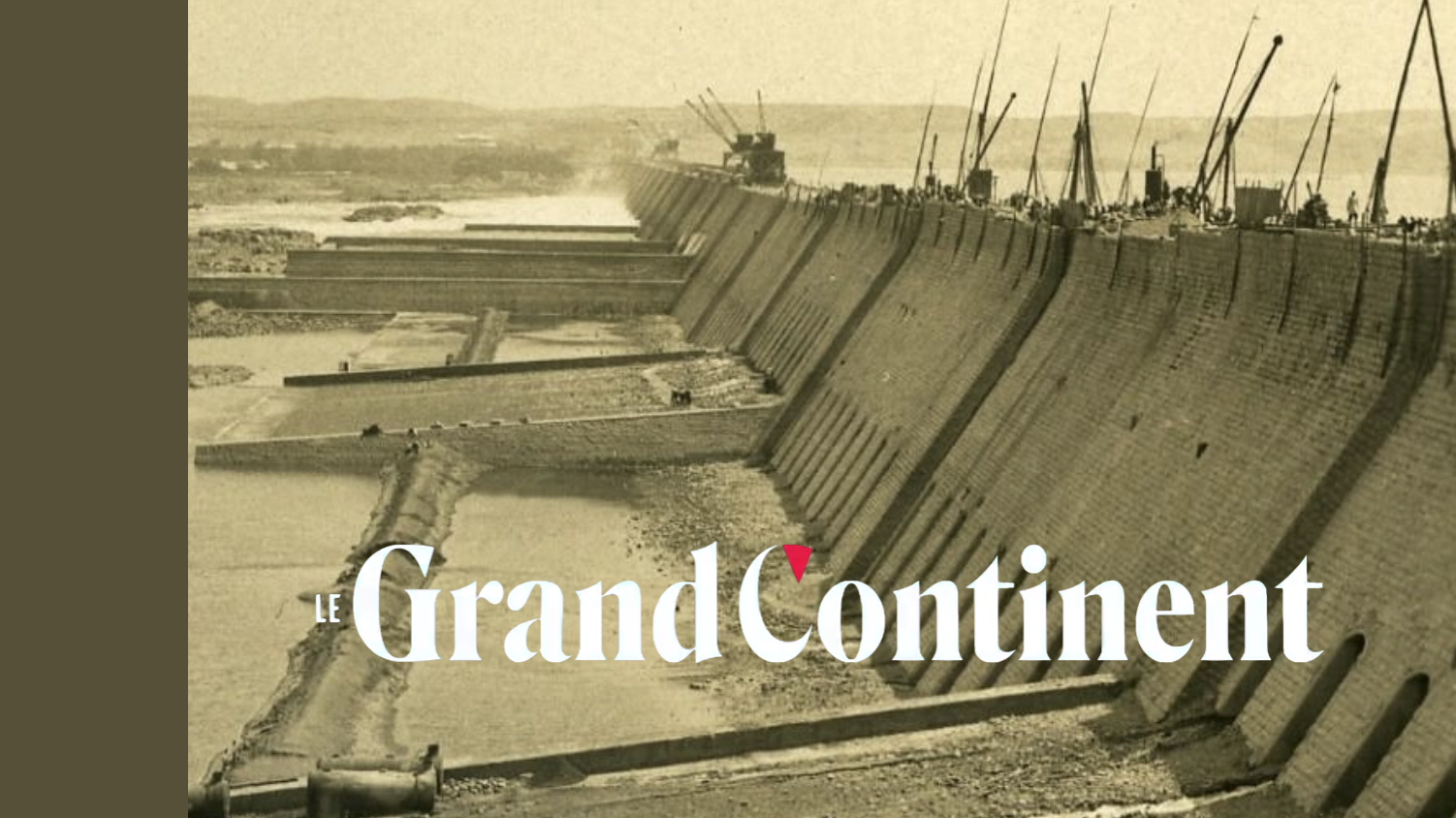
The history of irrigation works in Egypt in the nineteenth century has been the subject of extensive scholarship. It includes the construction of new canals, fed by a river whose level was raised by dams, a process that began at different times during the nineteenth century and culminated, initially, in the construction of the first Aswan Dam at the end of that century. These developments are generally presented as improvements for two reasons: firstly, they would have made the river more controllable, and secondly, they allowed a transition from a single annual harvest to three.
I try to show that these two claims are incorrect. These interventions actually created a landscape vulnerable to floods: in attempting to prevent or divert the river through canals, dams, and levees, they made the country far more vulnerable because the natural process by which floodwaters spread across the fields could no longer function.
So why were these changes made?
There was a precise reason for this transformation: agriculture shifted from a great diversity of crops to production dominated by sugar cane and cotton, which are not well suited to the river’s ecology. Moreover, their production takes time, enabling a more efficient process of capitalisation.
Examining medieval sources as well as nineteenth‑century accounts, it becomes clear that the river had always been used throughout the year. It was exploited during floods, then crops were sown as the waters receded, before cultivating other varieties through well irrigation.
These wells formed major elements of the landscape, though invisible from the surface. They often measured several meters in width and depth, resembling large subterranean chambers with a small opening. They had domed roofs, and it is through this opening that one installed a saqiya, i.e., a water wheel drawn by animals. While water wheels are often pictured as placed along the Nile, most were actually in the middle of the fields. Once the floodwaters receded, these wells were repaired and used to produce a second harvest and, if necessary, a third.
Uber did not invent the automobile, nor the GPS, nor the mobile phone, nor the computer chip, nor any of the devices it depends on.
Timothy Mitchell
This reveals a completely different ecological history of the Nile, and also highlights the damage caused by flood prevention, presented as progress. The loss is not limited to the absence of silt—the fine, fertile sediment deposit for the land—blocked by the dams, nor to the deficit in soil renewal: entire ecosystems depended on the flood. For example, fish had adapted to spawn in the flooded fields. When the waters receded, the setting of nets at drainage points allowed catching large quantities of fish, while the underground wells served as reservoirs where fish remained trapped as the water withdrew. Fish were the main source of protein for the majority of Egyptians until the twentieth century.
This narrative is not only about reviving a different ecological history, but also about explaining why these systems were replaced. This transformation was motivated by what I call the capitalization of life at the expense of the future. Some cultures could be more easily transformed and valued as assets, whereas more complex agricultural systems could not.
The narrative around rivercide recalls James C. Scott’s “high‑modernist” projects — except that, in your case, these projects are not driven by modernization but by profit, and are not necessarily carried by the state. How do you view this distinction?
There is a parallel with some cases studied by James C. Scott, particularly regarding modernizing approaches and state-led interventions. However, I do not primarily link these processes to a particular form of state, because I am interested in a broader set of actors, including large landowners and merchants. The state certainly plays a role, but these transformations are not, in my view, fundamentally driven by the state.
In his more recent work, and especially in In Praise of Floods, published just before I completed my own book, Scott addresses flood systems, revisiting his earlier work on Burma and river networks. He provides valuable insights into how these systems are disrupted by dam construction. Yet he does not relate these processes to the history of capitalization as I do. His work remains, first and foremost, an ecological history, whereas my argument places ecological transformation within a broader process of capitalization.
You take the opposite view of another story: that of an Industrial Revolution rooted in England, which then spreads to the Western world and beyond. Should we “provincialize” the Industrial Revolution?
Many narratives still focus on the Industrial Revolution born in Europe, especially in the north‑west of England.
The first point, which others have raised as well, is that once capital is understood in terms of debt and credit, its history extends over a much longer period. Building on works such as David Graeber’s, one can observe a global system linking South and East Asia, the Islamic world, and the Mediterranean, in which Europe long occupied only a relatively marginal position. By introducing this idea, one can understand the emergence of technical and industrial life through the lens of world history.
The book goes further, proposing that the Industrial Revolution was but a detour. Rather than seeking innovations that explain its emergence, I suggest it resulted from a sequence of upheavals that occurred in different parts of the world at the end of the eighteenth century.
What are these upheavals?
The first was the disruption of profits derived from the slave trade and slave‑based production, caused by revolts in slaveholding societies, notably, but not exclusively, in Haiti. These revolts disrupted both production and the flow of credit, since the people enslaved were themselves considered a future labor force capitalized.
A second upheaval occurred in India, where the East India Company, a massive joint‑stock company earning enormous profits from trade with India, underwent a radical transformation after defeating the Mughal Empire and began generating revenues by other means, notably by taxing the Bengal population rather than simply exchanging goods.
A third upheaval is linked to the rise of Napoleon and broader transformations in the Mediterranean world, including developments in Egypt following the French expedition and the rise of Muhammad Ali. Recall that Napoleon’s expedition to Egypt was financed and encouraged in response to the loss of Haiti, France’s most valuable colony, and to the attempt to recreate a new Haiti on the Nile through conquest. Although this failed, it signaled the beginning of enormous transformations in the Mediterranean world.
The Industrial Revolution was only a detour.
Timothy Mitchell
These upheavals did not give rise to innovation in the usual sense; they imposed a reorganization of credit flows. The Industrial Revolution can be regarded as a detour that reoriented these flows through the global cotton trade, linking production in America and Egypt, industrial transformation in Europe, and consumption in regions such as West Africa, India, and the Caribbean.
What is unusual is to situate the process of production thousands of kilometers from where the raw materials are produced, and thousands of kilometers from where the finished product is consumed. This is crucial because most cotton textiles were sold and worn in West Africa, the Caribbean, or India far more than in Europe.
So I do not contest the importance of the Industrial Revolution, but I argue that its origin should not be sought in north‑west England. Its importance lies in the reorientation of existing processes rather than their creation.
A key concept in your book is that of “technopolitics.” You describe the rise of the “business world” as having been, in part, shaped by technopolitical structures. Does this term seek to unite the political and the technological in a hybrid perspective akin to Bruno Latour’s theories?
A large part of my work has developed through conversations with Bruno Latour and Michel Callon. The first chapter on Uber was written because Bruno Latour repeatedly urged me to articulate my ideas about capital‑ism. He was preparing the catalog for an exhibition he was organizing in Karlsruhe, Germany. I wrote about six pages on Uber, and this text became the starting point for the book’s opening chapter. It offered a concise way to summarize some of the more general ideas, even though they go back much further.
As for technopolitics, the work of the École des Mines de Paris, conducted by researchers such as Latour and Callon and today continued by others, has allowed us to rethink technique and science from a far more interesting angle, namely as political fields—fields in which a large part of our political life actually unfolds. It is not merely because there are political struggles around technologies or particular scientific developments, but because the very configuration of a technical field has a decisive impact on how politics itself becomes possible.
I had already advanced this argument before, notably in my book Carbon Democracy, where I showed not that coal determines one form of politics and oil another, but that if one wants to understand political processes, one must regard technology not as a separate sphere that later influences what is called the political, but as part of the processes through which the political itself takes shape and is constructed.
To grasp this interconnection, I began to use the term “technopolitics” in earlier works, notably Rule of Experts, where it already played a central role, and it remains at the heart of my most recent books. This approach rests on the idea that one should not simply incorporate the technical dimension into social or political explanations, but should refuse to be intimidated by technical expertise. The stories of the world of the collective must be as much stories of technology as stories of economics or politics.
Your work also draws on the history of the economics discipline. How would you define “economy,” both as a discipline and as an object?
To develop these arguments about capital and capitalism as modes of capturing the future, it was necessary to delve into the details of the history of credit and money. The difficulty lies in the fact that most conventional narratives about money, including those of mainstream economics, treat money as the opposite of the real. There is presumed to be a real economy and a monetary economy, or a world of production and a world of finance, considered as separate.
The very configuration of a technical field has a decisive impact on how politics itself becomes possible.
Timothy Mitchell
In these discourses, one typically starts from the assumption that finance serves production or the real. But when I began to reflect on how these processes actually work, that distinction seemed less relevant. If finance consists in appropriating the future, if credit or money are always created as a claim on the future, then that claim is never purely financial. It depends on legal arrangements, because a share, for example, must be constituted as a form of property, as a legal entity. It also depends on governance and rule‑of‑law systems that guarantee this control.
Do you have an example to illustrate your thinking?
Housing is one. When a real estate project is developed, what is sold is not merely a building or an apartment, but a claim on the future value of that asset. That claim depends on zoning laws, urban planning regulations, the organization of neighborhoods, the exclusion of certain populations—and on the infrastructures and enforcement systems that uphold those orders. It entails legal orders, forms of governance, the construction of urban structures or companies. There is thus no meaningful distinction between finance and what is called the real economy.
At the same time, that distinction is continually invoked, even by seasoned analysts; it is therefore also important to understand how it works. One should not simply reject it, but ask how its meaning is constructed. This takes me back to work I did previously, notably in collaboration with Michel Callon, and to the argument that “the economy” itself is a relatively recent invention. The word existed before, but it denoted prudence or prudent management. It is only in the twentieth century, especially during the interwar period and after the Second World War, that “the economy” as an object emerges as a distinct and measurable object, made possible by new forms of calculation such as GDP. In this work, I connect this history to that of finance and financialization.
Jonathan Levy, drawing on Keynes, argues that time and space are two means of overcoming constraints on demand — a framework that Arnaud Orain describes as “capitalism of finitude,” based on competition among states and spatial expansion. Do you find this distinction useful?
Overall, yes. I find Jonathan Levy’s work extremely useful, and there are many parallels between his arguments and those I develop in this book. However, there exists a longer‑standing approach to spatial and temporal expansion, associated notably with scholars such as David Harvey, which holds that capitalism passes through crises followed by expansion phases, often spatial in nature.
I view things differently. Classical theories of imperialism — Hobson, Lenin, or Rosa Luxemburg — conceive expansion as a response to overaccumulation, an excess of capital that cannot find sufficient demand on the domestic market and thus seeks outlets abroad.
This interpretation rests on the idea that capital is something that accumulates from the past. If, instead, we view capital as something drawn from the future, that framework does not hold. In the case of nineteenth‑century Egypt, for example, what is observed is not the absorption of a surplus of capital, but the creation of new credit opportunities and new claims on the future.
I do not think the idea of geographic expansion serving as a safety valve for excess capital adequately explains what is happening. That does not mean this expansion did not occur or that it is not often a source of exploitation, but in my view it is necessary to adopt a different conceptualization. Capital does not seek outlets for what has already been accumulated; it seeks new opportunities for capitalization.
We can understand the economy not as an object, but as a process, which you call “economization,” appearing as a new form of governmentality in a Foucauldian vein. What does such an analysis permit?
There are already many important critiques of growth, including arguments for green growth and, more significantly, degrowth. My contribution is to regard the economy, partly drawing on Foucault, as a mode of governance. I use terms such as “economanality” and, in the final chapter, “the EconoCon,” to capture how the economy functions not only as an object but as a way of governing.
It is about understanding how the economy was made measurable as an object. This required deciding what to include and what to exclude. Forms of unpaid work, such as household tasks, were excluded, as were many environmental costs. Conversely, some expenditures—especially military expenditures—were included and counted as positive.
In the final chapter, I therefore revisit the question of the economy and its growth, to show the recent character of organizing political life around this object called the economy. Growth also takes on another dimension: it is the instrument of this way of governing, and no longer simply an object we could redefine or abandon to escape the present situation.
Before World War II, it was difficult to measure an entity such as the national economy, partly because of the problem of accounting for expenditures tied to destructive or wasteful activities. War planning changed the game, as it required accounting for armament production. This logic was then extended to peacetime and integrated into measures of economic activity. As we see today with the US–Israel–Iran conflict and the calls by the American administration to boost military spending by an additional 50% to reach $1.5 trillion, and to urge fellow NATO members to do the same.
You claim that “the economization of domestic political life in industrialized countries depended on the externalization of energy.” What do you mean by that?
This argument partly arises from reflecting on the political context of events such as the American invasion of Iraq. At the time, it was often asserted that there was a specific link between oil and the lack of democracy in the Middle East. One could develop the same argument from American attacks on Iran: the United States wanted to position itself as a democratic state whose interest was to overthrow maladroit regimes, thereby provoking regime change. It is clear that this was more a pretext than a genuine motive, whether for the 2003 war or for the 2026 one.
Capital does not seek outlets for what has already been accumulated; it seeks new opportunities for capitalization.
Timothy Mitchell
One of the arguments I advanced was that the shift from coal to oil allowed industrialized countries to relocate the political consequences of energy production and, in particular, to end a previous period that stretched from the 1870s to the 1970s, during which energy production, then coal‑based, was in fact a driver of democratization processes. Coal energy systems made Western states vulnerable to workers’ demands, contributing to democratization. Oil, by contrast, could be produced in regions where workers’ movements were easier to suppress, often with external power support. It was therefore much harder for democratic demands to emerge from the politics of energy production.
Finally, you argue that “the economy is a particular way of producing the effect of the material world as opposed to its representation.” How could this understanding help us develop a less predatory relationship with the future?
Throughout the book, I repeatedly refer to political movements that have highlighted how these capitalization processes, especially through property, impoverish people. Housing is a key example. It is the main form of personal debt in many countries, including the United States and the United Kingdom, and it is now common for a substantial portion of household income to go to housing costs.
There is a long history of alternative approaches, from nineteenth‑century thinkers like Henry George, through the garden city movement, to early twentieth‑century socialist experiments, and then to social‑democratic housing policies. There are also contemporary, often small‑scale initiatives aimed at developing alternative modes of organizing housing so that it no longer serves as a site of speculative capture of the future.
The first step is to understand how these systems work: how they distribute costs over time and place burdens on future generations, whether in the long term, as with climate change, or in the form of shorter‑term debts that will affect populations in the coming years.
Energy markets are another example. Oil is no longer merely traded as a physical commodity. Since the 1980s, and especially with the financial deregulation of the 2000s, it has become the object of large‑scale speculation. Today, for every barrel of oil delivered physically, a quantity of another is traded on futures markets. This creates an entire apparatus of profits based not only on expected price increases but also on volatility itself.
Understanding how the world has organized itself around these principles allows us to begin thinking about alternatives, which will likely not take the form of a single global solution. They will emerge in specific domains—housing, energy, and others—where one should find ways to organize them so they no longer function as mechanisms for large‑scale capture of the future.