
On September 1, the United States vice president appeared on a podcast hosted by a twenty-two-year-old evangelical host to discuss the end of the world, speaking with a tone more political than theological. He said he had grown passionate about eschatology around ten or eleven years of age. He stated that he would not be surprised to learn that the Antichrist is already walking among us. He added that in the meantime, he strives to accomplish as much of God’s work as possible. Then he uttered the phrase that circulated around the world: “If that leads to the end times, so be it; and if it leads instead to building a world that will endure for a long time, so be it as well.”
These two hypotheses are presented as equivalent, and it is this equivalence that deserves our attention. The passion for the last days has accompanied Christianity since its earliest generation and gave birth to letters, mosaics, cathedrals, and to the Dies irae; there is nothing improper in taking an interest in it. What is striking is rather the serenity with which the end and the duration are put on the same plane, as the two platters of a balance that balance each other.
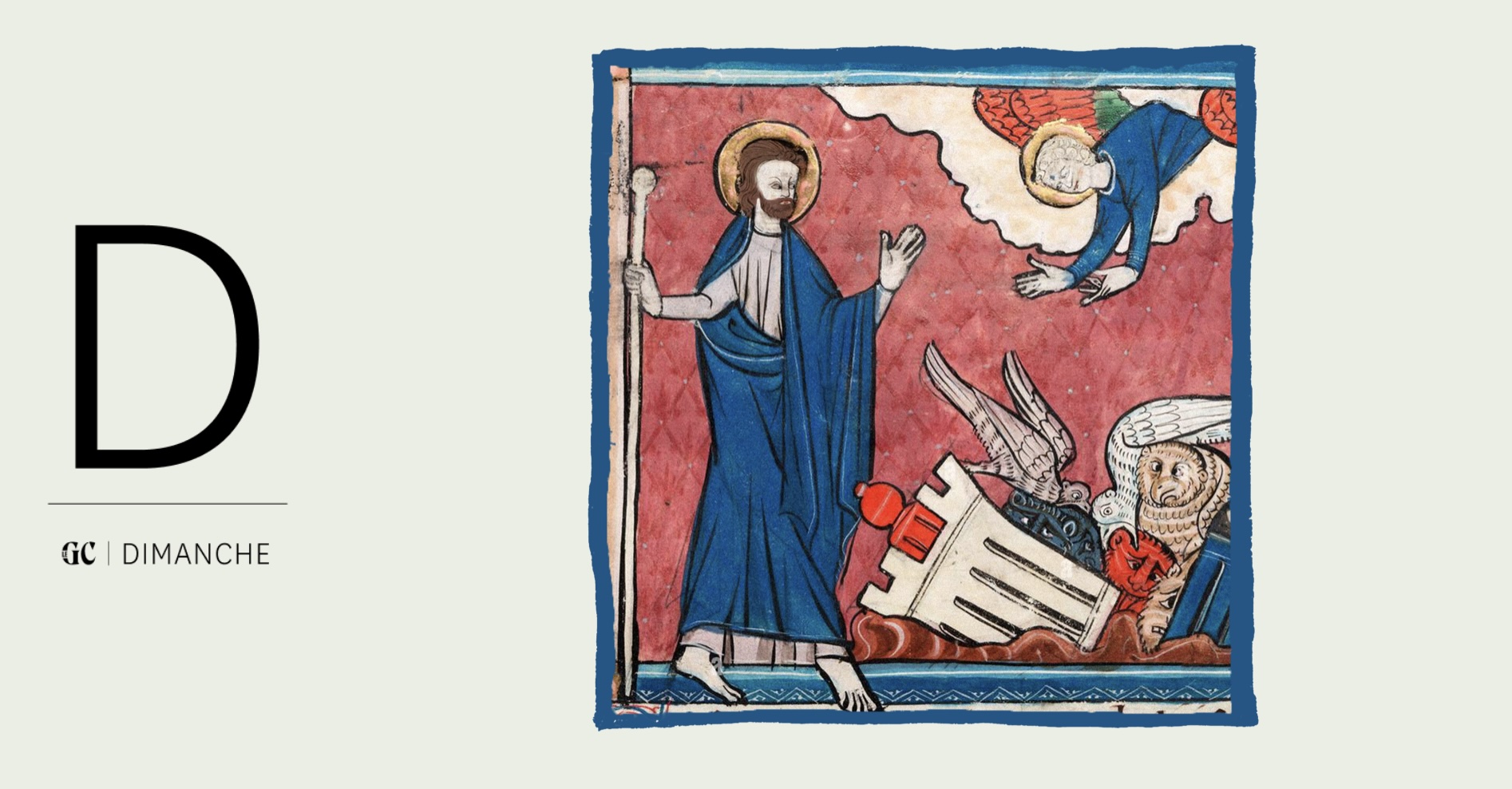
We should return to the text. Apokálypsis means “revelation,” “the unveiling of what was hidden.” In the Bible, the Apocalypse is salvific knowledge, written for persecuted communities so that they do not lose hope. Everyday language has reduced it to a synonym for catastrophe, and this reduction has very concrete consequences. When the end ceases to be a revelation from God and becomes a calendar to consult, theology yields to a technique of political orientation.
Nine years ago, following an intuition of Pope Francis, we called it the cult of the apocalypse in an essay written with Protestant pastor Marcelo Figueroa for La Civiltà Cattolica. There we described a simple formula: to combat threats weighing on American Christian values and to await the imminent justice of an Armageddon, the final confrontation between Good and Evil. We were more concerned with practical consequences than with doctrine. In the face of the urgency of the end, every process collapses. Negotiation, mediation, and the patient building of peace become luxuries reserved for those who have time, and time, there is not. The faith community reorganizes into a community of combat. We attributed this grammar to evangelical fundamentalism and Rushdoony’s dominionism, and even then it seemed that it overflowed. Today, this grammar is used effortlessly by a Catholic vice president: the surprising ecumenism we spoke of has been realized.
In March, Peter Thiel delivered four lectures in Rome on the katechon, the Antichrist, and the end times. Thiel has funded Vance’s political career, and the mechanism is recognizable. The Apocalypse does not function as a discourse about God and salvation; it serves as a grid for assigning roles in the present history: the one who obstructs my plans prepares the reign of the Antichrist, while the one who supports them delays the disaster. Thiel is an architect of the end that he says he fears. Vance goes even further and more explicitly: the end does not even need to be dreaded.
Here, the problem becomes theological. The Gospel says that no one knows the day or the hour (Mt 24:36), and when the apostles ask about times, Jesus answers that it is not for them to know (Ac 1:7). This ignorance should not be filled by geopolitical analysis; it is faith itself, which leaves the achievement in God’s hands and entrusts to humans the work. The one who calculates in which week of history we are already has exchanged trust for strategy.
Then there is the weight of the present. In Christianity, waiting for the end does not lighten what we do; it makes it definitive. In the scene of judgment in Matthew 25, no one is questioned about their ability to decipher the signs of the times. The questions are of a different kind: did you feed the hungry, welcome the stranger, visit the prisoner? The poor are the metric of judgment, and this reverses the meaning of “it is well.” To proclaim peace in the belief that one’s own action leads to the end of the world is to use eschatology as an alibi rather than as a measure. He who believed he had accomplished God’s work is not, for all that, exempt from giving an account to people for his actions.
What remains is the question of what God’s work is and who gets to decide it. For a Catholic at the pinnacle of American power, this is not a seminary question. In February 2025, Pope Francis wrote to the American bishops that the true ordo amoris is discovered by meditating on the parable of the Good Samaritan: a love that builds fraternity without excluding anyone. It was a response to the political use that Vance had made of that same expression a few weeks earlier. Cardinal Robert Prevost, now Pope Leo XIV, had publicly echoed a critique of that interpretation. Twice, on the same point, the same correction: the Christian criterion does not lie in the hierarchy of affiliations, nor in the proximity to the end.
Francis has emptied the millenarian story of its substance by insisting on mercy as God’s fundamental attribute. A history governed by mercy could not be misinterpreted as the theatre of a final battle. In the Gospel of Luke, the blessed servant is the one whom the master finds at work upon his return; he does not watch for the hour, and he does not stop working because he fears time has run out; he works because he has been entrusted with something. Between the two hypotheses that the United States vice president declares to be indifferent – a world that ends and a world that endures – lies the distance that separates an ideology from the end of Christian hope.