
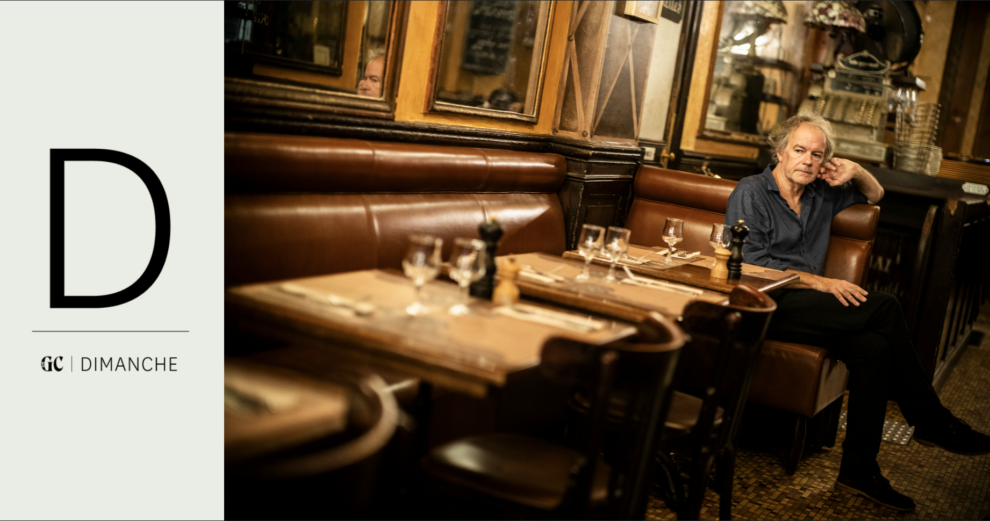
Chantefable. The title alone carries us to the border of poetry, beneath the shadow of Robert Desnos. This is the name of the bistro in the xxth arrondissement where Yannick Haenel, a longtime patron, can be found. True to a student whose entire life has orbited around the classroom, he naturally positions himself at the front, on the terrace. We, meanwhile, are in the back room, waiting for him in a charming Art Deco setting to photograph him. He waits, too, alone, watching the street and the pedestrians. He has ordered a very fresh Sancerre. We could leave it at that—it would have been hard to better illustrate the title of his new novel, The Solitude of Professors is Infinite. We fetch him; he arrives with his glass in hand: “It’s true that I would never have thought to come into the back room.”
He quickly justifies himself: the day has been long, interviews pile up, he is tired, so he ordered a glass of white wine. “When I improvised a judicial columnist role for Charlie Hebdo at the time of the January 2015 attacks, I had to write a text every day. Every evening, I went to the same brasserie, where I always ordered a Sancerre. The server would tell me each time, proudly: ‘A Sancerre, to be honest.’ At the moment, it seemed a bit silly. But over time, I realized he hit the mark fairly well. And it stuck.”
The Life of a “Troubleshooter”
We are then one of many, joined by Mathieu Roger-Lacan, who arrives just in time: today he is what Yannick Haenel was yesterday, a high school teacher who spends a portion of his time on the train to go teach. Several decades before writing this novel, Haenel taught French in secondary education for seventeen years. A teacher by vocation, “and nothing is more unsettled than a vocation.”
Trains. Corridors. Schedules. This, too, perhaps above all, is the life of teachers. “Being a young teacher means solving problems incessantly, being a kind of troubleshooter. That is what I find fascinating. The daily services that secondary teachers render are woven into the collective imagination, and yet they remain invisible, beneath the surface of a society that, by definition, ignores what happens in a classroom. This place is, in a way, an anti-place, like Roland Barthes’s atopos in Fragments of a Love Discourse. Here one escapes the rules of counting and measurement that govern all interactions in the capitalist world. What unfolds in a class (or even what plays out there) is a colossal expenditure—a spending, in Georges Bataille’s sense—that no tool can quantify.”
The Double Return
Yannick Haenel thinks as a writer: it is the words that guide his thinking. He moves quietly toward the truth of his speech, with a voice that bears a Modian gentleness, regularly punctuated by a bright, youthful smile. We want to know more about the book’s success, which also benefits from the overlap of two quintessentially French September occasions: the literary rentrée and the back-to-school season. We start by celebrating success with a second Sancerre, to see a little more clearly.
Success: the word unsettles him a bit, yet yes, one must admit it, the book is a success. For two weeks now, something has come back to him with an intensity he hadn’t anticipated. Letters, messages, an Instagram flood. Teachers especially, but not only. As if the book had touched a sensitive point that everyone knew existed but could not quite name.
“I’ve never had as immediate responses. But I don’t take it personally. I sense it’s a sign that it speaks from all sides, that it overflows. The real question is: what happens on the side of transmission? Is it over? Has the impoverishment of language reached a point where school becomes the Republic’s blind spot?”
More Beautiful Than Activism
The conversation also overflows: beyond the novel and toward the world. Haenel concedes that this book, which bears no thesis, no ideological arc, is probably his most political novel in the strong sense of the term. “For years, I felt very political when I went to the middle school in the morning, when I forced myself to wake early. I could have chosen another path in life. I still went, even if I was disappointed, even if I spoke harshly to myself. My appetite for politics was sated by teaching. I didn’t even vote at the time. Being a teacher in suburban Paris collèges was my way of doing politics. It’s more beautiful than activism.”
The publication date, too, mattered. The book appears at a moment when teachers begin to sleep badly again. Late August, early September, as the title of a film suggests: timetables emerge, classrooms fill again, the RERs begin to roar at dawn. We point out that The Solitude of Professors Is Infinite arrived almost exactly at the moment when its title could become the mantra of hundreds of thousands of people. He smiles. He swears he did not plan it.
But he acknowledges that something has happened. The novel has sometimes been received, he says, as a “manual,” not a pedagogical one, but a manual of existential survival. He likes that. “I have always learned to live with books. Dostoevsky, Hermann Hesse, and many others. Books taught me how to live.”
That may be why this one demanded so much of him. Haenel wanted to write it for nearly twenty years, after spending seventeen years teaching in secondary education. He first imagined recounting hours of class, quite simply, because they seemed to him to constitute a fictional material that no one was really looking at: “A very scintillating and combustible material, full of contradictions.” Fifty-five minutes in which one never quite knows if one is succeeding or failing, where thirty voices, almost involuntarily, form a kind of orchestra, sometimes dissonant, sometimes harmonious.
The Broken Vase
That could have been a nice title as well, “The Broken Vase.” Haenel confides that it was his working title during the drafting of the novel. “It was beautiful, but choices had to be made. It wasn’t just a matter of efficiency but of knowing to whom one is speaking. For once, I didn’t want to write a book by and for writers.”
He certainly did not want to write a memoir of the National Education system. Even less a sociological essay. “The states through which a teacher passes are absolutely ambivalent. One can leave a class feeling glorious, almost at the apex of existence, and the next is a disaster. One never stops thinking about it: before, during, after. And this simultaneity of sensations, it seemed to me that only fiction could articulate it.” It remained to find the form for this novel.
It came from two radically different events.
The first is tragic. In October 2020, Haenel covered for Charlie Hebdo the January 2015 attacks trial. Every day he attended the hearings; every night, he wrote. One morning, journalists’ phones began vibrating: a teacher had been murdered. Samuel Paty. That evening Haenel could not write his judicial column. He called Riss, the editor-in-chief of Charlie, and told him he would write something else, a piece not about Samuel Paty but for the teachers. And he titled it: “The Solitude of Professors.”
The second is a memory frankly burlesque. At the end of a school year, long ago, the young professor Haenel takes part in a farewell party. He drinks a little too much, dances with a colleague he admires, and ends up collapsing onto the table where the gifts were arranged. A vase falls. A beautiful vase, an authentic replica crafted by the Louvre workshops. The next day, his colleagues hand him the bill.
The anecdote makes us smile. There is always a secret joy when we learn that a brilliant episode of a book really happened. Yet the real world remains elusive, and in the meantime the broken vase has become something else. “I told myself it was the perfect metaphor for this imaginary fault that we constantly attribute to teachers. There is always someone to blame them for something: the parents, the administration, the inspectors. And teachers end up internalizing the blame themselves. With my friends, we left Normal School, we were agrégés at twenty-two, and after each class we’d still tell ourselves: I didn’t do it well enough.”
From the metaphorical terrain, we slide toward metaphysics. Haenel knows an old story of Jewish mysticism, drawn from one of the books of the Zohar, a compendium of Talmudic overinterpretations by medieval rabbis. At the moment of creation, divine light is so intense that the vessels meant to contain it shatter. Sparks scatter. It then falls to humans to work toward their gathering, toward the repair of the world: the Tikkun. The grotesque accident of the end-of-year pot suddenly fits into a cosmology. It is exactly the kind of collision that enchants him. “I like it when things write themselves obliquely between literature and philosophy.”
An Hermeneut of the Immediate
The teacher in the book, Jean Deichel, his fictional double—“me, in a better and worse version, more drunk and more brilliant”—thus moves through life with the Zohar in his pocket. He also listens to punk rock, reads incessantly, stacks books and tree sheets in his coat, and lives in a studio that overlooks a clay-court tennis court which he must open and close every day. A bit like the author himself in the early 1990s. But those books once carried in pockets—back when the era was not so distant—are not mere quaint accessories. Haenel is after a word. “They are intensity activators.” A teacher, he says, is “an interpreter of the immediacy.”
The phrase stops us in our tracks. It may summarize much of the novel. In front of a class, one must read signs and respond instantly. Deichel applies the same method to the world at large. Even when teaching in “those dreadful prefab buildings at the back of his ugly middle school,” he can see, at the same time, an Eden. The school is both tragic and comic. The teacher is ridiculous and heroic. The broken vase is a late-evening foolishness and the earthly manifestation of a mystical narrative. Literature serves less to choose between two versions of reality than to render their coexistence possible.
“There is no single truth about a social situation, least of all the one in education. The Zohar allows me to access both things at once.”
Dostoevsky would grant him the same service. The broken vase calls forth Prince Myshkin from The Idiot; the books later help decipher what the character lived through without understanding. For Deichel, life precedes comprehension. And then literature comes to tell him: look, perhaps that is the story you were part of.”
The inexhaustible Exhausted
Yannick Haenel freely admits that The Solitude of Professors Is Infinite is also an epic and picaresque novel. If one were to attempt to characterize its protagonist, one might say he is a kind of Quixote. He was about to take a sip of his white wine, stops, sets the glass down without drinking. He smiles. The comparison pleases him. It is one of the novel’s central female figures, Sophie, who initiates it. “The wandering knight without a lady is like a tree without leaves,” she says, playfully, to Jean Deichel, quoting Don Quixote.
This young professor, agrégé and poet, an unrecognized Hidalgo of literature “who tells his own story a little,” clarifies, in a direct line, that throughout the novel he searches for his Sancho Panza, whom he eventually finds by accident in the figure of the dog, Lumpen. Deichel is seized by a gentle madness—the desire to transmit, to be a teacher, but also the desire for fiction. He is conscious that he is the character in a novel that is being built and must never stop writing itself: the Quixote dies when he becomes Alonso Quijano again, i.e., when fiction ends.
“It’s very beautiful. It’s coherent; Don Quixote—that’s it, a production of fiction to avoid wavering while standing on a line to defend something one believes is right. Then there’s the idea of chivalry behind it, that is, all the library at the back. My professor, my alter ego Jean Deichel, is really someone who has a special relationship with books, who thinks things are written.” Should we read into this a kind of fatalism? Haenel does not think so. But his protagonist nevertheless ends up in an Etruscan tomb and sees that his life has already been painted, “in a great burst of laughter, of course,” he adds immediately, “because all of this is a farce after all.” To conclude: “To take with you all the books in the world, like Quixote, to spend them in a burlesque gesture, to try to spark a life and all the lives of others, that’s in the end what it’s all about.”
It is tempting to push the parallel. Is there a chivalrous gesture in teaching? “I truly believe it, I have no problem admitting it.” Haenel is an avid reader of Kierkegaard: “It’s hard for me not to think of the ‘knight of faith’ from Fear and Trembling.” But the novel’s final laugh is never far away. “It’s a comic knighthood, full of self-mockery, as Beckett would call it. This isn’t about seeking grandeur; it’s all a little passé, not suited to our world. It’s about seeking a justness. Quixote is someone without a vantage point, who accepts what others think is madness as the energy that sustains him.” Haenel stops. He smiles again, another sip of Sancerre to be honest: “You know, he’s an inexhaustible exhaust.”
The expression is from Jean Reverzy, a 1950s Lyon-based writer. “A novelist like Paul Gadenne or other great writers who will never appear in manuals but who are deeply touching.” Reverzy recounts in a very beautiful novel “that greatly pleases Modiano,” Place des Angoisses, the story of an emergency physician who is part of the “inexhaustible exhausted.” “Honestly, secondary school teachers are like that: they know fatigue intimately. Fatigue is an ontological thing; it has to do with being. And fatigue is inexhaustible.”
Paradox on the Teacher
The word remains: solitude.
There is something paradoxical in presenting the teacher as a loner. A teacher meets hundreds, soon thousands of students; he sometimes moves to another lycée, another colleague, another city. He spends his life surrounded by new faces. Haenel nods. That is precisely why the solitude that interests him is not only the solitude of institutional abandonment, even if he does not deny it. It is deeper. It does not take the form of a complaint but of the awareness of an ontological condition.
“No one can teach in our place,” he says very softly. “It’s like a great musician. You cannot take the place of the pianist. Like in writing. Like in love. It cannot be replicated. No class resembles another.” The teacher is alone not because no one surrounds him, but because no one can exactly share the act he performs.
The door closes. For fifty-five minutes, something happens, or does not happen, completely. Society, inspectors, even colleagues will never quite know what. And this reality, which nourishes the solitude of teachers, also constitutes for Haenel their strange liberty. “It’s not secret, it’s not taboo, it isn’t even incommunicable. It’s rather like play, in a mechanical sense: a space of liberty.”
We find again what struck us at the beginning of the conversation. The solitude of the teacher is not the opposite of encounter. It may be the condition of encounter itself.
To truly meet thirty people, one must be willing to expose oneself alone before them. One must be ready to be struck. “If we are not pierced, something is wrong. If we protect ourselves too much, if we put an upright screen of authority between the students and us, nothing happens. Fragility becomes a space for speech. But we pay the price.” We draw a parallel with Diderot’s Paradox on the Actor. Haenel’s novel has something of a Paradox on the Teacher. He likes the idea.
A Kamikaze of Gentleness
There is something radically strange in the act of teaching, and even more so in teaching literature today. A text by Stendhal or Duras read for fifty minutes by thirty adolescents who might otherwise never have opened it. “Sometimes I tell myself that schooling will become subversive. It might be one of the last places where language is not being impoverished.”
The teacher as vestal, he says later: one who watches over a fire whose burning is not exactly for whom. Like Quixote. Or like a kamikaze.
But then, he suggests, finally recommending PJ Harvey’s track to accompany this interview: a kamikaze “in the true sense.” “A kamikaze of gentleness. A kamikaze of speech. That’s what teachers are, in a way.”