
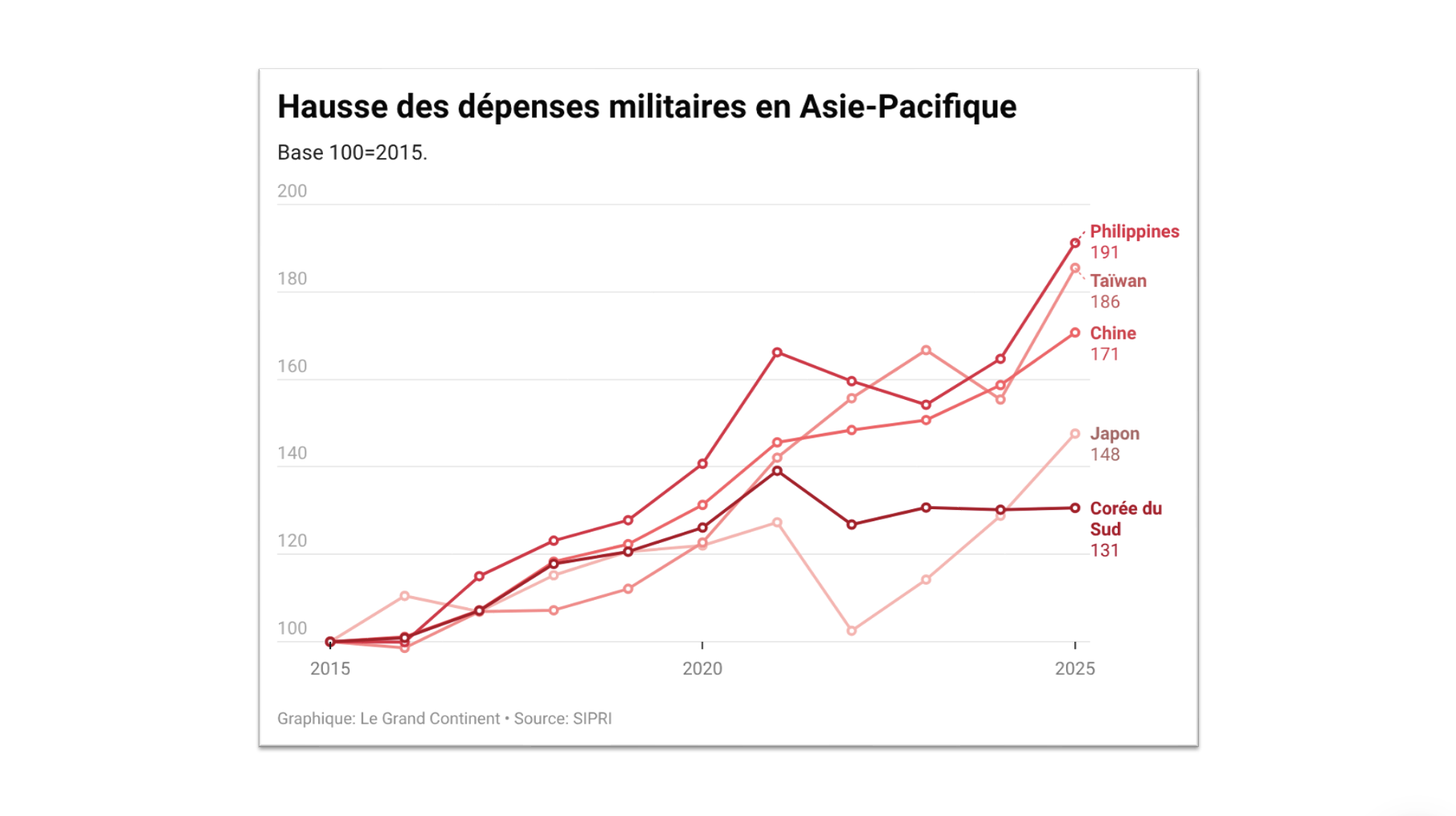
Beijing and Moscow view with concern the Japanese rearmament effort launched by Prime Minister Sanae Takaichi to counter China’s growing influence in maritime Asia, especially in the military domain. To pressure Tokyo, the two nations are mobilizing a little-known instrument of the United Nations Charter: Article 53.
– Adopted in 1945 in San Francisco, the Charter organizes international law to prevent wars, reserving to the Security Council the exclusive right to decide coercive military measures against a state.
– Its Article 53, however, provides an exception: it allows action without authorization against a state “which, during World War II, was the enemy of any signatory of the present Charter” to counter “the resurgence by such State of a policy of aggression.”
– This measure is aimed at preventing a potential resurgence of the Axis powers: Germany and Japan at the forefront.
In 1995, after the fall of the Berlin Wall, the United Nations General Assembly voted to delete this clause with notable support from China.
– This deletion was confirmed in 2005 by the World Summit on the “Millennium Goals,” still with Beijing’s agreement.
– But this deletion never actually entered into force, and the exception still appears in the United Nations Charter.
– For it to be transcribed in the text, it would have required formal ratification of the modification by the permanent members of the Security Council — something that has never been done.
Thus, Beijing and Moscow have unearthed this clause, as well as Article 107, which confirms the legal validity of measures taken against former enemy states of World War II, to denounce Japan’s “neo-militarism,” while also casting a shadow of possible future reprisals. Sergey Lavrov had attacked Tokyo in August after Japan summoned the Russian ambassador to protest Putin’s visit to the Kuril Islands, an archipelago partly claimed by Japan.
– Lavrov had specifically accused the Japanese government “of shirking its historical responsibility for its actions during World War II.”
– He told reporters: “If Japan tries to ‘reshape international law in its own image’ and in concert with the United States, with which it maintains a close alliance, and if it violates its own Constitution—at least, as has been reported, by renouncing the three non-nuclear principles and by building an army capable of conducting overseas operations, which the Constitution forbids—then the situation is extremely alarming.”
In an editorial published on Thursday, September 10, the Chinese Ministry of Defense stated that it was “essential to reaffirm the ‘enemy state’ clause.”
– According to Beijing, its fundamental objective “is to deter aggression through the rule of law, to eliminate the threat of war and to preserve peace for humanity, thus bearing witness to the universal justice of the international community. The deliberate distortion of this clause by far-right factions in Japan, who reduce it to a mere ‘political repression,’ constitutes a flagrant violation of the spirit of the original United Nations Charter.”
These threats are primarily a propaganda exercise reflecting the gravity of rising tensions in East Asia, at a moment when the United States is engaged in a conflict in the Middle East. Nevertheless, it seems plausible that Russia could seek to pressure Germany by following the same pattern.