
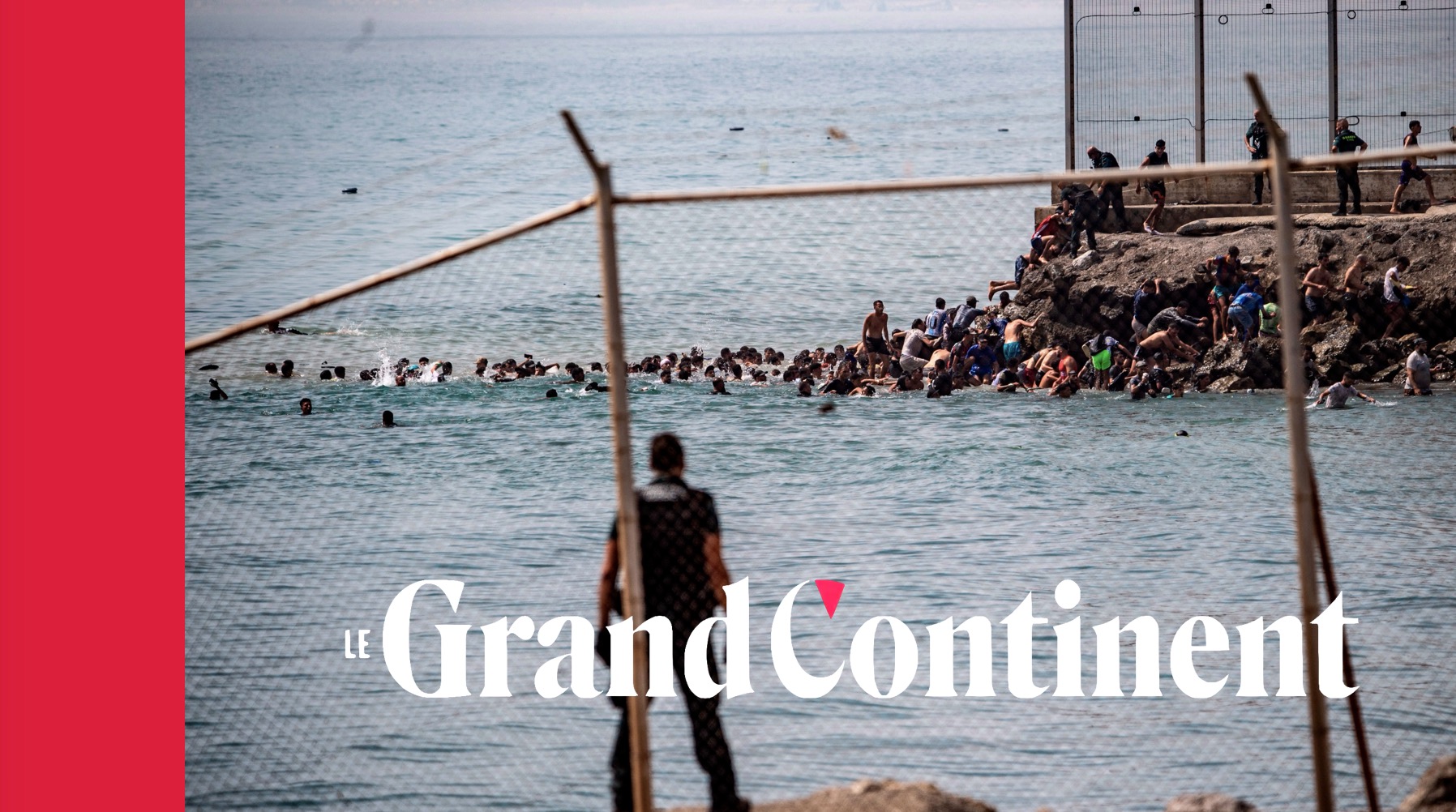
“Russian and Israeli networks spread misinformation on social media to attack the Spanish government.” A month after the massive crossing of the border by more than 70,000 people from Morocco into Spain, the Spanish prime minister, Pedro Sánchez, made his political return by granting on Monday, August 31, his first interview to a media outlet.
- Contrary to international criticism targeting the alleged “pull factor” of his migration policy, his response shifts the spotlight to digital misinformation while exonerating the neighboring country: “No information […] from the intelligence services leaves any doubt about the involvement […] of the Moroccan authorities.”
- The idea that misinformation and social networks were the “immediate trigger” of the crisis, according to the foreign minister, rests on a distortion of a precise piece of information: the Supreme Court’s confirmation that “hot returns” do not apply to migrants crossing the border by swimming.
- Distorted and presented as a “green light” within Facebook groups gathering up to 400,000 members, this news would have set off the snowball effect that sparked this massive influx.
Investigations by renowned verification bodies, such as Maldita, confirm the imprint of these messages within networks of fake accounts operating in a coordinated manner and under strict operational-security protocols. Likewise, works by analysts specializing in misinformation and digital propaganda highlight serious manipulation and information-interference maneuvers surrounding the crisis.
However, these statements by Pedro Sánchez, which follow his recurring charges against the dangers of social networks and the grip of “techno-oligarchs,” appear against the backdrop of a sharp internal political crisis.
- Once the illusion of a quick resolution had dissipated (the mass deportation of the majority of migrants back to Morocco within the first 24 hours), the coalition government split.
- On the Socialist side, while the defense minister says intelligence had warned the executive, the interior minister formally denies it; as for the left wing, made up of greens and communists, it counters Sánchez’s version by pointing to the active or passive responsibility of the Moroccan regime.
The work of leading Spanish digital-intelligence analysts sketches a more complex reality, demanding a rigorous examination of platform accountability.
- To bolster his accusations against Moscow and Tel Aviv, Sánchez relies on the conclusions of the European External Action Service.
- Publicly available elements to date on information manipulation nonetheless suggest a willingness to exploit the crisis from abroad rather than simply acting as a trigger.
- Analysts such as Ned Mendez, from the collective 411, revealed that Kremlin-linked accounts had spread messages reaching more than 500,000 users in the days following the massive influx, underscoring the existence of a disinformation infrastructure capable of weighing heavily on future crises.
- The Ukrainian foreign minister himself, Andrii Sybiha, pointed to this interference and the frenzied activity of Kremlin media outlets such as Pravda and RT from the outset of the events.
In the case of Israel, it is established that keywords such as #FreeMelilla served as conduits for Israeli influencers to enter the crisis landscape. Their discourse, highly critical of Pedro Sánchez’s position on the Gaza war, sought to present this Spanish territory as a colonial enclave. It remains, however, a propaganda campaign that, for the moment, cannot be directly attributed to actors coordinated by the Israeli state.
- Digital analysis by specialists like Mariluz Congosto also documents the propaganda activity of accounts affiliated with Morocco, whose interference aimed to portray Ceuta and Melilla as occupied territories.
- But although Sánchez suggests that interference by foreign powers—such as Israel and Russia—would constitute a response to Spain’s condemnation “of the genocide in Gaza and Putin’s invasion of Ukraine,” the government’s official narrative distances itself from these operations.
As for the weight of misinformation in mobilizing toward the border, most testimonies gathered by the press on Tarajal beach during the crossing already pointed to social networks as the main driver. It is a fact: the idea of an open border or that simply swimming across would avoid arrest reached the screens of more than 70,000 people who threw themselves into the sea well before being picked up by major media and televisions.
- Now, the architecture of the WhatsApp and Facebook groups through which the call spread is known, as is the nature of the messages that suggested a “window of opportunity” to cross the border without danger—a lure that cost at least 88 lives.
- These included both dangerously misleading instructions about the crossing (“it’s shallower here” or “if you can’t swim, we sell life buoys”) and fake alerts about an “open border” as well as false rumors about Spanish law (“those who qualify will not be returned,” “expulsion is impossible if the crossing occurs by sea”).
- Regarding the purportedly coordinated accounts fueling these spaces, the use of impersonated identities, empty profiles, changes of pseudonyms, or rotation of keywords all point to a covertly orchestrated operation designed to erase any trace.
It is hard to doubt the Moroccan state’s capacity to monitor networks to prevent thousands of people from putting themselves in danger.
- This massive influx occurred less than a year after the crackdown on a wave of ‘Generation Z’ protests, whose mobilization methods relied precisely on these messaging apps and on community spaces, such as Discord, where pro-democracy movements like “GenZ 121” operated via servers with over 200,000 users.
In both cases, as misinformation expert Marcelino Madrigal notes, “the primary responsibility lies with Facebook, the leading platform in Morocco, and with the messaging apps that allow these groups to organize.”
- Meta holds a near-monopoly on instant messaging in both countries thanks to WhatsApp, present on the phones of more than two-thirds of Moroccan and Spanish citizens, not to mention the 30 million users of its social network in Morocco.
- Just as X, Elon Musk’s social network, allowed far-right misinformation to proliferate at the onset of the crisis—conspiracy theories about the Red Cross, false alerts of church attacks, decontextualized riot videos—the sector’s giants failed to meet their most basic obligations.
Just as algorithms that expose a teenager to content encouraging self-harm, body-hate, or suicide rest on a dangerous and destructive business model, those that push minors to throw themselves into the sea “where it is least deep” also gamble with human lives.
- This logic operates at the expense of the most vulnerable and, more broadly, of all citizens who, at the height of a major migratory crisis for the Union, find no preventive or moderation tool.