
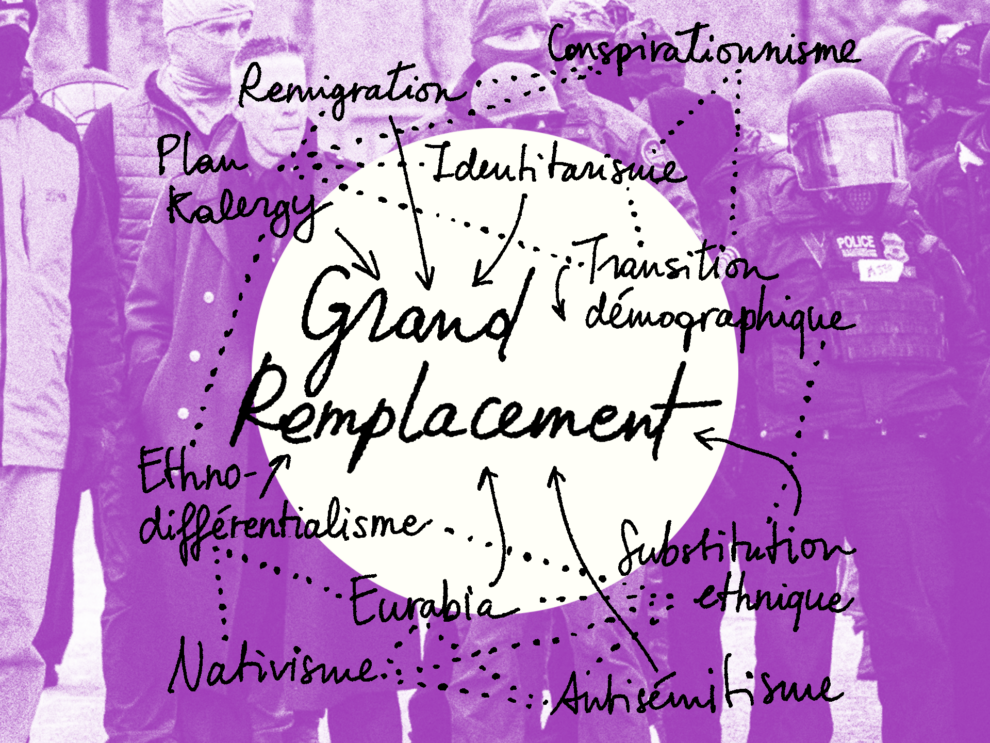
Throughout August, Le Grand Continent makes freely accessible The Vocabulaire de l’extrême droite, the fruit of the collaborative work of a group of researchers — sociologists, historians, political scientists, sociolinguists — from across Europe under Steven Forti’s direction. To receive each lemma in your inbox and support the work of an independent editorial team, subscribe
At the end of May 2026, several hundred people from around a dozen countries gathered in a rural estate near Figueira da Foz, on the Portuguese coast, for the second Remigration Summit.
On the same stage, Austrian activist Martin Sellner, who has spent more than a decade trying to turn the word “remigration” into a public policy like any other, stood alongside Gregory Bovino, a high-ranking official in the American Border Patrol who had led the Trump administration’s mass expulsions between October 2025 and January 2026, and whose long cloak, worn during the Minneapolis raids, had been likened by the California governor to an SS uniform, as well as Joey Mannarino, a MAGA influencer from the Overton Institute, who shares on social media images praising Vlad the Impaler, whose cruelty toward the Ottomans is reframed as a symbol of resistance to the taking of power by Islam in the West.
The participants praised the event’s professionalism, especially in comparison with the first summit held near Milan in May 2025, during which police vans had to escort the congresspeople to the enclosure. A year earlier, the U.S. State Department had created a Remigration Office within the agency historically responsible for resettling refugees.
A Metaphysics of Purity
In roughly fifteen years, the distance between a fringe slogan and a federal agency’s organizational chart has been crossed. To understand this trajectory, one must identify the different layers — biological, social, political — of a narrative that has grown increasingly central.
The narrative is the Grand Replacement. Its formulation in the 21st century comes from French writer Renaud Camus, who sketched it in a collection of essays in 2010 before making it the title of a book in 2011. According to this conspiratorial fantasy, “native” French people and, more broadly, white Europeans would be physically, culturally, and politically replaced by non-European populations, mainly Muslims, through the mechanisms of immigration and higher birth rates, with the complicity of what the far right calls “globalist elites.”
The fantasy presents itself here as demography, a science that claims to be “objective.” Its ideological base, however, is much older and draws from the German philosophy of the eighteenth and nineteenth centuries.
In 1714, Leibniz described reality as a composite of monads, each “a simple substance,” “without parts.” “Monads have no windows by which anything can enter or leave,” he wrote, and their natural changes “come from an internal principle, since an external cause could not influence within.”
A few decades later, the German theologian and philosopher Johann Gottfried von Herder translated a strikingly similar idea to human societies. A people, for him, was an organic individuality, endowed with its own spirit, its language, and its climate, growing like a plant from its own seed. Isaiah Berlin, who summarized his contribution in three doctrines — populism, expressivism, and pluralism — thus conveyed Herder’s vision. Each culture possesses its own “centre of gravity,” and no ranking among them is conceivable. It is worth stressing that the philosophy that would later feed the most extreme racial theories had thus inverted almost everything it once defended. As Berlin showed, Herder “hated the state and all forms of imperialism and conquest,” and his pluralism foreclosed any racial hierarchy in advance.
In his Discourses to the German Nation , addressing a defeated and occupied people in 1808, Fichte radicalized this idea and placed the border of a nation at the inner limit of its language. Early in the nineteenth century, the metaphor crystallized into the Volksgeist, the “spirit of the people,” a notion elaborated by the historical school of law and political romanticism, which late-century psychology of peoples would extend into Volksseele, its “soul.”
Once a nation is conceived as a body endowed with a soul, the presence of the foreigner ceases to be a political question and becomes an existential threat. Purity then becomes shorthand for health, as it concerns preserving the monad from all contamination, parasitism, and infection. The völkisch writers of the late nineteenth century framed this discourse through the medical lexicon. Paul de Lagarde saw Jews as “trichinae and bacilli,” with whom one does not negotiate and whom one must “annihilate” (vernichten, the word that would be carried into Nazi genocidal vocabulary) “as quickly and completely as possible”. The idea of racial hygiene formulated as early as 1895 by Alfred Ploetz gave this profoundly racist and antisemitic imagination its scientific garb, and the phrase “blood and soil” (Blut und Boden), popularized by Walther Darré and later adopted as a Nazi regime slogan, represented its culmination.
After the Defeat
What survives into the twenty-first century is not primarily racial science (a once-dominant theory that has become marginal again, albeit reinjected into public life through digital intermediaries), but the underlying logic: the people as a windowless monad that must be preserved in its pure state.
The Grand Replacement denounces a deliberate contamination of the monad that would be the people — American, French, Spanish, Italian, or German — by both internal and external enemies. It is thus not merely a demographic claim. It asserts that mixing corrupts the body of the “true” people. It is on this ground that “remigration” presents itself as a radical, yet essential, remedy to purify the national body and restore its former grandeur.
This organic view of society needed a relay to traverse the twentieth century, once the Axis powers’ defeat made explicit biological racism taboo. It found one in France. The Groupement de recherche et d’études pour la civilisation européenne (GRECE), an academic-black-tinted think tank founded in 1968 around Alain de Benoist, a central figure of what would later be called the Nouvelle Droite, aimed to win the cultural battle before contesting state power. Its members openly described themselves as “right-wing gramsciens.”
In this context, their central invention was ethnopluralism, or ethnodifferentialism, which proclaims a “right to difference.” The argument is no longer that some peoples are inferior; it holds that all are incommensurable. It recognizes the intuition Berlin attributed to Herder, but stripped of the pluralism that underpinned it. Each people would henceforth have the right to preserve its identity on its own territory, mixing would harm all equally, and multiculturalism would thus be true racism . Pierre-André Taguieff later labeled this construction “differential racism,” Étienne Balibar called it “racism without races.”
Preparing a Victory with a Novel and a Plan
In this initial retranslation, the organicist premise expresses itself in a vocabulary that appears anti-racist at first glance, and it is precisely this disguise that makes it usable within the liberal public sphere.
Yet the conceptual framework did not crystallize solely in Nouvelle Droite seminars. While the identitarian movement of the 2000s recycled this logic with a youth-oriented aesthetic and a knack for staging, three earlier materials explain why Camus’s formula took hold so readily: a novel, an invented plan, and a geopolitical neologism.
The novel is The Camp of the Saints, published in 1973 by the French royalist writer and explorer Jean Raspail. The book narrates the arrival on the French Mediterranean coast of a tattered flotilla carrying a million Indians and the collapse of a society that is paralyzed by pity. The arrivals are systematically dehumanized, reduced to a promiscuous and diseased mass lacking individual agency, while the rancor of the text targets priests, journalists, and progressive intellectuals who allegedly prepared the capitulation. Renaud Camus even dedicated his 2011 volume, The Grand Replacement, to Raspail and to Enoch Powell, the author of the 1968 “rivers of blood” speech against immigration.
Tracking the publishing trajectory of this work reveals the extent of the institutional conquest by the far right. Rejected by French critics in the 1970s, celebrated within far-right circles, and reissued whenever a migratory episode could be depicted as a fulfilled prophecy, it reached its eighth French edition in 2011, sixty thousand copies, the same year Camus published his essay. Its American parcours is even more remarkable. Translated in 1975, reissued in 1982 thanks to funding from Cordelia Scaife May, heir to the Mellon fortune and a patron of American nativism, and then in 1994 by the publishing house of anti-immigration activist and eugenist John Tanton, praised by Pat Buchanan in The Death of the West (2001), adopted as a bedside book by Steve Bannon and Stephen Miller, the future architect of Donald Trump’s immigration policy, who in 2015 asked Breitbart’s editors to draw parallels between Pope Francis’s words and the roman pontiff’s capitulating stance. In 2025, Vauban Books published a new English translation prefaced by Nathan Pinkoski and organized a public reading in Washington the day after the White House released a national security strategy anticipating Europe’s “civilizational disappearance.”.
This normalization is not solely American. On 13 August 2025, the Italian daily La Verità and the weekly Panorama distributed the book in newsstands, presenting it as a masterwork of literature, even though its only Italian edition for decades had been that of Franco Freda’s neo-fascist publishing house, a publisher condemned in 1981 for subversive association. Marine Le Pen, who calls it “visionary,” urged French readers in 2015 to “read it or reread it.”
The second material is the so-called “Kalergi Plan.” Richard von Coudenhove-Kalergi, Austrian aristocrat born in Tokyo, founded the Paneurope movement in 1923 and presided over the European Union for nearly half a century. A liberal-conservative, anti-fascist and anti-communist, he explicitly rejected racism and antisemitism. In a 1925 essay, Praktischer Idealismus, he speculated about the dilution of races and classes as distances and prejudices disappeared, going so far as to imagine a future “Eurasian-Negroid race.” The Nazi propaganda took this speculation as a target. In 1940, the NSDAP’s official press organ, the Völkischer Beobachter, described him as a “métis” serving a humanity subjected to Jewish domination.
To understand the passage from this Nazi calumny to today’s conspiratorial fantasy, one must look at a marginal author. In the mid-2000s, the Austrian neo-Nazi and Holocaust denier Gerd Honsik, then on the run in Spain, self-publishes a book denouncing a supposed “Kalergi Plan,” an expression he probably coined himself, and whose content largely stems from Nazi-era Nazi press. Honsik disseminates it on the Internet and through extreme publications, with links to circles close to the Austrian Freedom Party (FPÖ). By 2006, his book circulated on the white supremacist American forum Stormfront.
The “Kalergi Plan” is today one of the most recurring terms in online discussions of the Grand Replacement, alongside “Jews” and “Freemasons.”
The third material is “Eurabia,” a concept coined by the British-born, Egyptian-origin essayist Gisèle Littman, known as Bat Ye’or. In Eurabia: The Euro-Arab Axis (2005), she argues that since 1973 a pact exists between France, the Arab League, and the European Economic Community, coordinated through the Euro-Arab Dialogue, aimed at suborning Europe to the Arab world in exchange for petroleum and stability.
Mark Sedgwick noted that this is, rigorously, the first version that truly presents a conspiratorial replacement narrative. Indeed, if Renaud Camus merely describes a process, Bat Ye’or names the signatories and even specifies a date for the agreement.
The concept supplied a whole vocabulary to the transatlantic racist and anti-Islamophobic movement known as counter-jihad, appeared on electoral posters of parties like Germany’s AfD, and occupied a central place in the manifesto of the author of the Utøya and Oslo attacks, which claimed seventy-seven lives in 2011.
From Massacre to the Platform
The consequences of this theory in the twenty-first century are well documented. The gravest white supremacist massacres of the period drew inspiration from it. The Christchurch shooter’s manifesto in 2019 borrowed directly its title, the El Paso killer invoked an “invasion” of Texas, and the Buffalo attacker in 2022 largely reproduced its argumentation.
By 2026, the belief was no longer marginal. A 2022 survey found that one-third of Americans, and two-thirds of Republican voters, subscribed to one or another central tenet; a poll conducted days after Buffalo placed at 61% the share of Trump supporters agreeing with the core argument. That same year, a journalistic investigation documented regular defense of variants of the theory by the public television host Tucker Carlson in mainstream programs. Demographic research further showed that belief in replacement theory correlates with a markedly higher willingness to justify political violence.
Recent academic research allows measuring this shift with precision. James Dennison and Alexander Kustov conducted the first study on a nationally representative sample — about a thousand people in Germany — distinguishing a “weak” version of the narrative (demographic change exists, it is negative and will erode social order) from a “strong” version that adds the conspiratorial explanation and an implicit call to action. 39% of the sample subscribed to the weak version and 18% to the strong one. Among AfD voters, the figures rose to 75% and 55%, but 52% of FDP voters also accepted the weak formulation, indicating that belief is not confined to the far right.
Analyzing the Swedish case, Mattias Ekman showed that replacement functions more as a flexible political strategy than as a closed doctrinal corpus. The same argumentative pattern is found in a neo-Nazi article accusing “Jewish George Soros” of partnering with MasterCard to accelerate replacement, in a Swedish Democrats electoral clip pitting a wheelchair-bound old lady against a group of burqa-clad women in a public-budget race, and in the op-ed of a university professor calling for “repatriation,” published on a conservative site that presents itself as a rigorous information source.
Sedgwick adds a crucial caveat. Treating the narrative as a marginal theory that became mainstream by accident underestimates its force, because a large portion of its content comes from authors who are fully embedded in public debate. Cécile Leconte, reconstructing its circulation, shows that the decisive legitimization did not come from white supremacists but from conservative editorialists who whitewashed the text’s violent and antisemitic adhesions.
In the United States, the narrative has also mutated into the “remplacement of voters,” a variant that is also seen in Spain, where the government coalition of Pedro Sánchez was accused by Alberto Núñez Feijóo’s Partido Popular of engaging in “electoral engineering” through migrant regularization policies.
Beyond the reductio ad Trumpum
Reducing the Grand Replacement today to explicit white supremacy or Trumpism would therefore be a diagnostic error. Viktor Orbán stated the matter explicitly in July 2022 at the summer university in Baile Tusnad. He argued that some countries exist where Europeans and non-Europeans mingle and are no longer nations, while in Central Europe “we are not a mixed race and we do not want to become one”. A few days later, he clarified that he spoke from a cultural and civilizational perspective; one of his advisers resigned, calling the discourse “purely Nazi.”
In Italy, the preferred term is “ethnic substitution,” which the Minister of Agriculture and Food Sovereignty Francesco Lollobrigida used bluntly in April 2023. “We cannot resign ourselves to the idea that, because Italians have fewer children, they will be replaced by others.” The sentence, uttered the day the president Mattarella visited Auschwitz, cannot be understood as a mere blunder. The expression had circulated for years in interventions by Matteo Salvini and Giorgia Meloni herself.
In Spain, Santiago Abascal revived the thesis in a May 2022 address in Almería, speaking of Spaniards who feel like strangers in their own neighborhoods, while Vox spokesperson Jorge Buxadé regularly denounces before international forums a deliberate Brussels plan to organize a “population replacement”.
In France, Éric Zemmour made the expression the axis of his 2022 presidential campaign after years of television exposure, garnering two and a half million votes, while Marine Le Pen preferred the vocabulary of “migratory submersion,” more compatible with her strategy of normalization.
The most telling indicator of the shift does not come from either of them but from the classical right candidate Valérie Pécresse, who mentioned the concept during her campaign and eventually debated it on television as a plausible hypothesis.
In the United Kingdom, Nigel Farage was criticized in 2019 for spreading narratives about “globalists” that anti-racist organizations link to classic antisemitic roots. In Germany, the AfD nationalized the narrative with Nazi-origin terms Umvolkung (“ethnic involution”) and Großer Austausch (“great replacement”), while the chant Ausländer raus! Deutschland den Deutschen (“Out with foreigners! Germany for the Germans”) gained popularity among the young, echoing from Sylt to village fêtes in the summer of 2024, set to the tune of L’amour toujours by Gigi D’Agostino.
Who Is Replacing?
The key question remaining is who these elites behind the substitution plan might be. In Camus’s formulation, the answer is explicitly economic before it is ethnic. The “replacementism of the global kind” would be the work of what he calls the “davorcracy,” a coalition of “Davos, large financiers, banks, multinationals, hedge funds, and the GAFA”—who would treat populations as interchangeable stocks.
This vagueness is functional and helps explain much of the formula’s appeal. It allows for both a plainly antisemitic reading and a more ambiguous one.
The first reading manifested at Charlottesville, Virginia, on August 11–12, 2017, when participants at the Unite the Right rally marched with torches, chanting “Jews will not replace us” (Jews will not replace us). Then in Pittsburgh on October 27, 2018, when the Tree of Life synagogue shooter justified his act by accusing HIAS, a Jewish refugee aid organization founded in 1881, of bringing in “invaders.”
In the second reading, the culprits become the elites of Brussels, non-governmental organizations, or the national political class, and the argument can therefore circulate in ordinary political debate.
George Soros often functions as a perfect pivot between these two frameworks: a proper noun that can be invoked as a political opponent while conjuring the long-standing antisemitic stereotype of the cosmopolitan financier. The Hungarian government has made it a state instrument. In the summer of 2017, posters depicting the billionaire laughing spread across Hungary with the slogan “Do Not Let Soros Laugh Last.” In the autumn, a “national consultation” invited Hungarians to weigh in on the “Soros plan,” a modern variant of the Kalergi Plan, accused of organizing immigration to Europe. In June 2018, a legislative package called “Stop Soros” criminalized aid to asylum seekers. As Ekman notes, erasing the conspirator’s name does not make the theory less dangerous, but it makes it more usable.
Outside the mainstream, a subculture helped disseminate the antisemitic imagination of the Grand Replacement in the digital space. The Goyim Defense League, a small American network formed around 2018 by Californian Jon Minadeo, parodies the name and logo of the Anti-Defamation League, the U.S. non-governmental organization founded in 1913 to combat antisemitism, and operates its own online video platform, GoyimTV.
“Goyim” is the Hebrew and Yiddish word for non-Jews. The network uses it as a distinctive badge, an inversion typical of the digital far right where the supposed insult becomes an identity. Whereas Camus’s replacementists stay abstract, “goyim” directly and unflinchingly identifies a culprit: the Jews.
This mechanism functions as a diffusion engine for the theory. Nearly daily broadcasts direct viewers to downloadable antisemitic pamphlets. Its accounts spread memes that recycle 1930s antisemitic iconography, such as the “happy merchant” caricature. Cash prizes or merchandise reward those who manage to mention these posts on local television news.
Incidents of propaganda attributed to the network rose from 74 in 2021 to several hundreds the following year, effectively doubling the nationwide distribution of antisemitic tracts.
What matters is not the size of the network, which remains small — a core of a few dozen people — but the function it serves. By occupying the edge of the spectrum with explicit antisemitism, it shifts the reference point. Next to it, the “cultural” version of the same thesis, that a country is losing its identity in the eyes of its elites, suddenly seems measured, respectable, and electorally profitable.
The Overton window shifts, and the Grand Replacement ends up appearing as a debatable thesis rather than a conspiratorial fantasy. The margin does not need to convince anyone; it only has to move the median point. It is precisely this alleged existential danger to be resolved that elevates “remigration” to a grand solution for purifying the monad.
What Demographers Say
No piece of the replacement edifice withstood the scrutiny of demography.
Population change depends on fertility, mortality, material conditions, and migration — measurable variables that no one orchestrates. Among the many demographic trends that the replacement narrative oversimplifies or hides, two deserve mention. First, immigration modestly offsets European aging, a point demographers have emphasized since the early 1990s. Second, the fertility of migrant populations tends to converge toward that of host societies within one or two generations, to the point that in some countries, such as Finland, the descendants of migrants now have fewer children than the autochthonous population.
This story is constructed by taking existing demographic data and altering it, amplifying it. The share of people born abroad varies greatly from country to country — 2.6% in Poland to just over 20% in Germany, the largest absolute figure in the European Union. But the numbers do not sketch a replacement. With the exception of Luxembourg, the vast majority of residents in each country were born there, and nearly a third of foreign-born residents are EU nationals born in another member state, a fact the replacement narrative consistently ignores. Thus, in Germany, among foreign-born residents, there are roughly two million Poles, one million Romanians, around two and a half million people from the former Soviet Union (many of them Spätaussiedler, ethnic Germans born abroad who hold German citizenship), about one and a half million Turks, a legacy of 1960s recruitment agreements, roughly one million Syrians arriving mainly after 2015, and since 2022 more than one million Ukrainian refugees, the major factor behind recent increases. In total, almost two-thirds of migrants in Germany are born on the European continent. This “20%” figure, the exact kind of chiffre that the AfD’s replacement discourse brands, thus conflates Poles, Volga Germans, Ukrainian refugees fleeing war, and children of 1960s guest workers.
Yet refuting the Grand Replacement as a mere demographic hypothesis remains inadequate, because it misreads its nature. It is a metaphysic of purity cloaked in population statistics, a narrative that refuses factual contradiction. Once the people is described as a body, expulsion ceases to evoke historical precedents and begins to resemble hygiene and common sense. The monad has no windows. Everything coming from outside is, by definition, a contamination of the national body, hence an existential peril. It is also why the vocabulary of the solution is so cautious, measured, and full of legal terms.
The fifteen years separating a French pamphlet from a federal organizational chart were not crossed by proof but by repetition and saturation of the debate. The Grand Replacement is less a demographic thesis than one instrument in the broader strategy that Steve Bannon famously summarized with the motto flood the zone with shit.