
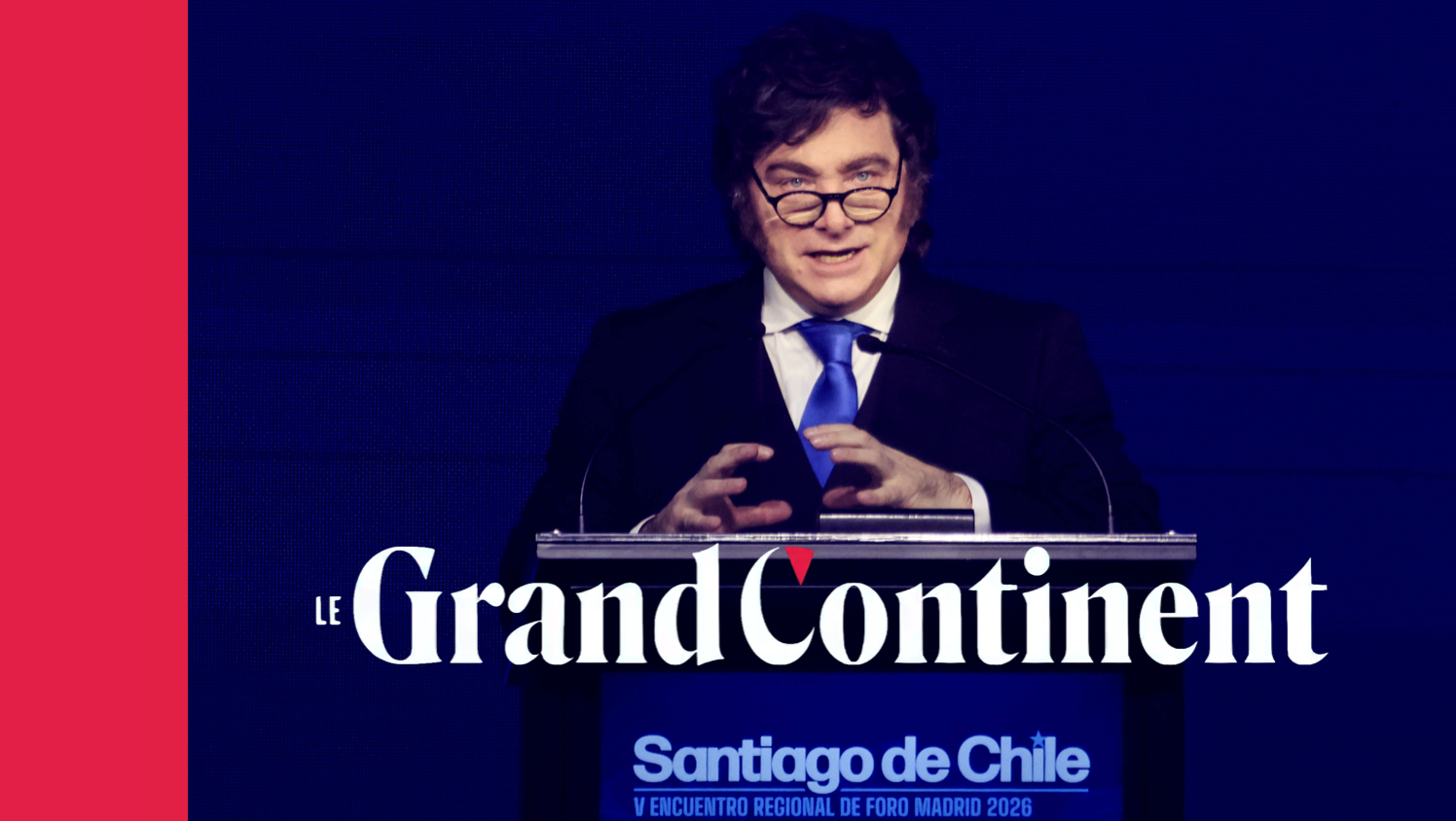
On September 3, the 5th Regional Meeting of the Madrid Forum was held in Santiago, Chile. Launched in 2020 by the Disenso Foundation, the think tank of the Spanish political party Vox, the Madrid Forum presents itself as a network of American and European far-right forces that organize annual meetings in different Latin American countries. After Bogotá (2022), Lima (2023), Buenos Aires (2024) and Asunción (2025), the Madrid Forum settled in Chile this year, taking advantage of José Antonio Kast’s electoral victory in last year’s presidential election, as well as the far-right’s “conquest” of another country in the region. Argentina, El Salvador, Ecuador, Honduras, Bolivia and Chile have recently been joined by Peru, Costa Rica and Colombia, with the Brazilian elections in October looming, in which the current president Luiz Inácio Lula da Silva will face Flávio Bolsonaro. The date was not chosen at random: it marks the fourth anniversary of the victory of the “No” in the referendum on the Chilean draft new Constitution, decidedly progressive, drawn up after the social uprisings of 2019.
Just like the Brazilian, Mexican and Argentine branches of the Conservative Political Action Conference (CPAC), which it draws inspiration from, the Madrid Forum has become one of the region’s main gathering places for the far right. Its summits bear witness not only to the rising strength of these political forces, but also to Vox’s strategy success in presenting itself as the European reference for the region’s right, thus supplanting the Partido Popular and the Trumpist network. The presence of members of the U.S. administration, as well as foundations and institutes tied to the MAGA movement and American conservatism, highlights the key role of Trumpism in building a transnational reactionary international.
Beyond the atmosphere of a “victory” the forum sought to convey, unlike previous editions, notably that of Buenos Aires in 2024, the Chilean meeting lasted only one day and did not feature the presence of Santiago Abascal, Vox’s leader, nor many of the region’s major far-right leaders. On the Vox side, however, Ignacio Garriga, the party’s secretary-general, Jorge Martín Frías, director of Disenso, as well as European Parliament member Hermann Tertsch and Spanish deputy José María Figaredo were noted among the attendees. The two other European political figures present in the Chilean capital were Hungarian MEP Kinga Gál, vice-president of Patriots for Europe, and Austrian FPÖ member Barbara Kolm, president of the Friedrich von Hayek Institute in Vienna and a member of the Mont Pelerin Society.
The American delegation was larger and carried more political weight, including Under-Secretary of State for Diplomacy and Public Affairs, Sarah B. Rogers, the president of the Heritage Foundation, Kevin Roberts, and other leading MAGA think-tank figures, such as the American First Policy Institute and the Hudson Institute, not to mention the U.S. ambassador to Chile. It is worth highlighting not only Kevin Roberts’s influence, present at almost every far-right summit in Europe and Latin America, but also Sarah B. Rogers’s, who announced in Budapest, in February, a program to fund trainings aligned with the White House in Europe, a program that was more recently implemented through a funding envelope of up to $25 million.
Among regional representatives, besides María Antonieta Mejía, vice-president of Honduras, the main figures were the presidents of Argentina, Javier Milei, and Chile, José Antonio Kast, who respectively delivered the opening and closing speeches.
Hello everyone. First of all, I would like to extend a warm greeting to my great friend Santiago Abascal, founder of this forum, who has always welcomed me when everyone turned their backs on me. Thank you very much, Santiago, as well as to all those who made this event so important for continuing to spread the ideas of freedom around the world. It is also a pleasure for me to be in Chile again, especially after the victory and the recent inauguration of my friend, José Antonio Kast.
The Chilean setting is emblematic because its recent history reminds us of the immense value of the cultural struggle: after the overthrow of communist Allende, Chile entered a period of stability and growth that lasted for more than forty years, and, thanks to that, it undoubtedly became an economic envy of the region. Yet, although it enjoyed the fruits of freedom, it fell into the ruse of 21st-century socialism, just like the rest of the region.
As one might expect, much ink has been spilled on the reasons for this phenomenon. Everywhere, the left has stubbornly argued that it stemmed from the inequality of the Chilean model or from similar questions, while in truth the inequality in Chile is lower than in any of the so-called socialist utopias, or that it was due to the standard of living of the poorest, when in reality, in Chile, the modest living conditions are better than in any other country in the region. We, however, know the truth: we know that the reason this uprising was inevitable is that, for too long now, the battlefield of ideas has found fertile ground here.
The ideas of freedom have triumphed in practice, but the path was left open for the media and universities to undermine and vilify them; and when they win in the arena of good and evil, they end up winning politically. This is how the country came to be plunged into an unprecedented wave of left-wing violence, which left dozens dead between 2019 and 2020, because the leftists, at a certain moment, believed they were right to resort to violence to advance their policies. Even within a functioning system that, year after year, produced better results for all Chileans, the left’s speeches and ideas convinced a large portion of the population that everything was going wrong and that the system had to be overthrown by force. But it did not happen overnight. The left built this false legitimacy after years and years spent infiltrating institutions one by one, and it sought to revel in this false sense of justice to topple the entire system that had lifted so many out of poverty.
Fortunately, this dark night was overcome and Chile chose once again the ideas of freedom. It woke up, just as Latin America is waking up, and it woke up because it has political figures with the courage to call things by their name and to say Evil as Evil and Good as Good.
Today, we are witnessing a shift that began in Argentina in 2021 and has gradually spread across the continent: Peru, Colombia, Ecuador, and many other examples testify to the winds of change sweeping through this historical moment. Today, the entire continent is turning toward the values that once made the West great, even after decades of socialist indoctrination. Little by little, we have shown them that we do not fear them and that we are ready to safeguard our civilization and our way of life. For from San Martín—the great liberator of America—we have learned that when duty calls, everything is permitted except not answering it.
But we must understand clearly what we are up against, for if we do not identify our opponent, we are doomed to lose to him. The left, regionally, has been organized for decades, since the era when guerrillas infiltrated the Cuban regime to spread their cancer across the continent. After the collapse of the Soviet Union, this left reorganized around the São Paulo Forum to redefine its strategy, to gain power through democratic means rather than armed struggle, uniting against what they called “neoliberalism,” a term devoid of real meaning, which often referred to a government that simply wanted to get its public finances in order. In plain terms, they did not want the ideas of freedom to triumph in the region after the global failure of Russian communism. Today, as they pass through their worst period, they continue to search for a way back. They destabilize, spread panic, send their militias to sow terror among the population, use the media to lie, among other things.
And above all, they attack every single institution of society to use them as venues for their ideas. They take advantage of the plurality of ideas encouraged by liberalism to infiltrate, then lock the door as soon as they gain control. For all these reasons, nothing will stop them from reclaiming lost power. In response, the right must also organize: if they had their International, we must strengthen our ties within our own international network, both regionally and globally. For we are not facing a local opponent, but a regional and global one. An opponent who thinks and acts transnationally, because their influence extends far beyond the borders of a single country, and all of this is nothing new. We observed it in the last century when all the world’s communist parties aimed to submit to the designs of the Soviet Union.
They had a modest mission to transform the world from the outside in, by corrupting the very essence of humanity. And they know that if they confine themselves to a single nation, they can do nothing; they will fail and be driven from power. This is what happened in Argentina, in Venezuela, in Cuba, and this is what always happens, because their ideas lead to economic and moral misery, and people flee their countries in search of a better life. That is why they cannot stop and must extend everywhere they have influence; that is why they must erect walls, barriers and every possible restriction to freedom; if they stay still, they die. The false nationalism they sometimes boast about simply masks this truth, namely that they constitute a movement without a homeland, without a future and doomed to cause the countries they settle in to fail. The best example yet is again the Soviet Union, which, when it ceased to expand, collapsed under the weight of its own inefficiencies.
Thus, for decades, the organized left subjected countries to its influence, hindering their development in the name of a radical social transformation ideology and at the expense of each nation’s national interest. The Argentine case is emblematic. They used their harmful ideas to impoverish us deeply and leave us defenseless against the threats of a world in constant evolution. But we love our country and understand that the only way to defend our peace, our sovereignty, and our national interest is to have a rich, dynamic country that attracts investments and has the resources to protect us. This goes hand in hand with eradicating the left’s impoverishing ideas, which want to see our countries subjected to an international regime of servitude, even if cloaked in nationalism.
The left organized itself within an international socialist network and, in the region, through the Forum of São Paulo, to enslave us by creating a vast prison from which it would be increasingly difficult to escape.
That is why the right must also organize, because this is a global battle to which each of our nations must contribute by reforming internally, removing the cancer of the left from its own institutions to become a strong member of an international alliance of freedom ideas.
In a world where relations between countries and global rules are redefined, friendly nations must behave as such, join forces, and support each other when needed. That is why we cannot remain divided, because we can ignore the problem, but the problem will not ignore us. We must set aside our differences and focus on what unites us. We are those who place human freedom at the heart of our model and those who understand that trade consists in exploiting these freedoms and is a source of prosperity. We are those who know how to punish wrongdoers firmly; we are those who face them. And, moreover, we are those who address the continent’s grave security issue, such as drug trafficking, because we know that without security against others’ violence there is no true freedom. And it is precisely because we agree on the essentials that we must unite our efforts to move forward. As I always say: evil organized is defeated by organized good; there is no other way.
In Argentina, thanks to this change in mindset, we see results that have helped spread ideas of freedom as never before. If three years ago Argentina was a warning about the abyss into which socialism leads, today it proves that when one maintains prudent economic stewardship with firm convictions, freedom grows, the economy expands, and insecurity recedes.
And this is what encourages the rest of the continent to take the plunge. Yet, this is not the case for the entire West. Unfortunately, Europe, the cradle of our civilization, is led, both nationally and supranationally, by bureaucrats determined to destroy everything we are. A radical left has taken control of the institutions across the continent. Spain is a striking example. Pedro Sánchez and the PSOE facilitate uncontrolled immigration and, on the other hand, systematically degrade Spanish identity.
In other words, Spaniards are taught to hate themselves and to be ashamed of themselves, paving the way for foreign hordes that will eventually replace them. The same plague extends across the Old Continent, where all nations led by progressive governments do everything possible to erase any trace of the West from the collective imagination, replacing it with a false multiculturalism. And those who have the courage to denounce and oppose this perverse plan are deliberately associated with the worst totalitarian regimes humanity has known, in order to silence their opinions.
Since the first day of my term, I have not ceased to warn the world that the West is in danger; I have repeated this many times, and it has not changed, even as we gradually wake up: day by day we wake with information reminding us of the stakes. Even in those territories we thought we had conquered, socialism lingers at the slightest relaxation on our part to return to power. Not to go further, in 2025, in Argentina, there was an attempted coup: Congress was used to attempt to pass dozens of laws aimed at breaking the economic and fiscal balance, to which were added seven dismissal attempts. They also attempted it from the street. Last year, we had to deport more than 10,000 people, and 14,000 since the beginning of the year.
But thankfully, our economic program is so well designed that it withstood all attacks. Thus, everything they attempted failed, but it cost Argentina months of growth slowdown and an uptick in inflation that we are once again eradicating. Nevertheless, beyond all that, what must be remembered is that this proves that we should not underestimate, from the outside, their malice and their firing power. In other words, they cannot allow the ideas of freedom to triumph, because otherwise their lie would collapse.
This is why we cannot let our guard down for a single second nor yield an inch. We know how they operate, we know they lie, distort reality, manipulate, we know they have bought the media to carry out psychological terrorism on the population. Worse still, they fund terrorists: they provide them money and, let’s say, when you travel to certain regions of the world to give a talk, the enemies of freedom fund terrorists to come cause trouble in Argentina, which we would call pickets at a conference. Recently, for example, in Argentina they even went so far as to invent that I had a health problem. More recently, they even invented that I had suffered a heart attack after a conference. They do not hesitate to make up and utter any absurdity.
I mean that this is just one example among thousands of media operations we have been subjected to. We know they are ready for any meanness to achieve their objective, which is nothing other than seizing power; they do so for power; power is what interests them and, of course, money too – they are always very generous, but with others’ money. It’s clear, is it not?
But beyond that, we have shown that it is possible to win, and not only to win but to govern. From the very first moment, we eliminated the Treasury’s deficit, which stood at five points of GDP; in six months, we eliminated the quasi-budget deficit, which stood at ten points of GDP. In other words, in six months, we swept away a consolidated budget deficit of 15 points of GDP. In addition, we fired more than 70,000 public servants, implemented 17,000 deregulation measures, and we are experiencing uninterrupted growth for 27 months. Moreover, we reduced poverty by 25 points, child poverty by 30 points, and cut extreme poverty by one third.
Exports are at record levels, consumption is at historic highs, and all of this is only the beginning of a model that puts Argentina back on the path to greatness. In other words, it is indeed quite curious, because sometimes in Argentina, when you turn on the television, you would think everything is going badly in the country; but if one analyzes the situation with a minimum of honesty and compares it with previous governments, it is clear that our model worked and that we are on the right track. Indeed, listen… to compare, if we look at the growth Argentina recorded over the last four administrations, for example under the second term of Cristina Fernández de Kirchner, it stood at 1.5%. Under Macri, the economy contracted by 3.9%, all of this in four years. Under Alberto Fernández, this decline was reversed and, if the estimates for this year and next hold, after growing 6.7% in the first year and 3.5% in the second, Argentina will have expanded by almost 20% in four years, while OECD growth stands at 6%. And we achieved this after twelve years of stagnation with no growth. Furthermore, if one takes a simple arithmetic average, we would show growth rates between 4 and 5% on average per year, whereas during the 100 years preceding our arrival, the average growth was 1%. There is no doubt that we are growing the economy.
And as I anticipated about poverty, even based on quarterly figures, once the economic variables were revised, the rate had risen to 53%. Today, it is 28%. This means we have pulled more than 14 million Argentines out of poverty. Moreover, despite the considerable transformations we are implementing, we have still created more than 500,000 net jobs under this government. And if we also take into account the civil servants we fired, the total number of jobs created since we came to power stands at 600,000; the market indeed generates jobs.
As I mentioned earlier, we balanced public accounts from the first month of our term and we are now in our third consecutive year of a financial surplus. That is, a surplus after interest payments. Consequently, the consolidated debt, which hovered around 100% of GDP, is now below 40%; the country risk, which had reached 3,000 basis points, is now around 500, and if one considers the current administration’s term, country risk has practically been eliminated. Additionally, exports have grown twelve times faster than GDP, with ten of the eleven private sectors of the economy now exceeding the pre-power levels. Moreover, a precise analysis, such as that presented by my deregulation minister, Federico Sturzenegger, explains how the opposition operates. He describes something we experience daily: they have no serious position on any of the central variables they criticize, whether growth, poverty, employment, or fiscal balance; and since they have none, they do the only thing they know how to do: switch from one topic to another to see what sticks. One day they claim that GDP is rising, but that not all sectors are growing; the next day they claim that employment is rising, but the number of declared workers is falling. Then they claim wages are rising, but not equally for everyone. There is always a new excuse, because what they need isn’t the truth, but a narrative, and each of these excuses collapses when examined seriously, with data to back it up, because that is how they are. Since they do not have a viable program for the country, they jump from topic to topic solely to push the idea that everything is going wrong.
It is extremely important to know how to confront them, to understand the strategy they use. They rely essentially on two sophisms: the cherry-picking fallacy and the fallacy of “everything by part.” For example, when we take the Monthly Economic Activity Indicator, which is a proxy for GDP, there are 16 sectors. One of them is related to the public sector. This sector is generally in decline, but that reflects government policy. So it’s not a problem; but among the remaining 15, 13 are expanding, that is, 13 out of 15 are growing. One is stable and one is decreasing. What do they do? They focus on the sector in decline and pick the worst of them all. This is called cherry-picking. And from there, they want to claim that this is the overall situation of the economy. Therefore, the best antidote against these dirty leftists who deny reality is data.
Because the reality is that they do not seek to solve anything. All they care about is spreading their ideology to seize control of public coffers, using them as war spoils while keeping civil society under fiscal yoke. Otherwise, look at Pedrito in Spain, isn’t that so? We are exposing him… he is dirtier than a potato, and he was quite offended when I told him, and the rabble that surrounds him, that it was a government of thieves, and it seems the facts confirm it.
Now, these strategies I’m talking about are not new: they are exactly what they did with Mauricio Macri’s government in 2017, when the economy was growing and poverty had reached its lowest level in decades, and yet they managed to sow chaos in the streets until he lost his course. The Cambiemos government gave in to political pressure from both the opposition and the far center. It was influenced by those who threw 14 tons of stones at him and by supposed allies who urged him to pull the handbrake. We learned from this experience. We will not be derailed by their rhetoric. And we will not, because we know that, whatever noise they make along the way, beyond the noise there is always reality, and we are on the right track. The model works. We will not yield an inch on any of our policies. Because the reality is that the ideas of freedom work when implemented and sustained, because they are the right ideas and those that all our countries need to develop. That is why we simply need to organize and show the population that there is political will to carry out this reorientation demanded by the silent majority. People want nothing more than to live in peace, to trade freely, and not be subjected to the tyranny of a policy that steals from them every day the time they could spend with their loved ones. The left’s greatest weapon is our own fear, our own timidity, our own reluctance to say “no” to them; that is why it loses strength when the people begin to tell it: “Enough, the leftists.” We are engaged in a battle that surpasses each of us and our nations. It is a global battle between Good and Evil. The Good is embodied by those who share respect for life, freedom and property, for the Good and the Beautiful, for the gains of our past and the culture in which we grew up and which made the West great. Meanwhile, Evil is led by the radical left and terrorism, whose aim is to sweep away our way of life through violence and propaganda. It is an existential battle that is about to be decided. History will judge the side we chose, and those who prefer to remain indifferent should know that this is precisely what the camp of Evil desires. For my part, I clearly know why I fight. For the ideas of freedom, wherever and against whoever.
And let us not be discouraged by the idea that we cannot do very much, because the difference between doing little and doing nothing is vast, and it is by acting a little each day that one ends up achieving many results. I believe this forum brings together people who share the same convictions and the same commitment to lifting our nations out of the decadence into which they have fallen. That is why, today more than ever, we must stay firm in our course and in our beliefs. If we maintain our political will and do not allow ourselves to be diverted by the siren song of statism and communism, we will prevail, have no doubt.
For all these reasons, may God bless you all, may the forces of heaven accompany us, and long live freedom, damn it; long live freedom, damn it; long live freedom, damn it! A big thank you to all.