
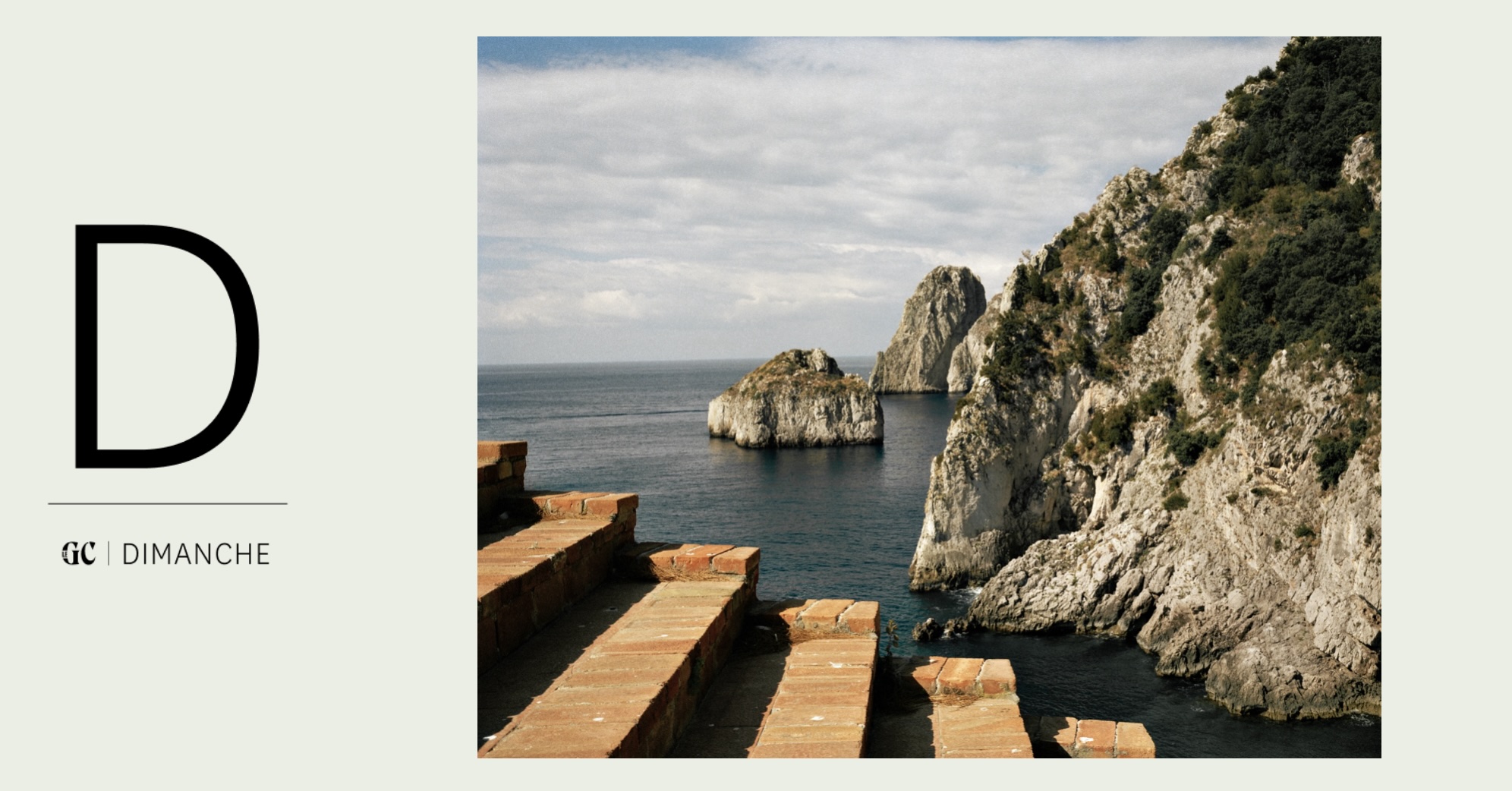
“Hello, Casa Malaparte?” answers a housekeeper in a soft voice. Moments later, she comes down to the landing to collect the luggage as soon as one steps off the zodiac. Thus one docks in front of one of Italy’s most famous houses — perhaps in the world.
On Capri, near the Faraglioni, rises this red house, extended by its spectacular staircase and topped by its white sail, becoming an icon on par with a pair of Nike.
The house is not open to visitors. It remains inhabited by its owners, the heirs of Curzio Malaparte, who indeed bear the surname Suckert, the authentic family name of the author of Kaputt and The Skin. Son of a Saxon dyeworker settled in Prato, Kurt Suckert later adopted the pseudonym Malaparte. “The black Suckert is still used today in the textile industry,” explains Niccolò Rositani-Suckert, his great-nephew, guardian of the family archives and of the house’s spirit.
Grandson of Malaparte’s sister, born into a family of scientists, Rositani-Suckert is a lawyer, advisor to the Milanese publishing house Adelphi and other Italian publishers. He also teaches copyright law at the Politecnico di Milano and is a reference in defending intellectual property, whether artistic or architectural. His resemblance to his great-uncle is striking. With an almost militant determination, he guards this family promontory against the onslaught of mass society.
There it is, precisely this mass society. Stars, gozzi, yachts and ferries stream by at the foot of the cliff, framed by the four immense bays — all different — of the vast drawing room on the first floor. The loudspeakers on excursion boats repeat the same commentary over and over: “Here is Casa Malaparte, a work by Adalberto Libera, bequeathed to the Chinese government…” From here, the outstretched arms of tourists are visible, smartphones pointed at the house. Their dream is obviously to go up, to take a selfie, and perhaps, to encounter those mysterious Chinese said to occupy it.
Rositani-Suckert, for his part, would sometimes prefer to repel them with cannon fire. He tires of calls from those asking to visit “the house of Alberto Libera,” mangling the architect’s name of the Palazzo dei Congressi and the Post Office Palace in EUR, Rome’s grand rationalist quarter. In his view, Libera has nothing to do with this house any more than its supposed Chinese occupants.
“This house has nothing to do with rationalism. If it belongs to a movement, it would be surrealism,” he declares. And the topic seems to exhaust him. The family archives tell another story, however. They show that Malaparte — writer, journalist, screenwriter, advertiser, but also, at times, maker of furniture and objects, a nearly unique figure of total creator in 20th-century Italy — designed this dwelling himself. He called it Casa come me — “a house like me.” An architectural self-portrait as much as an aesthetic one, infinitely more personal than many works by the celebrity architects of his era.
The evidence accumulates. The congratulations of Aldo Morbelli, an important architect of the fascist era, praising “the rare qualities of a non-architect.” A municipality document of Capri attesting that no project signed Libera ever existed for this house. The preparatory studies of the famous white sail, carried out by the futurist Uberto Bonetti, who notes having worked “under your aesthetic and constructive direction.” And finally Malaparte’s own drawings, where the entrance was originally planned at the foot of the monumental trapezoidal staircase — a homage to the Lipari church, the island where Mussolini had sent him into exile.
The transformations continued as construction progressed. The house was born white before turning red. In a text published in 1940 under the title Una casa tra Greco e Scirocco, Malaparte describes his project himself, in a language where architectural reflection blends with literature: “Not only the lines of the house, its architecture, but also the materials with which I would build it must harmonize with this nature, both wild and delicate.”
There too, everything is by Malaparte.
The original drawings have been preserved. Alessia Rositani-Suckert now oversees their study and promotion, while their son Tommaso works on reissuing a selection of furniture and objects imagined by his great-uncle. A way of reminding that Malaparte was not only a great writer, but one of those rare creators able to move with the same freedom from literature to furniture, from architecture to cinema, from journalism to staging his own life. A true total creator, he embodied that almost disappeared figure of the polymath creator, whose each work seemed to extend the one before.
Only eight pieces presently make up this catalog: a few frames, the grand table, the bench, several luminaires and other objects designed with an almost manic obsession for detail. Each type of wood is chosen with the same care as in Malaparte’s time, with the aim of reviving, without betraying, creations that had long remained confidential.
The house’s activity is not limited to preserving a heritage. For several years, it has become a place of research, transmission, and creation. Without ever giving up its private character, it regularly welcomes architects, art historians, and scholars from around the world. Richard Rogers, Renzo Piano, Achille Castiglioni — who recalled waking one morning to find a gecko in his bed — have stayed there, often in collaboration with American universities.
This openness remains deliberately limited. It is not a plan to turn the house into a museum, but to preserve its deep nature.
“Casa Malaparte was designed as a house before it became a monument,” explains the London architect Billie Lee, who has for several years accompanied the site’s cultural activities. “Opening it up massively to the public would amount to destroying precisely what gives it its character.”
The family thus favors another path: hosting few visitors, but giving them time to understand the house, rather than consuming it as another stop on Capri’s tourist itinerary.
Contemporary creation also has its place there. Over the years, the house has hosted artistic projects and events organized with a very small number of guests, in a deliberate dialogue between heritage and creation. Far from turning the place into a glamorous backdrop, these initiatives contribute to its upkeep and its international influence.
They also help finance conservation work that is particularly demanding. The sea spray hits the façades directly; storms sometimes reach up to the first floor. Plaster, joinery, stone, woodwork: everything must be restored continuously, with a level of meticulousness far greater than that demanded by a contemporary villa, even a luxurious one.
“Maintaining the house represents a substantial effort,” explains Alessia Rositani-Suckert. “We have never benefited from public funding; each intervention is made possible thanks to the activities we develop around Malaparte’s work and through the family.”
This distinctly Anglo-Saxon approach to managing a historic house continues to spark debate in Capri. Many dream of seeing Casa Malaparte become a national museum, open daily to visitors. Others challenge its use for occasional cultural projects or private events.
For Niccolò Rositani-Suckert, the question is almost inverted: preserving a work sometimes requires restricting access, even for those who wish to see it.
Yet a few privileged people still cross the threshold of the house. Not as tourists, but as guests.
Access follows no official protocol. There is neither a ticket office, nor guided tours, nor a public calendar. Entry is by invitation, or sometimes after a simple phone conversation, when the owners deem the visitor’s curiosity to outweigh mere consumption.
This freedom of choice regularly invites criticism. Some continue to evoke the old controversy surrounding Malaparte’s will, which in 1957 wished to leave the house to an Italy-China foundation. The story is indeed less mysterious than the legend. At the time of his death, the People’s Republic of China was not recognized by Italy; the legal conditions of the bequest could not be met. Ownership naturally reverted to the family, who has never ceased living there and ensuring its preservation.
Others reproach the house for opening only to a select few: from time to time, the great art dealer Larry Gagosian gathers the crème de la crème of his international clients for discreet happenings; and on June 10, 2024, Jacquemus was granted access: for its fifteenth anniversary, the brand presented its collection “La Casa,” forty-seven silhouettes climbing the stairs to the roof, filmed by drones, to the music of Contempt.
Chinese visitors, for their part, have never come to inhabit Capri’s cliff.
Perhaps this confusion says something about our era. We increasingly struggle to tolerate that a place of such beauty remains private. As if everything photographed, shared, or admired must eventually become accessible to all. In Capri, many dream of a museum; others imagine a public foundation run like a major heritage site. Rositani-Suckert defends an idea exactly the opposite: some works can only continue to live by escaping the logic of constant visitation.
It is a very contemporary paradox. The best way to preserve Casa Malaparte may be precisely to prevent it from becoming another monument.
While boats continue to pass by the cliff, the loudspeakers endlessly repeat the same, often approximate, story. Smartphones rise, lenses zoom, photos accumulate in digital memory. Seen from the sea, the house has become a universal image.
Seen from inside, it appears quite differently.
Little by little one understands that it is not merely spectacular architecture, nor even the residence of a great writer. It is perhaps Malaparte’s most complete work: a book built in stone, where every window, every piece of furniture, every staircase, every silence contributes to a single self-portrait.
As you leave, you carry away less the memory of a house than that of a spirit. The boats resume their patrol, the guides’ voices drown out the sound of the waves, phones begin to crackle again.
The house, for its part, continues to watch the sea.