
Today, Friday, August 28, marks six months since the United States and Israel launched a war against Iran. Framed as a campaign to destroy the country’s nuclear and military infrastructure, the operation has evolved into a protracted conflict that the United States is struggling to end.
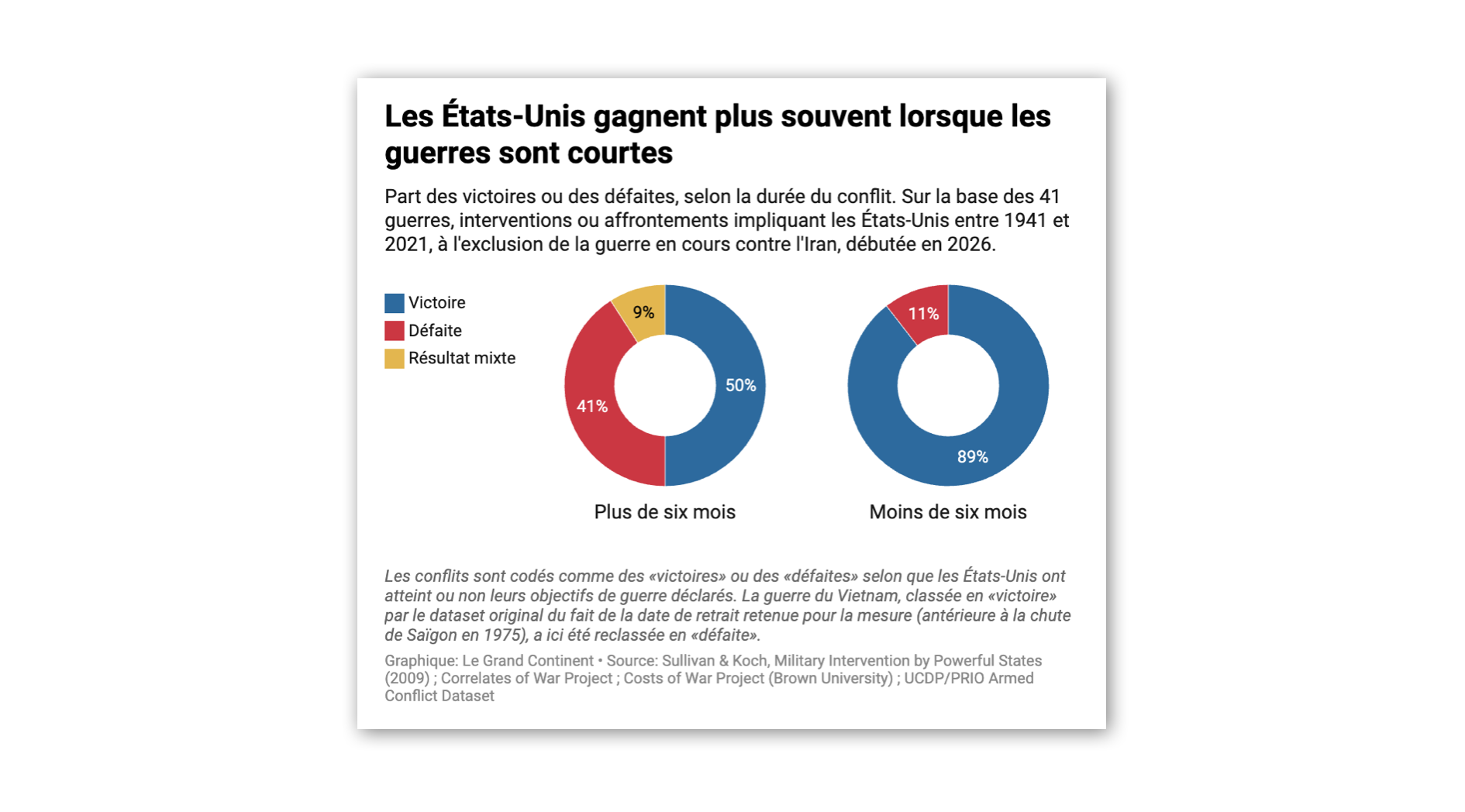
- Among the 41 American military interventions recorded since World War II—compiled from Sullivan and Koch’s MIPS data, supplemented by Brown University’s Costs of War Project and the UCDP/PRIO Armed Conflict Dataset for post-2001 conflicts—22 lasted more than six months.
- Among these 22 interventions, by recategorizing the Vietnam War as a defeat, the United States counts 9 defeats and 11 victories. For two of them, the Iraq War and the Libyan intervention, the outcome is mixed: an immediate tactical success followed by a long-term strategic failure.
The victory rate for conflicts lasting more than six months is thus significantly lower than that of shorter interventions: 50 percent, versus 89 percent.
- This gap reflects the increasing difficulty faced by the United States in securing decisive wins as a conflict drags on.
- This reality, applicable to both interstate conflicts and asymmetric wars, is illustrated by the American war against Iran, but also by Russia’s war against Ukraine, whose duration has surpassed that of World War I.
Military victories are rare in contemporary confrontations.
- According to data compiled by the Uppsala Conflict Data Program (UCDP), less than half (46%) of the 63 conflicts recorded over the period 1946-2005 ended in a ceasefire or peace agreement.
- Only one in five conflicts (21%) leads to a winner/loser scenario, while a third (33%) ends in a blurred situation in which neither a peace accord nor a clear victory emerges.