
Iceland is a small country, but highly connected. How does this duality, geographic isolation on one hand and global openness on the other, reflect in Icelandic identity?
That’s a big question. We have been isolated for a long time, and now we are hyperconnected, torn between the United States and Europe.
I think for a long time we have been more American culturally. Our culture is more American.
Why?
We were colonized for centuries, living in hardship and poverty, without a formal education system. People were very poor, suffering from hunger and disease: the situation was really difficult for most of our ancestors for centuries. Smallpox killed about a quarter of the population in the early 18th century, and the Lakagígar eruption of 1783 caused a massive famine that also killed around 20% of the population. There were almost no social classes. Of course, there were priests. The traders, for the most part, were Danish, thus from the colonizers’ people.
Among Icelanders, there were perhaps a few doctors, but most were herders or fishermen and worked under extremely harsh conditions. If you were not married or came from a poor family, you could be considered a slave: you could not own land or live freely. Thus, we remained backward for a very long time, perhaps until the end of the 19th century, or even until independence and the proclamation of the republic in 1944.
What happened at that moment?
In the years preceding independence, we tried to forge our identity. We gained internal autonomy in 1904, and we needed a sovereign state in 1918, still linked to Denmark by the person of the king. From the late 19th century, the emphasis shifted to culture: literature, the national theatre, the art gallery, and the national museum. We had no money, but we wanted to build, early in the 20th century, a theatre, a gallery, and a museum. These are things we instinctively understood as important. It is a source of pride for those who have nothing to have culture.
During World War II, American troops arrived in Iceland. The idea was to avert a German takeover, and then, with joining NATO in 1949 and the defense agreement of 1951, to protect the country, because Iceland occupied a strategic position between Russia, America and Europe.
And from your point of view, have Americans never left?
Yes, you could say that. They arrived in a country where there was almost nothing, and suddenly there were roads, money, new things, well-dressed men, products never seen before, and even fruit. This tension between Europe and the United States is being revived today because of Trump’s imperial projects. Since independence, the United States has been our most important ally, at least politically.
This was also a way for us to rebel against the old world, Europe that colonized us. The old world was Europe. So we have, in a sense, Americanized as a form of rebellion, and also because, after all, we are not connected to Europe by land.
Personally, I was born in this Iceland split between Europe and America, almost literally.
That is to say?
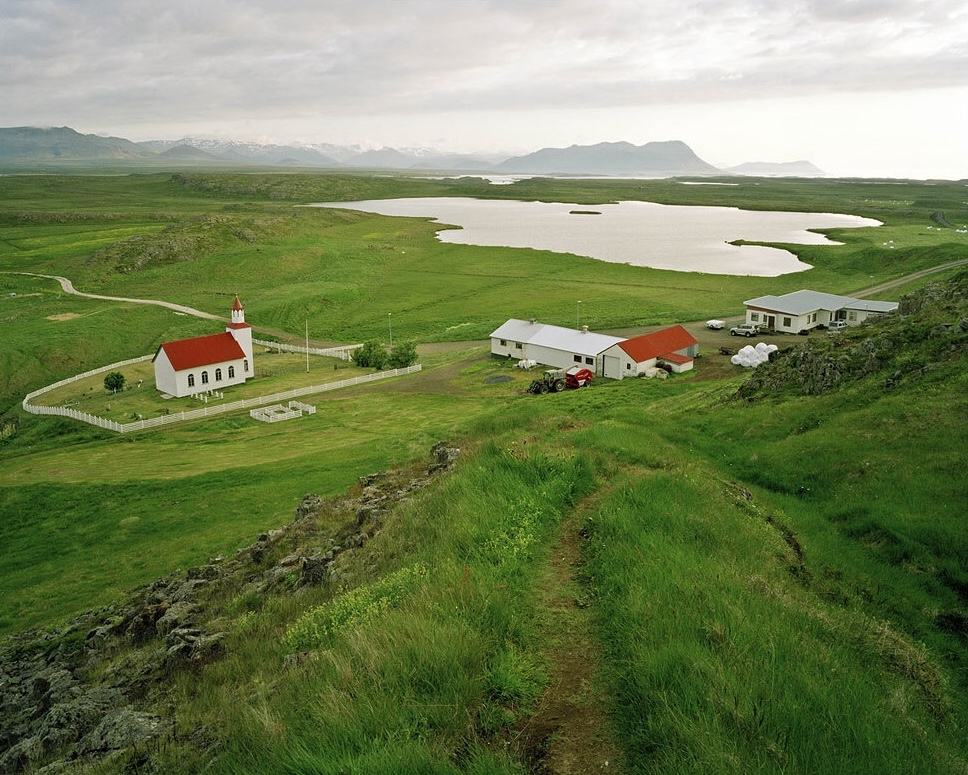
Geographically, I was born in the European part of Iceland, near Selfoss in the south, which is, in fact, a very American place, even though I grew up on a farm, so it was a bit different. But there was television and American media, like everywhere.
With Trump, what’s happening is fascinating to observe, but also dangerous. The American ambassador spoke of making our territory the 52nd state of the United States, and Trump himself began to confuse Iceland and Greenland, as if it didn’t matter…
Do you think your parents’ generation, and even more so that of your grandparents, is very different from Icelanders your age?
Each generation believes the previous one is different. But we are probably less different than we think. That said, between us and our grandparents, the change is immense. My grandmother and grandfather were born into a very different world, that of torfbær (peat houses).
My grandmother, born in 1936, hardly ever went to school. She learned to read thanks to a man she brought milk to. It’s really another world. They were very afraid of foreigners, of the unknown, and that’s completely natural.
How would you describe the political and social mood in Iceland today?
We hear nationalist discourse, a bit like everywhere. What’s interesting with Icelandic nationalists is that they have changed a lot. Before, their main idea was linked to independence and national liberty, even if that was already an illusion, because we can never be completely independent. We are a small country dependent on others, like an insect depends on a fruit: without the fruit, it cannot exist. It’s a symbiotic relationship. We are too small and, moreover, we cannot produce a lot of things ourselves. In fact, we are completely dependent.
Today, the far right, but also the liberals and the center, seem to be primarily concerned with regaining control of borders. But we are an island, our borders are natural by principle. And yet, they talk about migrants, asylum seekers, refugees, as if they constitute the greatest threat we face. Yet, when you look at the statistics, that simply isn’t true.
What do they say precisely?
We hear politicians openly saying that we must face the truth and that the truth would be that there exist certain groups of people coming from certain places – they mention Muslims – who would pose problems and that they should be prevented from coming, because they could not adapt. They say we must close the borders, protect the Icelandic, protect the country. I certainly think the Icelandic language must be protected, but I do not ignore that all languages evolve and change with time. The fact that more people speak Icelandic, including people who arrive in the country and learn it, is, on the contrary, a very good thing. It benefits the language.

Besides the border question, one notices that these same people do not seem bothered when the U.S. ambassador says we should become American. What nationalist are they then? They say they are proud of independence, they hate certain foreigners, but they are pro-Trump and use the same propaganda. They seek something authoritarian, and today it is embodied by the President of the United States.
What is your view on the debate about joining the European Union?
I am rather pro-European. Many Icelandic leaders oppose it, of course, because they profit from inflation, and ordinary people pay the interests… It’s a kind of oligarchy. Ordinary people, like me, would like Europe to take a closer look at us.
The problem is that we think we are free and independent, but we are not really. As I said, we are a very small state. We depend on a larger system. If you remove what nourishes us, we die. Without international relations, we are dead. In a way, we are already a bit the 52nd state of the United States… When the American ambassador said that, it didn’t shock me as much, because I thought: well, that’s somewhat what’s already happening.
Has the Trump presidency changed how Icelanders view the United States?
Yes, I think there is perhaps a slight move toward the European Union in public opinion. But we are still very divided, probably about half and half. Many people do not realize that we are already part of the European Economic Area and the Schengen Area. This means we must apply most European regulations, without the right to vote or the power to decide. Fishing remains the main exception, the big sensitive issue. But most of the time, people do not want to analyze the situation to see if a compromise could be found.
Do you think, if another Nordic country moved closer to the European Union, Iceland would be more likely to follow, or stay out?
I feel that we have often been too lax to take a stance in the past. We always wait for the great nations to act before doing something. Yet one of the incredible qualities of a small country is that distances between people are very short. Everyone knows someone. We should be proud of that and use it to our advantage to take positions on key issues, such as human rights, for example. I would like us to be a bit more at the forefront, more progressive. But we have been fully independent only since 1944, which is still relatively recent. Perhaps we are not yet experienced enough in this exercise.
What do you think, for example?
Instead of building a truly humane society, we have often let money take the upper hand. Yet there is real solidarity here, tied to the fact that we live on an island. That’s one reason I did not leave: my children can run by themselves to the playground without me constantly worrying. They have a freedom that is almost nowhere else, and it is extraordinary.
We have the opportunity to move in this direction, to rely on this proximity and solidarity. But selfish discourses dominate, or is it because we have simply followed a broader trend? In a capitalist society, we have let money become the real governor. Instead of vigorously fighting to preserve the nature we enjoy, we sometimes invite large companies to destroy it and pollute. It is money that ends up ruining everything.