
All summer, the Grand Continent will stay in motion. Each day, we will bring you, wherever you are, ideas you won’t find anywhere else (but which will be everywhere by the time the new season begins), texts you can’t find elsewhere or refreshing with our Sundays. To receive them directly in your inbox and support this momentum, consider subscribing to the magazine
When we invited you to pick a place of affinities and desire for our summer Grand Tour series, you did not choose one of the splendid locations of the Greek Mediterranean, but Germany. When did you first fall under the charm of this country?
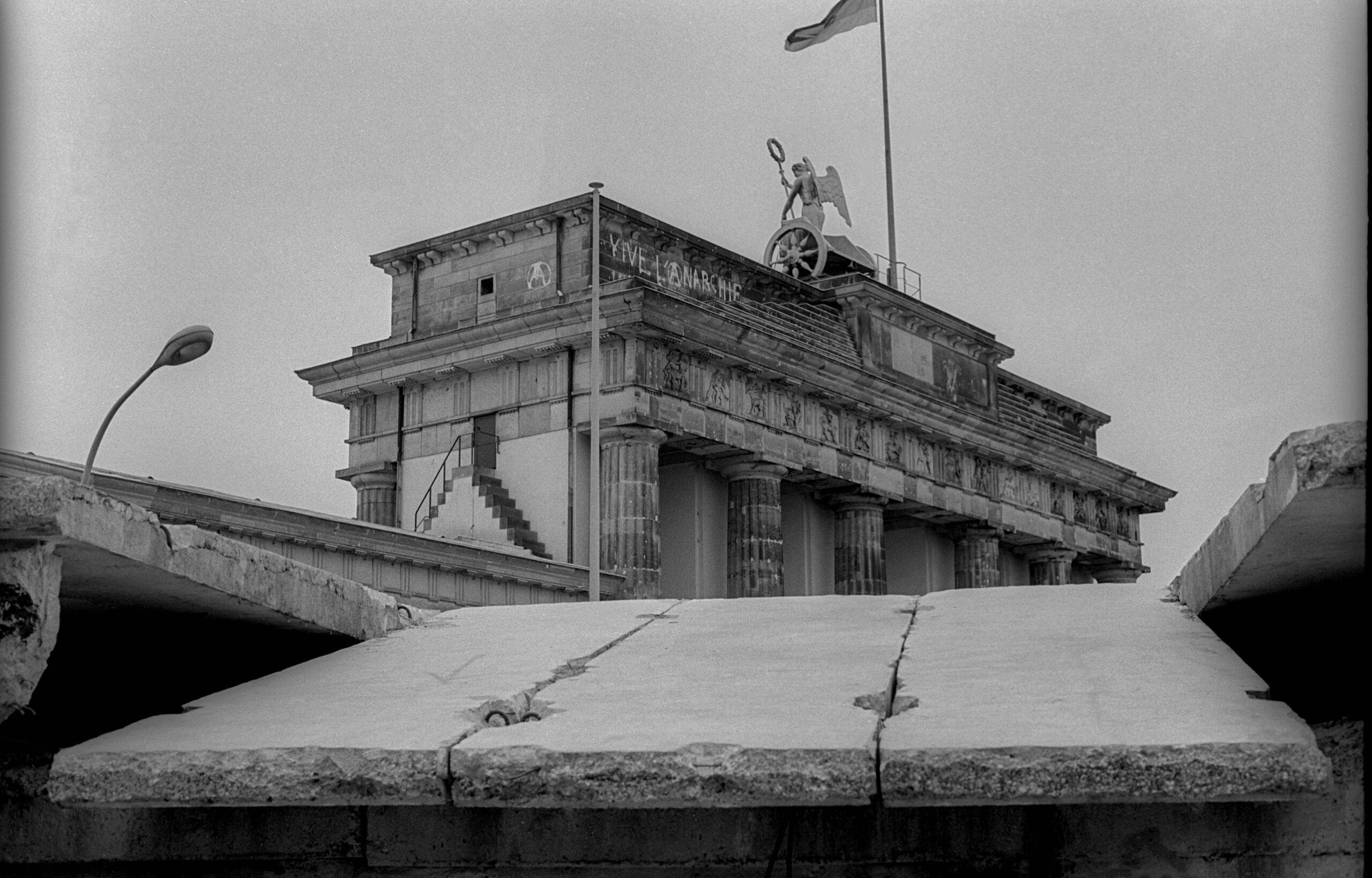
I first knew Germany during the era of division between the GDR and the FRG. The fall of the Wall in the night of 9 to 10 November 1989 was an unforgettable event. Thousands of East Berliners making their way around 11 p.m. to Bornholmer Strasse after Schabowski’s confused declaration and his enigmatic “immediately, without delay,” then guards overwhelmed by the crowd to whom the border post commander finally asked to open the barrier, and the incredible that followed: the crossing was free.
East Berliners crossed on foot, or even by car; some climbed the wall, others ascended to the top of the Brandenburg Gate, throughout the night. We watched these images live, feeling as if we were witnessing an event that had seemed inconceivable only a few weeks earlier. The moment was extraordinary. I felt so close to all those young people my age, with their hopes.
Before this event, what did you know about Germany?
I had already become interested in Germany in the 1960s-1970s, and in Ulrike Meinhof, one of the leaders of the Red Army Faction (RAF). I opposed the political violence of that organization, rightly deemed terrorist, but its rebellion expressed, in my view, a rejection of a society that was satisfied with its recovered comfort and in which youth demanded accountability.
The generation of German youths born in the 1940s was a generation without a father or with fathers who were “damaged”: accomplices in past crimes, men broken after long imprisonment in the USSR, sometimes fugitives, almost all condemned to deceit, often Mitläufer, the “followers” of Nazism, who now wanted to be innocent.
In what context did these “fatherless” youths grow up?
This generation had grown up in a country destroyed by 70%, occupied until 1949, it had known the “zero year,” where the only rule was to survive at any cost, then to forget and to intoxicate itself, to wash its conscience in daily torments and the resigned acceptance of the destruction endured. This first post-war generation could place no trust in the one that had come before it.
She had been raised in the silence and the powerlessness of relatives who could not explain how, day after day, for every adult, for every family, it was possible to witness horror taking hold and to avert their eyes.
In the 1960s, however, Germany reconnected with economic growth.
Indeed, adults who reached their fifties in the late 1960s saw a country in full bloom—that was the “economic miracle” (Wirtschaftswunder). Many former Nazis held key positions within the German state apparatus, notably within intelligence services where they were regarded as experts in fighting communism, but also in the business world and the private sector. With the Vietnam War, this reality contributed to the frustration and anger of a youth who could not look at their country’s past without facing horror.
After the attempted assassination of one of West Germany’s leading student movement figures, Rudi Dutschke, protests grew more violent and police repression followed. The rage and despair of these young people bearing the consciousness of a grave fault, but without words or narratives, which forced them to advance as sleepwalkers in a prosperous society, seemed to illustrate an “German problem” far older than Nazism to me.
It was after these years of violence that Germans finally took the initiative for a second denazification, not one led by the occupying powers, but by themselves, with trials against many people who had escaped American investigations, even if the accused are now nearly a hundred years old.
Was this surge of German youth the moment you projected yourself into? Do you feel it was a transnational phenomenon for your generation?
Yes, it left deep and lasting traces in German culture, that is certain. The television series devised and directed by the filmmaker Edgar Reitz in response to the 1979 broadcast in Germany of the American series Holocaust (which had been a shock for the German population) shows it poignantly.

Heimat tells the story of a family living between the Rhine and the Moselle from 1919 to the end of the 1970s, then that of their children, students at the Munich Music Academy in the 1960s. Two more seasons were released after reunification, in 1992 and 2004, as well as a film about ten years ago.

Patrice Chéreau staged the series in France, at the Théâtre des Amandiers in Nanterre, on 24 and 25 November 1984, for fifteen hours straight. All the young people my age who were in the room were struck by the poetry of the images, the subtlety of the analysis, and what we felt in living in this country despite its past.
Was it also a way of paying homage?
It is a homage to the creative force of the youth of that era, to their explorations and experiences. Some wrote scores with, among the instruments, a vacuum cleaner or a semi-nude woman seated on the floor, whose back took the shape of a cello, in the Bauhaus lineage, foreshadowing Fluxus and all subsequent movements. In rupture with the American narrative of Holocaust, Edgar Reitz wanted to speak of a modest family, of “good” people swept up by Nazi horror, while trying to understand what this feeling of German belonging, the meaning of Heimat, really is.
What about the current German relationship to Nazism? Do you think the country’s duty of memory has remained the same since the end of World War II? Does memory still safeguard democracy?
Just an anecdote. I was in Berlin in spring 2013. The city center was covered with posters recalling every episode of Hitler’s rise to power, from January 30, 1933, to the summer of 1934, 80 years earlier. On the sidewalks of the famous Unter den Linden avenue, Morris columns stood every 15-20 meters, each evoking through numerous photographs a man or a woman who left Germany at that time and never returned: killed, exiled, disappeared. Jews were very numerous, but many others too—Remarque, Marlene Dietrich, von Sternberg, Thomas Mann, then Heinrich Mann—political opponents, Communist activists, and also the great novelist and essayist born in Galicia, Manès Sperber, whom I only met once before his death in 1984.
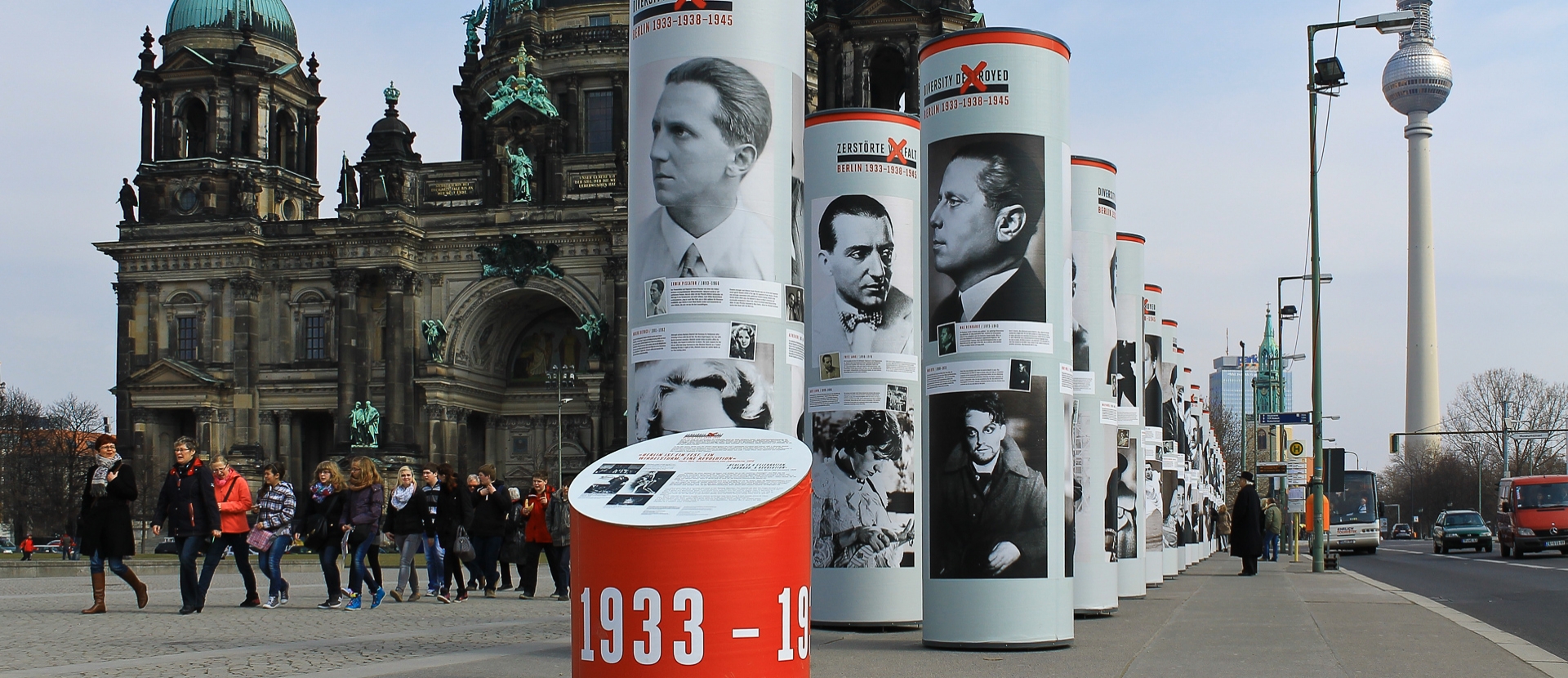
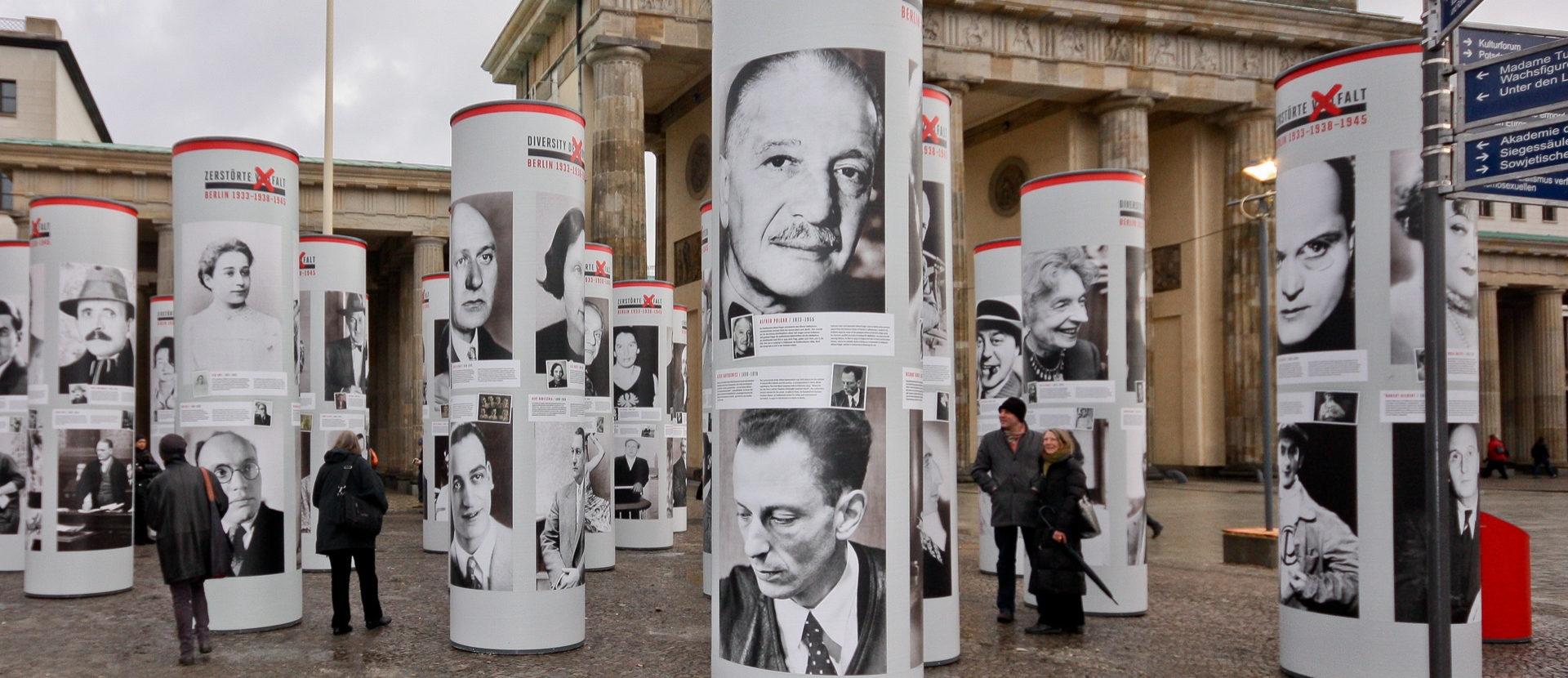
The city had become a memory, a reminder, almost omnipresent on every medium that could hold a poster. I was unsettled.
Why?
I felt that with this, Germany was sending a message to all of Europe: everything these posters evoke happened in these places, in this country, the responsible parties were of the generation of our grandparents, but we, the Germans of today, did not participate, we can no longer be guilty.
Yet, we have the duty to preserve all the vestiges, all the pieces of evidence: the photographs, the archives, the names of the dead, the places where they lived. This atrocity concerns Germany first, but also all of Europe. The era of collective guilt is over, what remains is the individual responsibility of each person, of each family, of every social group to explain concretely how this could have happened.
Real national celebrations, as we know them in France, do not really exist in Germany. It is hard to find in German history victories to celebrate. On what, then, is the country’s national narrative based, if one exists?
Germany indeed has the peculiarity of having very few victories to celebrate. There is hardly any national monument praising such or such war. The German states fought each other for centuries before uniting in 1871, so that fact is avoided in national memory. And as for the 1871 victory, it sparked a terrible momentum that is not worthy of celebration.
Apart from Arminius’s victory over the Roman legions (in the year 9), and a few successes during the War of the Austrian Succession, German history is marked by defeats and terrible destructions—think of the Peasants’ War of the 16th century, Louis XIV’s sack of the Palatinate, the Thirty Years’ War, and the two World Wars.

The principal, and often sole, message of Germany’s memorials is “never again.” In fact, Germany does not really have a national narrative: declared guilty at the end of World War I, cursed for the twelve years of the Third Reich, divided for forty years of communism in the East. Yet, this does not prevent a very strong sense of belonging within the country.
Where does this belong come from?
It is at the heart of what I have called the “German problem.” This sense of belonging—this Heimat, to reuse the title of Reitz’s series—is hard to grasp for a country whose borders have constantly shifted, with no single religion, and with vast regional differences. “Where is Germany? We cannot find it,” Goethe and Schiller asked in the Xenien. Belonging is first founded in language and culture. It has sometimes been understood as the coming together of all German-speaking communities, thereby serving as a justification for irredentist ambitions and the worst forms of pan-Germanism.
The German language is much older than French: in archaic form, it was spoken even before the Christian era. It is a language not derived from Latin, unlike French, which would not be recognized as a distinct spoken language from Latin until the 9th century, and later as a written language. It is very likely that Charlemagne’s language was Franconian, an early form of Old German. Before World War I, German was spoken from Strasbourg and the Northeast of Belgium to Königsberg—today the Russian exclave of Kaliningrad—and Eastern Galicia—which corresponds today to the Southwest of Ukraine—throughout Central Europe. It was also the language of the Jewish minorities of Central Europe, such as the German-speaking community in Prague.
Was it through its writers that you fell in love with the German language?
I have always been struck by Canetti’s remark about the responsibility placed on exiles to “save the German language” from Nazi distortion.
Most writers who left Germany permanently in 1933 continued to write in German, the language embodying the unbreakable link to culture. This was the case for Thomas Mann, Elias Canetti, and Manès Sperber.
With one striking exception: Hannah Arendt.
This was true for almost all philosophers, and for some writers, such as Arthur Koestler, who came from Hungary and adopted English after settling in London.
Why do people sometimes pit the “German soul” against the “French esprit?”
The German soul comprises its myths, its poetry, its music, romanticism, its speculative and theoretical mind, the lure of the forest, the world of the Grimm tales, both alluring and formidable, the figure of the Wanderer, but it has also at times been an insane ideology of a Germanic “destiny” justifying all violence.
Is that still the case? No. The army, religion, enormous estates, and the political power structure were historically necessary conditions for the expression of such excesses. They no longer exist today or have assumed an entirely different meaning. This is what makes the current period so fascinating, as Germany resolves, eighty years after the fall of the Third Reich, to assume its role as a European power. It will, it proclaims, possess the largest conventional army in Europe, but an army that will henceforth be defensive; it cannot be otherwise today.
The rise of the AfD doesn’t worry you?
In Germany, as in other countries, populist and nationalist currents are on the rise. It is worrying. The AfD was founded in 2013 as a party of intellectuals and economists anti-European, it has become an anti-immigration, populist party, hedging its stance on the Nazi past and now pro-Russia.
It is a party that captures the voices of those who feel abandoned and without a future, but its electorate remains far less stable than that of the National Rally. The government’s push to present a project for the entire country, a “season of reforms,” following the Zeitenwende announced in 2022, may change the game.
You have mentioned Manès Sperber, your father-in-law, several times. What role did he play for you?
His work has profoundly shaped my interest in Germany. Manès Sperber was born in eastern Galicia, then a Hasidic shtetl. He grew up in Vienna where his family settled in 1916. He later lived in Berlin from 1927. He joined the Communist Party, the only option in his eyes for collective resistance to the Nazi threat.
Arrested by the Gestapo in March 1933, he was released a few weeks later. He eventually joined France and helped host German political refugees. He partook of the break with the Communist Party in 1937. Drafted into the French Forces (as a foreigner) in 1939, and later endangered as a political dissident after the armistice, he made his way to the Free Zone. He was then close to André Malraux, then to Raymond Aron, and to many French intellectuals.
Did he want to stay in France?
Like all German refugees, he probably imagined returning to live in Germany or in Vienna after Nazism, but he learned, perhaps in 1943, of what was happening at Treblinka and also at Sobibor and Belzec, in eastern Poland, where nearly two million people were gassed over 18 months, the entire Yiddishland, with no names, no trace—the genocide in its purest form—and a reminder of the extreme caution one must exercise when using that term.
It then seemed clear to him that there would be no possibility of resettlement in Germany “for two or three generations,” he writes in his autobiography, recently republished under the title These Times in a new translation by Olivier Mannoni. At the request of Malraux and Aron, Manès Sperber nevertheless returned to Germany in 1946-1948, created the review Die Umschau, in Mainz, to revive a cultural landscape that he feared the communists would completely appropriate, which would have kept Germany away from Western Europe for a long time.

Besides being a novelist and essayist known in the German-speaking countries after the war, Manès Sperber was also a major pacifist figure. Does his struggle resonate with our times?
In 1983 he received the prestigious Peace Prize of the German Book Trade, awarded at the Frankfurt Book Fair, “the second Jew of the East, after Martin Buber, to receive it,” as he himself put it. He was already too ill to attend Frankfurt, but Alfred Grosser agreed to go and read his speech there.
It was the era when Americans placed Pershing missiles in Germany, which sparked massive protests, and when pacifism dominated German intellectual life.
In his Frankfurt speech, Manès Sperber called for lucidity, declaring that even after the end of communism, Russia would want to reconstitute its empire, and he forecast the return of power politics that would threaten the international order. Only a spirit of resistance and the creation of a common European defense could protect us from this danger. This speech drew sharp criticism, to the point that some demanded that his prize be withdrawn. When, in 2024, the historian and essayist Anne Applebaum received the same prize, she cited Sperber’s speech as prescient.
If you had to recommend one book, where would you begin?
I recently reread Goethe’s The Sorrows of Young Werther. It was a true revelation. Napoleon claimed to have read this novel seven times, and it was a success in its time. One understands why it could shape the imagination of an entire generation. Among more recent publications, I would mention Harald Jähner’s The Time of the Wolves, and Nail MacKilpatrick? MacGregor’s Germany: Memories of a Nation.
On the question of German guilt, I would cite the relatively little-known work of the philosopher Eric Voegelin, Hitler and the Germans, and also a novel by Chris Kraus, The Factory of Bastards.
I also greatly enjoy authors who were German-speaking but not German.
Whom do you have in mind?
I think of Elias Canetti, of course, with The Saved Language and The Torch in the Ear, and a trilogy called Sparks in the Abyss, written by Soma Morgenstern in the 1950s about the life of a Jewish family in eastern Galicia, which became Polish in the 1920s.
German cinema is also remarkable, from Fritz Lang’s Nibelungen to Fassbinder’s films and the work of many contemporary directors.
What draws you to the German language?
It is a concrete language, with a rich vocabulary, and for this reason difficult to master.
The Luther Bible, translated from the original Greek for the New Testament and Hebrew for the Old Testament, played a fundamental role in the “invention” of the German language. Thanks to his translation, Luther provided a text that everyone could understand.
Remarkably, the literacy rate in Germany was much higher as a result of that translation than in France.
This example says something about reading: it is not a skill learned in abstraction. One reads because there is something that must be read. That was the case with Luther’s Bible. In France, there would be no translation recognized by the Catholic Church until the very end of the 17th century.
This ideal of simplicity, whose beauty you emphasize, is it reflected in a German way of life?
The Germans I admire most live a simple life, marked by sobriety.
Iron, which is not the noblest metal, is nonetheless the metal of German military decorations, from the iron cross that passed from Prussia to the Nazi regime and now to the Bundeswehr’s logo. Frederick William III created it during the Napoleonic wars, after abolishing all the others. Many statues are also made from this material, unlike in France where bronze is preferred.
Life in Germany is cheaper than here; rents are a bit more affordable, an equilibrium has been maintained. It is a question of culture: there is far less display of wealth. The glamour side, which for very wealthy families plays a near-sumptuous role, appeared only recently in France and does not correspond to how Germans who are well-off live.
If you had to find contradictions in Germany, what would they be?
Germany is undoubtedly a country that rebuilt itself on fault lines, on internal fragilities. Above all, Germans often show us that it is necessary to move beyond the clichés of a country that is rational, disciplined, and capable of anything, for better or for worse.
Remember the political audacity of Chancellor Helmut Kohl, for example, after reunification: East Germany’s economy was much weaker than its Western neighbor. There had been a temptation, although both halves of Germany were reunified, to assign a different value to the East German mark and the Federal mark. Kohl did everything to prevent this. He was convinced that without it, reunification would not be complete or viable in the long term. Yet, from an economic point of view, this decision might have seemed absurd, and Germany indeed took a long time to recover. It was called, until the mid-2000s, “the sick man of Europe.” In fact, it was a political stroke of genius.
This last question could also have been the first: why go to Germany in August or at another time of year?
Germany is a country rich in culture. In every town, small or large, especially if it once served as the capital of different bishoprics, duchies, principalities that made up the Holy Roman Empire, one finds palaces, museums, remnants of the rivalries that existed among these myriad small states.
Even rebuilt, the towns on the left bank of the Rhine, Mainz and Speyer, those of Thuringia, Weimar and Erfurt, and those of the North-East, like Schwerin, are remarkable. There is also nature, mountains, of course, but above all, the forest.
The German way of life itself is both modern and still somewhat rooted in the past. In German trains, there is often still a dining car, and even a tea salon, as there used to be in France forty years ago.
There are ways of life that are regarded as timeless: the use of cash, for example. The communist surveillance apparatus left traces, and Germans hate being controlled. Cash somewhat represents this reluctance to be traced, just as the taste for driving, which leads some companies to continue producing non-electric cars.
There are many surprising aspects in this country.
One must absolutely shed the clichés that cast Germany as a conformist country, only concerned with its daily comfort. It is a very surprising country, in which one continually discovers new facets.