
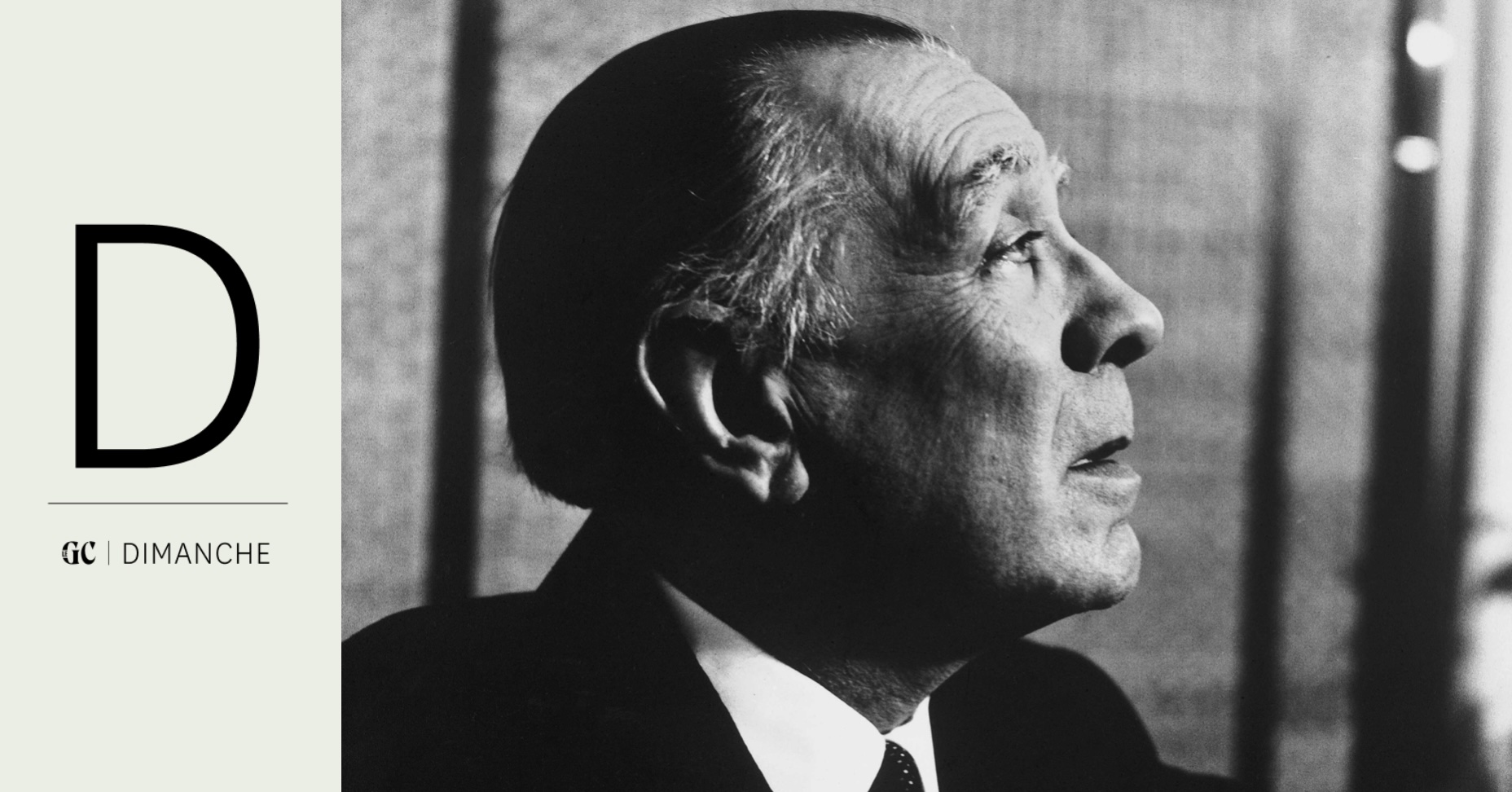
Borges may be the last of the great writers…
No, no, I disagree.
Our century has been marked by towering writers, and you stand among its last representatives. On top of that, you are also a celebrated figure in fantastical literature. How would you define fantastical literature?
I would simply say that literature has always possessed a fantastical core: it began with cosmogonies, myths, tales of gods and monsters… No writer can ever be a true contemporary. This phenomenon is something that only recently became prominent, in the nineteenth century… Before that, people preferred to talk about different centuries and different lands; it felt perfectly natural.
And in our own era?
One must return to that fantastical tradition, which is the genuine great tradition—the main stream of literature; the rest is more like journalism, perhaps history, but not literature.
And realism?
Realism is merely an episode, a brief moment in the history of literature. Great literature has never been realistic. Even in a book one might deem realistic, such as Don Quixote, which I hold in high regard, there are always two elements at play: realism and the fantastical; yet the latter tends to prevail because Cervantes leans toward Don Quixote and away from the peasants or other sensible characters. The reader himself tends to side with Don Quixote; thus the book balances these forces, but the most important factor is the fantastical, which triumphs. The Hidalgo’s madness holds far more weight than the lay reality of Spain around him, which Cervantes clearly scorns. He favors the magical world of Brittany, the era of chivalrous France, and Rome. One finds the same in L’Arioste too: to hold affection for something while lightly mocking it. This is the texture one feels while reading Roland furieux, where Ariosto speaks of a knight while gently lampooning him, without overdoing it. We encounter this in Cervantes, who, having read Ariosto and admired him, references him several times… When I write fantastical literature, I do not reinvent the wheel; I simply continue a long tradition that has existed with few interruptions since the nineteenth century, and which also persists in North and South America…
In Europe as well.
Yes, indeed.
I am by no means an innovator, and when I penned fantastical literature, I was merely carrying on what the Arabs had begun with The Thousand and One Nights, what Shakespeare did, and indeed what Dante did as well.
Certainly, but in the thirteenth century.
That, at least, was fantastical literature. It was never realistic. The Divine Comedy is not a small realistic volume.
That’s true.
It is a delirium… It contradicts every literature rooted in objectivity.
That is true. Yet today, in many literary circles, there is a preference for a kind of realism that “reflects things, reflects reality.” Those are common slogans. Meanwhile, imagination, even imagination in power, often receives little credit in literature.
Not at all. Every writer must stay true to their own imagination, and if they remain faithful to what they imagine, if they truly dream, that is their sincerity. And I strive to dream sincerely. In other words, I believe it is a mistake to think literature rests on words alone. It is not merely about words; yes, words are involved, but literature is chiefly about images, dreams.
And about books, and quotes…
And quotes drawn from books. Books are the memory of humankind, they embody the past… and the past is also a dream…
So literature is less about things than about literature itself…
Of course!
Literature as a library, a grand metaphor for your oeuvre…
On that point you’re right, but I think it was Henry James who was among the first to describe literature as a living literary life, which is particularly interesting because it came from James…
But, in your view, in “creative” literature, how important is dream, and where do the technical aspects fit in? Does dream align with inspiration, like a muse visiting the poet? Or is it something else?
Yes. I believe one always starts from a dream, from the muse, from the Holy Spirit, from the king, from God, from the Biblical Jews, and then one works these elements into the writing. I recall a famous case: Stevenson dreamt the central scene in which Dr. Jekyll becomes Mr. Hyde; afterward, he had to invent the rest. And obviously his reason did the rest. Yet the central scene was a gift of the dream. I, too, have often dreamt up stories in a vague way, then had to invent the details, the “circumstances” demanded by our era.
For instance, like…
We always begin with dream and imagination, which are one and the same. Dreaming—whether awake or asleep—matters not!
That’s true… There are writers like Julien Green…
Ah, Julien Green…
He says he always begins a novel with a dream, and his method, as he told me, is this: “When I write the first page of a new novel, I have an image, say a red-haired boy who might be a murderer, and at one point he leaves home, and I have absolutely no idea what will happen on page two or three… and then I let myself be carried by that image…”
That’s very brave… Not for me. I always know the beginning and the end of my stories and poems, and everything I write. I don’t know what will happen in the middle, so I must discover it. It’s like an island where I see a point on the shore, then a long coastline in the middle, and finally the other shore comes into view; but I must find or invent what lies between the two points.
But what is the weight and importance of literary technique in shaping a work… what one might call the assembly of formal structures?
Clearly, these are things one should hardly consider… I don’t think Poe viewed poetry as an exercise of intellect… to privilege intellect over imagination, over dream… I strive to be as simple as possible; I try to avoid obscurity, though I have often been accused of it. Both imagination, dream, and image—the image Julien Green spoke of—must coexist with reason. They must collaborate; they are not enemies.
Do you accept the frequent characterization of baroque art as applied to fantastical literature? Do you not also see a strong baroque element in fantasy and art?
But the baroque is highly artificial, very self-conscious, in a sense, and fantastical literature is not.
Isn’t it very artificial?
No, I don’t think so: it feels very natural… The baroque is artificial… Baroque is art…
And you think fantastical literature is natural?
Undoubtedly.
Does it have nothing to do with artifices, lies, dreams, illusions, appearances, and chimeras…?
Yes, but dreams are real, just as waking life is real; dreams are real, and fantasies are real; my past is real, memory and history are real, and history is to us a dream, as Joyce once said: “History is a nightmare from which I am trying to wake.” History is a nightmare, a dream; all is but a dream. Or as Schopenhauer put it: Die Welt als Wille und Vorstellung, the world as will and representation: our will and dream are one. Vorstellung can be translated as dream, image: the world as will and as image. Vorstellung can be translated in many ways…
A dream, then. But also a library, that vast metaphor of your world as an endless, undefined, infinite library of books that refer to other books—perhaps real or perhaps imagined and illusory, like in your other grand metaphor, the labyrinth of mirrors…
The library is a kind of dream; and it is also a space for dreaming; but I have not written labyrinths and mirrors for some time. Lately I have written simpler stories. I am weary of labyrinths and mirrors.
Weary of them?
Yes, I began to resemble Borges too much: I do not like Borges.
You don’t like Borges?
No, I do not, he is a mediocre writer… Yet I must live with him, which is a bit tiresome, especially at seventy-seven when I would prefer other interlocutors, for example someone like you. It is much nicer to talk with you than with Borges.
Really? Thank you, but I’d like to ask you other questions: you seem to prefer very short short stories, clearly you do not favor the novel. Why?
I dislike the novel because it feels overly artificial!
Do you find it very artificial?
Short stories, on the other hand, are always true to life, and people have always enjoyed telling and hearing stories. That’s why I so admire Kipling, one of the greatest writers of his time, not only for his poems but for his short stories, in which he conveyed so much… Since we are in Rome, I recall many Kipling stories where he speaks of the British Empire, but through the metaphor of Rome… It’s very strange… I once believed there was only one story, the story of the Roman Empire, and that one story endured while its name, race, and orientation shifted, but…
That it was always the same?
Always the same empire. It was the same empire for Stevenson as well, the great writer I admire, that eminent Scot who traveled to the Far West, to California, and who said there: “I stand at the frontier of Western culture, or if you will, of the Roman Empire.”
But then, these decays and downfalls of empires, including the fall of the Roman Empire…
And the decline and fall, for us in the West…
Isn’t that a tale of collapse or ruin?
Yes, that’s true. But it means there has been nothing but the Roman Empire, and the proof is that we now speak in French, a dialect of Latin, you speak Italian, another Latin dialect… And I naturally speak and write in Spanish…
But I wanted to ask you: within the richness of the novel, including in some of its structural feats like those of Proust or Musil, there are grand celebrations of imagination, triumphs of literary possibility…
Yes, yes, also in Joyce.
Yes, but I prefer Proust and Musil to Joyce… Why do you seem to hold so little enthusiasm for the vast construction possible in the novel?
Because it is a construction; I know I cannot write novels: I can only write short stories. And since I am not a reader of novels, why should I write them? I don’t read them, except for Conrad… I deeply admire Conrad…
Do you value him more than others?
Yes, but everyone has forgotten him. And yet Conrad saved what is epic in the novel, something others failed to do.
Is he to you the greatest novelist?
For me, yes.
Greater than Henry James?
As a novelist, perhaps. As a storyteller, no. But I always prefer Conrad. He has such direct, simple, decisive, courageous prose… Conrad! Courage is something I greatly admire. Perhaps because I lack it myself. I am rather calm… In my family, everyone has been in the military, people who fought, who were killed, who had to flee… Our history is very violent—the Argentine and Uruguayan histories are full of upheavals… I hold Conrad in high esteem; I do not understand why he faded into obscurity. Perhaps in Britain he is seen as almost foreign: he was Polish, and it seems unlikely that the greatest British novelist could be born in Poland. But such things happen; it is a gift Poland gave to Great Britain.
Yet, for example, among the great British novelists of the nineteenth century, like Dickens…
Ah, Dickens interests me greatly, but he belongs to the realm of the fantastical.
Yes, indeed.
When you read Dickens, reality doesn’t feel real, and if you look at old editions of Dickens, you’ll see the illustrations are caricatures…
A literature of dreams?
Yes, yes, Oliver Twist at night, with thieves blending into the night’s dreams, that is dreamlike literature… Then there is the marvelous: Alice in Wonderland and Alice Through the Looking-Glass, by Lewis Carroll, which are perfectly dreamlike…
But, for instance, among the great Russian writers, in the old quarrel between Tolstoy’s partisans and Dostoevsky’s, where do you stand? Dostoevsky?
No, no, I am firmly on Tolstoy’s side.
But Tolstoy is a realist, not a visionary! Then why do you side with Tolstoy? Perhaps you find him fantastical? Isn’t Dostoevsky the true writer of fantasy?
If that were true, I shouldn’t answer with another question: we do not know whether the universe is realistic or dreamlike; if the universe is dreamlike, then Tolstoy would be as well, though we know nothing for certain. Perhaps the world is a dream, as we mentioned earlier – Die Welt als Vorstellung – the world as representation, the world as dream. Yet while answering your question, I suddenly realized I derive far more pleasure from Tolstoy than from Dostoevsky. That’s all. I am not a theorist; I have no abstract ideas, I am incapable of systematic reasoning; I can imagine, dream… I can, in principle, write… but I don’t know if I can reason…
Huh? How so? For example…?
I am not an intellectual. I am a naive man.
So, in this old game of the infernal tower we can always play, for example, whom do you prefer, Balzac or Flaubert?
I do not like Balzac at all; I prefer Flaubert. But what I love most is The Temptation of Saint Anthony.
Not Madame Bovary?
No, I could never finish Madame Bovary; it never managed to engage me; and The Three Tales are rather weak.
And Bouvard and Pécuchet?
Bouvard and Pécuchet, yes: it is a great late-19th-century work, and not only of that century.
There is much talk of literature, imagination, inspiration, and technique, but in our era this grand debate on literature and ideology remains relevant, with many writers subordinating literature to ideology…
I think that is a mistake. Opinions are the most superficial thing there is, and an author’s opinions matter little. But I recall a Kipling passage I love, where he says that “a writer may invent a fable, but not be convinced by it”… Hence, the morality of the fable…
Why morality?
That is curious, because Kipling mainly writes about the white man and his empire…
The famous “burden of the white man”…
Yes, precisely the burden… And yet, these are the narratives in which the white man isn’t exactly sympathetic. For instance, Kim is a remarkable work, but when people discuss it they focus more on the soul than on Kim. The soul seems more real than Kim; it matters far more than Kim does, and that’s true for Kipling as well. He had his opinions, but he stayed true to his imagination, and so, when you read the book, you’re not convinced by his opinions, among other reasons because they aren’t that important… I believe it is dangerous to judge a writer by his opinions; and that is why I, who am not Catholic but far from insane, would say the greatest work in all of literature is the Divine Comedy. That does not mean I am a believer, nor that I accept Hell, Purgatory, and Paradise as real. It has nothing to do with me. Those are Dante’s opinions, or perhaps metaphors, images he drew from who knows where, and where he drew them from does not interest me. What interests me are Dante’s dreams and the characters he created and re-created… In general, people judge a writer by his opinions. For example, I greatly admire Whitman, but I do not admire the democracy he needed to write poetry. That is his affair, not mine. Only Whitman’s poetry matters to me; what he wrote about democracy does not interest me in the least.
But you are indeed an old anarchist, or something else?
Yes, an old anarchist. Or rather: an old Spencerian individualist. In other words, I am neither fascist nor communist nor nationalist; I detest nationalism. I was never Peronist nor Nazi, I hate all of that. I am an old pacifist anarchist, an old individualist anarchist, a longtime reader of Herbert Spencer who wrote The Right to Be Free from the State, but in the meanwhile the state spread everywhere, nationalism spread everywhere.
One often notices among the greatest writers of our century that the more revolutionary and experimental their work becomes, the more conservative their political opinions tend to be; and not only in well-known cases like Céline or Pound, Marinetti or D’Annunzio…
I don’t think Marinetti was that important as a writer, does that surprise you?
We discuss him because we are in Italy. All that zeal for war… Marinetti sang the praises of modern war, then he became a fascist; and D’Annunzio extolled the great Italian past and war, and he too drifted toward fascism…
I’d like to say something: there is a book I greatly admire, Momigliano’s History of Italian Literature. Marinetti isn’t even mentioned there.
He doesn’t cite it?
No, he simply omits it.
And yet futurism enjoyed great notoriety and influence, didn’t it?… But I’d rather speak of writers like Valéry, Mann, Benn, Eliot, Pirandello, Montale, Svevo, Rilke and many other Austrians: the great poets and novelists of our century had almost reactionary political ideas, yet they were genuine revolutionaries in their work… isn’t that so?
Personally, I don’t know much about politics and I never speak of it; I am a man of principles. I opposed Peronism for ethical reasons and for intellectual ones as well.
Also for aesthetic reasons?
Yes, also for aesthetic reasons. Perón was a great scoundrel, a sordid, not very bright figure, and decent people did not trust him.
Did you suffer much under Peronism?
That is a private matter…
Private?
My mother was imprisoned, as were my sister and my nephew. They attacked me through the people I loved.
Those are typical features of dictatorship.
Yes, all of that was so appalling… I don’t want to remember that period.
No.
As long as I am in Rome, I do not want to think about those past events.
Okay: never a link between lived life and literary creation. But then, for example, in the work of a writer or poet… excluding life and experience, what do you think is necessary to create a work? In short, what is truly essential for a writer?
Well, I’d like to recall something my father told me more than half a century ago. He said: “You must read a great deal and write a great deal, but publishing isn’t essential, or should be delayed as long as possible.” His advice was: read, write, then tear up what you’ve written. Publish only when you’ve reached maturity, though that isn’t even the core matter.
So very late, then?
Yes, very late; but that wasn’t possible for me. I started too young: I published my first book at twenty-four, in 1923, in Buenos Aires. I did not send copies to newspapers, bookstores, or fellow writers, nothing. I offered my book only to my friends. There were three hundred copies.
So, what do you consider today to be the greatest dangers to literature? The real enemies of literary practice, in your view.
I believe today the great danger is politics, in any form. I belonged to a conservative party but later left it, for I often agreed with opinions from different horizons. I find it ridiculous to belong to a political party. It’s quite peculiar to me: the communists see me as a fascist, the fascists see me as a communist; therefore I belong to no camp, I am a veteran individualist.
You don’t like making political pronouncements, do you?
No, but beyond that, I think we currently enjoy the best government possible in our country; yet that is not relevant in Italy.
And do you sense dangers, difficulties, or threats? In Italy, for instance, there is a period of crisis. Do you think Argentina’s future is darkening, as indeed seems so in neighboring countries?
We passed through an anarchic period ruled by a scoundrel. Then came mostly administrators, who are not much, but at least they aren’t gangsters.
Who were or are these gangsters?
Perón, of course; and his wife, his widow. All of them were real scoundrels in power.
I’d like to ask you another question about your intellectual formation. When you began to write, you were very young: in your cultural milieu, did Pound, Eliot, or others of that circle already exist, or was that before?
No, actually, at that time I did not know them. I read only the classics.
But when you were a teenager starting to write, which authors of your era did you model yourself on? Whose era did you feel you belonged to? Which writer?
It was the era of Shaw, the era of Wells.
Were they important to you?
Very important. In Spain, that was the era of Unamuno; in Buenos Aires, Paul Groussac. As for Ezra Pound, I discovered him later and I don’t particularly admire him as a writer. Eliot is another matter. Eliot is far more subtle than Pound, but he isn’t a poet I admire; his writings feel very cold.
Eliot?
Eliot, yes.
And as a critic?
As a critic, he doesn’t interest me at all. I would wish a critic to be a creator as well, like Francesco De Sanctis or Coleridge—those who can rewrite their own texts. With Eliot, there is little genuine criticism, only a rather petty debate and pedantry… I do not care for Eliot’s prose; yet he did write beautiful poems… And to me, Eliot is not a great British poet. I could name fifty poets before arriving at Eliot.
And who are the major early ones?
For example Robert Frost, and Yeats. Consider Yeats. Yeats was a nationalist.
Ah, I had forgotten to add the reactionary revolutionaries to the list.
Yet Yeats was a great poet despite his opinions, despite his mystic system, which is nonsense… Yeats remains a truly great poet who made the English language an extraordinary instrument of expression. Some lines cannot be explained or translated, yet their beauty surpasses their meaning.
But as a person, with his ideas…?
As a person, no, he was a nationalist, an Irishman by trade. Not like Shaw, who was Irish too, but did not always remember it. But that is irrelevant… He could be dreadful as a friend, and at the same time a charming and admirable poet. After all, the poet remains while the man fades away; it is far more important to be admirable as a friend at heart. It is a bit like Benedetto Croce: perhaps I disagree with Croce, but I love him, I count him as a friend.
But for example Croce’s stance on nineteenth-century French poetry… He didn’t like Baudelaire…
And he was right.
He didn’t like Mallarmé either…
And he was right about that too.
Was he right? You don’t like Baudelaire or Mallarmé either?
No, I don’t like them; but I do like Verlaine, even if he isn’t a great perpetual poet, I would call him. I also admire Victor Hugo; there are splendid things in Hugo, for example when he writes “the hydra of the universe writhing its scaly body of stars…” That is pure beauty.
Baudelaire then, no. But Apollinaire, yes?
Apollinaire was a poet, whereas Baudelaire was more of a construct, a poet built with brute force. He is very clumsy… At least that’s my impression. He always seems to have things… how to put it?… And I dislike his taste; I dislike bats, I dislike furniture, I dislike sofas…
But you don’t like that kind of grand vulgar taste, that sort of kitsch found in many nineteenth‑century poets, especially the French?
Yes, but in those writers I detest it. Verlaine doesn’t display that kitsch; whereas Oscar Wilde, who is not exactly a great poet, carries a kitsch with a wink and mocks it a little… Baudelaire took his demons, his bats, his prostitutes, and his mulatto figures far too seriously…
But in that vast warehouse, in that enormous central depot of intellectual kitsch that is Bouvard and Pécuchet… there stands a true monument… Isn’t that the triumph of kitsch?
Yes, but Flaubert was ironic; Baudelaire, on the other hand, took all of it seriously, he loved it!
Is that true?
Yes, that’s the only difference, but it is a huge difference.
But I’d like to ask you another question: when you were very young in Buenos Aires…
When I was young in Buenos Aires, I mostly read books in English, I think; or translations into English.
But what about French, German, Italian literature…? In your youth, were there names, titles, books in your library that left a deep mark on you at the time?
I first engaged with German literature through Carlyle, who introduced me to what Germany was. Then I learned German on my own so I could read Schopenhauer in the original. I began with Heine’s poems, which are very beautiful and simple…
And that you preferred to Goethe’s works…
Oh, by the way: Heine was Jewish and thus much smarter than Goethe. Of course, that was a joke. I love the German language, which is more beautiful than what is written in German. In contrast, French is beautiful, but the language itself is not as elegant as German, while the literature is splendid.
And in English?
I like the language as much as the literature. In Spanish, by contrast, there is hardly anything written.
Hardly anything?
Yes, there is Don Quixote.
And poetry?
Poetry indeed: Góngora, San Juan de la Cruz. Then there is the eighteenth century, which is as poor as the nineteenth. And beyond that, not much either.
And the twentieth century?
The twentieth century is something of a retreat for Latin America…
Are you alluding to all the recent South American novels?
Ah, those? To be honest, I’m not very familiar with them.
And does that not intrigue you?
I’ve read García Márquez and I think it’s well done. The others I’ve read did not appeal to me. They are experiments that belong to the Faulknerian genre: they play with time. I don’t even particularly enjoy Faulkner.
You don’t like the way Faulkner handles time?
If so, I have done it myself on occasions; many have. It’s Conrad who started this kind of thing.
Who remains naturally the greatest…
Of course he remains the greatest! Precisely, Conrad begins one of his novels—whose title I don’t recall—with a scene where two friends meet and discuss a third friend, and through their exchange the entire reality of that third friend is reconstructed… One says he saw a scene, the other says he arrived earlier, and everything becomes incredibly tangled… It is only at the end that you understand what they were talking about. (Note: the Conrad novel Borges can’t recall is Fortune.)
But Faulkner, for instance…
Yes, it’s the same idea; Faulkner did it two decades after Conrad, who was the first.
(To the audience) I would now like to warmly thank Borges for coming here, for honoring us with his presence from so far away, from the nineteenth century. As he himself says: “I am a man of the nineteenth century,” arriving not only from distant places like Buenos Aires but also from such distant realms of imagination and invention, with endless, imaginary libraries. I thank him for being here. Thank you.
It’s my turn to thank you, especially since I’m in Rome…
Are you happy to be in Rome?
Very happy. It is the center, Europe, Italy, Rome. Rome is forever the Roman Empire, enduring under new names.
Do you expect anything from Europe?
I expect everything from Europe. What can the periphery offer? The United States and Russia are part of the periphery as well. What can the periphery offer?
Are you expecting nothing?
No, no; it’s up to you to save us.
And do you think that…
I hope all of the West has something to offer you. We do what we can to help you. I hope the entire West will in some way serve as a mirror, a faithful mirror of Europe—or one that strives to be faithful. We will do what we can. It is up to you to save us, and to save yourselves as well. That is what a good Argentinian tells you. I love Italy.