
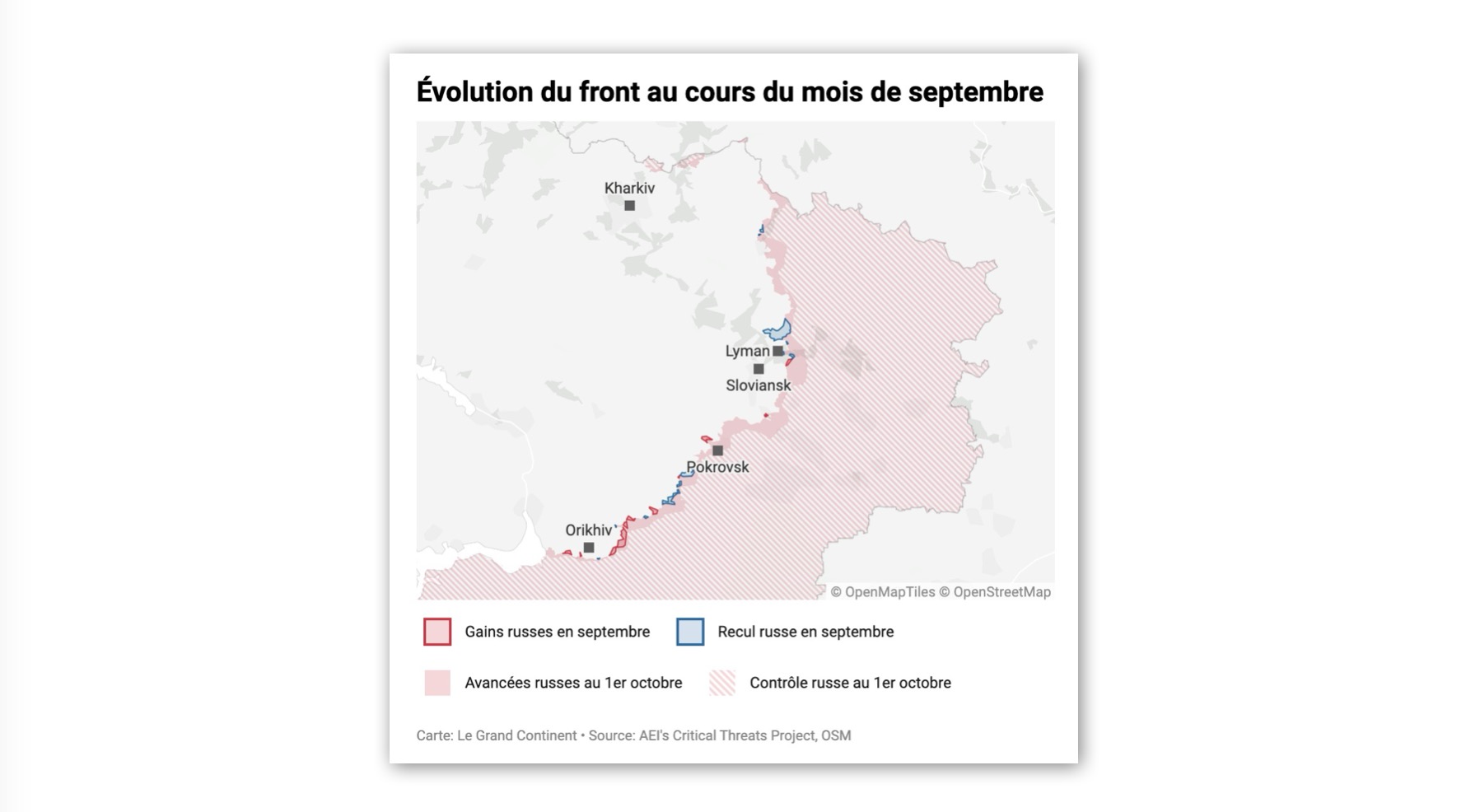
According to the Institute for the Study of War (ISW), the Russian military controlled 176 km² of Ukrainian territory in September, but ceded 256 km², resulting in a net loss of 81 km². In 2025, during the same period, Moscow had seized 330 km² in Ukraine.
- The September figures compiled by ISW account for the Ukrainian army’s progress under the “Vivaldi” operation, launched in May in the Lyman sector.
- However, there has been a clear slowdown in the pace of Russian advances since March, which has remained weak or even negative since then.
- Data from Deep State, a group of Ukrainian analysts, show a net Russian advance of 66 km² in September.
If the Vivaldi operation has not ended the Russian advance across the front, it could nonetheless have major implications for Moscow’s campaign.
- On Wednesday, September 30, a military blogger close to the Kremlin stated that Moscow’s situation was deteriorating not only in Lyman, where Russian forces have ceded ground in recent months, but also toward Sloviansk.
- He notes that Ukrainian forces have managed to “establish themselves in the region of Dibrova and Ozernoye,” north of the Siverskyi Donets River, which could jeopardize Moscow’s ability to encircle the “belt of fortresses” linking Kostiantynivka, Kramatorsk and Sloviansk.
The Russian army continues to advance in certain parts of the front, notably in the center of Donetsk Oblast and in the direction of Kharkiv, according to Rochan Consulting. ISW also notes Russian progress in southern Ukraine. However, this progression comes at a substantial cost: the Ukrainian general staff recorded more than 46,000 Russian losses for September, compared with less than 32,000 in January, a 46% increase.
- The Russian army has historically achieved significant gains during autumn: it advanced 730 km² in November 2024, and 505 km² in November 2025, according to Deep State.
- The shedding of autumn foliage, however, reduces cover for ground troops, making it easier for Ukrainian drone operators to target them.
In a note produced by Sberbank published at the end of August by the hacker group Black Mirror, the bank estimated only a 7% probability of a decisive Russian victory. The document read: “Without mobilization, there are no men. Without a solution to the problem of rear air defense, strikes against infrastructure will continue. These ‘without’ factors make this scenario unlikely, but not impossible: any of these factors could change at the decision of the supreme commander-in-chief.”