
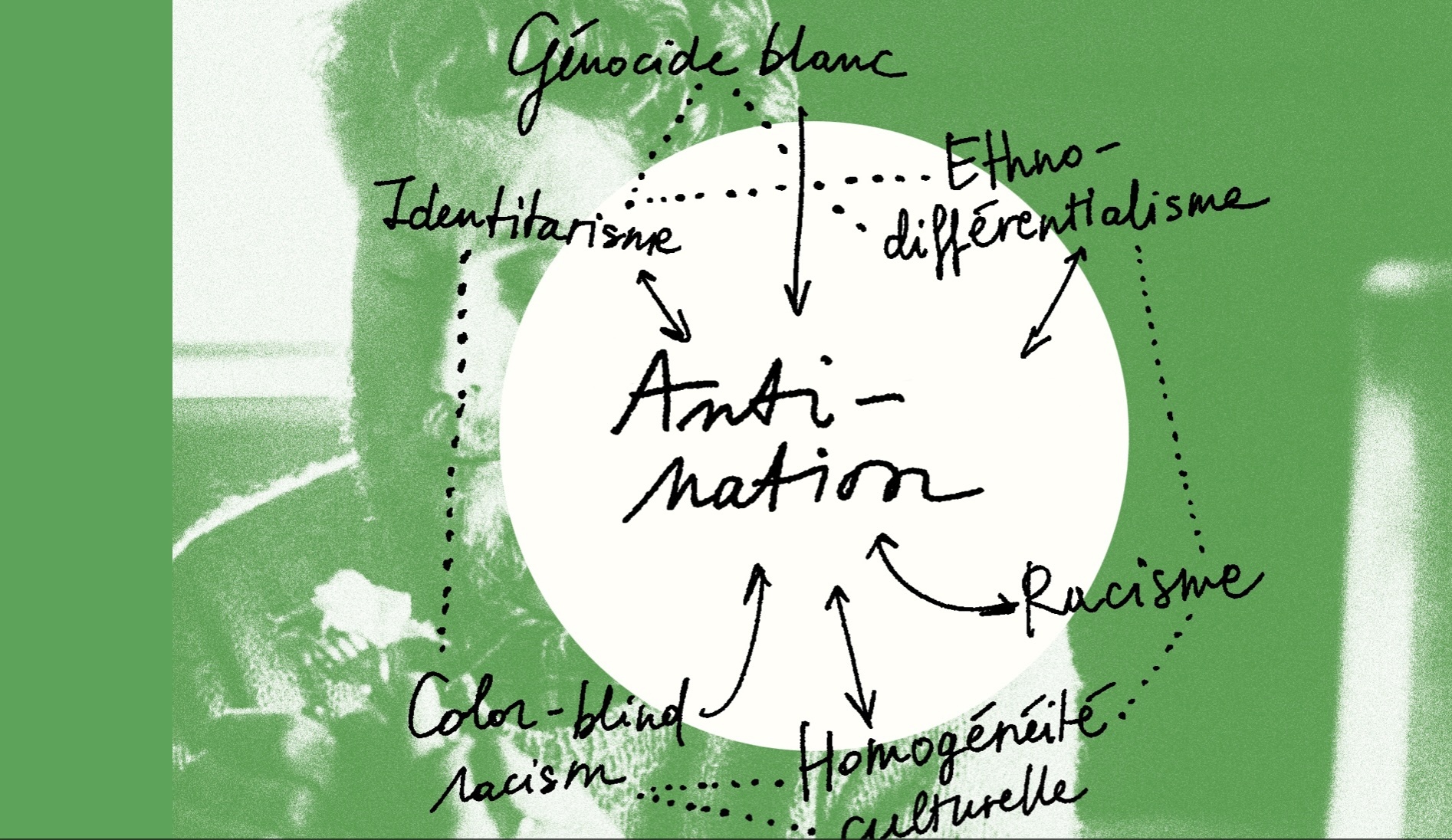
From today until August 20, Le Grand Continent will publish in open access The Vocabulary of the Extreme Right, the product of a collective effort by a group of scholars—sociologists, historians, political scientists, sociolinguists—hailing from across Europe under the direction of Steven Forti. To receive each lemma in your inbox and support the work of an independent editorial team, subscribe
In August 2024, amid the Paris Olympic Games, La France insoumise deputy Ersilia Soudais voiced her indignation at the ban on head coverings for athletes on the French team, writing on X: “France is an Islamophobic country” . In response, the government’s departing spokeswoman, Prisca Thevenot, symbolically awarded La France insoumise a gold medal: that of “indecency and anti-France” .
The history of this notion runs far deeper than the viral exchanges on social networks might suggest. To understand it, one must first widen the scope—spatially and temporally—and move toward an imagined extreme.
In Spain, a paradigmatic case shows how this notion ended up shaping the doctrine of a political party . Since the 2019 election campaign, Vox, and in particular its president, Santiago Abascal, have drawn a stark dichotomy between the “living Spain,” supposedly represented by this far-right party, and the anti-Spain (Antiespaña) represented by the Spanish Socialist Workers’ Party (PSOE) and its leftist allies, who are clearly identified as traitors and internal enemies .
The core discourse of the Spanish far right has since revolved around constructing enemies of the nation and traitors to the true and pure homeland. In October 2025, after Donald Trump spoke of excluding Spain from NATO due to its refusal to raise military spending to 5% of GDP, Abascal publicly declared his hope that the American president “can distinguish between Spain and Sánchez,” thereby dissociating a democratically elected head of government from the “true” nation, of which he claimed entitlement to speak as a legitimate interlocutor .
Genealogy of a Concept
This idea of anti-nation is not a newly minted rhetorical twist born in the last decade, nor a creation of contemporary far-right groups, but a battered and recycled concept from nineteenth-century reactionaries and twentieth-century fascists, used to label what these ultraright groups consider the ultimate political enemies. Enemies who, of course, can be internal (traitors) and external (invaders) who threaten the nation and its essence. All these groups form antagonistic forces that crystallize in the anti-nation. Charles Maurras theorized the “Anti-France” . For the思想 leader of Action Française, monarchist and virulent anti-Semite, it lay within the “four Confederate States”: Protestants, Jews, Freemasons and “métèques” who, through the democratic Republic, corrupted the “real country” in his view. He aligned with Vichy while remaining vehemently anti-German; he would be condemned in January 1945 for collaboration with the enemy. His verdict he greeted with the cry: “This is Dreyfus’s revenge!” .
That kind of ultra-nationalism, typical of the imperial phase of European powers, extended across the continent to Italy, where in 1910 the Italian Nationalist Association (ANI) was founded and later joined the National Fascist Party in 1923.
In Spain, however, this concept appears as early as the nineteenth century within academic debates between advocates of the free Institution of Education (La Institución Libre de Enseñanza) and reactionary forces. The case of Marcelino Menéndez Pelayo is particularly telling: in his work History of the Spanish Heretics, this polygraph traditionalist develops the idea that anti-Spaniards are enemies of the nation and conceives the nation as a living organism. Menéndez Pelayo is notably critical of the Enlightenment values, aligning his ideas with a struggle against what he sees as anticatholic action that would signify the defeat of “Tradition.” In a parallel register, in France, Maurice Barrès also introduces this organicist conception of the nation, summarized in the title of his 1899 lecture: “the homeland is the land and the dead” .
It is, however, during the twentieth century, and more specifically during the Civil War period, that the notion is popularized in Spain: the Francoist camp in revolt recurrently designated its Republican enemies as “anti-Spain” . These enemies embodied everything that opposed a system of values founded on ultracatholic nationalism, crystallizing in the figure of the internal enemy: socialism, communism (or Bolshevism), anticlericalism, Jews, Freemasonry, peripheral nationalisms, and class-based unionism as a whole.
It is here that we must mention the reactionary thinker Ramiro de Maeztu and his best-known work published in 1931, Defensa de la Hispanidad, which constitutes not only an ideological reference for Francoism but also exerted a significant influence on the political thought of Vox. Drawing on the ideas of the old guard of Spanish traditionalism, such as Menéndez Pelayo, de Maeztu defends the national Spanish unity under the aegis of an ultra-Catholicism capable of opening a third path between capitalism and communism and laying the foundations for a bloc of Catholic and authoritarian Hispanic states .
That national-Catholic axis drew its models first from the European counterrevolution (Action Française, Italian fascism, the Catholic authoritarian corporatism of Dollfuss or Salazar) rather than from Nazism, whose biological racism and neo-pagan leanings sometimes clashed with a Hispanidad centered on Catholicism. Yet admiration for Hitler’s Germany was embraced by part of the Phalangist movement and early Francoism, who shared with it the designation of the same internal enemies of the living nation: democracy and Marxism.
It is precisely Nazi Germany that provides one of the most radical examples of constructing these enemies of the nation, notably by resorting to propaganda campaigns designed to stigmatize an internal enemy embodied by Jews, socialists, and Marxists.
Against the Enlightenment — Yesterday and Today
The groups that comprise this anti-nation vary with historical and national contexts, but the structure of the discourse remains strikingly stable. By grouping very different adversaries into a single category, it allows for the quick identification of common enemies and presents them as a single threat. This pliancy facilitates both ideological transfer and cross-border circulation of far-right repertoires, which can then be adapted to each country’s specifics. It is precisely thanks to this ability to unite these groups under a loosely defined central enmity that federating concepts such as “cultural Marxism” emerge—an idea forged in the 1990s by the American radical right, heir to the notion of “cultural Bolshevism” (Kulturbolschewismus) that the German National Socialist Party (NSDAP) wielded against art and thought deemed “degenerate”—or its version popularized by the Black Illuminati and Elon Musk, the “woke mind virus.”
Two examples are especially telling of this circulation: on the one hand, its use by the world’s wealthiest man in an interview at the start of 2025 with the head of the Alternative for Germany (AfD), Alice Weidel, on his own social network X; and on the other hand, the way Hungarian Prime Minister Viktor Orbán has used it, branding progressive values as a “virus” created in a liberal laboratory to destroy the nation, even drawing a parallel between the “woke virus” and “communism” .
This discourse also blends with others that seek to present the nation in an organicist fashion, a recycled nineteenth- and twentieth-century concept . This representation profoundly changes how politics is thought: if the nation is a living entity, it can also die or, in a trope pervasive in far-right rhetoric, commit suicide. This is how Santiago Abascal defines it, in a formulation that directly recalls Barrès: “If the majority of Spaniards today wanted to commit national suicide, we would have to stop them. The nation is made up of the dead, the living (the people), and those who are to be born” .
This vision is not limited to Spain. Italy offers another illuminating example of this conception of a “living nation” that must be protected from threats to its existence. The 2017 “Trieste Theses”—the main ideological and programmatic text of Fratelli d’Italia (FdI)—defined nations as “living organisms” and named existential enemies (globalization, communism, and progressivism) against which they must be defended .
In international far-right discourses, the groups that make up this anti-nation are portrayed as a danger that could threaten the nation’s very survival. This dramatization fuels a radicalization of discourse and growing aggression toward political opponents. These opponents can be dehumanized and described as existential threats, to the point of legitimizing, or normalizing, the use of political violence in the name of national salvation.
Javier Milei in Argentina provides a striking illustration. The president identifies an internal enemy embodied by a “caste,” likens democratically elected lawmakers to “rats” or “mandrills” and explicitly designates them as enemies rather than mere adversaries . This lexical shift breaks with democratic logic, grounded in the legitimacy of pluralism, and turns political competition into an existential confrontation.
Another telling example of this logic is the campaign against antifascist movements. On September 22, 2025, Donald Trump designated Antifa as an “internal terrorist organization” by decree , even though it is not a formal organization but a decentralized movement, and U.S. federal law does not recognize any category of domestic terrorist organization. The decree’s reach is political more than legal: it opens the door to surveillance and criminalization of a current of opinion, marking a new step in regime change in the United States.
This sequence also illustrates the international circulation of these repertoires of action. A few days after Trump’s decree, Viktor Orbán announced his intention to classify Antifa as a terrorist organization as well. In the Netherlands, the Tweede Kamer passed a motion to this effect, filed by Geert Wilders (PVV), while Vlaams Belang’s European Parliament member Tom Vandendriessche called for Antifa to be listed as a terrorist organization on Belgian and European registers .
It would be ill-advised to claim that the French government spokesperson consciously revived this expression by reactivating its genealogy, but it is striking that it resurfaced in the mouths of Giorgia Meloni and Matteo Salvini during the Milan-Cortina 2026 Games.
The moment is far from trivial: major sporting events, and the Olympic Games especially, generate a powerful national imaginary and rally around the flag that incumbent governments seek to exploit—the moment any critique or disruption becomes, by symmetry, an assault on the nation itself.
While tensions during the Milan-Parade protests against the Games and a series of sabotage attempts, notably railway cable sabotage, there, the Italian President of the Council labeled those demonstrating against the Games “enemies of Italy,” thereby extending responsibility for the violence to all protesters . Meanwhile Matteo Salvini, deputy prime minister and leader of the League, explicitly used the concept of “anti-Italians” to refer to the airline transport unions that kept their strike going during the Olympics.
From Words to Things
Because it rests on the reference framework of the nation, a shared reference by definition, this discourse has a unique capacity to win the center of political debate. The United Kingdom provides a telling example: Reform UK led by Nigel Farage and the Conservative Party have both made the “woke virus” a central adversary, turning a deliberately vague signifier into a political category that encompasses all who would be outside the “true” British nation.
This convergence reveals horizontal circulation of discursive repertoires among new far-right formations and traditional conservative parties. It fosters a cross-pollination of political strategies that helps normalize, then banalize, categories and representations drawn from the far right.
While the far right presents itself as the sole “patriotic” force (indeed it is the name of one of its groups in the European Parliament, Patriots for Europe) and appropriates national symbols—from flags to national holidays, to even the football team jersey as in Brazil—those who do not share its reactionary values are cast into the anti-nation.
In the twentieth century, this category included syndicalism, communism, Jews, Freemasonry, or anticlericalism. Today, it has broadened to multiculturalism, the “globalists” accused of dissolving nations, liberal movements, feminism, LGBTIQ+ people, the United Nations’ Agenda 2030—the 2015 plan that sets seventeen sustainable development goals in climate, inequality, health, education, and governance—or ecologists rebaptized as climate fanatics. All these groups are blamed for national and Western decline. By casting them as existential threats, the far right can present itself as the only force capable of preserving a supposedly intact national identity at the brink of suicide.
One of the most striking examples of this designation of the anti-nation is Vox again. In June 2023, during the general elections campaign, the party unfurled on a façade on Alcalá Street in Madrid a giant banner that was removed a few days later by order of the Electoral Board. It showed a hand wearing a bracelet in the colors of the Spanish flag discarding a series of symbols: the Agenda 2030 logo, the symbol of feminism, the LGBTIQ+ flag, the hammer and sickle of communism, and, specific to the Spanish context, the Catalan independence estelada, accompanied by a series of words: imposition, insecurity, division, poverty, abandonment, and invasion. Above it loomed an unambiguous slogan: “Decide what matters” .
The dehumanization of political opponents and the transformation of democratic competition into a civilizational war are now recurring traits of far-right discourse. Without revisiting the historical precedents they echo, it is important to stress their connection to what the literature calls “stochastic terrorism.” This concept denotes a form of violence indirectly encouraged by discourses that continually designate certain groups as enemies, demonize them, and present them as existential threats against which one must act to save the nation. While these discourses do not explicitly call for violence, they can lead radicalized individuals, through repetition, to commit deadly acts.
The storming of the Capitol on January 6, 2021, the massacre carried out by Anders Breivik, whose manifesto targeted precisely “cultural Marxism,” or the assassination of the German prefect Walter Lübcke by a neo-Nazi, illustrate the potential consequences of this dynamic. They remind us that the construction of the “anti-nation” is not merely a rhetorical strategy: it can create the conditions for a transition to political violence.