
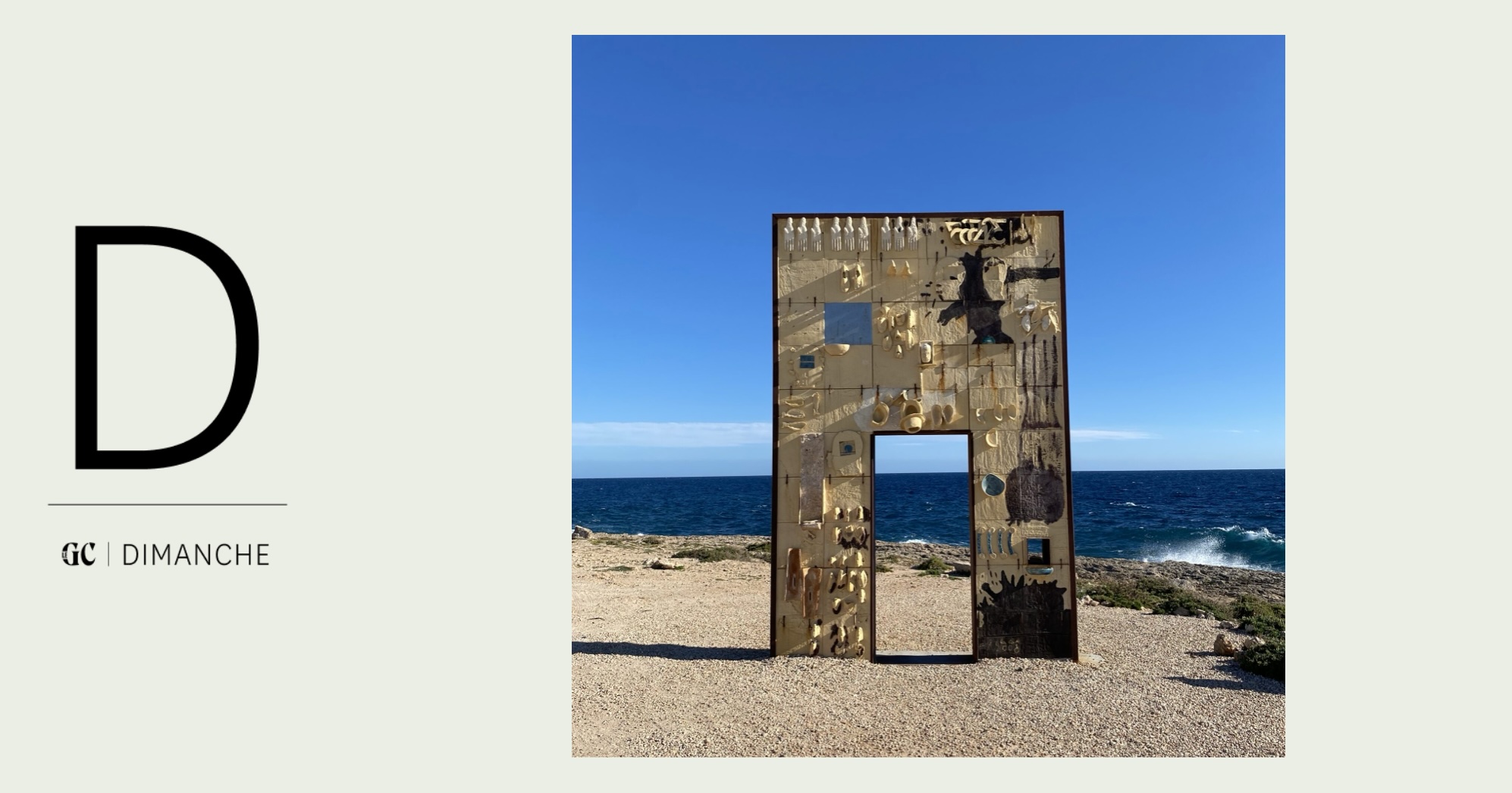
In September 2023, within a few days, thousands of migrants confronted the sea on fragile craft, departing from the Libyan and Tunisian shores.
A surge of arrivals crashed onto Lampedusa. This tiny Italian territory, adrift somewhere in the Mediterranean, found itself at the center of international media and political attention. Its arid, scrubby landscapes flashed for days on screens around the world and dominated the front pages of major newspapers.
Such a phenomenon is far from new. For decades, the island’s name has invoked the crossings across the Mediterranean.
Lampedusa: the name regularly echoes on news channels, associated with a sorrowful chorus of tragedies and human distress, with an overwhelming ledger of shipwrecks, deaths and survivors.
Lampedusa: no one ignores the meaning of these four syllables, which, depending on one’s leanings, provoke a spectrum of reactions, ranging from compassion and a more or less powerless solidarity, to fear of an invasion and the fantasy of the “great replacement.”
Lampedusa: she is known to all, but only from afar and superficially; she seems to surface from a hazy past; she seems to rise from the waves, only when the news spotlights focus on her. Yet there does exist a Lampedusa before “Lampedusa,” so to speak.
A foray into the past of this outcrop holds many surprises and twists.
The “violent heart of the world”
Viewed in the long arc of history, the island offers a compact sample of Mediterranean history. Across the centuries, its fate breathes with the surrounding water. As far back as records go, Lampedusa has been an important maritime crossroads, a key hub in the movement of people.
Archaeological traces hint at stable occupation since the Neolithic, alternating with phases of temporary presence. Then, from the 2nd century BCE, abundant remains reveal a thriving economy tied to fishing, and indicate a prosperous society that even minted a local coin. The island then basks fully in the mare nostrum, that guarded Roman sea, encircled by subjugated lands.
Such a comparatively peaceful arrangement endures under Byzantine rule, until the 7th century CE.
Then a new frontier settles in this watery plain stretching from Sicily to North Africa.
A true zone of warfare begins to take shape as Arab expansion northward peaks with the conquest of Sicily by the Aghlabids in the 9th century. Devastated and depopulated, the small islands pay a heavy price in this era of upheaval, and Lampedusa does not escape this fate. We do not know whether, subsequently, like Malta and Pantelleria, it is repopulated by Arab and Muslim settlers. If so, this venture ends in failure, for in the 12th and 13th centuries it appears devoid of stable human presence.
At this time, a gradual linguistic and religious homogenization takes place, cementing the rift between the two shores of central Mediterranean. Catholicization and Latinization to the north, Arabization and Islamization to the south. This process runs a bit slower on the small islands. After the Norman reconquest of Sicily, Christianization ends in Malta in the 13th century, but the Arabic language persists there. In Pantelleria there are still a few Muslim presences at the end of the 15th century. But these are only minor nuances in an ever more clearly contrasted landscape.
The configuration of Lampedusa stands out singularly from this horizon. This tiny territory is a desert. It does not belong to any power. No fortifications here, no armed deterrence. The island is easily accessible and welcomes ships that dock there. All find the possibility to obtain water and food. It is thus that Saint Louis discovers it in 1254, when he lands on his way back from the seventh crusade. Later, Sicilian nobles will attempt to establish a garrison, but without success. Only ruins remain of a castle and a few houses, testimony to the futility of such efforts. For this island, located far from any continental base, is inevitably exposed to incursions. Its conquest poses no serious difficulty, but how to defend it against a sea-born attack?
In the 16th century, the Mediterranean becomes the main stage for the clash between the Spanish and Ottoman empires. According to Fernand Braudel’s famous definition, this sea is then “the violent heart of the world.” When, later, the larger historical conflicts shift to other theaters, the clashes continue in these waters for several centuries, animated by the ongoing confrontation between the Knights of Malta and the Barbary pirates.
Lampedusa traverses these turbulent centuries without renouncing its vocation. Always at the edge, always desolate. Even its jurisdiction remains unsettled: this modest territory does not clearly align with one side or the other. Indeed, in the 15th century, it is granted as a fief by the Aragonese to a Sicilian dynasty. Then, through a marriage alliance, it passes to another family: the Tomasi, who, in the 17th century, would even receive the title of princes of Lampedusa. Yet the ancestors of the famous author of The Leopard remain comfortably in Palermo and never set foot there. Moreover, Tunis and Istanbul do not recognize this sovereignty and claim their own suzerainty over the island. When, in the 18th century, a few rare French and Maltese hermits begin to settle there, they can do so only with passes granted by the Ottoman authorities, who limit the number of residents to seven at most.
In essence, for at least six centuries, Lampedusa is a place of the in-between in a space starkly divided. Perpetually uninhabited, it is not a minor actor, though. This rock in the middle of the waves is a crucial node for navigation. Its strategic position and neutrality make it a mandatory waypoint for sailors from all origins, who find water, wood, and food (notably thanks to rabbit hunting).
Open, generous, nourishing, Lampedusa also offers shelter in its coves during the frequent storms that sweep the sea.
The miracle of Lampedusa
But the island’s virtues do not derive solely from its location and its natural setting. It becomes famous thanks to a human creation, the invention of a remarkable symbolic device that endures through time.
What is it? A small cave, tucked into the folds of the territory, houses a singular cult. Half of this hollow is reserved for the veneration of an image of the Virgin, the other for that of a Muslim saint, whose tomb it shelters. The many sailors who stop on the island always pay homage to the little sanctuary. They perform their devotions, seek protection for their voyages, and leave offerings. And this without distinction of religion.
The origins of this arrangement are distant. When the first references appear in written sources, from the second half of the 16th century, they reveal a tradition already well established. In the following decades, the texts proliferate rapidly. Travelers, adventurers, corsairs, many who pause at Lampedusa recount what they have seen in their narratives. They describe a complex symbolic system, based on a temporary truce organized around the sanctuary. All witnesses express their astonishment at the scene found in the cave, where a great many offerings deposited by Catholic and Muslim devotees accumulate. Visitors note the presence of Turkish and Spanish coins, alongside rings, pendants, and diadems. There are lamps, with oil to feed them, and a large quantity of candles and votive candles. But that is not all. A wide array of objects hangs above posts and cords. This assortment includes vividly colored garments and various utensils. Not to mention food, in the form of bread, cheese, and salted meat…
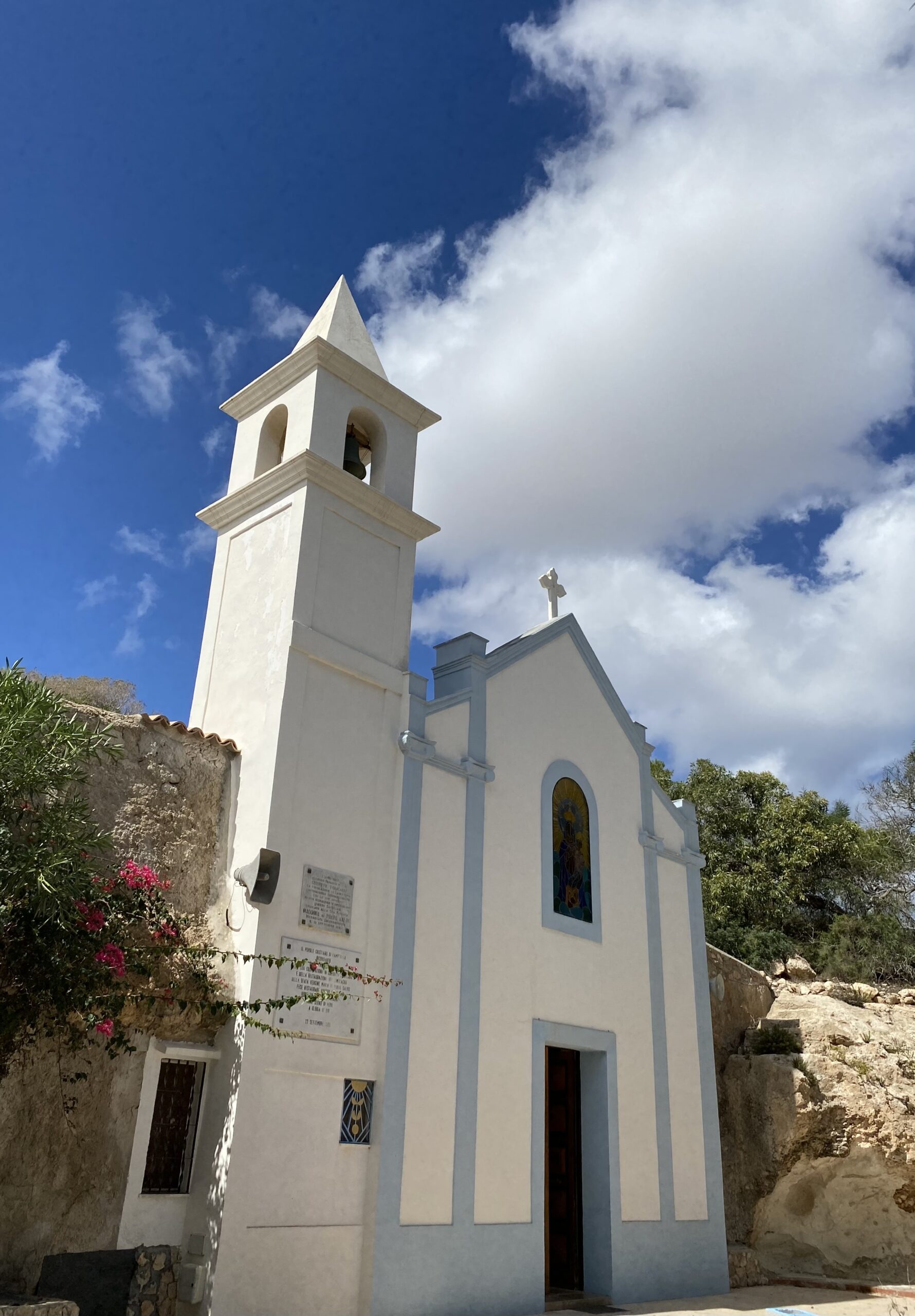
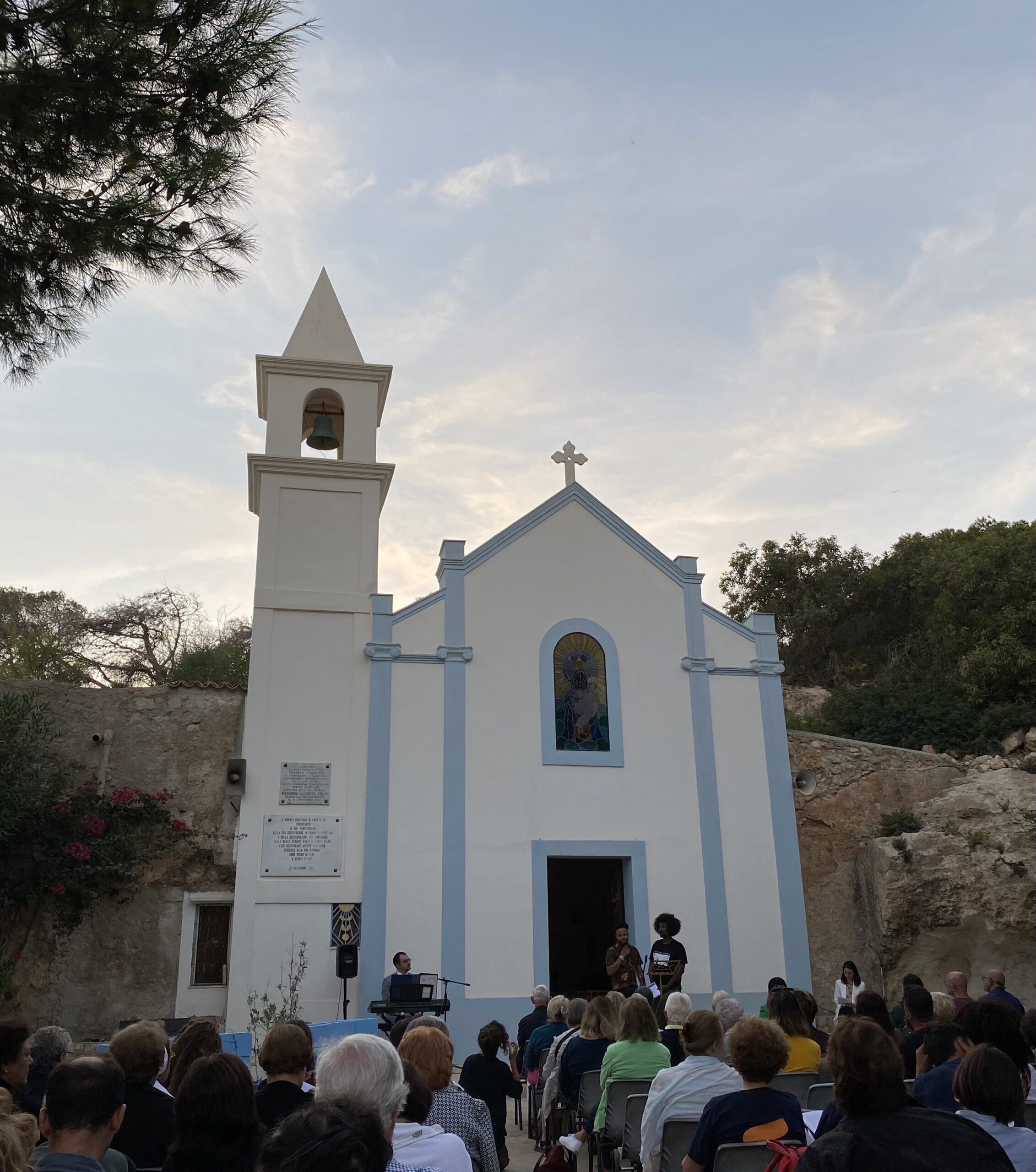
The main recipients of these provisions are runaway slaves or shipwrecked persons: whether Christian or Muslim, it makes no difference. With these goods, they can subsist while waiting for a vessel to dock and take them aboard.
There is no need, in this deserted island, to possess the sophistication of a Robinson Crusoe to survive alone. Through collective solidarity, the means necessary are available to anyone who strays there. In turn, passing sailors who require a few objects are allowed to use those buried in the cave, but they must return them or deposit an equivalent value. According to a belief shared by Christians and Muslims, those who would illegitimately seize something would lose the ability to depart Lampedusa, for the wind and the storms would scourge their boats.
Alimen maritime
This island then becomes a space of peaceful encounter, in a sea haunted by stubborn antagonisms and violent clashes, where violence can erupt at any moment, where naval battles, boarding of merchant ships, pillaging of towns and raids on coasts are routine. Borders are far from linear in the Mediterranean. They resemble arabesques drawn by waves and wind. Unstable and mobile, they rise and fall. They correspond to fronts, as in the Middle Ages, and know no standardized demarcation promoted by states on the European continent in the modern era. Across the liquid expanse, frontiers advance and retreat through assaults, reversals, ambushes. Conquests and reconquests. Alliances and betrayals.
These dotted borders form a fairly loose, stretched fabric. In their gaps lie numerous chances to meet the other. Even the fundamental ideological fracture stemming from the Islam–Christianity divide proves porous. It is pierced by countless experiences of exchange, connivance and collaboration that lend a distinct tone to life in the Mediterranean. A range of contact zones channels intercultural communication. One could list these places conducive to interaction: ports, fondacos, caravansaries, customs houses, ships that often carry a mixed crew of passengers, sanctuaries where the steps of Jewish, Christian and Muslim pilgrims intertwine.
With its sober, minimalist setting, Lampedusa perfectly embodies this principle. It is precisely that: a contact zone, a transition, a threshold. Lonely in the open sea, it offers the experience of a limen.
Landing on its shores, entering its interior, down to the cave-sanctuary, corresponds to a crossing toward the other. In its sunlit, wind-swept landscape, the island allows an intimate and tranquil encounter with the other. It encourages a suspension of hostilities that extends to mutual aid among enemies.
The miracle of Lampedusa has no designated showrunners.
No ecclesiastical impresario has laid a hand on it. The sanctuary and the traditions tied to it are the result of spontaneous, anonymous creation, the work of sailors, slaves, corsairs. Yet the island’s fame travels to every corner of the sea. Who does not know the profile of this outcrop? Who has never heard of its prodigious grotto, in ports where ships set sail? The Madonna of Lampedusa has devotees in Marseille as well as in Livorno, in Tunis as well as in Tripoli.
The island’s extraordinary configuration soon becomes familiar to Europe’s cultured public.
Its mention threads through numerous works written in various languages—Latin, Italian, Spanish, French, English, Dutch—and spanning the broad spectrum of genres. Many devotional writings seize the island’s traditions to assert the vigor of Marian worship, capable of winning over even the “infidels.” Travelogues and novels frequently evoke the encounter, real or imagined, with this singular and enigmatic place. And dictionaries, geography books, histories echo it. Through this expansive production, the myth of Lampedusa travels across the continent. The small island is thus identified as “a high place of mutual aid and tolerance in the Mediterranean,” to borrow the expression of the historian Guy Turbet-Delof.
Cradle of a Enlightenment society
In the 18th century, Lampedusa enters Parisian salons where the intelligentsia of the Enlightenment gathers. A symbol of religious openness, often referenced in a somewhat subversive way, it insinuates itself into the reflections of the era’s most discerning minds and makes its way into some of their pages. In a work published in 1757 (Le fils naturel ou les épreuves de la vertu. Comédie en cinq actes et en prose, avec la véritable histoire de la pièce), Denis Diderot makes Lampedusa the cradle of a new society. Relying on the tradition of the double cult, which he knew well, he places there the utopian dream of an island society composed of actors, in which theatrical art becomes the foundation of communal life, replacing religious rites.
The success of Le Fils naturel, with all the ensuing polemics, circulated the island’s name among intellectual circles, both among opponents and supporters of Diderot—and not only in France but also in Germany. In turn, for his unfinished novel, Émile et Sophie ou les Solitaires, Jean-Jacques Rousseau designs a plot steeped in the Lampedusa myth. Let us also mention a letter sent in 1780 to Friedrich Melchior Grimm by the abbé Ferdinando Galiani, an Italian economist of encyclopedic knowledge (in Beyond Good and Evil, Nietzsche would call him “the deepest, most perceptive—and perhaps also the dirtiest—man of his century”), in which Lampedusa is described as “the temple of perfect tolerance.”
This long, fairy-tale-like story comes to a close in the 19th century. There are then attempts at colonization by the Maltese. With very small, disorderly and erratic forces, this undertaking is encouraged and partly overseen by the British. The Union Jack thus flies over the island, but after much hesitation London renounces any official seizure, contenting itself with controlling Malta. The Russians and the United States then eye the southern sea and also consider acquiring Lampedusa as a military base. Yet this remains without result.
It is the Kingdom of the Two Sicilies that undertakes colonization of the island, purchasing it from the Tomasi princes. In September 1843, two steamships carry about 120 people, including soldiers, settlers and administrators, with the equipment needed for the first constructions. The few Maltese families who had lived there for around forty years are forced to depart. The grotto-sanctuary is reorganized and the facilities tied to the Muslim cult disappear. The tradition of interreligious sharing ends and the Lampedusa myth falls dormant.
At that time, the Barbary threat has been neutralized. A new political order emerges in this part of the Mediterranean, now pacified and dominated by England and France. In short, it is a European mare nostrum. After so many centuries, Lampedusa becomes the foundation for a stable human settlement. The population increases over the decades.
From 1860, the island falls under the new Italian state. A small outpost south of a largely neglected Mezzogiorno, it finds itself thousands of kilometers from the country’s economic and political heart, which beats in the north of the peninsula. At the same time, Lampedusa loses its role as a resupply point for Mediterranean navigation. With the rise of steam navigation, speed increases, as does ships’ autonomy.
At first, the island’s colonization is oriented toward agriculture. Yet, despite the peasants’ hard work, yields remain mediocre, especially as wild deforestation for clearing fields and producing charcoal causes severe damage, promoting soil erosion and groundwater depletion. The inhabitants gradually change course and turn to the sea. They become fishermen, participating in exploiting resources in the surrounding waters—particularly sardine shoals and sponges—that also attract many ships from Italy, Dalmatia, Greece and Tunisia. They learn the trade on the job, building fish-processing industries and maintaining close ties with the Tunisian coast.
During this period, Lampedusa loses its aura of exceptionality. It becomes a territory among others, lacking any border attributes. At the dawn of the 20th century, European states have now claimed the entire southern rim, from Suez to Tangier. The old political, religious, and civilizational divides between the two shores are paused. Within this framework, the Mediterranean social fabric can unfold freely. Freed from the burden of wars and guerrillas that had almost always afflicted it, the sea fully reveals its vocation as a space of movement.
The battles of World War I spare this region, especially since the principal colonial powers controlling the southern shore are allied or—Spain being an example—remain neutral. The rise of Italian fascism, with its dreams of a Mediterranean empire, introduces substantial tensions. During World War II, the central Mediterranean becomes a theater of conflict. The border returns and Lampedusa becomes a military base. In June 1943, it is heavily bombed by Allied aircraft launching from Malta.
Return to the center
Probably the island would have slipped back into anonymity, if, from the following decade, it had not been seized by the explosive growth of migratory flows that cross the sea from the south. Its geographic position, just south of Tunis, places it on the front line. Moreover, political decisions at the Italian and European Union levels have reinforced this role. Lampedusa has become the pivot for monitoring human flows and the launching point for managing landings in the central Mediterranean: it is now a bulwark and a fortress for a continent that feels increasingly besieged but also a dock and a mirage of an Eden of abundance and peace for the migrants traveling desert trails. Once again, ships converge in large numbers toward the island, but now they are mainly Italian or European patrol vessels, or the fragile boats crowded with the wretched of the sea.
The European unification gradually erased the deadly borders between states, those bloodied trenches drawn with a sword, at the cost of millions of lives sacrificed over the centuries. Yet this peaceful process shifted the burden of the border outward from the continent, with a substantial hardening of visa regimes. The fortress Europe builds a wall for those born in the wrong place who would seek better life prospects. It is this policy that generates clandestine immigration—efforts to slip through the barbed wires encircling this zone of law and prosperity.
As the EU’s outer ring expands, it swallows the entire southern shore’s edge of the Mediterranean. The border with the south becomes entirely liquid. Yet this boundary’s line is utterly ill-suited to stopping human flows. The maritime boundary of Europe in the central Mediterranean ends up coalescing at Lampedusa, transforming into a tiny terrestrial transition zone.
If one settles in Lampedusa, one almost daily notes that Europe’s peace utopia tolerates a scandalous number of deaths at its southern gates. The narrow sea between Sicily and the Maghreb is one of the world’s deadliest. No one on the island forgets October 3, 2013, when a boat carrying Somalis and Eritreans capsized near the shore, causing 368 deaths. This was only the culmination of a funeral sequence spanning months, weeks and days. Death continually encircles this outcrop. Many wreckage fragments from ships wrecked elsewhere wash up on the island’s rocks and beaches. Each year, dozens of corpses remain trapped in fishermen’s nets or are recovered by the coastguard. Some even reach the coast after a long macabre dance on the waves.
Again an island on the border, Lampedusa reverts to its ancient vocation as a place of transition and contact. In a distant past, it enabled peaceful encounters with the other in a wholly natural, pristine, solitary setting, devoid of any stable human presence. Now it has become a limen again, but in an overcrowded space, a genuine bazaar of difference, where disparate and often antithetical groups jostle together: migrants, tourists, local population, soldiers, EU and UN officials, NGO staff, activists, artists. Lampedusa is a world island where a number of the major contradictions shaping the modern Mediterranean space converge.
Within this uncertain magma, the seeds of new open, peaceful practices can also be discerned: to prevent shipwrecks, to aid boats in distress, to assist the rescued, to honor the dead, to preserve their memory as much as possible. In short, to restore some humanity to the border, to resist turning the sea into a wall of barbed wire. A collective, bottom-up process converges here and gives form to an open island.
As in the Enlightenment era, Lampedusa stands to challenge European conscience.