
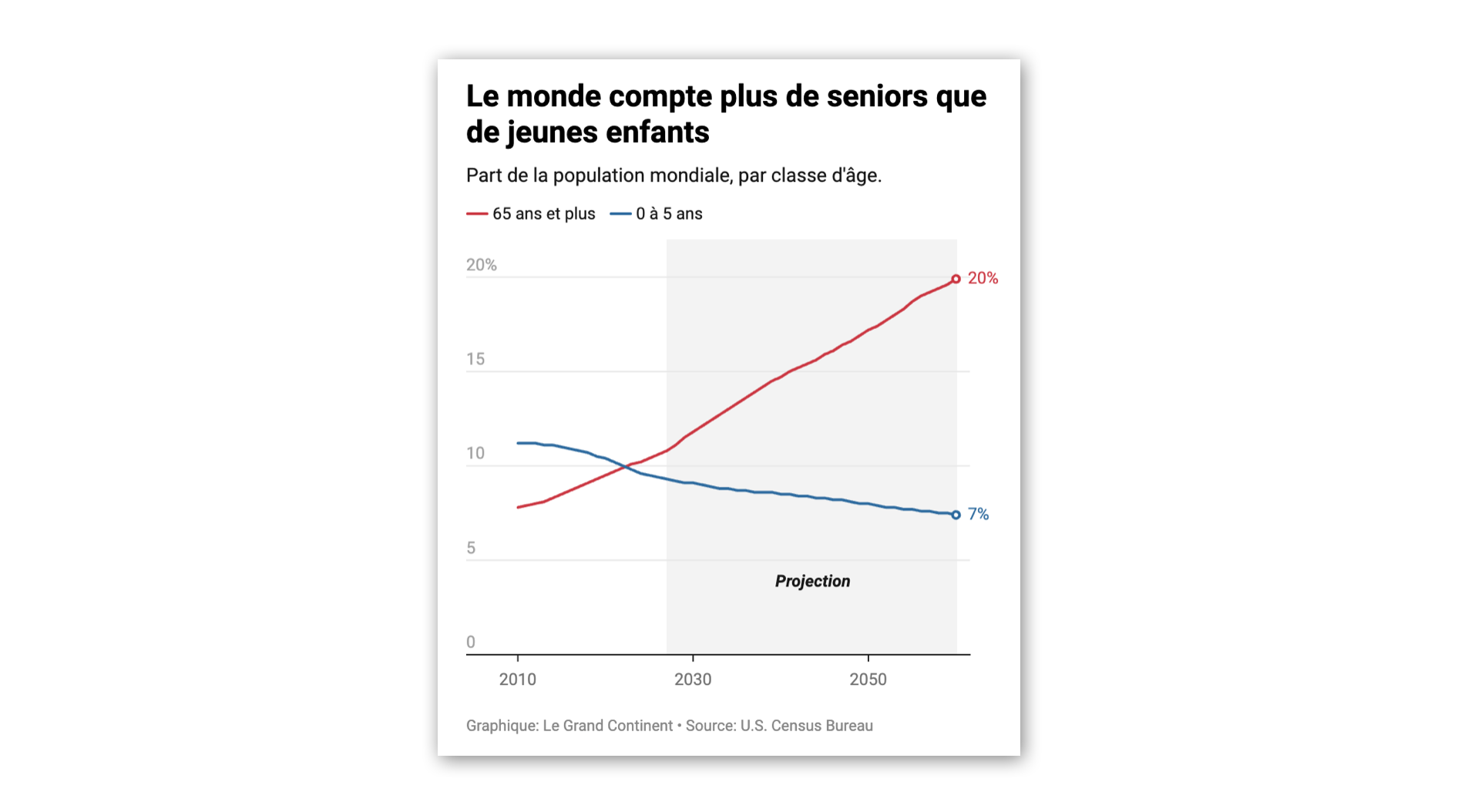
According to a new report from the U.S. Census Bureau, the share of the world’s population aged 65 and older surpassed that of children aged 0 to 5 in 2023. The gap is expected to continue widening at least until 2060, when there will be almost three times as many seniors in the world (20%) as young children (7%)1.
The decline in fertility combined with longer life expectancy is anticipated to trigger an unprecedented demographic reversal.
- By 2060, the number of people aged 65 and older is expected to more than double, reaching 2 billion.
- Those seniors are projected to account for more than half of the total global population growth anticipated over the next 35 years (1.148 billion out of roughly 2.1 billion in total growth).
- At the same time, the number of young people aged 0 to 19 should remain stable, around 2.6 billion people.
In Asia, the share of those over 65 is expected to represent the largest portion of societies by 2060: up to 41% of the population in South Korea and 39% in Taiwan, Japan, and Hong Kong.
- If all regions around the world are going to experience population aging by 2060, it will be fastest in Asia and Latin America—ahead of Europe.
- The report notably confirms that India and China, the two most populous countries in the world, have now both fallen below the replacement threshold of 2.1 children per woman.
With a projected median age of 49 in 2060—versus 44.1 in 2025—the ongoing demographic transition in Europe could lead to significant social, cultural, and political changes, particularly in France, where nearly a quarter of public expenditure goes to pensions.
- As of January 1, 2025, more than half (51.6%) of French citizens eligible to vote were over 50, according to INSEE data.
- The high turnout of seniors in elections also contributes to their overrepresentation among voters, beyond their share of the population.
- The figures collected by Ipsos over the past decade show a shift in the voting of those over 50 toward far-right movements, notably the National Rally2.