
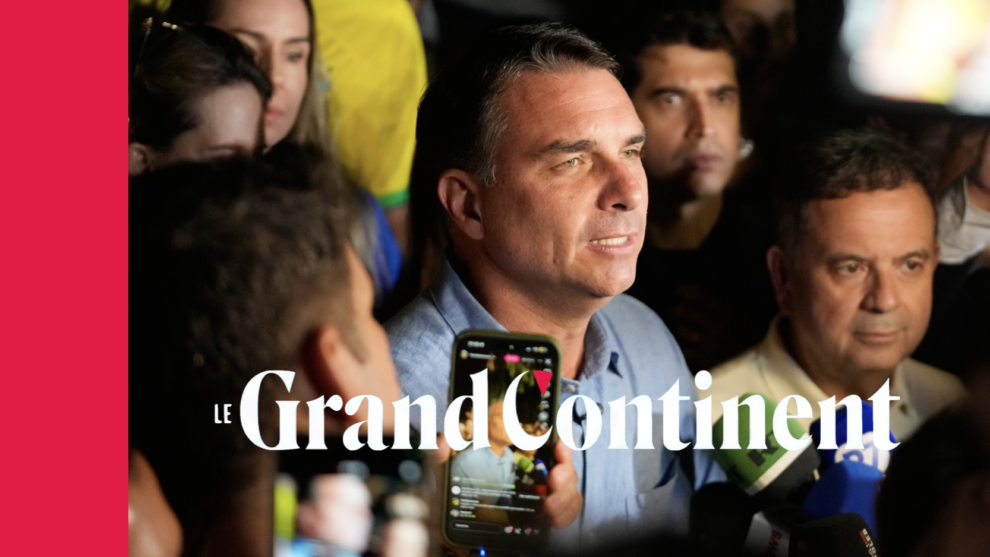
For the first time since 1998, a candidate has edged ahead of Luiz Inácio Lula da Silva in the Brazilian presidential election. With 47.1% of the expressed votes to Lula’s 45.1%, Flavio Bolsonaro finished about 2.4 million votes ahead. He celebrated the result in a deliberately informal setting at the Lago Sul campaign HQ in Brasília, among barbecues, jingles, and supporters wearing the Seleção jersey.
His message boiled down to one sentence: “The slogan is change. Brazil has had enough.”
Flávio Bolsonaro built a political line in the continuity of his father’s reactionary stance, breaking clearly with Lula’s PT. He integrated elements borrowed from two central figures of the Latin American right, Nayib Bukele and Javier Milei.
From the president of El Salvador, the senator of the Liberal Party adopts the response to a strong demand for security and state action, even if it calls into question the rule of law and the independence of the judiciary. He promises to appoint “at least four judges” to the Supreme Court “who will not seek to interfere in elections.”
From the Argentine president, particularly active in supporting the Bolsonarist campaign, he retains a very liberal economic line summarized by “a modern government with fewer ministries.” To the millions of workers of the informal economy, he does not propose the union tutelage embodied by Lula, but the reorganization of work through self-employment and the promise of neoliberal emancipation.
His electoral success seems to hinge on his ability to portray Lula and the PT as a worn-out power, lacking energy: “Lula fights for power. He has already run in seven presidential elections.” Facing him, Flavio Bolsonaro presents himself as the candidate of a single term, here to close “the PT era”: “it’s over, it’s the end of the PT era. The end of the PT era, the change in our country. The PT era, which leaves behind only a record of murdered women, a record of indebted Brazilians, a record of high taxes, a record of despair, a record of closed businesses.”
This result places him in a position of strength for the second round on October 25 and seems to prolong the Trump-inspired domino effect in Latin America. Yet, one absence stands out in this brief speech: Washington. The candidate did not mention Donald Trump, perhaps signaling the difficulty in selling to Brazilians the administration’s doctrine of recolonizing Latin America.
Nearly 56 million Brazilians have given this vote of confidence in change. The word is change. Brazil has had enough.
And I am very satisfied, because many polling firms had us behind. Our own trackings showed us ahead, as this happened, with a real chance of winning in the first round. It was very close. But I am very happy with the number of Brazilians who took to the streets, who went to the polls, rather, to express themselves. They did not abstain, because they wanted this change.
And this is the end, the end of the PT era. The end of the PT era, the change in our country. The PT era, which leaves behind only a record of murdered women, a record of indebted Brazilians, a record of high taxes, a record of despair, a record of closed businesses.
And I am very happy about the real possibility that, in three weeks, Brazil will deliver a definitive answer. It will be a modern government, a government with fewer ministries, a government that will [value / respect] democracy. It will be a government that will appoint at least four judges to the Supreme Federal Court (STF) who will not seek to interfere in elections, after all Lula did, using the state apparatus, spending more than 350 billion reais to try to win the election.
What I have to say is that Lula is fighting for power. He has already contested seven presidential elections. Seven presidential elections. Lula is fighting for power. He has already contested seven presidential elections. I, I care about the future of Brazil, I am fighting for Brazil.
And this is how I will continue to conduct myself over these next three weeks: with a clean campaign, as a man who does not seek to perpetuate himself in power. I am the only candidate who has committed to ending re-election because I only need one term to place Brazilians at the center of my government, in order to tackle the real problems of Brazil and solve them.
I want to have the opportunity to take care of Brazil. I want to have the opportunity to take care of the Brazilian people. I want to have the opportunity to take care of you who are watching me. And this is what I will do, with a lot of energy, a lot of joy, and a lot of hope, because Brazil will win.