
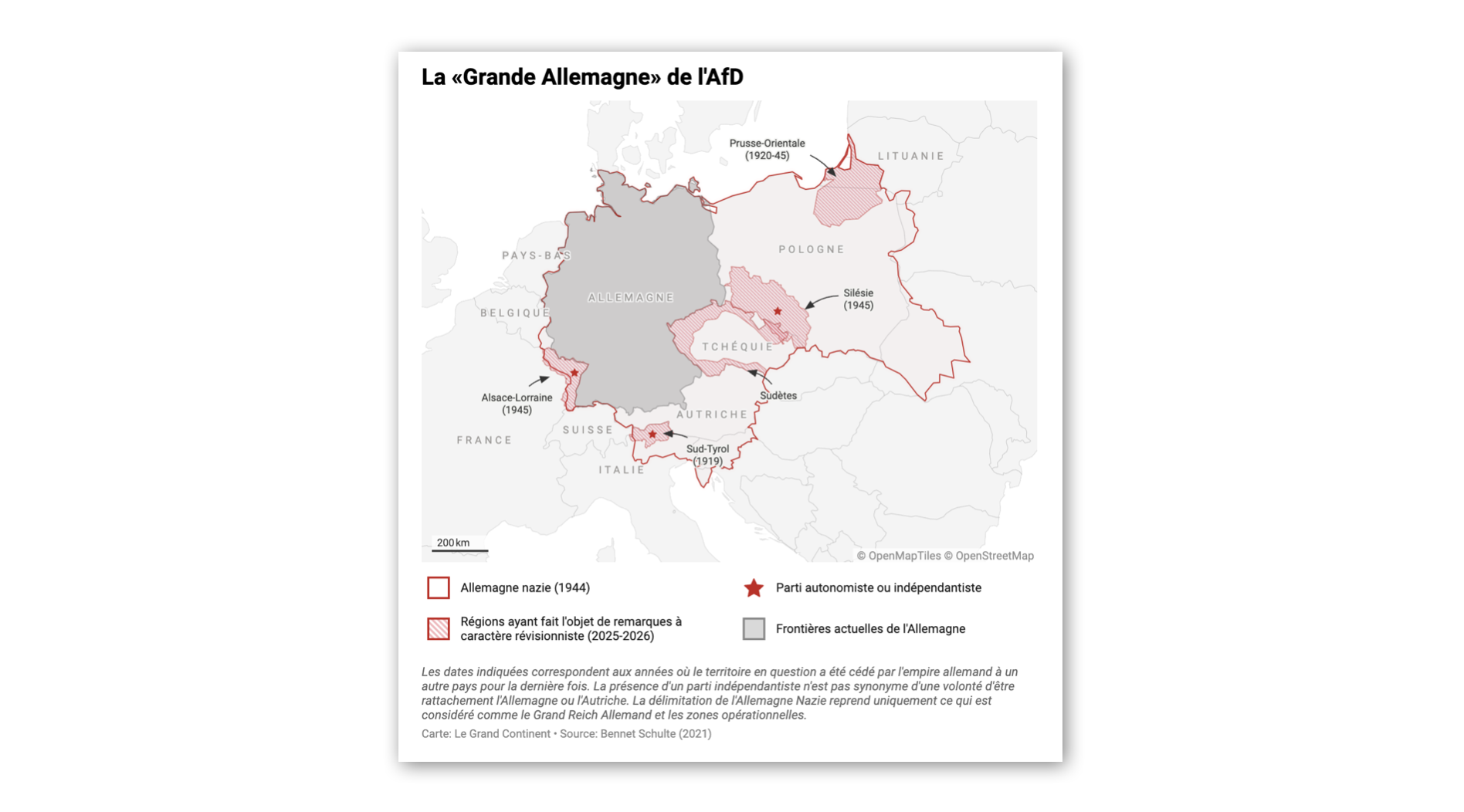
Members of the Alternative for Germany (AfD), the far-right party in Germany, have been issuing a series of irredentist signals toward regions that once belonged to the German-speaking sphere but are now located in other European countries. The approach does not necessarily originate from the party leadership, but none of these statements have, to our knowledge, triggered any disciplinary action.
- In 2018, the AfD group in the Bundestag questioned the government about the work of the “cultural liaison for West Prussia, the Province of Posen, central Poland, Volhynia and Galicia,” in a series of questions in which it demanded institutional funding for associations of expellees.
- In November 2019, Stephan Protschka, AfD member of the Bundestag, helped finance a monument in Bytom paying “homage to the German soldiers who fell during the First and Second World Wars, to the fighters of the self-defense corps and the Free Corps, and to the oppressed and murdered East Germans.”
- In 2024, Alice Weidel stated that she had always refused to use the Polish name Głubczyce for Leobschütz, the town of origin of her father’s family, in the current Opole Voivodeship.
There has been a noticeable acceleration in verbal provocations linked to “lost territories” since the start of the year.
- After the Russian state designated Landsmannschaft Ostpreußen, a cultural association of expellees from East Prussia, as an “undesirable organization” in May, the AfD condemned the decision and asked the German government whether it had discussed it with Moscow.
- In the same month, AfD elected representatives in Bavaria called for the repeal of the 1945 Beneš Decrees, which provided the legal basis for expelling Germans from the Sudetenland in the recreated Czechoslovak state after it was dissolved by Nazi Germany in 1938–1939. On the occasion of the Sudeten German Congress, which was being held for the first time in the Czech Republic, members of the AfD defended organizing the demonstration despite hostility from the Czech far-right party Freedom and Direct Democracy (SPD), with which the AfD sits in the European Parliament in the Europe of Nations and Freedom (ENF) group.
- On September 12, in Termeno (Termeno sulla Strada del Vino), at the youth-movement congress of Süd-Tiroler Freiheit, founded by Eva Klotz, Jean-Pascal Hohm, the head of the AfD’s youth organization (Generation Deutschland), echoed the party’s slogan by declaring: “South Tyrol is not Italy.”
Alsace, whose territory was part of the Holy Roman Empire before being attached to France in the 17th century and which was annexed to Germany twice (in 1871 and 1940), also became a target of claims.
- A young activist from Generation Deutschland, the AfD’s youth wing, Marco Eggebrecht, posted on X on May 9 a photo of himself accompanied by the caption: “How I look at you when I hear: Alsace-Lorraine must become German again.”
- Three days later, European Master Tomasz Froelich, a 2024 AfD member of the European Parliament, attacked France and denounced “its aggressive policy of linguistic assimilation,” as well as “the hypocrisy” of the Union for criticizing China’s policy toward the Uyghur populations.
On October 3, German Unity Day, a leader of Generation Deutschland, Luca Maurice Strauf, described reunification on X as a “step-by-step victory,” commenting on an image that includes among other things Alsace-Lorraine, Luxembourg, and Austria but not Silesia, Pomerania, or East Prussia.
He has since deleted his post.