
All summer long, the Grand Continent will stay in motion. Each day, wherever you are, we will bring you ideas you won’t find anywhere else (but they’ll be everywhere at the start of the season), texts unavailable or refreshing with our Sundays. To receive them directly in your inbox and support this momentum, consider subscribing to the magazine
Tuesday, July 28, as the World Cup had barely ended, a journalist revealed the existence of a secret FIFA plan aimed at selling a portion of its commercial rights to investors via a private company, the FIFA Forward Enterprise (FFE). The European public sphere immediately ignited, for three days of twists, before Gianni Infantino, the FIFA president and architect of this plan, abandoned it by the following Saturday.
For football enthusiasts, this episode will probably remain a memorable moment, just as the attempt to create a European Super League that had sparked headlines in 2021. Beyond its brief existence, what should be called the “Infantino plan” is an opportunity to address the global governance of football, its drift, and the role that the Union could and should play there.
Selling a stake in FIFA: the Infantino plan and its downfall
The FIFA never revealed the details of the plan, notably the rights that investors would have at disposal within the FFE. It merely communicated the broad outlines of the project. In short, it involved transferring FIFA’s commercial rights, notably those related to sponsorship, ticketing and media rights, to a company in which FIFA, a Swiss non-profit association, would remain majority. 20% of the shares of this company would then be sold to private investors. Their identity is known: the Thrive Eternal fund, charged with assembling the pool of investors with the support of the American bank J.P. Morgan, is led by Joshua Kushner, the brother of Jared Kushner, son-in-law of Donald Trump.
What was Infantino’s objective? FIFA had just closed a World Cup record in terms of revenue. The body isn’t really short of liquidity, unlike French professional clubs which had in 2022 resorted to a relatively similar arrangement with the CVC Capital Partners fund to offset significant losses caused by the Covid-19 pandemic. FIFA presented mainly the Infantino plan as an opportunity for member associations to obtain a substantial envelope (up to 40 million euros per federation for the 2026-2033 period) to invest in the development of football on the territory they administer. This immediate windfall would inevitably translate into a decrease in the revenues they would receive in the future, as a significant share of the FFE’s receipts would now be paid to investors rather than FIFA. Infantino likely counted on the short-sightedness of FIFA members and their leaders to persuade them of the plan’s merits.
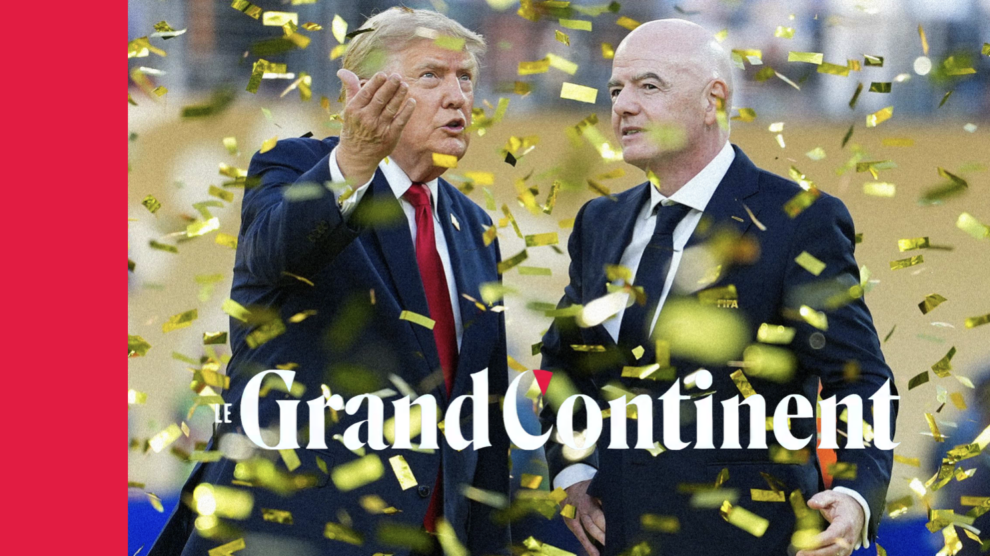
The motive for this maneuver seems to have been primarily personal for Gianni Infantino. On one hand, by transferring large sums of money to FIFA members, whose leaders will next year form the electoral body for the election of the next president, he surely hoped to secure his reelection as head of the federation. On the other hand, this plan would create a company whose future chief executive could only be the president of FIFA. He would thus be able to earn one of those dizzying remuneration packages to which leaders of companies with turnover comparable to FIFA are accustomed. This is not permitted by the mere status of president of a non-profit association. Finally, for Infantino, it might also have been a way to prepare his future beyond FIFA — perhaps even for the role of United Nations secretary-general — by serving the Trump clan. He could thus hope for the American president’s support. Therefore, while the benefits of this plan for FIFA are hard to find, one can easily understand the reasons that could have pushed Gianni Infantino to devise it.
What the FIFA president had not properly anticipated, however, was the strong resistance that his plan would provoke. The proposal to align investors with FIFA could have seemed normal across the Atlantic, even if it ran into opposition from the North American, Central American and Caribbean Confederation of Football. But in Europe, it sparked an immediate outcry, fueled by the frustrations caused by Infantino’s numerous compromises with Donald Trump, notably in the Balogun affair, the American player whose suspension was lifted following the intervention of the American president. Surprisingly, given their initially divergent interests, UEFA members quickly agreed to boycott FIFA competitions if the plan were adopted. Many political leaders also threatened to use their prerogatives to block the project. Although UEFA is far from representing a majority within FIFA, which operates on the principle “one association, one vote,” Europe remains indispensable on commercial and sporting levels: a World Cup without European teams would have lost a great deal of its value.
What conclusions can be drawn from these three days of crisis? The glaring governance flaws of world football are evident, but there is a real risk that Infantino’s forward push may fail to address the root causes of the problem.
The Infantino plan: a symptom of FIFA’s poor governance
The Infantino plan is indeed the symptom of a deep lack of democracy and counter-powers within FIFA. As the European Court of Justice noted in its Superleague ruling, FIFA and UEFA are the private rulers of football in Europe and worldwide. They legislate, supervise the application of rules, settle disputes, and redistribute resources within the football ecosystem. In labor law matters, for example, FIFA is the originator of a transnational right that applies to all professional footballers. They are thus neither associations nor ordinary companies. They perform functions of “public powers,” albeit rarely perceived as such.
Nevertheless, the internal political structures of these organizations do not foster democratic accountability. Within FIFA, the congress elects the president for four years and can also amend the organization’s statutes. Each member of FIFA, numbering 211, has one vote: Curaçao (with 150,000 inhabitants) weighs as much as Germany (with 8 million licensed players). Consequently, following the multiplication of micro-member associations, strongly encouraged by the successive presidencies of João Havelange (1974-1998) and Sepp Blatter (1998-2015), a small minority of licensed members (which one could liken to “citizens of football”) can easily control FIFA and ignore the majority’s interests.
This political dynamic underpins the repeated corruption scandals and the Infantino plan. Indeed, to retain his position, the FIFA president must do everything to satisfy the smaller nations of football. João Havelange and Sepp Blatter turned a blind eye to bribes tied to the marketing of media rights and to the resale of World Cup tickets by member federations. Gianni Infantino went further by strengthening a formalized system of revenue redistribution, via a development program called “FIFA Forward,” which allows each member association access to substantial financial aid that is not proportional to their size or needs. In theory, these aids are supposed to fund infrastructures for football on a territory, such as football pitches or administrative resources. However, FIFA does not rigorously control their final destination, and a substantial portion is probably diverted to those who pull the strings within the member associations. FIFA is thus far from a genuinely democratic organization, even though it claims otherwise in its communications. It is, in reality, controlled with an iron fist by its president, who maintains influence through a well-oiled clientelist structure, of which the Infantino plan was only the latest avatar.
The hubris shown by Gianni Infantino in recent months is likely partly linked to his proximity to Donald Trump, but above all to the absence of counter-powers within FIFA. He could string together controversial decisions, such as awarding a “FIFA Peace Prize” to Donald Trump or appearing to interfere in the Balogun affair, without encountering any internal resistance.
This weakness of internal counter-powers within FIFA is not surprising. The independence of its jurisdictional bodies, highlighted in its Balogun communications, is far from guaranteed in practice. Indeed, the members of its commissions (disciplinary, ethical, or appeals) are proposed by the FIFA Council, then elected by the Congress, which can also dismiss them. Their terms are short (four years) and renewable. These positions, which grant access to numerous benefits, tempt members of these “independent” bodies not to offend the executive and its majority in order to preserve their chances of renewal. Many of them have built their careers within the member associations or their services, which creates major conflicts of interest.
This internal justice is thus far from independent in the sense of state judicial independence. It is not able to resist the excesses of a president supported by the Congress. In the only instance where such a confrontation occurred, when the Governance Commission refused to let Vitaly Mutko (then Russia’s deputy prime minister and sports minister) stand for a seat on FIFA’s Council, Infantino did not hesitate to do everything to have the committee chair, Professor Miguel Maduro, former Advocate General of the EU Court of Justice, removed from his post in 2017 by the first Congress that followed his decision. The message was clear: if you oppose my decisions, I will end your terms within FIFA. Thus, the few counter-powers that might have emerged after the 2015 corruption scandal and Blatter’s departure disappeared.
The Infantino plan does not come from nowhere; it fits within the continuity of a clientelist system that grants the FIFA president absolute power. It is therefore not only about stopping this plan, but about launching a democratic revolution, something only the European Union could accomplish if it chose to do so.
FIFA’s bad governance: Swiss responsibility, an opportunity for the European Union
Outraged press releases from national or European lawmakers, posts on X criticizing the European Commissioner for sport, or the Council of Europe Secretary-General’s call to reform football governance all sound familiar. Whether in 2015, during Sepp Blatter’s departure, or in 2021, with the creation of the Super League, the political world regularly steps up to demand better governance of football. Yet, once the media buzz subsides, nothing changes. The United Kingdom stands out as an exception to this inertia, with the creation in 2025 of a public regulator for football.
Switzerland bears a heavy responsibility for FIFA’s drift. Indeed, Swiss private law plays a fundamental role in the governance of global sport. It allows international sports organizations to register in Switzerland as associations, without being subjected to constraints different from those of a local chess club. Until recently, this liberal regime even tolerated private corruption within FIFA; it was only the 2015 scandal that prompted Switzerland to legislate to criminalize it. Moreover, the Swiss Federal Court plays a key role in protecting a transnational sports judiciary, overseen by the Court of Arbitration for Sport in Lausanne, which in practice is largely at the service of the executives of the sports federations. The absence of counter-powers within FIFA has thus been encouraged by the lack of supervision by Swiss authorities, whether administrative or judicial. If one can rejoice in seeing the current Secretary General of the Council of Europe, Alain Berset, speak out against FIFA’s excesses and call for reforms, one can also regret the Swiss government’s lack of action on these questions, even when it held the presidency.
Gianni Infantino, a Swiss jurist himself, has fully leveraged this regulatory paradise and its laxity. Switzerland’s position is easily understood: the activity of international sports organizations is extremely beneficial to the Confederation’s economy. However, this situation creates major negative externalities for the rest of the world: other countries do not benefit from these economic spillovers, but suffer the harmful effects of FIFA’s poor governance. It is to address this Swiss paralysis that the European Union must take up the question and introduce a European sports regulator, or at least for football.
The Union does not necessarily have a good reputation among football fans. It is often seen as the cause of deregulation and its excessive commercialization, largely due to the Bosman ruling. This is a fundamental misinterpretation, which has unfortunately become a commonplace, propagated in part by the sports organizations responsible for this commodification. It is nevertheless undeniable that to date, EU law has been used primarily to challenge existing sports regulations (notably when they are abusive), but not to regulate international sport.
The European Court of Justice shows nuance in its review of contested regulations: it has recently broadly supported FIFA’s agent regulation in its RCC Sports ruling. Nevertheless, it is not the right institution to rethink sports governance as a whole. This responsibility lies with the European legislator, and it is an opportunity. FIFA’s strength stems from its global reach; it naturally maintains an asymmetric power relationship with nation-states and can impose certain choices while resisting their interventions. By contrast, the Union represents a group of states that FIFA cannot ignore. Although the UK’s departure has weakened the bloc’s football power, member states still include four of the five most-watched professional leagues in the world, their national teams are indispensable in international competitions, and European consumers represent a crucial market for FIFA’s drawing cards (ticketing, TV rights, Panini cards, etc.). In short, the Union possesses a decisive sporting and economic lever over FIFA.
It is time for this lever to be used to reform FIFA. Admittedly, the Commission in principle has only a very limited competence in sport, but FIFA’s commercial activities clearly fall within its remit related to the internal market. Thus, three academics recently proposed to introduce what they called, in reference to the Digital Markets Act, the “European Sports Act.” The idea would be to impose minimum governance standards on sports organizations that offer on the European market products and services tied to international sports competitions.
If many aspects of this proposal can be debated, it has the merit of showing that the Union is legitimately able to assume a regulatory role that goes beyond the negative and sporadic interventions of the CJEU or the rare DG Competition investigations. Such intervention would, on the one hand, correct the notion, embedded in European supporters’ collective consciousness, that the Union is the source of all current football ills. It would also demonstrate that the bloc can preserve a European model of sport, affirming its specificity in contrast to the North American approach that is predominantly commercial.
The task ahead is immense. It will provoke heated debates, but it represents a unique opportunity for European construction to prove that it can effectively represent its citizens’ interests by forcing transnational private governments, which emerge outside democratic control, to finally be accountable.