
Today, Wednesday, August 12, a total solar eclipse will be visible in the northern part of Spain and along the western coast of Iceland in particular. In the north and west of the continent, the eclipse will be partially visible, with the obscuration ranging from about 80% to 99.5% approximately.
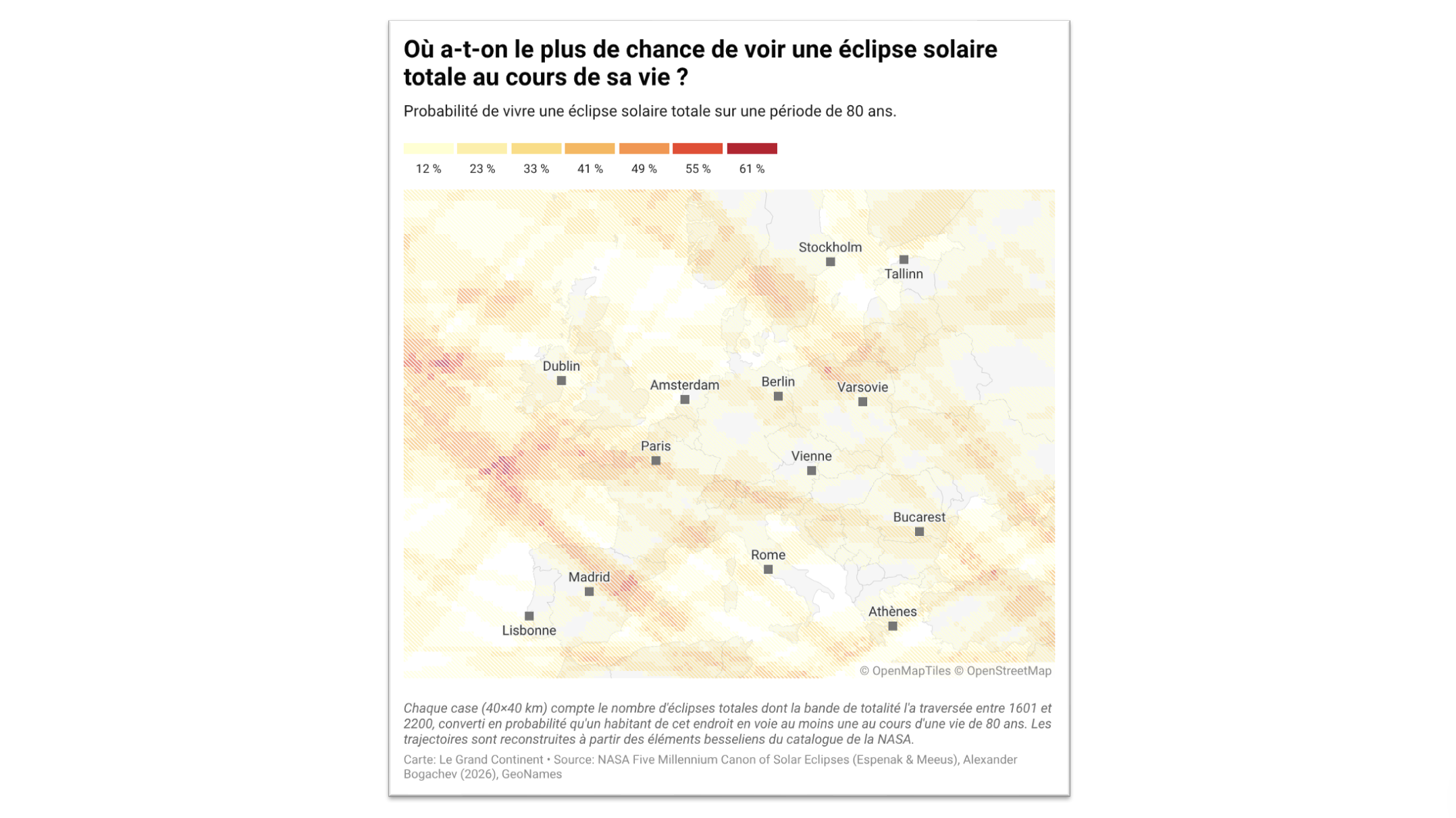
- Based on an average life expectancy of 80 years and the trajectories of the 87 eclipses observable between 1601 and 2200, the probability of witnessing a total eclipse in Europe within one’s lifetime ranges from 0% to 61%, according to an analysis published in the journal.
- By reconstructing the totality belts from NASA’s solar eclipse catalog, one can observe that France, Ireland, Lithuania, and parts of the Balkans are the regions where the chances of witnessing such a phenomenon are the highest.
- Ahead of Barcelona to the west and around the Polish town of Brusy, in the north of the country, the probability of observing a total solar eclipse is over 50%.
Thus, while it may be relatively common to glimpse a total eclipse during one’s lifetime, it is much rarer to observe it at its point of maximum totality.
- Today, the maximum duration of the eclipse’s totality (the 16th since the century began) will be 2 minutes and 18 seconds, to the west of Iceland.
- We will have to wait until the year 2088 for the point of maximum totality of a total solar eclipse to be observable from Europe: it will pass over Malta, south of Sicily.
- In France, a totality at its maximum point last occurred in 1605, in the southwest, and is not expected to recur before the end of the millennium.
Solar eclipses are relatively common in polar circles.
- Several hundred total eclipses should be visible over the coming centuries in Alaska, northern Russia, Iceland, or Greenland.
- In Paris, only 18 eclipses will be visible by the end of the century (with only 2 total), and 16 in Madrid and 15 in Rome (and none total).