
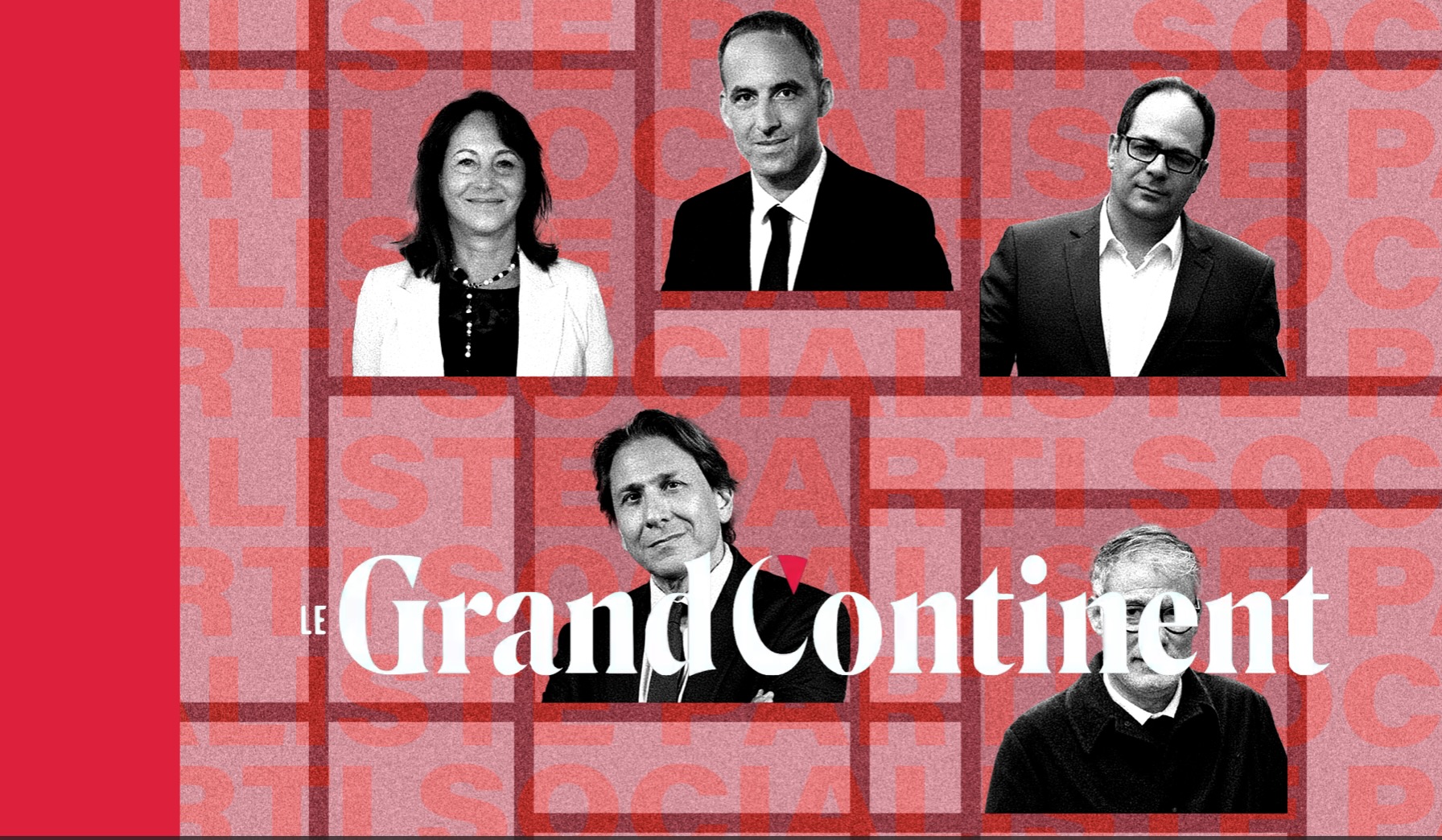
Rarely have questions of international security and defense weighed so heavily as a French presidential election looms. The landscape for 2027 remains far from stable, but on October 9–10, the “socialist pole” begins its nomination process. We posed nine questions to the five candidates in the Socialist and Democratic primary about the geopolitical choices that will shape France’s future at the moment of a great turning point. As with our series French Doctrines, their positions do not bind the independent editorial staff of the review.
Test Grand Continent. Ideas and analyses you won’t find anywhere else. But you’ll see them soon everywhere. In your inbox starting at 8 euros per month
1. Ukraine and Russia
Should France and the European Union go further in backing Ukraine, or should they seek to reconnect with Putin’s Russia?
Olivier FaurePeace is not a concession: it is the objective. We must pursue a ceasefire and work toward it relentlessly, but not at any price.
I went to Kyiv. I saw a people fighting for their freedom who, in doing so, defend ours as well. We should not ask an attacked people to lay down arms because we are tired of the fight.
Peace cannot be Ukraine’s capitulation. It cannot be a reward for the aggressor either. A peace that validates conquest by force would invite more aggression, in Ukraine or elsewhere in Europe.
That is why supporting Ukraine and seeking peace go hand in hand. The better Ukraine endures, the more Vladimir Putin will have an incentive to negotiate. We must continue to help: air defense, European production of munitions with Ukrainian industry, using the proceeds from frozen Russian assets to aid Ukraine, and pressure on the phantom fleet that finances Russia’s war effort.
And there must be guarantees that the ceasefire is not just a pause before a new offensive: security guarantees, return of deported children, the release of prisoners, reconstruction and a European perspective. No peace will be decided without Ukrainians.
This war has taught us one thing: we have too long entrusted our security to others. Building a worthy European defense is one of this generation’s major tasks. But this rearmament must not come at the expense of cutting hospitals and schools. Those who bear the greatest burden must contribute the most.
Raphaël GlucksmannWe assist Ukraine not only out of solidarity with a people heroically fighting for their freedom or out of concern for international law. We help Ukraine because it is in our vital interest to do so. Because our security is at stake.
The Ukrainian resistance is our first line of defense. The Russian war is no longer a distant threat; it is striking EU soil. In August, a drone laden with explosives targeted Leipzig Airport. In Tallinn, an arson attack hit a defense contractor. Sabotage, cyberattacks against our hospitals, drones over our bases: hybrid warfare is now a form of state terrorism.
Yearning to reconnect with Putin is, at best, illusion, at worst, treason. The only policy capable of delivering peace is the one that strengthens Ukrainian resilience and builds autonomous, robust European defense.
We must therefore increase aid to Ukraine, work toward a shield to protect the Ukrainian skies—what we did for Abu Dhabi’s skies without hesitation, why not for Lviv’s—and seize the more than 210 billion euros of frozen Russian assets in Europe to finance Ukrainian resistance.
Weakness does not breed peace; it invites tyranny. It is the weakness of European leaders for two decades in facing Putin that has magnified the threats of war. It is only our strength that can preserve peace and freedom in Europe.
Jérôme GuedjPolitics begins with values, at home as well as abroad.
When a state aggresses another and occupies 20% of its territory, that is a problem for all Europeans: Putin is testing European cohesion. Rejoining with Putin and seeking a Munich-style peace is preparing for even more dreadful wars.
He tested our resilience in Crimea in 2014, he is now testing it in Ukraine, and the Baltic states or Finland are in his crosshairs. European security starts with Ukraine. Zaporozhye may seem distant, but hybrid attacks and cyberattacks target our unity.
Yes, we must do more—for humanitarian, financial and military support. Unlike those who “want to turn off the tap,” France must continue delivering weapons, including those such as the SCALP missiles that enable Ukraine to strike deep into Russia’s logistics hubs and depots.
The question of protecting Ukrainian skies from drone and ballistic-missile attacks (distinct from a delicate no-fly zone) must also mobilize us. To finance this support, seizing the 210 billion in frozen Russian assets should no longer be a matter of debate.
Emmanuel MaurelWe must maintain unwavering support for Ukraine because Russia has no intention of negotiating or revising its war aims.
Ukraine and the EU have repeatedly proposed to Russia to halt fighting and come to the negotiating table. But Vladimir Putin has never engaged; his foreign minister Lavrov keeps repeating that the “special military operation” will run to its end, and his defense minister has a mission to intensify the Russian war effort. And so it goes.
We are at the 21st sanctions package, which targets crypto transactions and imports of “dual-use” equipment via friendly intermediaries like Kazakhstan or Kyrgyzstan. The Union acts to disable all levers allowing Russia to pursue its aggression, and that is a good thing.
If another package, one or ten, is required, I will back it. So too will I back any decision to prolong European financial support to Ukraine or to supply it with equipment for its defense.
But the threat is real, it is drawing nearer, and France is in the Kremlin’s crosshairs. We must respond by strengthening protection of our critical centers and infrastructure, by resisting destabilization attempts, and by enlarging our own defense efforts. The military planning law points toward a defense budget around 2.5% of GDP. I think we should aim for about 3%.
Ségolène RoyalI believe war is the worst possible thing. It is always an appalling failure of political and then humanitarian will, and we have a responsibility to leave future generations a world in peace. […]
This war could have been avoided. Why? Because we knew, we were informed of the Russian attack on Ukraine and the breaches of its borders. If I had been in government then, I would have called for Blue Helmets on the border and a strengthened defense—precisely, to shield Ukraine before the Russians attacked. We were warned, and nothing was done. The longer a war lasts, the harder it becomes to stop. […]
Yes, of course, we must sustain Ukraine’s defense, but we must also mobilize the same energy for negotiating and mediating. The same effort must be directed toward diplomacy, toward discussions, toward mediation. […]
We must always keep faith with the victims of colonizing wars, because that is what this is when Russia invaded Ukraine. We must maintain the channel of dialogue.
My central position is neither naïveté nor knee-jerk warfare. It is to hold both axes: defend Ukraine and relentlessly pursue mediation and negotiation. It is essential to help Ukraine achieve a just and durable peace. It is not easy. Some tell us it is impossible, that we must not even speak of peace for fear of appearing pro-Putin. Yet the French diplomatic tradition has always been to hold both ends with equal force: defending international law and pursuing diplomacy. So we must try; just because it is difficult does not mean we abandon it […]
We can be enemies of leaders without being enemies of peoples. If we do not begin to negotiate, even as Zelensky goes to Washington, he also asks that a ceasefire be supported. Do you think the Ukrainian people do not want a ceasefire? […]
I have never doubted the balance of power. Negotiation necessarily proceeds within a balance of power with Putin. Europe is dedicating enormous funding to this effort. But this war inflicts immense damage, not only in Europe economically but around the world, especially in poorer countries where the price spikes of essential commodities and energy, as well as inflation, hit hardest. This war must stop, and everything must be done to stop it.[…]
If I am elected President, my first move will be to ask our American friends in Washington, our European friends, and those who wish to join us, to establish a permanent venue for negotiation and engagement. […] We must help Ukraine achieve a just and durable peace.
2. Middle East
What role should France play in the Middle East with regard to Israel and its neighbors, Iran, and the Gulf monarchies?
Olivier FaureFrance must reclaim an independent voice in the Middle East, guided by a compass: international law, equally applicable to everyone.
On October 7, Hamas committed an act of terrorism. No cause can justify terrorism. Israel’s security and the right of Israelis to live in peace are legitimate. But the crime of October 7 cannot justify genocide in Gaza. I choose the word genocide deliberately for its weight and because the 1948 Convention obliges us to prevent genocide, not only to acknowledge it after the fact.
We cannot practice “two weights, two measures.” What was a crime in Bucha cannot become acceptable in Gaza. The life of a Palestinian child is no less valuable than that of a Ukrainian or Israeli child. How can we ask the world to condemn Russia’s aggression if we avert our eyes when the law is violated elsewhere?
The French recognition of the State of Palestine was timely and just. It must have consequences: suspension of the commercial part of the EU–Israel Association Agreement, prohibition of products from settlements, sanctions against violent settlers, European engagement in rebuilding Gaza.
On Iran, only a controlled international negotiation can sustainably prevent nuclear proliferation. And Europe must stand with Iranian women and men who resist a regime that oppresses them. With the Gulf monarchies, now powerful diplomatic and economic players, we should build partnerships without buying contracts at the expense of our commitment to human rights.
Speak to all, align with no one, apply the same principles to all: that is the distinct French approach the world must see again.
Raphaël GlucksmannFrance must lead a genuinely serious European effort to defend international law in the region.
The regime in Tehran is a threat first to its own people, then to the region, and finally to us, as illustrated by the Bochum synagogue attack. We must strengthen sanctions and pressure, but the war launched without a plan by Trump and Netanyahu is a catastrophe. They did not consult us, yet we pay the price daily. With pearl-like positions to the north and Bab el-Mandeb to the south, Tehran and its allies now hold two locks on global energy. The current oil crisis shows that our fossil-fuel addiction makes us dependent on hostile regimes or on decisions by foreign leaders over which we have no influence. The ecological revolution is the condition of our geopolitical independence.
In Gaza and the West Bank, France and the EU must stop delivering only words. Weeping for the dead is not enough: crimes must have consequences. The suffering of Palestinians in Gaza and the colonization in the West Bank will not end until condemnations are followed by sanctions. France must lead the charge toward the emergence of a Palestinian state and be once again a reference for both Israeli and Palestinian voices seeking peace. It must also strongly support the International Criminal Court, attacked by the American administration.
Where France can make a clear difference is Lebanon. Strengthening Lebanese sovereignty by pressing for Hezbollah disarmament and pressing Israel: that must be at the heart of our regional policy.
With Gulf countries, defense pacts are structuring, and we will continue to uphold our commitments when their security is at risk.
Jérôme GuedjFrance can and must be a balancing power: speak to all, and apply the same two principles everywhere—the security of states and the rights of peoples. It is this coherence that gives its voice weight.
With Israel and its neighbors, that means the two-state solution, which Mitterrand defended as early as 1982. I am a child of Oslo, and I know peace has enemies on both sides: Hamas’s terrorism and the extremist Israeli who assassinated Yitzhak Rabin in 1995. France must condemn both Hamas’s crimes and the violence in the West Bank and the suffocating blockade of Gaza by Netanyahu’s government, using the language of the International Criminal Court. Weighing means using all of Europe’s tools, including the EU–Israel association agreement. But pressure targets a government, not a society: we must back those on both sides who resist.
Against Iran, the same lucidity: a regime that represses its people and threatens the region must be contained. I understand that a measured reaction is sometimes deemed legitimate, but I regret the international-law weakness: France must work to restore its weight in this regard.
With the Gulf monarchies, France keeps its commitments to its partners, including the United Arab Emirates, attacked by Iran, without compromising or surrendering strategic assets.
Emmanuel MaurelThe recognition—late—of the State of Palestine is not enough. The intentions of Israel’s far-right coalition are explicitly genocidal toward Gaza’s Palestinians, and the ongoing settlement expansion accelerates, as does territorial predation in Lebanon. The first move is to suspend the EU–Israel Association Agreement. On this point, I find the government’s and the president’s stance far too ambiguous.
France must reembrace its Gaullist-Mitterrandese diplomatic tradition, whose non-negotiable principles are defending oppressed peoples and honoring international law. Regarding Iran, we condemn both the regime’s repression and the insane war unleashed by Trump and Netanyahu. As for the Gulf countries, when we are bound to them by defense and military cooperation agreements, we must uphold those commitments—unlike the United States.
Ségolène Royal We cannot forget the October 7 pogrom. The next day I was at the demonstration with the CRIF. We cannot forget that. But we cannot tolerate what is happening today in Gaza either. […]
There is a will that is even stated by today’s Israeli leaders: to eliminate the Palestinian population so Gaza cannot rebuild. The words matter: we must acknowledge the genocide. […]
There is a hypocritical rhetoric that condemns what happens in Gaza while taking no action, and that recognizes Gaza only belatedly. The Global South does not understand this hypocrisy. There is a worrying rise in anti-Semitism. And this rise is not due to Israel but to current Israeli leaders. More Israeli and Jewish voices are needed to say what is happening is absolutely intolerable, because that is also what will curb anti-Semitism.
For those who resist using the term genocide, I understand some concerns. They worry that using the word genocide might strengthen Hamas […] Yet there are Israeli ministers who today declare their intent to pursue genocide.
Reaffirming the two-state solution, even today, who still believes in it given how destroyed everything is? What is needed is unity around solidarity with the peoples. That is what General de Gaulle spoke of: what is peace on the planet if not an understanding with neighbors and help for others to understand their neighbors.
(Excerpts from Ségolène Royal’s positions on this question during the primary debates.)
3. China
Is China a threat to France or a counterweight and partner? And what does 21st-century socialism have to learn from the Chinese Communist Party?
Olivier FaureChina is first a challenge for Europe. An industrial challenge because it has built a manufacturing power that now threatens whole sectors of our industry. A geopolitical challenge because it supports Russia’s war effort. A political challenge due to its repression of the Uyghurs, the strangling of freedoms in Hong Kong, and its surveillance model. That does not preclude cooperation with it when our interests converge, especially on climate.
Our priority must be to reduce our dependencies. We will not escape dependence on Russian gas and American technologies to fall into dependence on Chinese batteries, solar panels, or critical metals. Europe must adopt an aggressive industrial policy and condition greater market access on domestic production, employment, and technology transfer on its soil.
Do we have anything to learn from the Chinese Communist Party? Not about its political model. But look at its industrial strategy: long-term planning, directing investments, protecting strategic sectors, massively funding research, and turning innovations into factories and jobs.
That is not becoming Chinese—it is ceasing to be naïve. While Europe believed markets would choose its future industry, China chose its own.
Raphaël GlucksmannChina is neither a counterweight nor a partner. Its industrial and commercial policy is a threat to our economic and social model.
Peking massively subsidizes its excess capacity and dumps it onto our markets, decimating our industries step by step. Within a decade, Europe—the world leader in solar energy—has become completely dependent on Chinese panels. Tomorrow it could be batteries, EVs, or wind turbines.
We must shed our naïveté. Our response should be European sovereignty: produce at home, protect our industries, defend our interests as well as our values. I propose, for example, a European rapid-reaction instrument against overcapacity that can impose quotas and tariffs across the value chain within days, not months.
The next president will have to bang the table in Brussels so that the EU stops being so weak in face of China’s juggernaut. As for the Chinese Communist Party, which blends old Soviet-style authoritarianism with unbridled oligarchic capitalism, it is a counter-model. The socialist and democratic left I believe in is deeply anti-totalitarian.
Jérôme GuedjChina is neither merely an adversary nor merely a partner. It is a great power with which we must trade and dialogue, but Europe has accumulated dangerous dependencies toward it. It defends its interests with method: the problem isn’t that it does so, but that we do not do the same.
Our automotive industry is directly facing competition from Chinese electric vehicles, while Europe depends heavily on China for many goods. In the digital realm, dependence on Chinese and American infrastructures and companies raises sovereignty concerns: 59% of Germany’s 5G network relies on Chinese equipment.
The answer is not autarky. It is to leave naïveté behind, not the relationship. A smart, nuanced protectionism—European when the scale fits, French in other cases; control of our strategic infrastructures; a European industrial policy capable of rivaling Beijing and Washington. Where we need China—climate cooperation, for instance—we work with it; elsewhere we insist on reciprocity.
As for 21st-century socialism, it has nothing to learn from a single-party state or its lack of freedoms: democracy, pluralism, and the rule of law cannot be negotiated. But China reminds the left of something that has too often been forgotten: a state can think long-term, invest massively in industry, and set directions for an entire economy. We have disarmed our own capacities in the name of “soft commerce.” It is time to rebuild them in our own way—with clear missions, social offsets, and democratic oversight.
Emmanuel MaurelI do not believe the Chinese Communist Party has particularly innovated in state-planned development.
What stands out is the scale of that planning and how swiftly it is implemented. Some specific aspects—such as capital consolidation controlled by the Party in the overseas subsidiaries of Western companies—have played a role.
Yet the spine of this state-driven development rests on opening to foreign capital, providing a cheap, skilled labor force, and wartime-like working conditions that subsequently permeate the national productive apparatus. Other countries did this before China.
The takeaway is that it is possible, even necessary, for the state to be deeply involved in investment, direction of financing, and organization of logistics (infrastructure, identifying key skills, training programs, regionalization). For a country like France, this would be more of a rediscovery than a discovery. Since the right and the Macronists resist changing their laissez-faire approach, it falls to the left to propose, for this century, a development model in which the state plays its full part, as it did for much of France’s history.
In my view, the best solution—if not the only one given our public finances—to spur ecological, industrial, and technological planning is to appeal to the French people. I propose launching a grand citizen loan that channels a few percent of our 6.6 trillion euros of savings toward these major projects, making immediately or near-immediately available a large portion of those funds.
Ségolène RoyalNo relevant elements on this question during the debates.
4. United States
France and the EU depend on Washington for their defense, energy, and technologies. Should we pursue rupture? To what extent, and at what pace?
Olivier FaureThe rupture is not something we decided. It was initiated in Washington: punitive tariffs, coercion on NATO, threats regarding Greenland, pressure on our digital rules. Our response must be to end our dependence.
The United States will remain a ally. But an alliance is healthy only among partners who can say no. We depend on them for our defense, the cloud, semiconductors, AI, and now a significant portion of our gas. Our security cannot hinge on the outcome of another country’s election.
We must start now: European preference for defense equipment funded by European money; sovereign cloud for administrations and sensitive data; effective taxation of digital giants; use of the anti-coercion instrument against commercial pressure.
Reducing these dependencies will take ten or fifteen years. That is all the more reason to begin today. I am not proposing anti-Americanism in Europe. I am proposing European maturity.
Raphaël GlucksmannWe must proclaim European independence, break, not with the American people, but with our dependence on their leaders’ dictates.
For eighty years, Europeans entrusted their security to the United States. A page is turning, and there will be no turning back, because the Trump moment is not a mere aside. The effort will be enormous since Europeans still depend so much on Washington for our defense and on American giants for our digital realm.
The world’s largest market must stop negotiating on its knees. We must urgently break our dependence on American payment systems through a digital euro, on California tech giants, implement a European preference in public procurement, and finally be serious about a sovereign European defense.
A truly independent Europe is not a Europe hostile to the United States. It is a Europe that chooses its alliances rather than submitting to dependencies and speaks to Washington as an equal. A free city does not entrust its survival to anyone.
France—alone European country with autonomous deterrence and a truly sovereign defense industry—must be the bedrock of this future independent European power. That is its destiny and the source of its regained greatness.
Jérôme GuedjI would not speak of rupture but of emancipation. The United States remains an ally, but following De Gaulle and Mitterrand, France is the ally of those who share its positions without being aligned. Today, Donald Trump confirms the need to build European strategic autonomy as quickly as possible. We have already wasted too much time.
To what extent? To the point where we can no longer be obliged to. In defense, this means a European pillar: the total of EU armed forces exceeds Russia’s army, but interoperability is a problem. We must have a defense hub and sovereignty over armaments: you do not build European sovereignty by buying American equipment, and European companies must be prioritized. In the digital realm, control of our infrastructures must become a cardinal principle: how can we allow the core of our energy to be monitored by servers of an American giant, as in the EDF–Amazon subsidiary contract? In energy, our nuclear fleet is our best asset, and we should not swap one dependence for another.
At what pace? Quick where it is vital—arms, data, critical infrastructures; more gradually elsewhere, with milestones and a calendar. It is a matter of responsibility, not hostility.
Emmanuel MaurelThere are the United States, but there is also China! It too lags behind us in technologies—for example in battery development for electric motors, but also in semiconductors, and even in nuclear! Adding America’s sway over Tech, digital, and AI shows the scale of our decoupling and dependencies.
Yet Europe still has the economic, financial, and technological resources to recover sovereignty. But it requires ruptures; without them, even the largest investment effort would be seriously hampered or fail.
That is why I propose import contingents on Made-in-China electric vehicles, batteries, and solar panels. This is not particularly heterodox or revolutionary, since it was even contemplated by the Commission. By preventing our market from being flooded with high-value-added technologies, we can reclaim space for our own productions. I would be glad to see this approach extended to the military domain as well, but I fear the euro-Atlantic tilt may be too strong to overcome. France must rely on its own strengths while remaining open to bilateral cooperation, as it already does with Italy or the United Kingdom.
On the energy question, breaking free from reliance on the United States is tantamount to ending dependence on hydrocarbons. We should have accelerated electrification since the Ukraine war forced us to free ourselves from Moscow’s gas embrace. But instead, we now depend on American LNG. And Germany’s approach has not helped Europe to truly change its approach.
Ségolène RoyalNo relevant elements on this question during the debates.
5. Artificial Intelligence
To guarantee the future of French and European sovereignty, is the development of a frontier AI model, modeled on Prometheus, a strategic priority? How should it be done?
Olivier FaureYes, it is a strategic priority. A Europe that relies on American or Chinese models for its research, its industry, its defense, and its public services would already have lost part of its sovereignty.
The Prometheus project poses the right question at the right scale: the investments needed to stay at the technological frontier. But my answer is European. No single European country can sustain a durable lead against American or Chinese investments.
We must build a true European AI infrastructure: pooled computing capabilities financed in particular by a European loan; European actors able to stay at the frontier; mastery of the chain from semiconductors to data to energy; guaranteed access to these capabilities for researchers, businesses, and public services.
But sovereignty is not simply owning the most powerful model. What jobs do we want to automate? What do we do with productivity gains? What energy do we devote to computing? What decisions do we still want to leave to humans?
Workers must have a say in introducing AI into their work, productivity gains must be shared, and the most powerful models must be evaluated.
Regulating without producing is to depend on others. Producing without regulation is to let technology decide for us. Europe must do both.
Raphaël GlucksmannWe have already lived through a digital revolution, and we missed it. We allowed American and Chinese platforms to build the infrastructures, accumulate our data, and impose their standards. With AI, we cannot afford to repeat the same mistake. Today Europe hosts less than 5% of global computing power, versus 75% for the United States. Facing Washington and Beijing, the choice is simple: submit or organize.
Yes, having European AI capability at the frontier of AI is a strategic priority. But sovereignty is not reduced to one grand model: it requires mastering the entire chain—from chips to cloud, from energy to skills. Therefore I propose an AI plan for Europe. First, a frontier-laboratory modelled on CERN, giving our researchers—among the best in the world—access to the computing and data they need so they stop going overseas. Then, a sovereign fund to scale our bright ideas, rather than seeing them acquired by American players, with clear counterparty commitments for every euro public investment. Finally, a sovereign computing and cloud base operated in Europe, backed by decarbonized French electricity.
There is no need to choose between innovating and regulating, developing and mastering. I would propose an AI social contract that teaches workers about AI’s integration into their work, ensures productivity gains are shared, and reinforces public services. AI should not be a machine to concentrate wealth in the hands of a few billionaires, but a lever for collective progress and European independence.
Jérôme GuedjYes, it is a strategic priority. In June, the United States suspended access to Anthropic’s Fable and Mythos models for export-control reasons, before restoring access in early July. An economy that depends on AI it cannot control can be disconnected overnight. This is what Prometheus highlights, and I share that diagnosis.
But sovereignty is not just about technology. Who controls the data? Who benefits from productivity gains? AI must be an opportunity for workers, not a machine to concentrate income. A project of this scale requires reciprocal arrangements: on wages, employment, and sharing the benefits of AI developed with public funds.
How to do it? With a strategic, patient state that takes risks, sets a clear mission, and mobilizes public and private actors. France has strengths: decarbonized energy, leading researchers, more than a thousand start-ups. But our public research spending is now below the OECD average: a frontier laboratory cannot be financed on the backs of public research alone.
There is the scale. Prometheus estimates the effort at around 710 billion dollars over three years. No state can bear that alone: as with quantum, it must be a European bet with willing partners.
Emmanuel MaurelI first think the geographic separation of tech activities must be addressed, otherwise we will keep exposing our data to American predation, as allowed by the 2018 Cloud Act. No one is bringing forward a discussion of anti-trust law, and that surprises me.
We clearly face a near-monopoly—indeed an oligopoly—of American origin, growing in power, but European institutions do not yet know how to respond. We do not control the data, we do not know the code, we do not own the data centers; all of this is orchestrated from across the Atlantic, yet we continue to dream of catching up with our hands tied and with our feet shackled.
Returning to the heart of your question, I agree with the premise: we must develop our own AI models and run them on sovereign data centers, whether French or European. Your “Prometheus” proposal intrigues me, but it raises a first question: the viability of its business model. So far, OpenAI and Anthropic have poured in hundreds of billions of dollars without returns, to say the least.
And opting for open, specialized models does not seem, in principle, a bad path to develop AI that is truly useful and does not cannibalize essential resources such as water and electricity. If deploying AI can spur potentially enormous productivity gains, it cannot be done under disastrous conditions for the environment.
But I take from your proposal that boldness and strategic independence are within reach. We could pose this question through a democratic framework. I propose convening a citizen convention on AI—its goals, applications, opportunities, and risks.
Ségolène RoyalThere is a profound societal shift under way, particularly in the nature of jobs, so we must prepare for the future. […] I have a proposal: use AI once and for all to fight tax fraud; we are told it’s impossible […] Let us deploy AI, lay out an industrial plan, and bring the revenues into the state coffers. […] We have talked about this for a long time; now is the moment to tax machines.
6. European Construction
Europe seems paralyzed. Should integration be accelerated—giving the Union more tools—or should the course be changed, perhaps by disobeying rules or inventing other formats?
Olivier FaureThe problem with Europe is not that it went too far; it is that it stayed in the middle of the road.
We have a common currency without a common economic policy. A single market without a real industrial policy. A trade policy, but foreign policy paralyzed by unanimity. A defense ambition without the corresponding budget. In the face of the United States and China, no European country alone has the scale needed.
I want more Europe where national sovereignty has become theoretical: defense, energy, industry, climate, digital. This requires three decisions: end unanimity when it prevents Europe from acting, notably in foreign policy and taxation; create a common, lasting capacity to borrow to fund European public goods; create real own resources, including a European wealth tax and effective taxation of multinationals and the digital giants.
This last point is decisive. If Europe finances itself through austerity, the people will reject it—and they will be right. It must be financed by fiscal justice.
More Europe does not mean more centralization everywhere. And when the Twenty-Seven cannot move forward together, I prefer that a few countries move ahead rather than no one. Europe has often been built this way: by vanguards that eventually pull the others along.
Raphaël GlucksmannThe Union’s first problem is the lack of courage among its leaders, for we could be infinitely more powerful even with these imperfect institutions. Yet there is a structural problem, and I will embrace a federal leap in European construction. I will place it at the center of this campaign, in a radical confrontation with the RN’s vision.
First, end the rule that allows one state to block the other twenty-six. For years, an entire continent depended on Viktor Orbán’s whims. That is unacceptable: we must embrace qualified majority voting, notably in foreign policy and taxation.
Then give the Union the means of its power: multiplied own resources, a Union of saving and investment so that the 300 billion euros sent every year to the United States finally finance our industry, our defense, and our energy transition; a European preference in public procurement; common investments commensurate with the challenges.
In the world of threatening empires, nationalist retreat is the enemy of sovereignty. Patriotism means France controlling its destiny, and that requires a European scale. Otherwise, we will be a theme park where Americans and Chinese come to drink wine and eat sausage.
Three tasks lie ahead: complete the continent’s reunification, deepen political integration, and develop a genuine policy of sovereignty at the European level. I will pursue them without flinching.
Jérôme GuedjEurope is not paralyzed by a lack of integration but by a dogma: openness at any cost. It remains bound by competition rules from another era while the United States injects $280 billion into its tech industry and the Union invests five times less in private research and development. Without a bold upheaval, there will be no European techno-power, and we will confirm our dependence on the two giants for the century to come.
So I am not choosing between acceleration and a new path: we need both. Accelerate where scale is vital: defense, AI, quantum computing, energy. No member state can rival the US or China alone. Change course on the rules: smart protectionism, serious screening of foreign investments, which some member states still refuse, and a break with free-trade agreements like Mercosur that organize unfair competition. France showed the way with the 2014 Montebourg decree; this requirement must be extended to a European level: our infrastructures are not ordinary goods.
And if unanimity is impossible, France should not wait: it should move forward with those who want to, and accept not applying rules that disarm us.
Emmanuel MaurelToday, the European Union is in stagflation: little growth paired with inflation. In France, prices rose by 3%. That’s significant and, from a monetarist and treaty standpoint, supports a high-interest-rate policy by the Central Bank.
But must that also justify the Central Bank’s quantitative tightening, with sovereign bonds held by the ECB not renewed, thereby increasing debt service and undermining our deficit-reduction efforts? I’m not sure.
On the more structural debate about integration, I do not think it is French people’s priority. And I remind you that this integration followed the 2005 referendum’s “no” to the constitutional treaty. Bringing the question of integration back on the table is not a good idea. I disagree with transferring diplomatic and defense competencies to the European level, i.e., moving to qualified majority voting.
As for its results, they are, to say the least, mixed. It has been twenty years since we diverged from China and the United States. It has been fifteen years since our economic progress has been the slowest in the world. Yet the same recipe persists: generalized free trade, free movement of capital even outside the EU, social dumping, dismantling of public services, an obsession with “structural reforms.”
Why should European construction necessarily hold onto a course that the people do not want and that does not work? I advocate a Europe that serves the peoples, not the other way around.
That means rethinking decisions that have harmed us, such as pitting public services against each other and marching toward liberalization that destroys our agriculture and industry, including Germany’s. Europe can do other things, and within Europe there is room for change.
Ségolène RoyalToday there is a stronger Europe than before, with Nordic countries among those involved; but there remains a parallel need to advance mediation, negotiation, and diplomacy, because Europe remains weak. […] France and Europe still have a special voice to continually exercise, in this peace effort. […]
(Excerpts from Ségolène Royal’s positions on this question during the primary debates.)
7. Global South
Is the “Global South” a meaningful notion? How should France build new partnerships with Africa and other developing regions? Is this compatible with France and Europe’s current migration policy?
Olivier FaureI am wary of the term “Global South.” It suggests a homogeneous bloc—from India to Senegal, Brazil to Indonesia. Yet it captures a truth: much of the world no longer wants to choose between the West, China, and Russia. It rejects an international order it deems built without it. We must listen.
With Africa, we must move beyond a relationship that oscillates between development aid, military operations, and migration control. I propose a relationship based on shared interests: joint investments in energy, health, agriculture, digital technology, and local industrialization; technology transfers; better representation of Africa in the Security Council, the IMF, and the World Bank.
Yes, this requires rethinking our migration policy. We cannot promise African nations a relationship of equality while speaking only of returns and borders. A relationship of trust requires fighting people-smugglers, but also opening legal pathways for students, researchers, and workers.
The partnership begins when both sides stop looking at the other solely through their own fears.
Raphaël GlucksmannThe “Global South” is not a single bloc. It encompasses profoundly diverse realities, but it expresses a fundamental truth: the West, fractured and weakened, can no longer treat the South as it did before. If we do not listen, others will gain, with China leading the way.
I want to build a partnership of equals with Africa and the Mediterranean to jointly create a space for co-development. At the European level, the Global Gateway strategy must embody a credible alternative to China’s Belt and Road Initiative.
This also requires fair-trade and low-carbon co-development agreements that invest in local infrastructure and transformation industries rather than simply extracting resources and critical minerals without reciprocity. It is vital to maintain ongoing dialogue with local civil societies.
The Francophonie, a powerful lever for this dialogue, must be renewed into a true space for shared cooperation—cultural, educational, and scientific. This ambition also calls for strengthening the means of the French Development Agency and renewing our commitment to the Sustainable Development Goals, pursued beyond Agenda 2030.
This ambition also needs to manifest in our migration policy through dignified and well-regulated mobility partnerships. Coordinated migration regulation is a policy of mobility built on legal pathways and visas, under agreements that address consular passes.
Jérôme Guedj“Global South” is a convenient label that lumps together countries with very different interests: China, India, Nigeria, Brazil do not share the same stakes or the same relations with us. I prefer to talk about countries and partnerships rather than a bloc.
With Africa and other developing regions, France must build partnerships on an equal footing, grounded in production rather than mere aid: industry, training, energy. Migration policy is a central piece of this.
I reject the moralizing paternalism in which the left has occasionally cloaked itself: immigration is a major social fact that must be organized, planned, and secured by law. The current policy is not compatible with genuine partnerships. Issuing broad black lists to irregular foreigners ties up the prefectures and the courts, while lawful migrants slip into irregularity because of delays in renewing their documents. We are responding instead of organizing.
I propose planned immigration, through a multiannual orientation law passed by Parliament and led by a cross-ministerial ministry that brings together Foreign Affairs and Labor, since interstate cooperation is essential to this issue.
With legal pathways: a multi-year seasonal worker status allowing people to come work, then return the following year while living in their home country for the rest of the year, and organized permanent immigration via our embassies.
With a labor-first approach: condition immigration to address labor-market tensions with improved wages. And a non-negotiable right of asylum. Organize rather than endure; protect rather than exploit; cooperate rather than stigmatize.
Emmanuel Maurel“Global South” captures heterogeneous realities, but it expresses a legitimate rejection of a Western-dominated world order.
We have still not understood that our shrinking share of global economic power has political consequences. We are no longer in the era when the G7 weighed half of world GDP. Great powers have emerged—countries like China and India, and regional blocs like ASEAN.
And what is striking is that France appears to the world, but also in its actions, more “Western” than it was when the West was stronger. It would be more relevant and coherent for France to reconnect with its traditional diplomatic stance, which was better suited to the geopolitical reality as it is.
For my part, I remain faithful to De Gaulle and Mitterrand’s principles: non-alignment, independence, and multilateralism. But we must go further.
We must be free to form partnerships that offer mutual and reciprocal advantages. I believe the priority should be to reinvent our relationship with Africa in general and the southern shore of the Mediterranean in particular.
The Gaullist–Mitterrandian principles remain, but Françafrique no longer exists, and that is a good thing. We should seize the opportunity to offer concrete acts for development: technology-transfer agreements, scientific cooperation, large ecological projects, and biodiversity preservation.
And of course it is our duty to renew La Francophonie. In 25 years, 700 million people will speak French, mostly in Africa. This is an extraordinary opportunity that we must not miss. I advocate for French language to shine in the world.
This requires deepening our cultural and academic ties, through extending the Francophone network of high schools and higher-education institutions, under governance shared with host countries.
Ségolène RoyalFrance has lost significant prestige internationally. So the priority must be to restore France’s international prestige. That will be my main priority.[…] Beyond diplomacy, there is also a network that used to give France its standing: the network of French high schools, French schools, and French cultural centers, which today are degraded. […] The fact that France was pushed out of Africa is a real problem because Africa is at our doorstep, across the Mediterranean, and where mass migrations will come from—driven by climate disruption, wars, conflicts, and poverty. Partnerships between Europe and Africa, or with other world regions, are essential, because China and the United States are stepping in massively, and so are Russia; they are our European neighbors. Building partnerships is a growth, peace, and migration-management opportunity. […] I will regularize those who work, as there is a notable hypocrisy in letting employees stay illegal when some employers bring them in. The responsibility also lies with employers who hire foreigners because they can pay less than French workers. The migration question will only be solved with a better North–South balance. The demographic pressure will be significant as Africa’s population doubles in the coming years, and there is substantial potential that colonial powers long exploited. If we sever ties with colonial reflexes and allow African companies to emerge, train their youth, and develop solar energy access, we can help, since energy is a core issue. The 2015 COP21 in Paris, which I presided over, produced the Solar Alliance with Africa to install solar panels on all homes and devices; today there is not a single solar production facility in Africa.
8. Ecology
Green politics are retreating. To give them majority appeal, should ecology be recast as a project of reindustrialization and geopolitical power, rather than merely a sobriety-focused campaign? Should we shut the door to Chinese green technologies or import them en masse to accelerate the transition?
Olivier FaureEcology will regain majority support only if it returns to being a symbol of progress and justice.
I do not think sobriety and progress must be opposed. We will need restraint in some uses because resources are finite. But sobriety too often means asking more effort from those who already have the least. Ecology cannot be reduced to asking people to consume less: it must enable us to produce differently and to live better.
The transition must become Europe’s grand industrial project: producing decarbonized energy, renovating housing, expanding rail, manufacturing batteries, vehicles, and heat pumps, decarbonizing steel and chemistry.
These are jobs in our regions, lower bills for households, and fewer dependencies for Europe. It should be financed first by those who pollute the most, not by those who have no choice but to drive.
Should we shut the door on Chinese green technologies? No. But we must not orchestrate our industrial demise. Import when necessary, produce whenever possible, and use public funding to rebuild European value chains. That is the line.
Europe was wrong to separate climate policy from industrial policy. The 21st century will show that they are one and the same.
Raphaël GlucksmannThe oil shock we have faced since February—the strongest since 1973—reminds us that nearly two-thirds of our energy still comes from imported oil and gas, costing about a billion euros per week.
This addiction makes us weak in a world that tolerates no weakness. Petro-monarchies can restrain their production and Putin can cut gas, but no one can stop the wind from blowing at Saint-Nazaire or the sun from shining in Marseille.
The convergence of power and ecology lies at the core of my doctrine. It does not oppose sobriety and efficiency. On the contrary, power today comes from our ability to control the consumption that makes us dependent.
Ecology is not a punishment: it should allow us to breathe better, to eat better, to live better—and, thus, to live freely.
To construct Europe’s ecological power as I propose requires resisting the right’s and far-right’s assault on the Green Deal, and opening a new chapter: planning, investing, accompanying.
Should we import Chinese green technologies en masse? We have seen this film before: as the world leader in solar energy, Europe allowed Beijing to wreck its solar industry with dumping. Replacing dependence on Russian gas with dependence on Chinese batteries would be a mistake.
We will not slam the door shut, but we will set conditions: investments that create added value, jobs, and technology transfers in Europe; a European preference and swift protection against overcapacities.
The ecological transition must happen in our plants, not in their ruins.
Jérôme GuedjYes: ecology will become majority if it offers more than a discourse of renunciation. The environmental crisis leaves us no time for cosmetic measures. I defend dignity through sustainable production: a reindustrialization of the nation that addresses sovereignty, transition, and social progress in tandem.
Specifically: urgently relocalize vital industries, starting with medicines and food; massively develop future-oriented sectors—wind power, green hydrogen, next-generation batteries—and push toward decarbonization of historic sectors like automotive without delay.
This planning cannot stay confined to Parisian offices: it must unfold locally, with citizens, unions, and businesses, to define the future of every employment hub. It also requires a deep agroecological transformation and financial support for farmers through targeted tax relief and zero-interest loan guarantees.
As for Chinese green technologies, neither close the door nor leave it wide open. Our automotive industry cannot be sacrificed to a market left undefended: protect it while we build our own value chains. But the transition cannot wait either. We should condition access to our market on investments and production in Europe: we want the technologies, not dependency.
Emmanuel MaurelChina undoubtedly leads in many areas of the ecological transition, but that does not mean we should hand over our transition to it.
Despite the regrettable decisions made a decade ago on photovoltaics, it is still possible to build a powerful European industry in this sector. The same holds for batteries and electric vehicles, as I mentioned when addressing dependence on technologies.
For us French, the first step is to scale up to meet enormous needs. And I reiterate: there is no other solution than tapping a (small) portion of French savings through the citizen loan. We will not electrify, green-chemify, or decarbonize processes with a tax or succession tweaks alone. We will need far more than that, amounting to hundreds of billions of euros. The French expect truth and conviction. Among them are seniors with savings who know their children and grandchildren will face climate disruption. The citizen loan will be a pact between generations.
Moreover, the green transition’s productive base lies in electrification, so we must also invest in new capacities—including new nuclear reactors, which are costly upfront but yield long-term societal returns.
More broadly, the message is this: all these changes, all these relocalized industries, and all these green investments will pay off—not only economically but socially, because the job opportunities in these fields are substantial and well paid.
Finally, I am convinced that developing a circular economy is an excellent way for the French to own ecology. It is evident in the rising second-hand economy. There is much to do in recycling, refurbishing, and repairing.
Ecology is partly industrial, but it is also, clearly, about proximity and connection. We should democratize repair hubs, grant tax incentives to that sector, via VAT reductions or other measures, which is the exact opposite of an “eco-punishment.”
Ségolène RoyalI believe the country’s economic resurgence can come from ecological and energy transition, and we have the resources, human capital, ideas, and fundamentals to succeed in this transition and create new jobs for the next generation, alongside the jobs they love. […]
I have always opposed funding ecology through taxes on gasoline or by placing the burden on people who cannot afford an electric vehicle. We will not police consumption. We committed at COP21, which I had the honor of presiding, to the Paris climate agreement and planning for a post-oil era. There has been a slowdown in this post-oil phase, a stagnation, because the electric car, which we’re rediscovering today, was developed by France—by French manufacturers, twenty years ago, Peugeot and Heuliez.
Visionary leaders are needed, who set directions and tell business operators: “you have a stake in this transition because it is in your interest.” With me as president, the state will be strategic and visionary, securing business operators’ interests.[…]
First, we must save energy. It is rarely discussed, but if my building-insulation program had been pursued, today we would have 80% of the building stock properly insulated and much lower energy consumption. […]
Investments in climate-related fields are productive investments. We invest, create jobs in green-growth industries and biodiversity restoration. […]
We must invest in energy efficiency. There are opportunities, jobs, creativity, and action to take. This is the energy transition I want to pursue.
9. Power
Should the left embrace a policy of power? What would a progressive French power policy look like? Would you describe yourself as “Euro-Gaullist”?
Olivier FaureYes, the left must embrace power.
But power is not merely about being strong: it is about serving whom. The left has too often abandoned that term by associating it with domination. In a world of power dynamics, weakness means depending on others’ strength, and the most vulnerable pay the price.
A progressive power is credible European defense, a solid industry, energy under control, technologies we master, a diplomacy that speaks to all, trade that protects our social and environmental standards.
More importantly, it is a just power. A country that leaves its workers, its regions, and its public services behind is not powerful: it is fractured. Social cohesion is not the enemy of power; it is one of its prerequisites.
The power I defend is not imperial. It is bounded by law, equal for all, democratically controlled, and used in the service of common goods: peace, climate, democracy, social justice.
Euro-Gaullist? I do not come from that tradition. But if Euro-Gaullism means refusing that Europe become a vassal of the United States, a playing field for China, or prey to Russia, then I understand what that word means. I prefer the term European autonomy.
Power is not an end in itself. It is the ability to choose. And the capacity to choose is the condition of our freedom.
Raphaël GlucksmannYes, without a doubt. Otherwise, it will disappear.
We have entered the era of predatory powers. Not thinking in terms of power in a world of Putin, Trump, or Xi Jinping is ultimately consenting to submission. Merely invoking rights or rules is accepting servitude.
For too long the left ceded the idea of power to nationalists. Yet there is today in our societies an irresistible demand for strength, a legitimate one. If we do not answer it, the far right will triumph everywhere.
We will restore strength to the left and power to France. And this French power will be fundamentally European. This is how we resist authoritarian empires. This is how we fight against the algorithmic capitalism that turns our nations into digital colonies. This is how we lead the ecological revolution. And this is how we preserve democracy.
By embracing power, Europe will become Gaullist, and thus Euro-Gaullism will indeed exist.
The 5 million citizens who went to see La Bataille de Gaulle is a call to reconnect with the search for liberty and grandeur. I am convinced we need today three figures in particular: Blum—to repair the social contract torn by inequalities; Mendès France—to end the insincerity of the political class that undermines democracy; and, of course, De Gaulle.
Jérôme GuedjYes, a left that wants to govern must embrace a power policy. A left that only talks about distributing what has been created is a left of the past: there must be a left of the future and a left that acts, which must have the means to produce, decide, and protect. This power is not an end in itself: it is what allows France to remain free to choose its path, and ensures social progress does not depend on others.
What would it look like? First, a strategic, patient, risk-taking state: the TGV and Airbus were born of large public bets. Then energy, industrial, agricultural, and food sovereignty, starting with relocalizing what is vital. A defense industry that nourishes our regions with 200,000 non-relocatable jobs. Control of our digital infrastructures. Finally, a constant social demand: massive investment with clear offsets on wages, employment, and shared benefits. Produce and share, without needing to choose.
As for “Euro-Gaullist,” I do not claim a label. But if the term means refusing Europe’s subjugation to the United States, the arena of China, or the prey of Russia, I understand what it implies. I subscribe to that legacy in my own place, as a socialist.
Emmanuel MaurelI strive to offer ideas, a method, and a process that fit this label. And just because one seeks power does not mean one seeks domination.
There is therefore no ontological incompatibility between the left and power. I reject domination’s relationships, which, in the logic of the world, amount to imperialism.
And if I advocate a policy of power, it is precisely to ensure France is not dominated by anyone. This entails military strength, or we become subservient to the United States. It entails industrial and technological power, or we remain dependent on the United States, but also on China, Germany, Taiwan, South Korea, and beyond. It also requires strong public power to ensure wealth redistribution, reinforce public services, and support the social model.
But at the same time we must maintain a dispassionate view of power, which for the left must always be a means, never an end in itself.
Ségolène RoyalThe Macronists have left France in a painful state, in distress, […], through a cultural and economic crisis. They have left us battered youths with a grim outlook on their future. They have left us a crushed industry. They have left us a France not respected on the international stage. They have left us unmanageable debt. They steal from French youth the very right to hope, to dream, to create, to imagine a better future, and to have children. That is my priority. To say to the French tonight: the France they have inherited, in the state they have inherited, is not a fatality. We can climb back up. …
France must reclaim its international prestige. That will be my priority. How to regain prestige? First, when chaos images fill the streets of Paris and travel the world, France loses prestige. So social peace, civil harmony, and prudent public-finance management are essential. France, with its 3,600 billion euros in debt, is not as respected internationally. So prudent public-finance management is crucial. […]
We sit on the UN Security Council. France and Europe thus have a special voice to exercise. We must show imagination, creativity in diplomacy.