
My mother says you shouldn’t spoil children, and she whips me every morning; when she hasn’t time in the morning, it’s for noon, rarely later than four o’clock.
Miss Balandreau […] lives beneath us. At first she was pleased: since she has no clock, it gave her the time. “Vlin! Vlan! zon! zon! – there’s the little one we whip; it’s time to make my coffee with milk.”
Jules Vallès, The Child, 1889.
The evening of August 27, 1934, at the Belle-Île-en-Mer penal colony, one of the incarcerated minors bites into his cheese piece before drinking his soup. Following the rules, a guard strikes him. During the night, nearly fifty children flee. The next day, residents and passing tourists are invited to join the search, at twenty francs per child found. Caves, fields, forests, abandoned houses: everything is combed. The following day, all the children are recaptured, screams echo across the island. While vacationing there at the time of the events, Prévert finds the idea for La Chasse à l’enfant, which he will write a few months later. Set to music by Kosma, the poem was published in Paroles in 1946:
Bandit! Rascal! Thief! Scoundrel!
What are these howls (…)
It is the pack of the respectable people
That hunts the child
He had said, I’ve had enough of the reform home
And the guards, with keys, had broken his teeth
And then they left him stretched out on the cement
(…)
To chase the child, you don’t need a permit
All the brave folks joined in
What swims in the night
What are these flashes, these sounds
It’s a child running away
They shoot at him with rifles
According to a surreal, typical strategy, Prévert’s poem inverts the form of the nursery rhyme. In the song, the “refrain” is the sequence of insults hurled by the “pack of the respectable” at the children. Children who are humiliated, hunted, beaten, shot at. Reversing the animal-human hierarchy, here the adults, turned into wild beasts, pursue, like wolves, the child from fairy tales, “a hunted beast [that] gallops through the night/And everyone gallops after him/The police, the tourists, the landowners, the artists.” In other words, everyone, Prévert included.
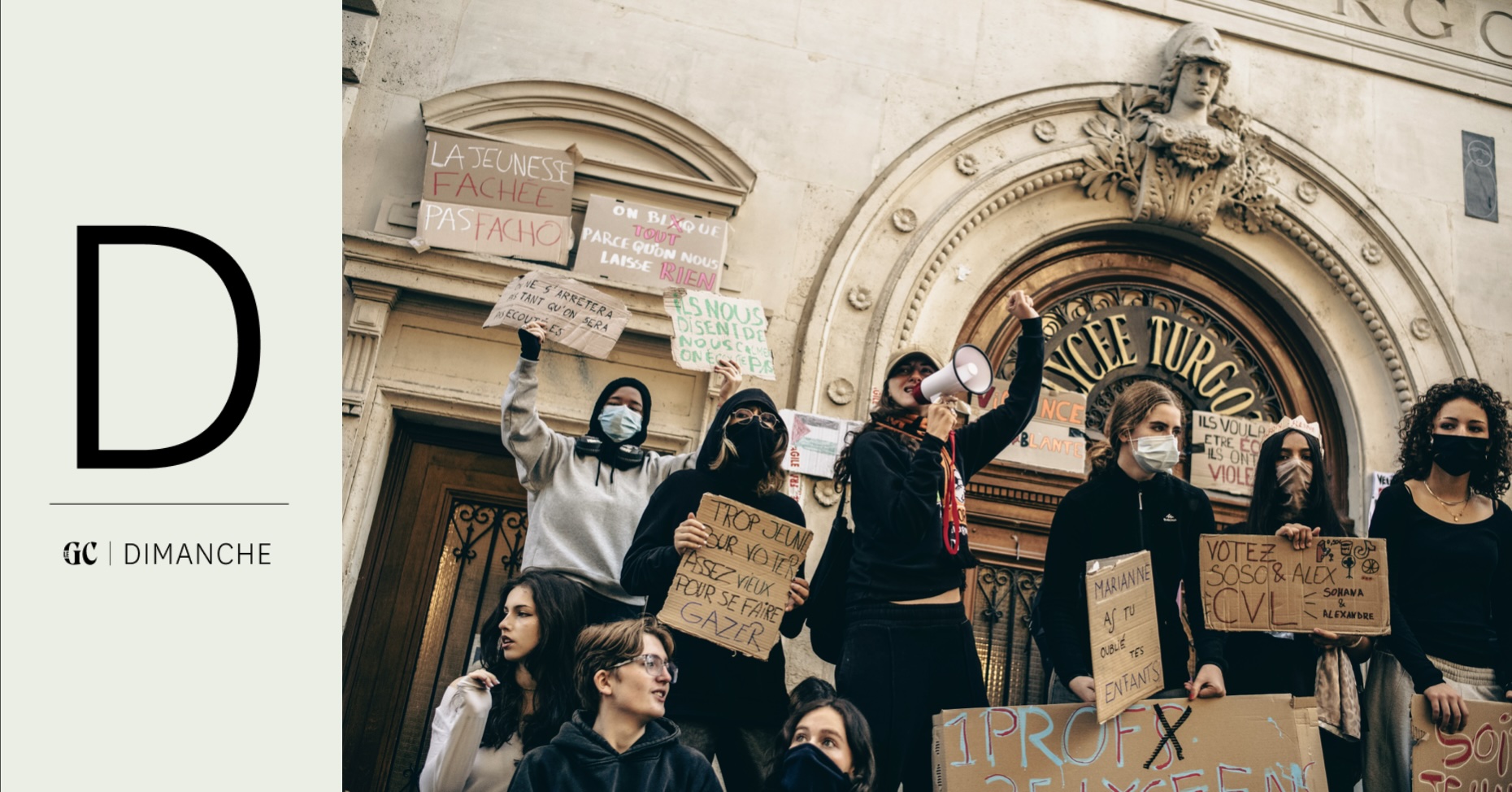
The day after, September 28, 2026, in Saint-Ouen l’Aumône, a fourteen-year-old high school student, enrolled at Château d’Epluches vocational high school, receives a close-range LBD shot in the mouth after a confrontation with three CRS. The boy loses his upper teeth and part of his lower jaw. On September 29, in Alençon, a fourteen-year-old high school girl is strangled. On October 1, in Tours, a sixteen-year-old student receives a shot to the right eye from an LBD. It has just been learned that he is now partially blind. On October 3, interpellations climb to 5,000. On October 5, a high school student loses a hand. In the high school where I work, in the Paris suburbs, the blockaders are gassed; about twenty high school students, including my second-year class, are taken into custody.
The comments following various articles in Le Monde and Le Figaro reproach the police for its laxity and rejoice in the physical abuses. One suggests that the child’s family pays the compensation. Another reminds that you don’t make an omelette without breaking eggs. Strange omelette, strange eggs. Others, finally, recall that “High school students have a right to be in class, to stay quiet, and to obey the teacher.” I note a martial refrain that applies the laws of war to a teenage revolt: “You’re going to war, you assume it.” Weird flex but ok.
The conservative edge of the electorate suspects in the high school revolt a covert manifestation organized by the left or by unions. If some commentators unearth immigration and violent mores as the cause, others see it as the result of too lenient an education and the “leftist” tilt of the National Education system: the Revolution, as everyone knows, eats its own children. Others point to the snowball effect of social networks, the “TikTok-ized” escalation pushing students toward ever greater violence. The police, tested hard, even assaulted and beaten, react with appropriate measures to maintain order. The only problem, if any, would be to stop them from doing their job, and to bring students back home, safe and sound.
On the left, the revolt was greeted. It follows the degradation of teaching conditions, the meager salaries of teachers, repeated absences, the stress of Parcoursup, the inequalities between suburban and city high schools, the sense of youthful exasperation. Some let themselves go. By the famous truism, excess is legitimate; moreover, if there is excess, it is the result of infiltrating agents – which, in any case, is proven. Schools are set ablaze, pianos are broken, police officers are beaten. It’s amazing. Beyond the riot-porn, the childish revolt is encouraged and followed. People have pointed to the lack of listening by successive governments. For many years, teacher unions, associations, youth representatives, and the youths themselves have sounded the alarm about the deterioration of teaching conditions, the fatigue caused by reforms, about classroom overcrowding. They have not been heard.
The administration of high schools, meanwhile, is unsettled; schools close and we move to remote learning. The most disadvantaged students will suffer the most.
Both viewpoints contain elements of truth. They nevertheless overlook, on both sides, the situation as it is truly experienced on the ground, from the perspective of students and teachers, and they pose a problem of diagnosing reality and understanding the human mechanics at work.
They thus impede resolution by failing to understand the situation.
*
Last week, I notice that the high school where I work is occupied. A pile of trash bins blocks the entrance. Students have climbed the fences and confront the CPEs and teaching staff. They’ve turned up the music and are laughing loudly. It’s burning, it’s shouting, they insult the principal: “X., you suck dicks!” It’s really funny. We read signs: “No need for sexual education, the State already sucks us dry.” As I pass, I see some of my students wandering in front of the bus stop. These are the top of the class and the nice ones. I recognize among the trash cans and fences my struggling students, T. and W., whom I’ve expelled or placed in detention several times, and who drag the class down. Some students throw boxes at the CPEs. I go back into the school. In the teachers’ lounge, I have a coffee that costs me fifty cents. No one knows what’s happening. I go out several times in the morning to find a few students and talk with them. The clashes with the police begin around nine o’clock. Some students want to throw Molotov cocktails, others pour gasoline on the trash bins or fling old cardboard waste at the CPEs, who yell. Others, coming from other high schools, try to open the parking lot door to enter the building. They pelting the cafeteria’s window. It’s the mess. The police respond with tear gas. I meet in the reception hall T., who has just swallowed tear gas, and I hand him a tissue. He already has eye drops on him to disinfect his eye. I do not know whether the nurse gave them to him or if he had anticipated it: both possibilities scare me. That a portion of the staff soaks up the violence of others, or that a fourteen-year-old knows already how to dodge the pain of tear gas.
The situation eventually calms down and the day passes. We wait, but we do not know what we are waiting for. Around three in the afternoon, the Terminal year students finally return and want to have class, because they are “terrified” about the baccalaureate.
The next day, at eight o’clock, I teach seven students. Some are forced to come by their parents because they’ve already been kept after class. The others, the “nice ones,” are here because they must be. I ask them if they know why we are blocking. The reasons are somewhat unclear. They tell me about Palestine, about the canteen, about the right to go to the bathroom (they cannot go during class), about “too many classes.” The top of the class, whose family obviously listens to the radio, talks about the deterioration of high schools, Parcoursup, the absence of teachers. Some condemn the violence even if they understand the cause; others don’t know.
Some days later, the administration and I have a meeting with W, who, since the start of the year, has accumulated numerous hours of absences, detentions, and exactions (as above). He also fought with a classmate during class: “Shut your mouth, shut your mouth,” etc. His father is dead; he and his brothers are known at the establishment; they are real “terrors,” except for the elder sister. We brought in his mother because after a pause with his history teacher during a break, he “acted up” to the point of breaking. He comes with his sister who is in a BTS program; A. will watch me during the session with increasingly wide eyes. My colleagues recall W.’s misdeeds. He apologizes for his attitude but barely justifies it. He says he will change. The colleagues address W. as equals. His mother looks kind but from the West. During the discussion, she begins to cry. We tell W. that he shouldn’t be proud of making his mother cry; he should be ashamed, she left her job early for that and now she cries. W. is embarrassed; he laughs because, as he says, everyone is looking at him and saying nothing, it’s funny. He says, “I’m doing what I can.” We tell W. that given how he’s started, he will have no future: no second chance, no other high school, no job, nothing. Does W. want to end up on the street? W.’s mother also cries and speaks to us in Arabic while pointing at us. W.’s sister, for her part, is exhausted. She would like us to be stricter. At one point, she mimics the action of tugging her ear. She says she is “overwhelmed” by this generation, she says she does not understand it. The CPE, ten years in the job and who has seen a lot, tells W.’s sister that not all children are like her brother. Maybe W. needs to see a psychologist. Maybe, thinks W., that people believe he is gogol. During the discussion, it is recalled that W. was with the others yesterday wearing a Ninja Turtles mask. They say W. insulted the CPEs and tried to set fire to the trash bins. W. says no; he was down the street, he “was watching his mates.” In the end, W. gets a class transfer and a permanent exclusion with a probationary term. After W. and his mother leave, I learn that W. was filmed in front of the high school; he is clearly recognizable. The CPE tells me: Anyway, I think W. won’t last the year, he clearly doesn’t care about anything, it’s always the same.
Going out, I find myself thinking that if I were W., if this school stood for the place where I am humiliated, where I make my mother cry, of course I would hate it, of course I would want to burn it all down, of course I would want to set it on fire.
*
I am a high school teacher on the outskirts of Paris. It is my students who are gassed and beaten. I must, whether I want to or not, try to respond to what I see, what I hear, what I observe.
C’est-à-dire d’une part, une partie de la jeunesse qui n’en peut plus ; de l’autre, une partie de la police et des adultes qui entendent poursuivre, incarcérer, gazer, frapper, étrangler, éborgner, défigurer, des lycéens, c’est-à-dire, des enfants.
Les raisons qu’invoquent une partie du mouvement sont connues. Les locaux d’une grande partie des lycées des banlieues parisiennes sont dans un état déplorable. On ne peut pas y étudier décemment : cafards, trous au plafond, rats, humidité telle que l’eau sort des murs. Les toilettes sont souvent bouchées et les élèves se retiennent durant neuf heures. L’hiver, on meurt de froid, on fait cours avec les manteaux mais pas de bonnet car les couvre-chefs sont interdits. L’été, il fait trop chaud, les élèves vomissent et doivent aller aux toilettes pour s’asperger d’eau. Lors des oraux du baccalauréat, on donne (en retard) des ventilateurs aux examinateurs, pas aux élèves, qui suent sur leur convocation. Les professeurs sont mal payés (leur pouvoir d’achat s’est effondré en trente ans et ils gagnent moins que les autres fonctionnaires de catégorie A), envoyés pour leur premier poste sur des postes difficiles loin de chez eux, ils ne sont pas remplacés et subissent des réformes absurdes et trop fréquentes. 65 % des établissements manquent de personnel. Dans mon lycée, à la fin de septembre, il n’y a pas de professeur de philosophie. Les professeurs malades ne sont pas remplacés, ou si mal que ça revient au même. Les élèves n’ont pas le droit d’aller aux toilettes, de manger ou de boire en cours, ils ont des journées de neuf heures à l’âge de treize ans, la violence et le harcèlement sont monnaie courante. Leurs bulletins et leurs notes sont examinés par Parcoursup. Selon une logique arbitraire, un certain nombre d’entre eux ne trouvent pas d’études supérieures à la sortie du baccalauréat.
Bref, « c’est la merde », comme on dit.
Il me semble cependant qu’une chose a été négligée, qui n’explique pas la révolte, mais donne à ces derniers facteurs leur vivacité et les renforce. Voire les multiplie. Je l’avance à titre d’hypothèse ; je ne sais pas si elle est vraie ; je ne peux pas m’empêcher de m’étonner de ne pas la voir soulignée dans le débat récent. Je précise aussi qu’elle n’explique pas tout et que je ne cherche pas à réduire ce qui se passe à une simple question de les-adolescents-sont-des-débiles-qui-bloquent-pour-aller-sur-tik-tok. J’avance, donc, une hypothèse de déclenchement.
We know the important status of the cellphone among adolescents. It is often a “security blanket” that accompanies them daily and participates in their social life. It is a source of pleasure, of play, of communication, of friendship, of self-display, of addiction. Parents give it or take it away to reward or punish.
This cellphone was banned in high schools at the start of September. That is a good thing. Last year, in the 93, my students spent all their breaks, lunches, sometimes classes, with their noses buried in it. Doomscroll. As soon as class, with its necessary tyranny, stopped, the brains powered down. The thirty brains available were siphoned by the drug of imagery. My class became a group of zombies. There were several silent, strangely silent, too silent moments, with only the sound of a thumb scrolling, the chairs squeaking, mouths chewing.
This year, without the cellphone, my students are more distinct, more endearing, more messy, more excited, more childish. They are also more annoying. And it is not impossible that the disappearance of the device has played a role in all of this. If, in this revolt of adolescents, a reflex of an addict craving his fix enters the scene, if he thrashes because he lacks his dose, it is also possible that, lifting their eyes from the feed, the French high school student has opened his eyes to a situation that appeared to him suddenly intolerable. He has seen that the adults who claim to guide him humiliate him constantly. He has seen that his generation was confined for two years during Covid to protect its grandparents, and that those grandparents voted against his interests. He has seen that the planet was ravaged by the previous generation, and that he must apologize for buying fast fashion. He was born into the era of fast food, and he must apologize for loving Tasty-Crousty. He knows that the previous generation is that of MeToo, of sexual violence, and he is accused of not losing his virginity early enough. He reads that he is illiterate, and he sees that the number of French lessons he must take in life has drastically declined. Everywhere, he hears that he is a generation of idiots, superficial and stupid, and he has just been born. He notes that his generation contains more people from immigration than the previous ones, and that it is the generation most likely to see the National Rally come to power. He sees that he lives in an aging society that rejoices in striking its immigrant, proletarian, humiliated and doomed youth.
Everywhere they ask him to obey, everywhere the situation worsens.
Above all, he sees that these adults who take away his cellphone are themselves addicts, and that his teachers, to take the register on Pronote, use their own devices in front of him. Calm, they too rejoin the imagery of narcotics in the metro each evening. None of them really tries to act to change the unjust situation that is imposed on them. When he looks at the adult who watches over him, he sees two addicts and he sees a hypocrite.
*
I know that the argument may, at first, resemble a boomer’s trope. Nevertheless, I offer this reflection without any aggression or contempt toward my students, whom I love and appreciate.
If banning cellphones in high schools is a good thing, we cannot offer repression as the only political horizon for our children.
The hunt for the child must stop. If excess and violence directed at schools and the police are unbearable, it is nonetheless unacceptable that a society tolerates that the police, without “permits,” beat up teenagers and that this society offers their demands only violence, repression, hypocrisy, and stupidity. The gesture of the high schoolers, however violent and immature it may be, is that of the youth and it raises pertinent questions. It is not the result of a “vogue” of social networks, nor of political instrumentalization of the left, nor of a lax institution or of an “enframing.” It is the fruit of a crisis situation that we let settle in, and which, to be resolved, requires dialogue, intelligence, respect, and pragmatism. This will not happen without engaging with the usual interlocutors (unions, teachers, parents), to whom must be added the first concerned themselves.