
Throughout August, Le Grand Continent will publish in open access The Vocabulary of the Far Right, the fruit of collaborative work by a group of researchers — sociologists, historians, political scientists, sociolinguists — from across Europe under the direction of Steven Forti. To receive each lemma in your inbox and support the work of an independent editorial team, subscribe
During the 2016 American presidential campaign, Donald Trump repeatedly used terms like “globalism” and “globalists.” In a June 2016 tweet aimed at Democratic candidate Hillary Clinton, he wrote that the November vote would be “a choice between Americanism and its corrupted globalism.” Having become president, he explicitly rejected, at the United Nations General Assembly in September 2018, the “ideology of globalism,” opposing it with the “doctrine of patriotism” summarized by his slogan “America First.” This narrative that Trump has continued to repeat since, as evidenced by his speech at the same podium in 2025, seems to structure a movement paradoxically global.
Genealogy of an Insult
The leader of the MAGA movement (Make America Great Again) did not, however, invent it. The pejorative use of the term circulated for a long time across the Atlantic. In the United States, during World War II, the most conservative and isolationist sectors of the Republican Party used it to criticize Franklin D. Roosevelt’s policy, opposing a “globalist” approach with a nativeist view, resisting European immigration and neutrality in the conflict. As early as February 1943, Republican Representative Clare Boothe Luce mocked in the House the “globaloney,” the world-spanning globalization nonsense of Vice President Henry Wallace. This neologism captured a general trend. While white supremacy found its most massive expression in the Ku Klux Klan, with 2.5 to 5 million members by the mid-1920s, isolationism was the true compass of Washington’s elites up to the Japanese attack on Pearl Harbor.
In the 21st century, it was primarily right-wing activists and propagandists of the so‑called “alternative right” (alt-right) who again placed the concept at the center of political debate, a convenient tool to construct a binary opposition between a “us” and a “them” against a background of economic recession and deep cultural upheaval. Former director of Breitbart News, later chief strategist of Trump’s 2016 campaign and adviser to the president until August 2017, Steve Bannon developed a radical nationalist discourse, nourished by resentment toward the “system” and cultural traditionalism. Echoing ideas articulated in the 1930s by Henry Ford and Charles Coughlin, then by Samuel Francis, Bannon opposed productive capitalism to speculative capitalism attributed to “globalist elites” and to minorities deemed parasitic.
In 2014, another representative of the far-right’s most radical wing of the so‑called “alternative right” (alt-right), conspiracy theorist Alex Jones, founder of the InfoWars site, whose accounts on major platforms have been suspended repeatedly, went so far as to define globalism as “a global digital panopticon of control” and “the total form of slavery”. As numerous studies have shown, this rhetoric gained traction in the public debate through social networks, propelled by marginal sectors, notably the alt-right, which tied globalism to political and cultural grievances—more than to economic ones—that pre-existed.
Before Trump’s networks, the term had little traction during the Cold War, beyond isolationist Republican circles. It was in the 1990s, as neoliberal globalization accelerated, that it began to be used and, above all, defined. As most dictionaries would gradually do, from Oxford to Cambridge, sociologist Ulrich Beck distinguished “globalization” from “globalism,” understood as the idea that the world market displaces or replaces political action, in other words as “the ideology of the rule of the world market,” that of neoliberalism. Another sociologist, Manfred B. Steger, similarly contrasted “globalism,” “a political ideology that furnishes globalization with norms, values and determined meanings,” with “globalization” as “a multidimensional set of social processes that widen and intensify social interconnections on a world scale”.
The anti-globalization movement itself, crystallized at Porto Alegre’s World Social Forum in 2001 as a progressive counterpoint to Davos’s World Economic Forum, did not much employ “globalism”; it spoke of globalization or global capitalism, hence the slogan “Another world is possible” and the concept of alter-globalization. It was mainly after the 2008 financial crisis, against the backdrop of a crisis in globalization itself—once considered not only positive but almost natural—that radical and extreme right groups appropriated the concept to channel the resentment of broad segments of the population.
The Antiglobalists’ International
The use of globalism is not an American peculiarity. Viktor Orbán, a leading figure of Europe’s illiberal right, has made abundant use of the concept since returning to power in 2010. In a speech on the 62nd anniversary of the 1956 Hungarian Revolution, he echoed Trump’s UN address almost word for word: “Let us reject the ideology of globalism and instead support a culture of patriotism” . At the Conservative Political Action Conference (CPAC) held in Texas in 2022, he fired up the room with “Let the globalists go to hell” . As early as 2016, in a more conspiratorial mode, the Fidesz leader warned that “dark, faceless world powers will eradicate everything that is unique, autonomous, ancestral and national” . These unseen powers, he specified, are primarily the European Union and the Jewish-American philanthropist of Hungarian origin George Soros, accused of weaving a plan to weaken the Hungarian nation. The persistent references to Soros fall into the dog whistle of politics—coded allusions to the anti-Semitic narratives of a “world Jewish conspiracy” .
The Italian extreme right is not left out. Fratelli d’Italia’s main programmatic document, the “Trieste Theses” (2017), explains that Giorgia Meloni’s party opposes “the ruleless globalism supported by multinationals and finance with the complicity of the European Union” and denounces a “wild globalization” where “the utopia of old internationalist communism, the pauperized Third Worldism, and the globalist business practice of large multinationals meet.” In the face of “globalism,” the response would be patriotism, a return to tradition and a rediscovery of an identity anchored in Christian values. In France, Marine Le Pen likewise opposes the “patriots” to the “globalism,” which, according to the Rassemblement National leader, presents two faces of the same totalitarian project, one financial and business-oriented, aimed at destroying the nation, sovereignty and French values, the other jihadist, pushing for uncontrolled migration and attacking cultural identity: “Economic globalization that refuses any limitation, any regulation of globalization and which, for that reason, has weakened the immune defenses of the Nation, dispossessing it of its constituent elements: border, national currency, authority of its laws guiding the economy, thereby allowing another globalization to be born and grow: Islamic fundamentalism.”
At Vox, globalism is the through line of the main programmatic document, the Agenda España (2021), written entirely against the United Nations’ Agenda 2030. Santiago Abascal presents it in the introduction as “a response to globalist agendas that aim to destroy the middle classes, debilitate national sovereignty, and attack the family, life and the common roots of the West” . Globalism thus becomes synonymous with progressivism, but also with liberalism, environmentalism, or feminism. Ernesto Araújo, Jair Bolsonaro’s foreign minister, expressed this vividly at his inauguration by defining globalism as “a current configuration of Marxism” that “is constituted in hatred through its various ideological ramifications and its instruments contrary to the nation, to human nature and to human birth itself” .
On the economic and the identity fronts, a third variant is embodied by Argentina’s president Javier Milei, who rejects multilateralism and challenges the liberal international order. Before the United Nations General Assembly in September 2024, the paleolibertarian leader described the UN as “a model of supranational government by international bureaucrats who pretend to impose a determined way of life on the world’s citizens,” attacking individual freedom, private property and free markets in favor of “collectivist policies” . Following the US lead of Trump, Milei formalized a few months later Argentina’s withdrawal from the World Health Organization and its pullout from climate talks, while distancing himself from the UN Human Rights Council .
The intellectuals of this anti-globalist international hold similar discourses. The movement’s principles declaration, launched by Israeli-American essayist Yoram Hazony, president of the Edmund Burke Foundation, places in its second point the “rejection of imperialism and of globalism” and harshly criticizes supranational bodies that would destroy national sovereignty . Hazony’s main work, The Virtues of Nationalism, casts globalism as an imperial project that, after the Allied victory in 1945, would have imposed a world regime of international institutions founded on supposedly universal principles such as human rights . A interpretation curiously very close to that developed by Russian essayist Aleksandr Dugin in The Foundations of Geopolitics (1997) and The Fourth Political Theory (2009). In a 2024 article in a publication close to Hungary’s power, conservative Christian writer and critic of “wokism” Rod Dreher, corauthor of the national-conservative manifesto, explained that “globalism, which conceptually involved both liberal democracy and hypercapitalism, depends on the deconstruction of borders, the dissolution of peoples and the abandonment of traditions that stand in the way of frictionless economic exchange” .
The step toward openly conspiratorial thinking is quickly taken. At a conference at the Italian Parliament in May 2026, Kevin Roberts, president of the Heritage Foundation, defined globalism as “a conspiracy” and “a selfish and dreaded oligarchy” that would use free trade, open borders and the fight against climate change to punish Western citizens who are “workers, patriots and God-fearing” .
The Heritage Foundation is the author of Project 2025, a near‑term governing program for a second Trump administration, implemented by more than 50% according to the foundation’s own calculations . The lead thinker of miléism, Agustín Laje, president of the Fundación Faro, has devoted a whole book to globalism, which he sees as the most dangerous project “of social engineering and total control in progress,” explicitly targeting the United Nations and Agenda 2030, the World Economic Forum, the Gates Foundation, the Rockefeller Foundation, or George Soros’s Open Society . Nigel Farage, leader of Britain’s radical right, invited six times between 2009 and 2018 by Alex Jones’s InfoWars, has accused globalism, embodied in his view by the Bilderberg Club, of pushing toward a world war to establish a global government, even a “New World Order” of which the European Union would be the most advanced example .
From Globalism to the “New World Order”
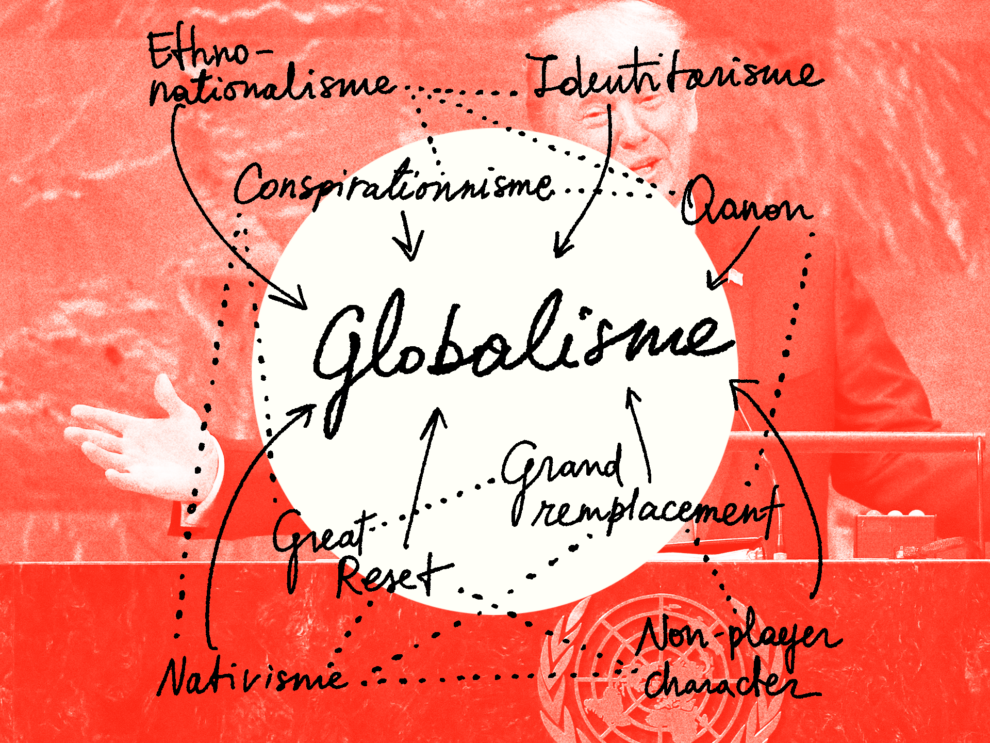
“New World Order” is one of contemporary history’s most enduring conspiracy theories. It has been associated with both the Illuminati and an alleged international Jewish conspiracy. As current references to Soros show, antisemitism surfaces readily, though more veiled than before, whenever globalist conspiracy is invoked. Its origins trace back to Tsarist propaganda’s fraud, the Protocols of the Elders of Zion (1903), and resurfaced after World War II with the theory of the “Zionist Occupation Government” (ZOG) and the John Birch Society’s fantasies. The very creation of the United Nations had led isolationist wings of the Republican Party to denounce, by the mid-1940s, the threat of a “new world government” . At the end of the Cold War, in September 1990, President George H. W. Bush’s speech invoking a “new world order” allowed the theory to renew itself. It has been linked to the role of international organizations (UN, WTO, IMF), to supposed occult powers such as the Bilderberg Club or the Trilateral Commission, but also to imagined projects of ethnic substitution, from the “Kalergi plan” to the “Great Replacement,” or even to esoteric fantasies like the reptilian theory popularized by David Icke and propagated by Dutch far-right leader Thierry Baudet .
During the pandemic, these theories blaming globalist elites for the project of a New World Order gained wider diffusion, grafted onto the coronavirus, health restrictions or vaccination. Alongside the theory of the “plandemic,” which will soon be treated in this Vocabulaire, the summer 2020 saw the spread of the “Great Reset” theory, according to which the World Economic Forum would use Covid-19 to reorganize society and the economy against ordinary people and impose a global totalitarian regime. In October 2020, Archbishop Carlo Maria Viganò, former apostolic nuncio to the United States (2011–2016), excommunicated in 2024, wrote to Trump to lend credibility to this alleged “infernal project” that seems to lurk as a subtext of Peter Thiel’s writings on the Antichrist. .
For the extreme right, globalism eventually became a macro-container, a convenient label for naming and identifying an alleged enemy of national sovereignty, of nationalism, of the natural order of things and of traditional values. An extremely loose ideology (globalism) encoded by transnationally powerful groups (the globalist elites), the concept is deployed according to context and can mean very different things. In far-right narratives, it would be responsible for the loss of cultural identity and political representation, for industrial relocations, for the clash of civilizations, for mass immigration, or for the “imposition” of environmental and diversity policies. In short, like other concepts in this vocabulary (cultural Marxism, gender ideology), globalism is a catch-all term with strong conspiracist potential, often with antisemitic permutations. A word that does not describe the world, but designates those whom it would be necessary to expel from it.