
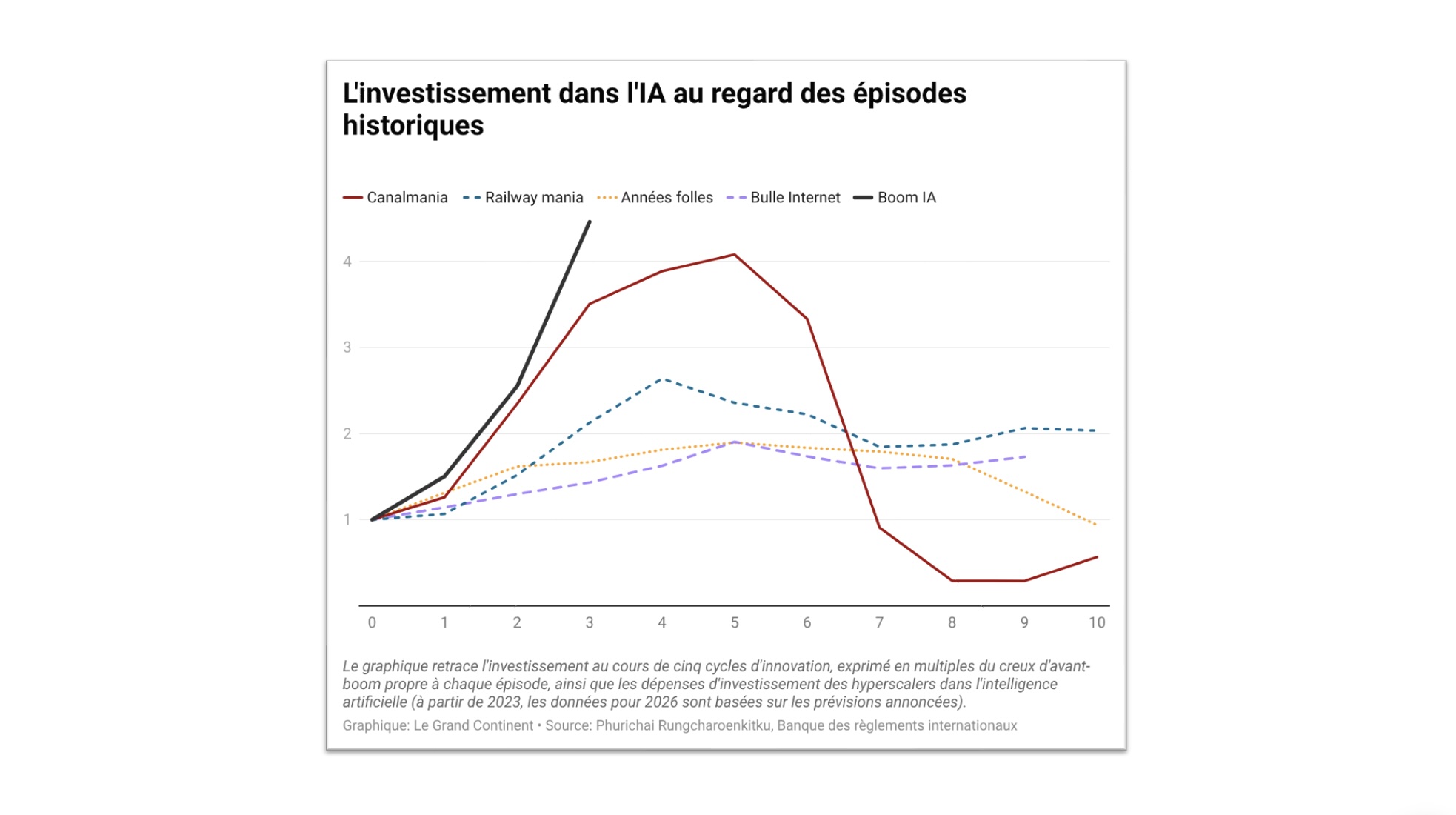
In a working paper published in July 2026, Phurichai Rungcharoenkitkul, an economist at the Bank for International Settlements, models the construction of artificial intelligence infrastructures as a race, a contest in the sense of economic theory, in which a few dominant positions capture most of the gains.
- His central thesis is that the AI race “creates a fragility that undermines it.”
The graph below, drawn from the report, presents one of the two facets of the phenomenon: its historical scale.
- Measured against its nadir prior to the “boom,” AI investment spending is on the verge of surpassing all major episodes of technological booms in just three years.
- The AI curve climbs faster and higher than that of the American canalmania of the 1830s, the British railway mania of the 1840s, the Roaring Twenties, or the late-1990s Internet bubble.
- Spending by the major hyperscalers should exceed $700 billion for the year 2026 alone, and sector projections place it at $3 trillion to $4 trillion for the coming years.
- All the historical episodes cited ended with brutal corrections.
The current slope is not a guarantor of resilience, but rather a sign of quantified over-building, which makes the booms most likely to reverse.
- This phenomenon is triggered by a typical feature of the race.
- The victory is such that “the winner takes almost everything”: each actor therefore invests heavily to outpace rivals, without considering the impact of its own race on others. According to the calibrated model, the outcome is an over-investment of about 1.5 times the socially optimal level, and up to three times where AI demand is less elastic.
- This dynamic, however, has a critical threshold. Once the build-out reaches a certain level, which the author places around $3,000 billion, the net economic surplus (total production minus the cost of capital) would become negative. Projections between $3,000 and $4,000 billion would thus place the sector “in the zone of significant downside risks,” he writes.
- The capital thus accumulated is specialized. In the event of a downturn, it would have to be liquidated simultaneously on a market that is not very liquid, which would further reduce the recovery rate, especially given the sector’s indebtedness.
The analysis also focuses on a second central issue, that of the circular financing of AI.
- The phenomenon is as follows: a player takes an equity stake in an AI laboratory in exchange for the commitment that the latter will buy future computing power from them. Demand is thus “manufactured” by those who finance the supply.
- The network thus links hyperscalers (Microsoft, Amazon, Google, Oracle and Meta), chipmakers (Nvidia and AMD), laboratories (OpenAI, Anthropic and xAI) and the main neocloud (CoreWeave). The scale is impressive: about $46 billion in equity stakes have actually been disbursed, but multi-year purchase commitments amount to $879 billion.
- These cross-holdings merely concentrate risk. The author sums up: “The financial structure that fed the growth is also the one that transmits bankruptcy.”
By abandoning the assumption of isolated actors to model the real network, the report thus highlights a new vulnerability: the failure of a single lab could, by affecting the balance sheet of the hyperscaler financing it, prompt the latter to disengage from another lab, thereby propagating the crisis.
- This risk would worsen as the race continues. According to the simulation, the first cascade would occur at an investment scale of 1.6 times the optimal level, the second at 2.3 — and the projected trajectory of $3–4 trillion would push the sector into this contagion zone (between 2.1 and 2.9).
- Thus, the more funding flows through several laboratories linked by a few “pivot” nodes, the more a local default can become systemic.
The author also notes that potential AI demand is “vast” and could justify a substantial expansion of computing power. However, he stresses that the logic of the race pushes toward over-building.