
The Kremlin does not publish any systematic data on its forces deployed in Ukraine.
In an analysis published on August 3, German researcher Janis Kluge, a specialist in the Russian economy, proposes to measure them directly from an open-source source: the lines of the Russian federal budget dedicated to salary supplements.
- Since a decree signed by Vladimir Putin on November 2, 2022, each mobilized soldier receives a monthly supplement of 158,000 rubles (about 1,780 euros), paid from the federal budget, i.e. nearly 2 million rubles (about 22,500 euros) per man and per year.
- The contractual soldiers (“kontraktniki”) on their side receive a much more modest supplement of 15,000 rubles (about 170 euros) per month, created on March 31, 2023 at the launch of the large recruitment campaign and paid only as long as the soldier actively participates in the war.
- These two payments come under separate budget lines and are in principle not cumulative: by dividing the sums spent by the amount of the supplement, Kluge obtains the number of beneficiaries, which allows him to make a direct estimate of the Russian troops engaged in Ukraine.
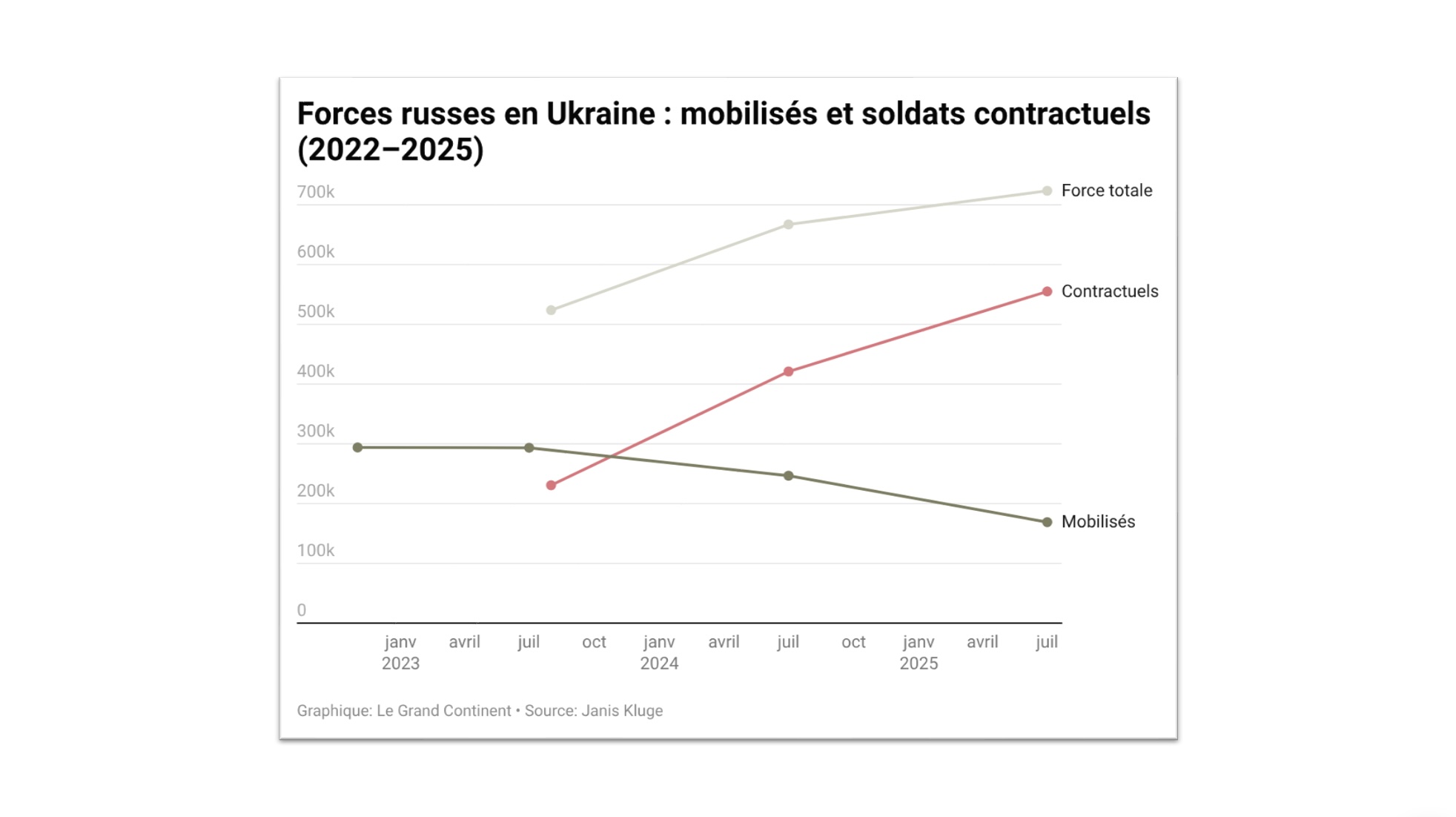
The results of Kluge’s analysis sketch a profound transformation of the Russian army. The mobilized personnel of autumn 2022 would gradually give way to a contractor army.
- The number of mobilized personnel compensated would have fallen from nearly 300,000 at the start of 2023 to about 245,000 on average in 2024, then to a little under 170,000 in 2025.
- Meanwhile, the number of contract personnel would have more than doubled, rising from 230,000 on average between April and December 2023, to 420,000 in 2024, and to a little over 555,000 in 2025.
- In total, the Russian forces in Ukraine would have increased from just under 525,000 in 2023 to around 670,000 in 2024, then to around 725,000 in 2025.
The decline in the number of mobilized does not mean that all the absentees are dead or disabled: the Defense Ministry is indeed pushing mobilized personnel to sign contracts to switch into the “kontraktniki” category.
- The independent media outlet Vyorstka documented as early as 2024 the pressures exerted on mobilized personnel to sign recruitment contracts.
- According to Kluge, these “converts” — likely several tens of thousands of men — accounted in 2025 for 10 to 20% of new contract personnel in some regions: Irkutsk Oblast spent 1 billion rubles on engagement bonuses for former mobilized, vs 5 billion for other recruits.
- The real pace of recruitment is thus somewhat lower than suggested by the budgetary data and official announcements.
It is by cross-checking the flows (recruitment) and the stock (the personnel numbers) that the analysis yields its most striking result: an estimate of the losses (killed, too seriously wounded to return to service, deserters or transferred) among the contract personnel.
According to Janis Kluge’s calculations, the following figures would emerge:
- Between mid-2023 and mid-2024, a little over 370,000 engagement bonuses were paid to new recruits, but the stock of contract personnel increased by only a little over 190,000, which corresponds to around 180,000 definitive losses, i.e. about 15,000 per month.
- Between mid-2024 and mid-2025, a little over 385,000 bonuses were paid, i.e. an increase of a little less than 135,000, for around 250,000 definitive losses, i.e. about 21,000 per month.
- Related to the force levels, these losses correspond to an annual attrition rate of 43.3%, then 45.3%. However, Kluge conditions this result on several “ifs”: if the recruitment figures are accurate, if all active troops actually receive the supplement, and if no other significant exit path from the battlefield exists.
- “If the answer is yes to each, he concludes, that would mean Russia loses almost half of its active troops in Ukraine every year.”
The researcher notes a paradox: this calculation could almost be performed from official Russian statements alone.
- While the numbers touted by Putin increase only slightly since the end of 2023—from 617,000 to “over 700,000”—Dmitry Medvedev proclaims each year about 400,000 new contract soldiers.
- “It is perplexing that Russian propaganda makes two assertions — broadly constant manpower and massive recruitment — which, taken together, imply something catastrophic for Russia,” notes Kluge: massive losses.
Early 2026 data, which Kluge still regards as unreliable, nevertheless suggest that the machine could start to stall.
- Adjusted for their usual seasonal underexecution, the expenditures for the first quarter would indicate a new decline in active-duty military personnel, with about 120,000 mobilized in active service, but, for the first time, a drop in the number of active contract personnel, with about 525,000 people, i.e. 30,000 fewer than mid-2025.
- This slowdown mirrors the recruitment slowdown — the Defense Ministry signed only 800 contracts per day on average in the first half of the year, about half of what it was at the end of 2024 — and fuels rumors of a new mobilization after the September elections.