
First, you must name the light. In Saoû, at the foot of the Roche Colombe in the Drôme, July’s light does not fall; it settles, it presses, it slices the limestone with a precision that leaves nothing unscathed. It is a kind of immense collapsed mineral mass, what one calls a perched syncline—a mountain hollowed at its center. There are very few of these in the world, as far as I can tell, a geological singularity.
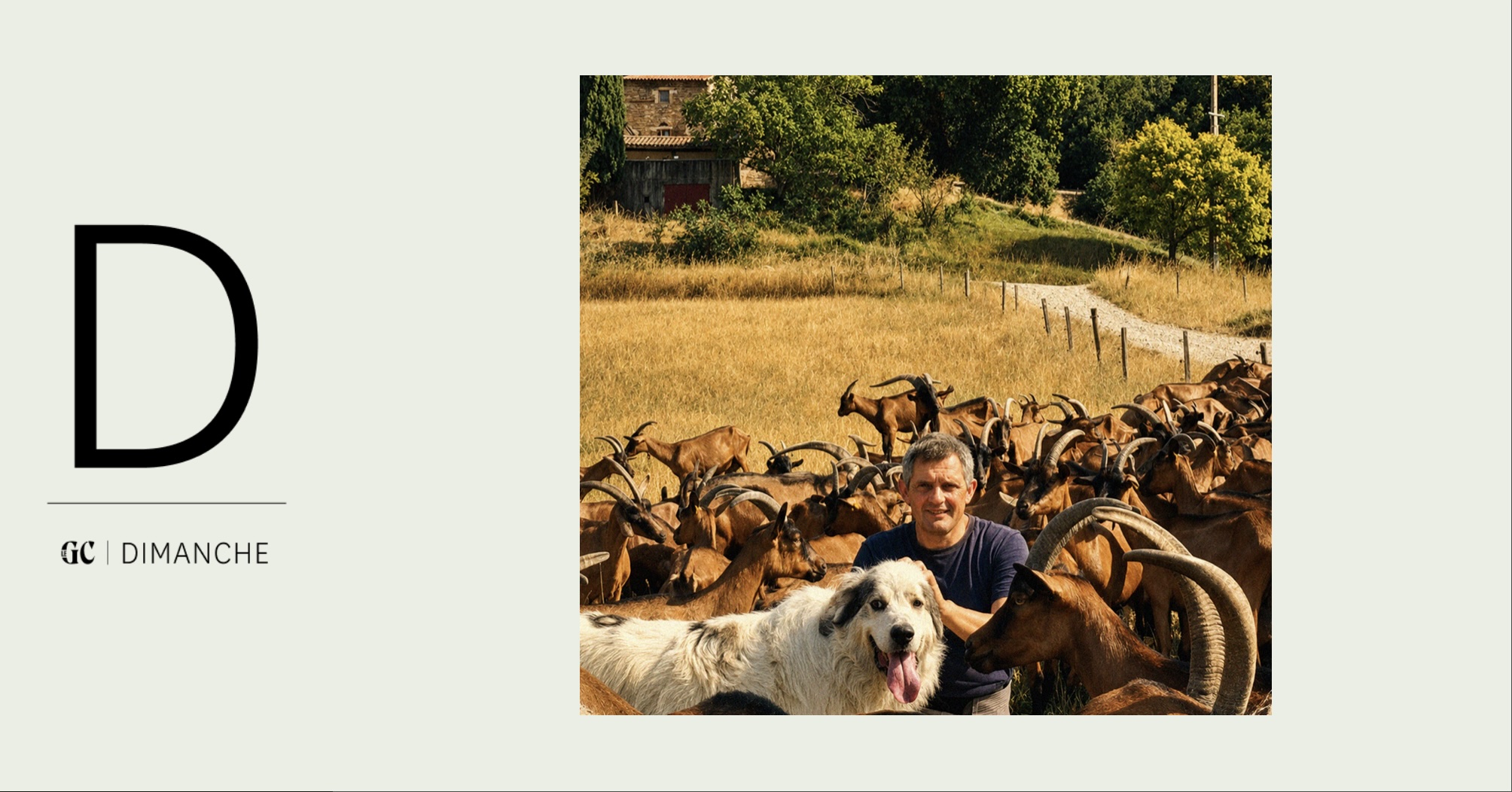
Daniel Gilles lives and works there; he was born a few kilometers away, in Crest, and he has that somewhat slow habit of looking toward the horizon, which is not contemplation but expertise. It is very hot, the goats wait for evening, and I am about to commit the Parisian countryside’s classic error: to think he will discover a remnant of the old rural world.
For here is what people think they know: that the organic farmer is a repentant city-dweller, a late convert who came seeking in the Drôme what the city no longer gives. Daniel Gilles immediately complicates the picture. Fifty-three years old, two lineages of farmer-grandparents, parents who were dealers in agricultural machinery. His first passion was not goats but machinery, which explains why he spent a long time working for an automobile manufacturer. The return to the land, for him, is not a mystical conversion: it is a decision taken with his ex-partner the day he stopped being aligned with his company’s policies. The question he asked himself then was not “Who am I?”, but “What should we do with this family land?”
Twenty hectares at the start, thirty-five today, land on slopes, dry, water scarce. “You must take what you have,” he says, and work with exposure, soils, the presence or absence of a water source. On such hillsides, large-scale farming is impossible and market gardening would require irrigation. The remaining option was livestock, provided he did everything himself. Daniel Gilles therefore has seventy goats, transforms their milk, ages his cheeses, and sells them directly in his commune. Five trades, one person, two labels—the Protected Designation of Origin and organic—on which he has been engaged for fifteen years.
What he makes is called picodon. Sixty grams, eight centimeters in diameter. I must admit I was struck by this precision. We readily believe that nature yields the typical and that standards destroy it; it is the opposite that is true. A specification even governs the shape of the faisselle, because the faisselle gives the cheese its form. The lactic technology relies on natural ferments, whey, rennet, milk-curd ladled and molded, followed by a sequence of steps: turning, salting, passing to the drying room, then to the curing room. Before fifteen days of aging, nothing is sold. The terroir is not a childhood memory; it is an institution. Durkheim would surely have loved picodon, and Daniel Gilles.
But it is not the norm that makes the taste. Daniel Gilles shows the other side—the Mediterranean vegetation on Roche Colombe—and explains that a goat from the Gard, grazing in a drier, more woody place, would never yield this cheese. The animal’s diet determines the cheese’s flavor: the landscape is the main ingredient. What we call authenticity is only geology transformed into protein, and what we call tradition is a very old way of rendering a dry hillside edible.
This land has not always been agricultural.
Drôme was once an industrial region. They reared silkworms, planted mulberry, they spun, they milled, and the river’s water pulled the wheels and belts. In Saoû, a district is still called The Foulons. In Daniel Gilles’s house, his daughters’ room was an attic where four chimneys heated the silkworms. We picture the countryside of yesteryear as an immobile eternity interrupted by modernity: it had already known its industry, its world market, and its collapse.
What his grandparents endured resembles more what we imagine: a small self-supporting farm, chickens, pigs, oxen for the fields, a horse to go to Crest’s fair once a month. No refrigerator, so no preservation, so a system of exchange: when the pig was killed, one carried fresh meat to a neighbor, who returned the favor the following month. Daniel Gilles describes this without nostalgia, with the precise word: it was very virtuous, because there was no choice. Reciprocity wasn’t a moral virtue; it was a technology of conservation. Yet he refuses to idealize them: they lived with very little money, while on his father’s side, at La Répara, the farm was vast, the great-grandfather a miller, the land irrigated. Two peasant economies within one family—the alluvial and the hillside. We speak of the rural world in the singular even though it was always a hierarchy, and that hierarchy was named the slope.
Now we must speak of politics. Daniel Gilles was the mayor of Saoû. Emerging from La France insoumise, he now sits in L’Après; he serves as vice-president of his intercommunal community, in charge of biodiversity and mobility, and he is a departmental councilor for the Crest canton. He is best known for issuing, back in his time, an order prohibiting the spreading of phytosanitary products within one hundred and fifty meters of homes. The prefecture’s legality review knocked it down. He kept it. The Grenoble Administrative Court canceled it. That is precisely what Weber would have called the ethics of conviction, and that is why these decrees, legally doomed to fail, still moved something: they were acts of language, not administrative acts.
I note to him that his position is not the majority among farmers. He does not deny it, but adds a striking image: farmers would not trap themselves in an hermetic cabin, with mask and suit, if they believed these products to be harmless. The knowledge is there, entirely, in the protective gesture. There is no ignorance to dispel; there is only an economic constraint to which one adheres while knowing it. He also rejects a Manichean view: some essential oils he uses on his animals are, he says, very dangerous. The difference lies in persistence: the natural product acts strongly and disappears, the synthetic molecule remains, in water, in the soil, for a long time. Hence his anger at the so-called Agricultural Emergency Law, which reauthorizes substances withdrawn from the market a few years earlier. What offends him is less the principle than the direction: rather than elevating our standards to match European norms, they lower ours. You will not save farming that way, he says; you will save a sugar-based agro-industry.
What about money? In the Drôme, he tells me, nearly a third of farmers receive RSA. Market gardening feeds a man only if you accept fifteen hours a day; translated into hours worked, the calculation is humiliating. He traces the chain: cereals resold three times between Moscow, New York, and Paris before reaching the miller, never leaving their silo. He describes the live-exported New Zealand lambs loaded aboard ships fitted with slaughterhouses and freezers, landed in Marseille at unbeatable prices because labor on the international waters has no status. His conclusion is heartbreakingly simple: all intermediaries take their cut; the producer is the only one who does not take anything. The farmer is not poor because he works poorly; he is poor because he occupies the sole position in the chain where one cannot pass anything on.
And yet this man calls himself lucky, and he repeats it several times. Lucky to have inherited, lucky to have had parents who only worked, lucky to be able to hope to pass the farm on to his daughters. He adds that he is very glad to pay taxes, because Social Security and the infrastructure that still keep the factories in France were funded by public money. In Saoû, six hundred inhabitants, there is a post office, a grocery, restaurants, a school, and a municipal water utility. They fought to keep the post office there.
The fracture everyone talks about remains, the one between neo-rurals and the old-timers. He is native; he could belong to the latter camp, but he resists the quarrel. The desertification of the seventies emptied the villages, he reminds us, and today it is the children of those who left who are returning. What has changed is not the sociology of arrivals but their genealogy: in the eighties, the newcomer to the countryside still had an uncle, a farm in his family, and thus stories. That thread is broken. Hence a scene that would fill every treaty: a resident asks him why there is a pile of manure there. We have become rootless.
He offers newcomers what he calls a landscape reading. You stop, you look, you ask: what do you see? The wind, the dry grass, the birds, the cicadas, the smells. He says this without mysticism, adding that he himself spends too much time on his phone. But he makes it a political hypothesis: we will only slow warming if we reconnect with what we inhabit. He speaks plainly about his fear: yields will fall, temperatures will exceed forty degrees, pollination will go awry. Either we keep going this way, head in the wall, honking, or we make an effort.
Is his life hard? It is hard because it is passionate, and both are directed toward the same goal: he works with living things, which means twenty-four-hour vigilance. Then he speaks of the morning milking. At six-thirty, the goat house is fresh before the heat, the animals’ contact. He uses a word I did not expect: restorative. This man who sits in three assemblies, who has dared a prefecture and who dismantles the world cereal market in three sentences, cares about something more than anything else at that moment. We all search for reasons to endure. He found one: the herd, seventy goats, waits for him every morning before sunrise.