
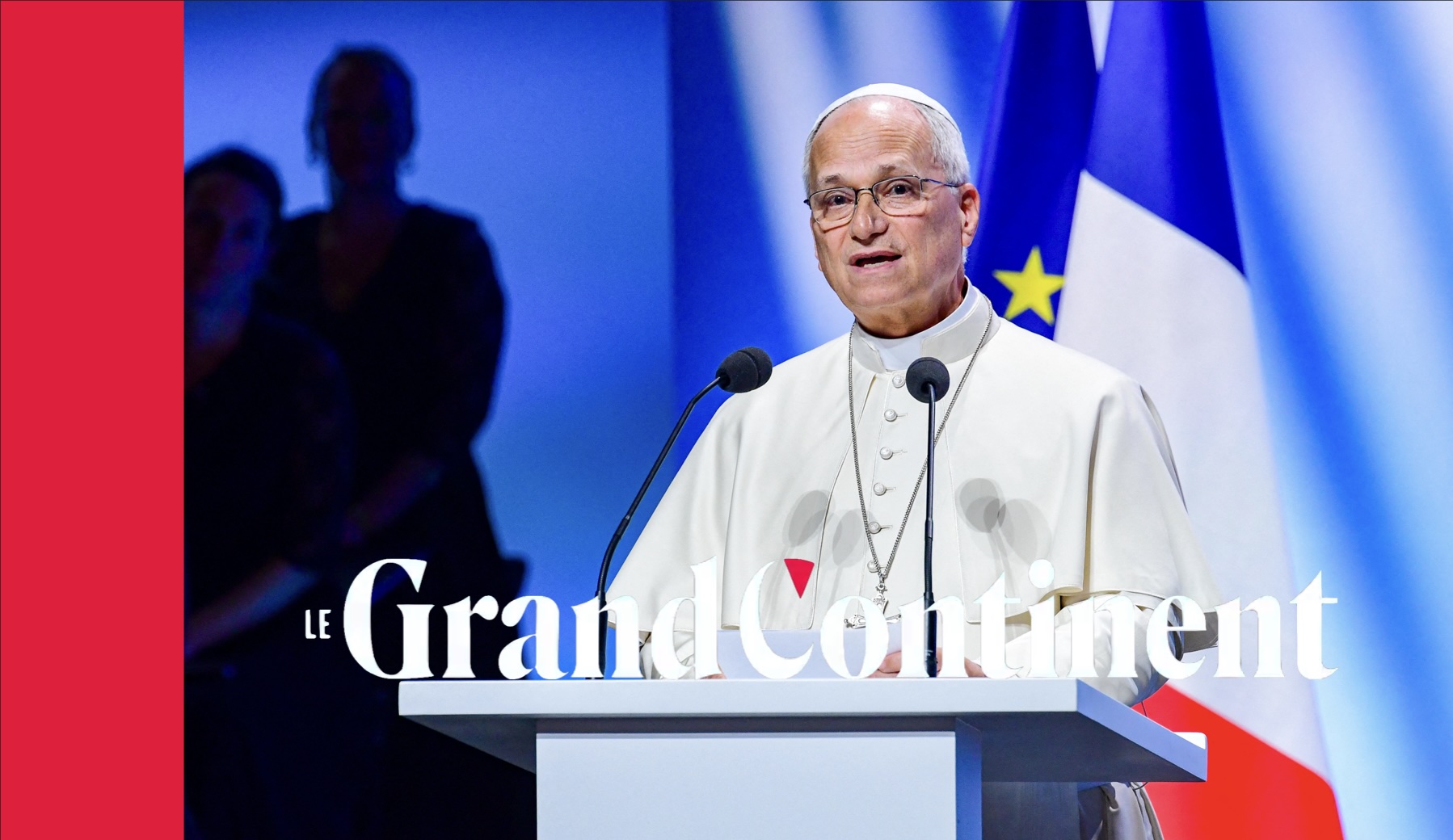
In Metz, the birthplace of Robert Schuman, Léon XIV describes a world in which “human relations, and relations between states, are becoming increasingly barbaric,” where “the value of a pledged word is spurned” and where “one boasts more of deceit and fraud.”
Facing the return of war on the continent, which he again calls an “useless massacre,” he urges citizens to “beware the illusion of rearmament.”
He defends the heritage of the founding fathers of the European project, the respect for treaties, and the patience required to achieve “concrete gains,” as opposed to the thirst for domination. He revisits the theme of Christian roots, but not as an exclusive confessional criterion. He hails Saint Benedict as another father of Europe, insisting that “without this monastic foundation, European civilization as we know it would not exist.”
In the Middle Ages, the Guelfs aligned themselves with the pope against the emperor. Faced with new empires that flout the law and feed on messianic or apocalyptic visions, the first American pope presents here the doctrine of a Guelf Europe grounded in authority, dignity, and hope rather than power. We publish and comment on this important speech.
Monsieur le Président, Monsieur le Cardinal,
Distinguished Civil and Religious Authorities,
Ladies and Gentlemen,
I am very pleased to be here, in this historic city, a crossroads at the heart of the continent, for a gathering with the evocative title: “At the Roots of Europe for Peace and Unity.” I thank you for the kind words that have been addressed to me.
The proposed title surely draws from the figure of the venerable Robert Schuman, whom we today wish to honor in this center that bears his name, and especially here in Moselle where he lived for a long time, where he rests, and where he long represented him and his people at the National Assembly.
It is from this region, with its tribulations in the nineteenth and twentieth centuries, that he drew the inspiration to help shape Europe as it is today and as it will be tomorrow, through his very famous declaration of 9 May 1950. This declaration stands both as the starting point and the culmination of his commitment to reconciliation and unity of the European continent, which marked his entire life.
Today we wish to undertake, in thought, a journey that begins at the roots of Europe, reaches its present, and looks toward the future. And we ask how Robert Schuman was fashioned by the history of this land of which he was the son, and how he fundamentally contributed to shaping modern Europe, to the point of being regarded as a “founding father.”
Defining Europe is always difficult, for both present and past. Europe gradually became aware of itself through historical periods of Hellenistic civilization, the Roman Empire, and then the diffusion of Christianity, integrating over time new cultures such as the Germanic and Slavic ones; eventually embracing regions that grew ever vaster.
Europe should thus be understood as a cultural and historical reality before it is a geographic one. Over the centuries it has taken on new contours and definitions, passing through growth, deep crises, and new renaissances. A constant that can be discerned in its long and tumultuous journey is that Europe flourished and progressed when it could draw on the positive aspects of its past and re-present them in new and creative forms through encounters with the other. European civilization is, indeed, also the fruit of centuries-long encounters, even when not always easy. One need only think of the presence of Arab culture on the Iberian Peninsula, or the projection of the Old Continent into the New World, which generated, sometimes painfully, new syntheses on the American continent.
But to understand this long history, one cannot overlook another father of Europe: Saint Benedict, whom Saint Pope Paul VI proclaimed patron in 1964, describing him as a “messenger of peace, artisan of union, master of civilization.”
Helping the poor, the sick, the elderly; educating children and universities; hospitals and medicine; architecture and engineering; the advancement of the sciences; law and the organization of cities and states: so many facets in Europe were deeply influenced by Saint Benedict and his monks! Without this monastic soil, European civilization as we know it would not exist.
Here, in Metz, thanks in part to the work of Saint Chrodegang, a Benedictine spirit of fraternity, communion, and sharing could be felt. It is from here that Gregorian chant spread to the Carolingian territories, bringing harmony and beauty to the entire continent.
Thus one cannot speak of Europe without mentioning Christianity. Robert Schuman himself was aware of this when he stated: “Christianity taught the equal nature of all men, sons of one God, redeemed by the same Christ, without distinction of race, color, class or profession. It made the dignity of work recognized and the obligation for all to submit to it. It recognized the primacy of inner values which, alone, ennoble man. The universal law of love and charity has made every man our neighbor, and it is upon this that social relations in the Christian world have rested since then.”
Another founding father of modern Europe, Alcide De Gasperi, echoes him by stressing “the European common heritage,” meaning “this unitary morality that exalts the figure and responsibility of the human person, with its impulse of evangelical fraternity, its respect for the law inherited from antiquity, its worship of beauty refined through the centuries, and its will for truth and justice sharpened by a millennial experience.”
Far from being an exclusive confessional criterion, the reference to Europe’s culture’s debt to Christianity helps to better understand how openness to the transcendent remains a constitutive dimension of the human person and a living source of civilization.
In this regard, Article 17 of the Treaty on the Functioning of the European Union holds great significance. It fosters “an open, transparent, and regular dialogue with the churches,” all “while respecting and not prejudging the status they enjoy” in the Member States. The secular framework that governs state life implies not only the secular character of civil institutions, but also a genuine collaboration among stakeholders, as well as respect by state and community authorities for the autonomy of the Churches and the promotion of their freedom of organization, expression, and worship.
It is about going back to the source of the values that constitute the foundation of civil coexistence, namely “the universal values comprising the inviolable and inalienable rights of the human person, as well as freedom, democracy, equality, and the rule of law.”
In today’s multicultural context, the assertion of the universality of these values, essential for Europe’s survival, must be translated into faith through a rediscovery of its roots and through openness to dialogue with the other.
It is a social and political necessity to rediscover the central place of the human person and to give tangible substance to words such as freedom, democracy, peace, and unity. To this end, Pope Francis’s invitation to appreciate the complexity of European reality in the richness of its traditions and sensibilities is valuable, by embracing “the challenge of constructive harmony, liberated from hegemonies.”
This dual movement of renewal and dialogue will also help restore a just balance between rights themselves and between rights and duties, for—as Pope Francis always reminded us—“the concept of rights, which is essential and complementary, of duties, does not seem to be connected, so that one ends up asserting individual rights without considering that every human being is linked to a social context in which their rights and duties relate to those of others and to the common good of society itself.”
Indeed, contemporary Europe faces a new phase in its long history of encounters, with the arrival on the continent of many men and women fleeing theatres of war and persecution, or seeking a better life far from poverty and misery.
As I said during my recent visit to the Canary Islands, in Spain: “Human dignity requires lawful and safe pathways, aid and assistance, real cooperation against traffickers, effective protection of victims, serious processes of reception and integration, and policies that allow every person to live with dignity on their own land.”
But all of this would still not be enough: to welcome a person is to integrate them as in one’s own family, by offering them the possibility to develop their talents, their abilities, and their sensitivity, but also to enter into the spirit of the home. We must grasp the historical scope of what is happening, namely an unprecedented encounter between peoples and cultures that calls for the creative rediscovery of our roots and, at the same time, a careful listening to the other. The universality of Europe’s founding values assures us that this dialogue is possible, and that it can provide a solid foundation for our societies, enabling us to work more effectively for peace and for a reconciled world.
It is precisely this lucidity that inspired men like Schuman to overcome the clash of cultural identities and to give birth to European institutions at the end of the immense tragedy of World War II, which had starkly revealed how great the evil man can commit when he believes he faces no obstacle to the exercise of power.
Robert Schuman, who experienced borders in constant flux, helped lay the groundwork for a Europe aware of the urgency to tear down the walls that tore it apart. His Christian formation instilled in him the value of equality, without distinction of race or social class, and taught him the dignity of work. The succession of different sovereignties taught him the importance of international law and the value of a spoken word. Having grown up in a setting where pride and a spirit of revenge seemed to prevail, Schuman committed himself to peace and fraternity among peoples who, after long years of conflict, finally recognized their need for one another.
What are the lessons of Robert Schuman for Europe and the world today? First, a deep desire for peace. Today, unfortunately, war has resurfaced—even in Europe: another “useless massacre,” claiming daily countless civilian victims.
And today again, as in 1950, the words contained in the Schuman declaration remain timely: “The contribution that an organized and living Europe can make to civilization is indispensable to the maintenance of peaceful relations.” It is necessary to engage in patient dialogue, to show courage in negotiation, and to be prepared to sacrifice certain positions for the higher good of peace.
Undoubtedly, the pursuit of peace in Europe, as in the world, must not be confused with naïve appeasement. On the contrary, Schuman’s words are more relevant than ever: “World peace cannot be safeguarded without creative effort commensurate with the dangers that threaten it.” It is necessary, however, to beware the illusion of rearmament. “It is no accident that repeated calls for increased military spending and the choices that follow are presented by many governments with the justification of danger posed by others.” Promoting peace is an active undertaking. Today, one must ask whether we are truly deploying “creative efforts” to foster world peace, or simply trying to “stem the bleeding of war” and to better prepare for those we suppose must come.”
Europe, according to Schuman, is a continent where dialogue is preferred to fighting, where resources are pooled so that “every war… becomes not only unthinkable but physically impossible.”
Europe, in Schuman’s vision, rests on the respect for international law, which, unlike national laws, cannot be imposed by force by a state, but rests on the universally recognized principle that pacta sunt servanda.
This principle is jealously safeguarded by the regional legislation that governs also the relations between the state and the Catholic Church on the basis of the Concordat of 1801 between the Holy See and France, still in force.
International law and multilateralism emphasize the genuine equality of states in their mutual relations and constitute the best antidote to the will to domination, which lies at the root of every conflict. Today, human relations, and relations between states, are becoming increasingly barbaric. The value of a word pledged is scorned; deceit and falsehood are boasted. Europe can break this spiral through the respect for the other that it has cultivated and preserved, since it has overwhelmingly demonstrated in the past eight decades that it is possible to assert divergent opinions, demands, and interests by meeting rather than by clashing.
Schuman reminds us that one must always be realistic and courageous: “Europe — he said — will not be built all at once, nor through a grand plan: it will be built by concrete achievements that first create a real solidarity.” We must never lose faith in our ability to progress, even if progress comes in small, almost imperceptible steps. The modern urge to have everything, immediately, does not align with European history and culture, which, on the contrary, teach the value of time and patience. It is through small steps that one can give life to this effective solidarity, which implies that no one should feel abandoned or forgotten.
As I address you, I think above all of the young people, who are called to build today’s Europe and tomorrow’s. As Schuman once observed: “Let this idea of a reconciled, united, and strong Europe become the watchword for the younger generations, eager to serve a humanity at last freed from hatred and fear, which relearns, after too many tears, Christian fraternity.”
To the youth, I say: have the courage to live responsibly the mission of building peace, in your hearts, in your relationships, within your family, in schools and universities, in the life of your cities, your countries, and all of Europe.
Do not yield to the logic of violence and oppression. Love life at every moment, and do not fear the future!
Do not fear starting a family, bringing children into the world, defending the dignity of every person, from the first moment in the womb to the last breath.
Do not fear working tirelessly for the good of your communities, including through political engagement.
Be builders of communities!
And with you, Europe, firmly anchored, will continue to flourish and inspire the entire world. May God sustain you in these resolutions, and may He bless and protect Europe as a whole!