
Test the Grand Continent. The ideas and analyses you won’t find anywhere else. But you’ll see them everywhere soon. In your inbox from eight euros per month
The Enlightenment is attacked from all sides, by actors who oppose each other in every respect. On the far right of the political spectrum, a vertical and authoritarian conception of power is defended, which seems to relegate liberal democracy, the separation of powers, and parliamentarism to relics of an archaic past. On the opposite end of the spectrum, the Enlightenment is often attacked en bloc as the sisters and accomplices of European imperialism. Between these two extremes, there are attempts to rehabilitate it or even to return to it.
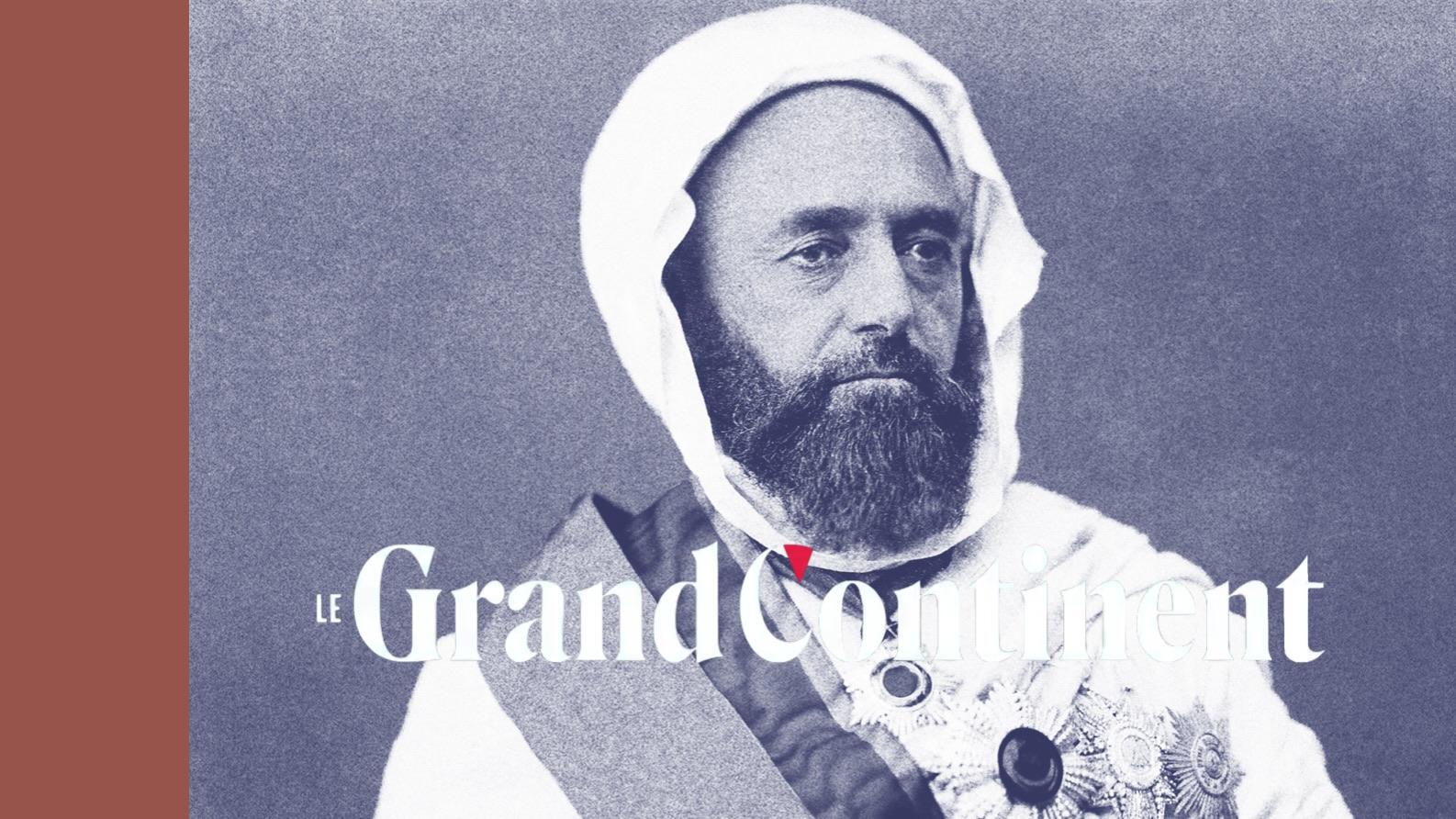
What exactly is meant by the term “Enlightenment”? Who are its actors? What are the non-Western matrices, especially in Afro-Arabic-Andalusian, Muslim, and Jewish philosophy? How can one explain their historical link to empire without treating imperialism as an intrinsic consequence of the universalism of the Enlightenment, a ban that would condemn it outright and without any due process? Answering these questions requires engaging with both classical authors and marginalized writers within this current, across France, Germany, and England, as much with Rousseau or Hegel as with Michaelis or Eichhorn; the forgotten founders of modern biblical criticism. We thus see how Emir Abdelkader, among other philosophers of Afro-Asia in the nineteenth century including a certain al- Afghāni, pioneered a way out of this false alternative that pits the Enlightenment against the anti-Enlightenment. Neither abstract universalism nor religious particularism, this thought maintains that reason must know humans through truth, and not truth through humans; that imitating humans or submitting to authorities or books is neither religiously valid nor reasonable.
And what if the “Enlightenment” had been only a European, modern translation of this older promise to liberate knowledge, neither Occident nor Orient? And what if it is now necessary to defend the existence of plural reasons to remain faithful to it, ceasing to oppose the rationality of some to the supposed obscurantisms of Others?
Orientalism
Orientalism is at stake in what leads the political spectrum’s opposite ends to resist hearing these questions. Orientalism designates the discourse that the West has long held about Afro-Asia and which it named with a single word—the “Orient.” Orientalism is often defined as an imaginary, a set of representations and visual and literary tropes that some view as colonial. Yet its proponents also insist that orientalism is a body of knowledge and sciences that allow for the objective and neutral study of societies from various regions.
Orientalism, colonial illusion or objective science, negation of the Other or openness to it? Answering this question requires looking at the long history of orientalism and the human sciences it helped give rise to. The birth of orientalist themes indeed lies in Christian definitions of the “false prophet,” the devil, and the Antichrist, attributed to a fictitious double: “Muhammad.” It is by speaking of prophecies that certain Christians laid the foundations of a device that would turn against them: the Sacrifice of the Sky. If “Muhammad” is a false prophet, why could not other prophets be as well? This question opened the possibility of a “sacrifice of the sky” within Christianity. In posing it, philologists, orientalists, and philosophers opened the way for the Enlightenment and a critical reading of the Bible that would revolutionize thought and mark our era.
The remarkable and innovative fact is that orientalism has played a central role in how we think today. Therefore, correcting—here and there—one or another empirical way of observing Afro-Asian societies will not free us from orientalism; what is needed is a transformation of our way of thinking. The task then is to measure the limit of critiquing orientalism by asking not what the West says about the Orient, but what philosophers of Afro-Asia have said about the West and about the West. This is the case of Emir Abdelkader, who answered not only to orientalism but to a way of thinking to which we are still in debt, in one word: the Sacrifice of the Sky.
The Statues
The challenge is first to pose a series of questions, however abyssal they may be. Can thought become planetary, or is it doomed to be imprisoned in cultural cul-de-sacs? Can “Neither West nor East” become the dawn of a new form of thought, crossing philosophy and the human sciences? To introduce these questions, one can rely on a simple image: our “thought” has fossilized into a set of statues. We tend to venerate them, quote them, and celebrate them. We think less often in fidelity to the dissidence of those who hide behind these marble bodies, not to mention all those who have no statues or whose voices remain thus forgotten. The image is an invitation to open breaches in the canon, an act of fissuring rather than toppling through mere iconoclasm. Dethroning Westernized thinking also means freeing it from what prevents it from being alive and thus pledging it to death. There is a tension between the principle of the Enlightenment and the principle of the Pantheon. The former is dissent; the latter is canon.
The statues necessarily crack. They do not need anyone to do so. One does not determine the quality of a book by the number of its references but by the quality of its argument. The more we lose sight of public and scientific debate, the more we fill this gap with citation mechanisms that function as appeals to authority. It is possible that AI will soon master this little game of citations better than humans themselves. Scholarly philosophy has a habit of saying, “one does not think by oneself, but with others.” Yes, but with which others? Which others that are not always the same? The question is not who one cites but how one relates to such authors and not to others — an inevitable question of the unequal distributions of authority to speak and persuade within which ethno-racial, but also class, gender, and religious hierarchies are reproduced that the social sciences claim to critique but continually reproduce at the heart of their citation apparatus.
There is a tension between the principle of the Enlightenment and the principle of the Pantheon. The former is dissent; the latter is canon.
Mohamed Amer Meziane
The renewal of the human sciences will not happen as long as we think only with the Western canon that was forcibly built by erasing the Afro-Arab heritage of philosophy up to Emir Abdelkader and al-Afghani, which must be studied and placed on an equal footing with Hegel or Kant. This would entail reorganizing the geography of knowledge in a way that should be the norm but is not. Strictly speaking, these authors and the philosophical heritages to which they belong do not belong to “cultures” radically foreign to one another. They have simply decided not to speak to each other and to do everything to misunderstand one another. The method I advocate is, quite simply, to treat them as equally important without ignoring the power relations that have caused us to overlook Afro-Asia in favor of Europe alone in the history of thought and to never relegating the Arabic- and Persian-language heritage to a bygone glory with no bearing on today.
The lack of serious, non-purely philological or past-oriented teaching of non-European philosophers and theorists — a teaching that does not marginalize them or cannibalize them — is highly damaging to knowledge institutions. But banning so-called “Western” philosophers from curricula is not the position I wish to defend either. I believe they are inevitable, for better and for worse, and that we must analyze with precision the systematic yet subterranean force that makes European philosophical discourse still a coherent thread that irrigates the social sciences, structures them as much as it delimits their horizons.
The Question of Exoticism
Exoticism, like Orientalism, inevitably confronts us at every moment in this task to which no one can be exempt except by indulging in postures of denial that belong either to Eurocentrism or to the most lamentable intellectual laziness. On the other side of the spectrum, some believe they have already decentered themselves or decolonized themselves, and some fall into an overreach that makes them think they no longer need to speak with the West at all as they are authentically rooted in the Global South. The injunction to “speak from the South” yields nothing but the very culturalism we hastily reproach in the Other, without seeing that this attitude betrays exactly what one thinks one should not reproach in oneself. Either one constructs an ontological Other more or less essentialized in relation to the West, or one denies any dissent by playing as if Eurocentrism no longer existed, reproaching postcolonial voices for supposed “reverse orientalisme,” as many epigones of Jean-Paul Sartre’s Black Orpheus do when they relegate the poets of negritude to a supposed “anti-racist racism.” This dialogue of the deaf constitutes a major impasse since these debates neutralize any attempt to find new places of thought.
Non-European intellectual, critical, and theoretical traditions — or those preceding eighteenth-century Europe — are not all strictly “religious.” But they are saturated with what one could call metaphysical, if more precise terms are lacking. By excluding a priori this dimension from our definition of rationality, we refuse the existence of multiple rationalities and retreat into an intellectually anemic approach to thought that is unjustifiable and irrational. The symptom is the way our intellectual life oscillates between crude and inept defenses of a Eurocentric world and a sort of prevailing presentism that is not against staging “diversities” so long as they suffer, do not think too much, and stay in their place: that of praxis. At the risk of provoking controversy, I would say that the supposed authenticity of one’s “positionality” or the apparent immediate politicization potential of an idea not only does not solve the question before us but distances us from a real de-imperialization of thought, from its deoccidentalization.
And if the “Lumières” had only been a European and modern translation of this older promise to liberate knowledge, neither West nor East?
Mohamed Amer Meziane
We should indeed speak of other traditions of thought, at least Chinese, African, Indian philosophy, etc. But this eagerness to skip intermediate steps is often suspect. Western philosophy was constituted by a seizure of the philosophy in the Arabic language and then by the denial of this same appropriation and thus of its dependence. That is why a decentering of philosophy that happens without taking this event and this debt into account will lead nowhere but to reproduce exoticism in which contemporary thought bathes: that is, the opposition of distant and supposedly harmless Orient extremes — typically “Buddhism” or some other religion of immanence deemed without God — to distant Occidents — typically “animism” of the Amazon — as Claude Lévi-Strauss did in chapter 39 of Tristes Tropiques.
I add that there exists a manifest but constantly concealed contradiction between the act of philosophizing and philosophizing only within a single intellectual tradition. For the same reason, the idea that one should ignore European philosophy is absurd. Thinking only within the corpus of Arab or Chinese philosophy makes no sense today, and this act is not liberating in itself. It will never free us from the nets of orientalism.
It is not just a matter of criticizing the geography of our citations. If we cited non-European authors in the same way, it would not fundamentally change the problem. Citing one thinker or one theorist non-European as an authority (which is rare) or as a “magnified” exception so long as it remains exceptional (which is almost systematic and exactly what Ernest Renan did in his response to al-Afghani) will not solve the problem. Even two or three names will change nothing in this way of saving appearances; a thin alibi that convinces no one. What matters is to transform our way of thinking, reasoning, and arguing without making citations or figures of authority into alibis or sanctuaries for our ignorance, however learned it may be.
There is an intellectual arrogance as considerable as it is indefensible in not taking a stand from a full and complete rationality that is not limited to a handful of twentieth-century French thinkers. The great authors are “great” only because they defended precisely an attitude of critical dissent toward the scholasticism — in both its literal and figurative sense — of their time. Descartes or Kant but also Nietzsche in his own way, to name just a few. Once they become statues, they lead their guardians and their followers to reason irrationally, even though the latter often present their irrationality as “science” atop a learned ignorance. It is worth insisting: it is just as illusory to pretend that the dominant citation machine is marked by some kind of inheritance equivalence. The mass, normalized fact is that the figures and citations that carry authority in the social sciences, and this remains true worldwide today, are predominantly European or Western.
The intellectual habits we have recently internalized lead us to identify the position I defend with a kind of latinate universalism or, worse, with “decoloniality.” I reject such reading as conventional and devilishly imprecise. Universality becomes a doctrine after 1789. Its current French form dates from the Third Republic, hence the late nineteenth century, a century during which republican universalism truly took shape after the Enlightenment. Before 1789, one could speak of universals or the universal within the framework of logic, and nothing in that gesture was intrinsically imperialist. The problem lies elsewhere, and even if universality bears an ambiguous relation to imperial questions, that does not mean it is an imperial project.
Universality paradoxically causes the world to be lost to the one who proclaims it. The universalism arises from an occidentalization of thought that narrows the horizons of thinking, gradually closing the ears of the learned understandings of our secular clerisy. To oppose particularism to universalism is therefore vain and doomed to failure because it is staged and already digested by universalism: one need only know a few outlines of the history of relationships between indirect colonial governance and the birth of ethnology in the British Empire after 1857 to realize this.
AI and the Humanities
Philosophy and the human sciences have a great deal to lose if they re-centralize themselves for a long time. They will likely not survive the AI onslaught if they merely maintain a status quo that is already extremely precarious. The fate of philosophy and the social sciences is linked to that of the humanities. If a disciplinary reflex, partly legitimate, leads to spontaneous mistrust of the term, I contend that we must now invest it strategically to face the intrusion of AI into our lives and into everyday practices of knowledge. We must recover an ambitious philosophical practice of the humanities that allows conceptual rigor to traverse empirical methods without being locked into a corporatist framework that no longer has the material means to defend itself. The latter has no right to drive the future of thought into its collapse, and fortunately, it does not have the power to do so.
Universality paradoxically causes the world to be lost to the one who proclaims it.
Mohamed Amer Meziane
This corporatism continues to drive the social sciences to dissociate themselves from philosophy or to denigrate it as abstract and unreal. This stance is utterly deleterious and it feeds an anti-intellectualism that more generally fosters a narrowly empirical distrust of theory and even more of metaphysics, of which the defenders of the small corporatism of thought understand almost nothing except the few prejudices to which archaic positivism has blindfolded them. The social sciences still too often imitate men (or what Emir Abdelkader called taqlīd al-rijāl). They prefer to submit to those who heroically rejected the old absolute rather than to submit themselves to critique and its demands.
One might be shocked by the claim that I reproach Western philosophy for what it is. How is it a defect to be “Western”? It is not a reproach but a clinical observation. The post-Kantian concepts on which the dominant social sciences and philosophy rest were born from the emergence of knowledge such as biblical criticism and orientalism. Without such a history of the Sacrifice of the Sky, we cannot claim any knowledge of the presuppositions with which we think spontaneously or a priori. It is a prerequisite to the desacralization of the humanities, to their de-imperialization. This is why the problem of orientalism concerns anyone who claims to think the world and the worlds: because it has determined and continues to determine the way philosophy and the social sciences think (or think they think). Orientalism functions first as a critique of sacred texts, and especially of the Bible, since the end of the eighteenth century. The major paradigms of the social sciences solidified at that epoch, from within not only philosophy but philology. The old “armchair” anthropologists are the direct heirs of this sort of knowledge and its mutations during the nineteenth century. But the field ethnographers of the twentieth and twenty-first centuries, the on-site anthropologists, have not succeeded in dismantling the conceptual apparatus their forebears built in the preceding century. They still confirm it, often in spite of themselves.