
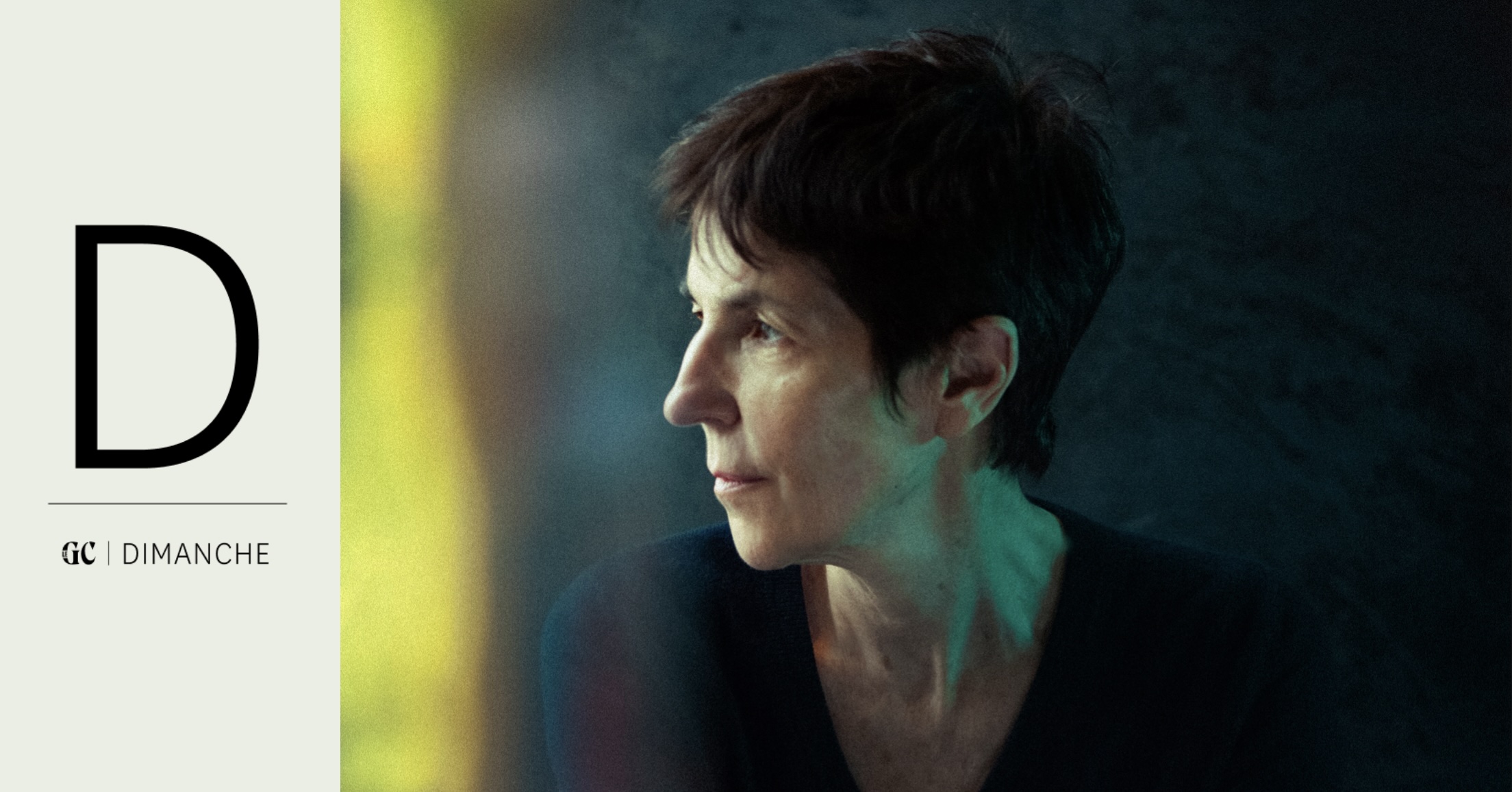
I cannot quite remember the moment I first wondered why Christine Angot was named Christine Angot. A mother, Rachel Schwartz; a daughter, Christine Angot: the pairing didn’t fit. Especially since Angot was the surname of the incestuous father, not the kind of name one wants to bear. She answers this in her latest book. For fifty years she bore the name of the man who raped her. In I Change My Name, Christine Angot tells a century of forbidden filiations in Châteauroux, incest as a “barter,” October 7, and the reappropriation, in April 2026, of the name of her Jewish grandfather from Alexandria.
She chose the setting, Le Lutetia, on Île Saint-Louis. She lives just nearby, she comes here often—not only here, but often. It’s a sunny Saturday and the terrace is teeming with tourists. She does not complain about overtourism; she puts the presence of passersby in perspective and even finds there something of what she had already lived in Châteauroux, on Rue de l’Indre, another small radius, when she was four or five: “Everyone knew me. We were identified, it was truly the neighborhood. I was my mother’s daughter.”
That is exactly how I Change My Name opens: a small girl who goes alone to the grocery, lives with her mother and grandmother in a turreted house whose garden slopes down to the river, tells herself she is “perfectly happy,” and spells proudly her name, S.C.H.W.A.R.T.Z., as soon as she learns the alphabet.
She is associated with Châteauroux, with Montpellier, rarely with Paris. Yet several of her books recount the arrival in the capital, from Leaving the Town to Night on Command, “like Julien Sorel, like in the nineteenth-century novel: someone who lands and discovers the streets, the societies, how one moves and, above all, how one talks, what the language strategies are between people.” She has an explanation: “Perhaps that’s why I’m not identified with a single place. I always seem to be moving.” The paradox is that she almost never leaves. Holidays? “I don’t know how to do that.” For eighteen years, Claude, her husband, the father of her daughter Léonore, organized everything. Today, the only regular trip leads her to Montpellier, to her ninety-year-old mother.
Christine Angot’s voice is unique, in writing as well as in speech. She does not cheat with words; she does not know how to—or rather, she cannot. Moreover, she does not cheat with anything: she is either bluntly honest or nothing. It is in her company that one can understand what interviews with writers are for. For yes, you may ask yourself, as I do: what is the point of interviewing writers? To have them summarize their books? Usually you know their writings better than they do. It is well known: once the text is published, it no longer belongs to them. But then, what is the point? Well, to understand the strange mental machinery that serves as their LLM. Angot’s machinery is particularly singular.
A Century Without a Man in the House
I Change My Name is a history of women. Christine Angot speaks of a “repetition of female scripts” over a little more than a century, at moments when a house without a man signals that “something is not right”: a widowhood, or a fault against social order. “It always goes through one sexual thing. At some point, someone makes a child for these women, and it doesn’t happen within the frame of marriage, which then becomes the only possible, proper, bearable, society-integrated frame.”
The chain begins with Marie, the great-grandmother, a farm girl driven away pregnant by the owner, whom a Châteauroux butcher, Henri Sigoigne, marries knowingly before acknowledging the child. This child, Augustine, will never know who her father is. She marries Joseph Schwartz, a Jew born in Egypt, who speaks around ten languages. He leaves for Alexandria in 1935 and does not return until 1948. Thirteen years. “I know this because thirteen is the age I am when I meet my father. There is this thirteen-year period that replays itself.” Their daughter Rachel, Christine’s mother, falls in love in 1958 with Pierre Angot, a translator at the American base in La Martinerie, who refuses to acknowledge the child. The only lead: Pierre’s father, a director of collections at the Michelin Guides, on Boulevard Pereire. He receives Rachel in his office and tells her that nothing proves the paternity of his son. “There you go, it’s the daughter who wants to get married.”
Should one read this, as a pop psychoanalytic reading might suggest, as the repetition of a failing scenario? The answer comes with blunt clarity: “Honestly, if that is a failure, I prefer this failure to all their string of successes with their marriages that succeed.” These women “manage it; they hold their own.” She herself was “extremely happy” in that house of women. And it is precisely at the moment when she is drawn into the frame, with the official recognition of her father, that the frame rejects her: “All this will to fit within the dominant frame, and as if by chance, this frame rejects me. It is the humiliation one reaps.”
As a child, her mother advised her to say that her father was dead or away on a trip. Not divorced, since there had been no marriage, and a divorce would have muddled “the positive social image” that a married couple was meant to guarantee. She did this for a long time, then chose death, “for the absence of a destination and a return date.” As an adult, she made a decision even before meeting Claude: if she had a child, she would be married. “I had heard all my childhood that otherwise it was a problem.” In the book, she phrases it differently: she wanted to mark the end of a cycle, for it to stop with her.
The Name of the Enemy
The book opens with a harsh epigraph: you must know the name of your enemy, and perhaps to know it, you must bear it. Why is Angot the name of an enemy? “Because an incestuous rape is committed by someone who is an enemy. You have to be your child’s enemy to commit an incestuous rape. It goes together.”
The father, she sketches him in a few strokes. A military service spent in Germany rather than in Algeria, thanks to paternal recommendations. One night in 1958, at the wheel of a company car, returning from a date that went badly, he runs over a pedestrian and does not stop. The man dies. Three months of military prison, then an intervention at the ministry. “He’s a killer.” He tells this to Rachel, because “the technique of these people isn’t to hide, well, to hide from society, but to confide in private, telling a false tale to elicit sympathy. A terribly twisted psychological thing.”
In 1972, the law on filiations finally allows a married father to recognize a natural child. Rachel insists for months, Pierre hesitates, recoils, ends up signing at the town hall in Châteauroux. Christine Schwartz becomes Christine Angot. What did she think of it? “The problem is that it does nothing for me.” Her mother asks with a look of triumph; she speaks of wanting to be like all children, of finally bearing her father’s name, whom she had always been told was a great love. “From what point will I tell him no?”
The early acts begin in the summer of 1972, just as the parents discuss the procedure. The book offers an almost anthropological reading: a “barter” between the name and the incest. With one hand, the father acknowledges his daughter; with the other, he degrades her, to reaffirm the inferiority of this branch that his family had rejected. The signature is authentic, but tainted, and the vice does not show on the papers. “He paid himself back,” she writes, taking up a legal expression, “on the beast.” Lévi-Strauss had made the prohibition of incest the rule that underpins exchange between groups. Angot describes its reverse: incest as an instrument of hierarchy within the family. There is a cruel irony: it is a post-68 conquest, a progressive law that Rachel followed with passion, which opened the door.

Nevertheless, her relationship to the name remains “divided.” “I love Christine Angot. It is the name of the writer, the name on the covers, from The Incest to A Week of Vacation to The Journey to the East. It is she who carried all these books, who owned them. I don’t see why she should be ostracized, fired. I wouldn’t want to precipitate a new purge.” Angot would thus remain a writer’s name. A name that, according to the etymology given by her father, means God.
A Useful Shame
There are in this book two theses that run against the grain of the time. The first concerns shame. It is not right to tell victims that shame must change camps. “That would mean it would no longer be borne by the victims, but by whom then—the rapists? I have never seen a rapist feel shame. In any case, the rapists I have met did not feel shame. My father did not feel shame, and at the moment when he could have felt shame, when things began to leak out, he chose to die. Pierre Angot died in 1999 of Alzheimer’s disease. ‘As if one could act on people’s thoughts. You must stay in the real.’”
In the book, the argument goes further. Since the culprit is proud, and a society where no one would feel shame about incest is unthinkable, it is the child who bears the shame, not for themselves, but for their father, in a kind of altruism. Hence this maxim: to be ashamed, and not to be ashamed of one’s own shame. One thinks of Primo Levi, who observed that shame falls to the survivors, never to the executioners. “Shame is useful. It is a social, deep, human function. If we tell victims to get rid of it, it will disappear.” Above all, it is knowledge: “Only victims know what it is made of, on what it rests. This knowledge is important to be able to pass it on, to find words that describe it.”
The second thesis is that writing does not heal. “Same idea: you should heal, not be afraid. We’re told to seek comfort when there are things of real importance to face. Write, will it do you good?” “That’s stupid. I’m not saying it can’t help some people, but then it’s not literature. If you have a passion for literature, it isn’t therapy. Or else you become a doctor.”
Few writers cling to the word “literature” as firmly as she does. “It is a place. An imaginary place, but a very particular place.” It was first the space of her mother, a great reader, who read books aloud to her. Today, if one must name one, it would be The Bound Princess (La Princesse de Clèves): “When you open the book, you are confronted with such proofs of literature, as one speaks of proofs of life. It’s crazy, it produces a kind of light. You don’t know what literature is, but you sense it.” The book also recounts her first encounter with the world of publishing. A law student, she tells her grandfather Joseph that she has written a novel. He warns her: it will cost her a lot; one of his friends learned this at his own expense. He thinks she wants to publish as a self-publisher. Then, when he understands: “Ah, if you have talent, it’s something else.”
Durval, Clovis
There is also Didi. During the Occupation, with no news of Joseph, her grandfather, Augustine, her grandmother, has a daughter by a married man from the Saint-Christophe neighborhood: Edith, called Didi. Neither parent, each married to someone else, has the right to recognize her. The child is recorded as “of unknown father and mother,” and the civil registry assigns her a name: Durval. She discovers it at thirteen, on the day of the diploma, on the label of her desk. “A guy in an office who says: well, here’s a girl, we must give her a name, here, we’ll put that. It haunted her all her life, today still, at more than eighty.” The only solution was to marry, as a teenager, Jacques Vidal, and become, as they used to say, Madame Jacques Vidal.
It is the method that had been used, a century earlier, to name free slaves in the Antilles. Christine Angot’s partner, Charly Clovis, was born in Martinique and is descended from those men and women whose civil registry officers invented surnames in 1848. In Martinique, he says, you know people by their first names; he ignores the family name of most of his friends. But his own name makes him smile: to be named Clovis, the name of a king? Before concluding, in the book, that the person who chose it did very well. “We could say names are incidental,” Christine Angot resumes. “But bearing a civil name is not nothing. It is extremely important.”
“I Cannot Sign”
The name Schwartz she has always linked to her grandfather. When Joseph would pass through Châteauroux, with his two suitcases, she felt “very strange” walking in the street with him: “He doesn’t look like anyone. I sense the glances on him, and therefore the glances on me.” He spoke of Israel, told stories where there were always Jews, bridge partners whom he specified were Jewish, and he spoke of money, which no one around her spoke of. Her mother, by contrast, had rejected everything, religion as well as foreign languages. Baptized on Christmas 1942, taunted as a “dirty Jew” at school at the same time, she raised her daughter in Catholicism: religious schooling, communion.

On October 7, 2023, everything shifted. Christine Angot had returned from a festival in Corsica where she had befriended a Franco-Lebanese filmmaker. The day after the attack, she receives a text calling for a ceasefire, signed by many. “It’s obvious I must sign. But I can’t. I don’t know if I want to or if I don’t want to; I can’t. That is what people don’t understand. That is the question of identity.” Signing out of conformity would have drawn her back into a situation she has already known: “A betrayal of myself. When I change my name to Angot, I did not organize it myself, but it’s a betrayal of my own person. And when you betray yourself, you pay dearly, sooner or later.”
What struck her was the speed. “By October 8, it’s over. You say right away: yes, it’s sad, but one cannot be surprised; putting another people in this situation could produce only this. That is the sense of resistance.” And what does the call for ceasefire mean then? “Do we say: beware, it will set everything ablaze? Or do we say that attacked Jews have no need to defend themselves because they are guilty?” Three years later, she admits that it has become difficult to recall that moment, given the war’s many terrible acts on the Israeli side. The book, however, recounts what followed: the CRIF exhibition on Place des Vosges, where she’s thanked for coming as a non-Jewess and where she finally tells a stranger that her name is Christine Schwartz; then the video of a gathering at Paris-VIII where an entire room refuses to condemn October 7, and the op-ed she writes to tell those people that they are “bastards.” No argument: it is, she writes, a matter of identifying the “bastard phrases” about incest as well as about Israel. The word is almost Sartrean. But where Sartre defined the Jew as the one others hold to be Jewish, Angot experiences the opposite: she is treated as non-Jewish, and this misunderstanding became unbearable for her. She does not speak of Judaism, for lack of initiation: “I would call it Jewish identity.”
A Language That Saves a Life
There is, however, a Jewish language she embraces, though it is not exclusively so: psychoanalysis. “If listening is part of the language, then psychoanalysis is a language. It is listening to what someone says. This language saved my life. And if a language saves your life, you owe it forever.”
That is what illuminates a scandal recounted in the book. In Germany, in Cologne, before about a thousand people, a celebrity journalist who had enjoyed her books keeps reducing every question to the same injunction: you must file a complaint, you must go to the police. “I cannot stand the instrumentalization of books. They tell you: go file a complaint, because they don’t want to listen to what you know. There are a thousand things to do first. One can ask: what happened? In which city? Was it raining?” She remains polite, stands her ground, the audience turns against her and boos. She then tells them Freud did not deserve to have written in their language. She has not been published in Germany since. One thinks of Jankélévitch, who refused to speak German. Her critique lies elsewhere: “They live in that language, but with police-state mentalities, judges, narrow rules. As if there were only one way. While with psychoanalysis there are as many paths to freedom as there are people.”
The book offers a vivid illustration. Years after her father’s death, she rings the widow’s door in Strasbourg, accompanied by a friend filming, and she props her foot in the door to keep forty years of silence from sealing again. The conversation, transcribed almost word for word, reads as a treatise on inversion: they speak of a “relationship” rather than rape, of an “absent father” rather than incest. A few months later, it is she who is summoned to a tribunal.
Neither Novel nor Essay
What is the status of this book within her work? “I feel it is a bit apart.” It is not an essay; she has never written one, because “there are novelistic elements, which makes it impossible to be an essay.” It is not exactly a novel either, even if the novel remains “my natural form.” To discuss it, she takes out her phone and reads a message from Yasmina Reza, received after sending the book: her work would be unique by a “double incidence,” life and writing. What usually works in one direction—from life to writing—works with equal force in the other direction. I Change My Name is the demonstration: a book where you can see writing produce effects in life, all the way to the court, to civil status.
What does a writer do when they are not writing? Some say they wait for morning. For her, morning is elastic: for this book, written in one go, it began early and could last up to fifteen or sixteen hours. “Afterward, you must rest, you must stop.” And then? “I don’t do much. I read. I try to take a walk in the neighborhood, to be outside.”
In April 2026, a ten-line letter informs her that her request has been accepted: she is now named Schwartz. In the book, she cries for half an hour, with joy, then speaks to her name as to a childhood friend found again. The last page returns her to Châteauroux, to the cemetery, before a small gray grave where three names are inscribed one above the other. The last one is hers.