
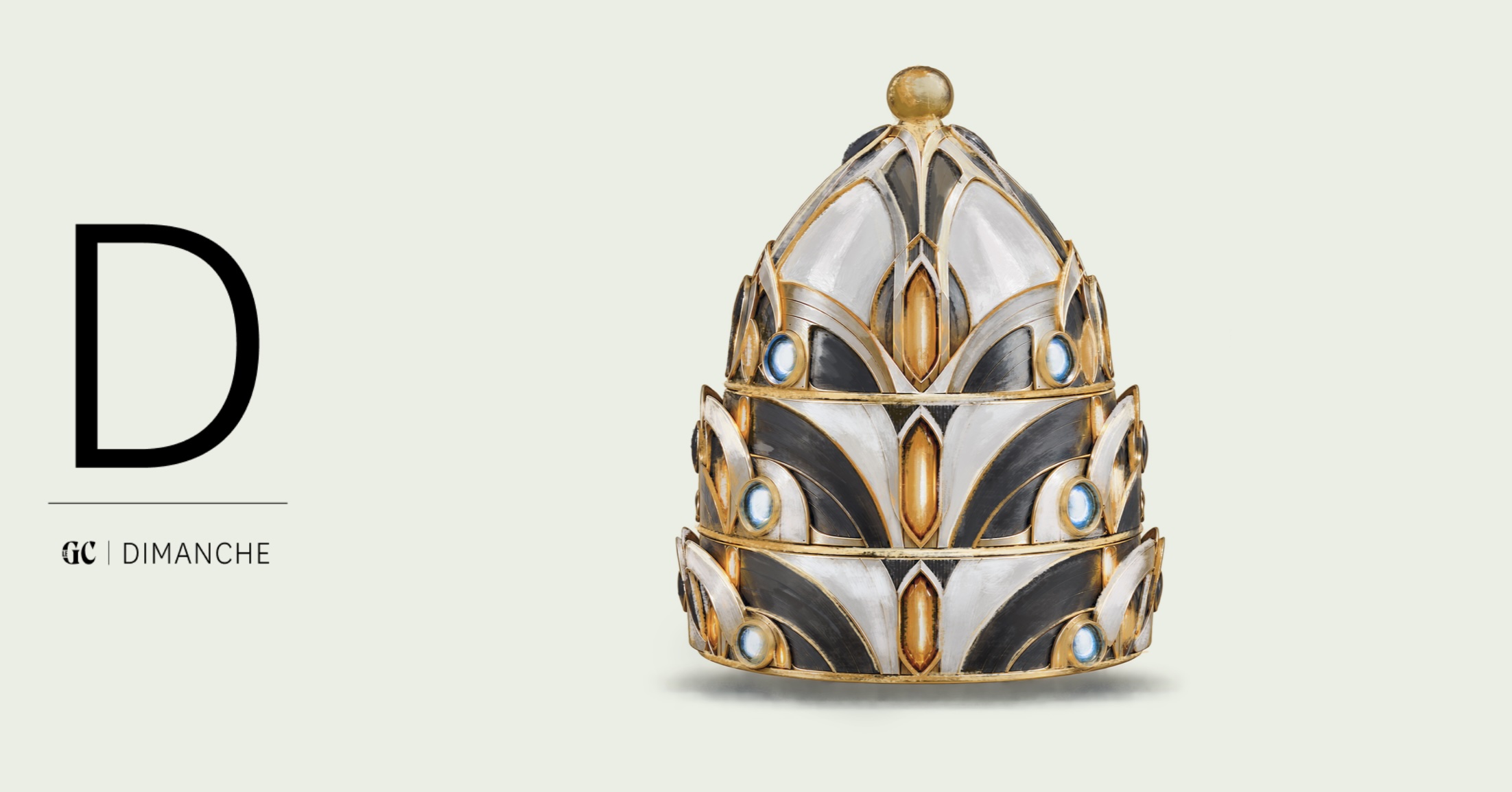
For decades, the Catholic Church had lived on the legacy of Clement XV’s reforms, enjoying a relative stability. But soon, at the dawn of the 22nd century, new factions began to crystallize, reviving the old rift between progressives and conservatives and adding fresh tensions between the now-unified American continent and a Old World that sought to counterbalance it.
Long latent, these rivalries finally came to the fore during the conclave that followed the Albanian Zosime II’s death, the 279th successor of Peter. The conclave saw a clash between the ultra-conservative camp, whose informal candidate was the Monacan cardinal Trebaldi, and the larger Liberal faction, though itself divided by significant splits. Most of all, the new rules of the conclave itself made it a puzzle: it is remembered that Clement XV had admitted women among the cardinals while still denying them the right to sit in the conclave; but his successor, Alexander IX, had lifted that barrier, allowing cardinal women to participate in the conclave to elect the pope, provided they remained ineligible to be elected themselves, which seemed to create distinct classes of cardinals.
Facing the outcry of the conservative prelates, Alexander IX offered concessions by permitting a return to an indirect voting method, already in use in the Middle Ages: each order of cardinals (the cardinal-bishops, cardinal-priests, and cardinal-deacons — permanent or not, and thus the women cardinals) would first vote to elect three cardinals in each order, who would then, by a two-thirds majority, agree on a papal candidate, on the condition that they themselves were non-papabile. “Another shock of simplification!” quipped the free press. And indeed, Zosime II was about to reimpose the one-vote-per-person rule, but his death occurred before the pontifical decree could be signed. The result was near-total confusion and debates about voting by order or by head that recalled the Estates-General of 1789.
After two months of stalemate and countless ballots, the cardinals, led in large part by the members of the Commission appointed by their peers, realized that they needed to attempt a solution long fallen out of use since the fourteenth century: elect a pope outside the cardinal college. This option had been used, for instance, at the 1294 conclave, where the cardinals selected a simple hermit, Celestine V, drawn by his reputation for sanctity, who would resign a few months later, discouraged by the already alarming complexity of Roman affairs. At the 2106 conclave, the cardinals went even further, choosing a plain layman, a married man, English by birth, named John Arnold. The canon-law experts were adamant: anyone “fit for the priesthood and episcopate,” i.e., ready to receive them, was eligible for the throne of Peter; yet history had seen at all times couples of devout laymen (viri probati) who, by mutual consent, entered the orders after their children’s education was complete. Certainly, the 2106 conclave did not hesitate to move quickly by voting for a married layman who had not yet expressed his desire to join the clergy; and some canonists worried that the overt pressure of the election could bias his consent and thus render it invalid.
In plain terms, the cardinals of 2106 had attempted a high-stakes gamble that would, in the short term, pay off: John Arnold, initially thinking it a prank call, eventually consented to enter the orders with the obedience and devotion that had always characterized his conduct. Beforehand, as required, he obtained his wife Imelda’s consent, who herself was preparing to join an urban Poor Clares convent, of which she was already a tertiaried member. Once he accepted the papacy, which legally confers plenary power on the pope, John Arnold thus became for a few hours the first lay and married pope, albeit now with a nun for a wife, a fact not missed by the satirical press.
After boarding a plane for Rome, he successively received the minor orders (reinstated by Clement XV), the subdiaconate, the diaconate, the priesthood, and finally the episcopate; for simplicity, he forgone the coronation ceremony of the tiara, likewise revived by his predecessor, and, emulating Paul VI in this respect, organized a grand raffle to sell this emblem of papal temporal power. A lover of pleonasms, he chose Sixte VI as his regnal name. For several years thereafter, he governed the Church in the manner he had always lived—prudently.
It was, however, a time of war between progressives and conservatives: emboldened by the admission of cardinals to the conclave, the powerful feminist associations within the Church, which conservative prelates had failed to curb, grew dissatisfied with half-measures. Remembering that their pope had had a wife, they demanded his exit from the convent, even more so since Imelda Arnold had herself once shown notable administrative gifts in the century. Yet she had since retired to cloister and taken a vow of silence. What the church’s feminists demanded (feminism having become the majority among believers, while masculinism had spread quietly among the unbelieving and secularized populations) was not a role as First Lady of the Holy See, but real jurisdictional power.
Thus a small band of activists conceived a coup that mirrored Sixtus VI’s improbable election: in the dead of night, Imelda Arnold was abducted from her convent with the complicity of the cell-sister, and after a clandestine highway journey and a videoconferenced conclave, she was symbolically installed in Avignon, at the very heart of the Papal Palace. It was summer, and the many festival-goers took it for another theatrical happening (the Avignon Festival was preparing to celebrate its bicentennial). The new papess adopted the name Jeanne II: despite reminders that the legend of Pope Joan is a late, baseless myth, she meant to rehabilitate those historical figures who had been left unseen. Of course, to her opponents, her election was null and void; as the supporters of Pope Joan were predominantly women (though not exclusively), there was briefly concern about the potential birth of the church’s first gender schism.
From the Papal Palace, Jeanne II traveled to Lyon, where she paid tribute to a distant precursor, the French biblical scholar Anne Soupa, who had declared herself a candidate for primacy of the Gauls after Cardinal Barbarin’s resignation. Her papacy thereafter was itinerant, in keeping with medieval modes of governance. If she saw herself as a papess, and indeed possessed de facto jurisdictional power, Jeanne II nevertheless refused ordination to the priesthood and to endorsing the ordination of women, arguing the classic distinction between the powers of order and jurisdiction; the barrier recalled by John Paul II in 1994’s Ordinatio sacerdotalis, though denounced, had now stood for more than a century. Jeanne II thus accrued a modest base of support for her tiara, but she too governed with caution. In the long run, however, the schism proved wasteful; no one understood this better than Sixtus VI, who, after a few years, announced his renunciation of the throne of Peter. Expected to provide a dignified exit from the crisis, this decision was not surprising; even more striking, however, was Jeanne II’s decision to imitate him, and their joint announcement to retire together.
Now that the former Jeanne II is dead, no one knows whether she will be included in the official list of pontiffs or counted as an antipope: the early Avignon popes were regarded as legitimate papal successors, but their successors during the Western Schism, when there was simultaneously a pope in Rome, were not.