
Capri occupies a central place in your work. Could you revisit your relationship with the island?
I first discovered Capri when I was invited to a music festival, and it inspired me to write a novel, The Inner Island, and to compose an album, Capri – Ballad Of the Spirits. But even if I’ve visited it several times since, my perception of Capri has become somewhat dreamlike.
My Capri is a blended Capri, part imaginary and part real. What one envisions of Capri partly exists, and many places I’ve found myself in invite daydreaming.
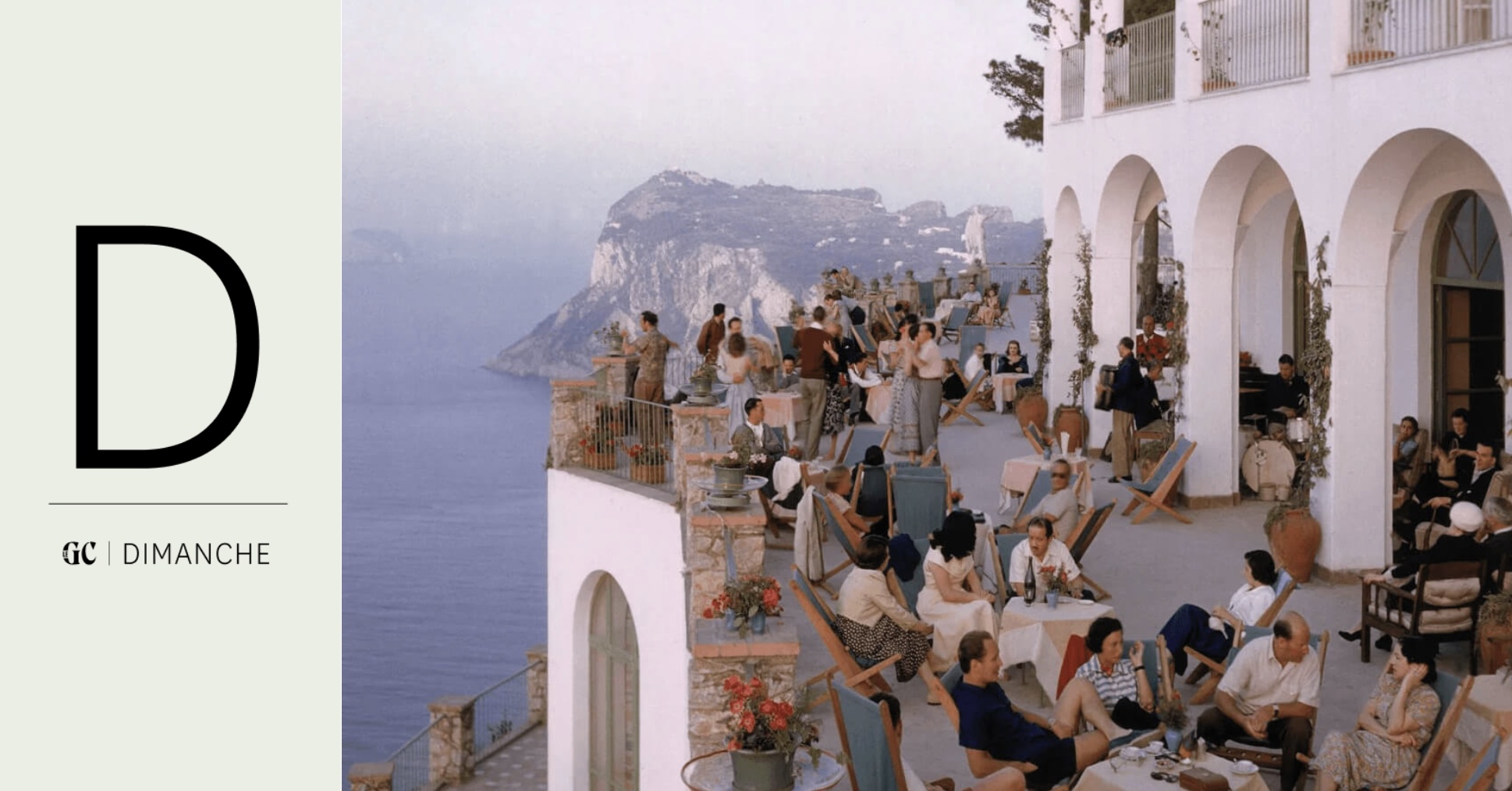
That Ralph Crane photo is a good example.
What does it evoke in you?
It captures the mythical spirit of this terrace: a holiday mood, a sense of leisure, elegance and pleasure, all framed by a spectacular setting with a magnificent view of the Mediterranean Sea. It’s utterly enchanting.
You can tell it’s the Caesar Augustus hotel, but the photo also resembles the island’s funicular bar. When you arrive, the crowd of tourists that overruns Capri during the seasons can be quite overwhelming. Many of them take this funicular by the port. You ascend quickly and arrive on a terrace near the Piazzetta.
Do you have to climb to the heights to truly enjoy Capri?
The possibility of escaping the island’s center has always appealed to me. I take the little paths that lead upward, where you find a Capri reminiscent of the one Crane captured, in a way preserved, because you encounter fewer people.
As with all major tourist spots, once you move away from the beaten tracks, you come upon very mysterious places, with vegetation and an atmosphere that inspire my writing.
What aspect initially drew you to Capri?
At first, I didn’t know much about it. With my husband, Peter von Poehl, we were asked to do what we do: sing, play music, but also blend poetry into my lyrics.
So I did a lot of research on Capri. It was at that moment, even before going there, that I discovered a place that was completely fascinating. The fact that it has always been a refuge for artists is probably what left the strongest mark on me and drew me to it. Everyone gathered there: painters, novelists, then, later, film people.
It’s a place with a real soul. You can still feel the presence of the artists who inhabited it, who wrote about it, painted it, photographed it. Some were quite decadent and eccentric; they fled because they weren’t quite normal and found refuge on the island, because it welcomed people from all backgrounds. All the stories that Capri has carried are romantic.
In The Inner Island, there is notably a singular relationship to history, to the past, to ghosts. Is that something you feel more on Capri than elsewhere?
Yes, at least for me. The island is so electric and loaded with history that, especially in the evening, you feel that a ghost could pass through you at any moment.
When you arrive on a terrace like the one in the photo, where you can hear conversations, the wind, the smell of the sea, the clinking of glasses, the faint music resonating, you hear the whisper of the ghosts.
I feel it every time.
Would you say Capri is more of a literary island or a musical one?
Capri is a literary island. But in reality, everything comes together through poetry, which holds it all. It is a poetic place.
Did you write or compose what you did on Capri while being there?
No, always afterwards. It is Capri from memory that interested me, like when you pour a little sand into a bottle, in a way.
When I was there, I tried to soak up all the atmospheres and all the landscapes. More than trying, it was a necessity. I was permeable to this environment. I went home, and Capri continued to live inside me.
Does this Ralph Crane photo stimulate that memory?
Absolutely. Looking at it, a part of me wants to be there, as if the earth were calling me. I feel good in Italy. It’s surely my distant Italian roots that make me feel a little at home there. But I think it has that effect on many people, even those who have never been. This illustration is a teaser, a first journey.
There is something magnetic about this terrace that plunges you into one of the world’s most beautiful landscapes, with a glass in hand, in good company, with a bit of music. That sweetness of living can only be alluring.
If you were on that terrace, what would you drink?
I’d be very happy to order a small glass of Prosecco and gaze at the sea as conversations drift by.
What would you read?
If I were alone on one of those turquoise sun loungers, in a corner facing the sea, I would read Capri by Alberto Savinio or The Land of the Sirens by Norman Douglas.
And what would you listen to?
You can spot musicians on the photo. But if I could choose, I’d pick Eternamente. Composed by Charlie Chaplin for Limelight, that song was notably performed by Nilla Pizzi.
It’s a piece you can find on one of my previous albums and which I sang with my husband in that magnificent place that is Villa Lysis. It pairs well with the idea of my Capri, a dreamlike and eternal Capri.