
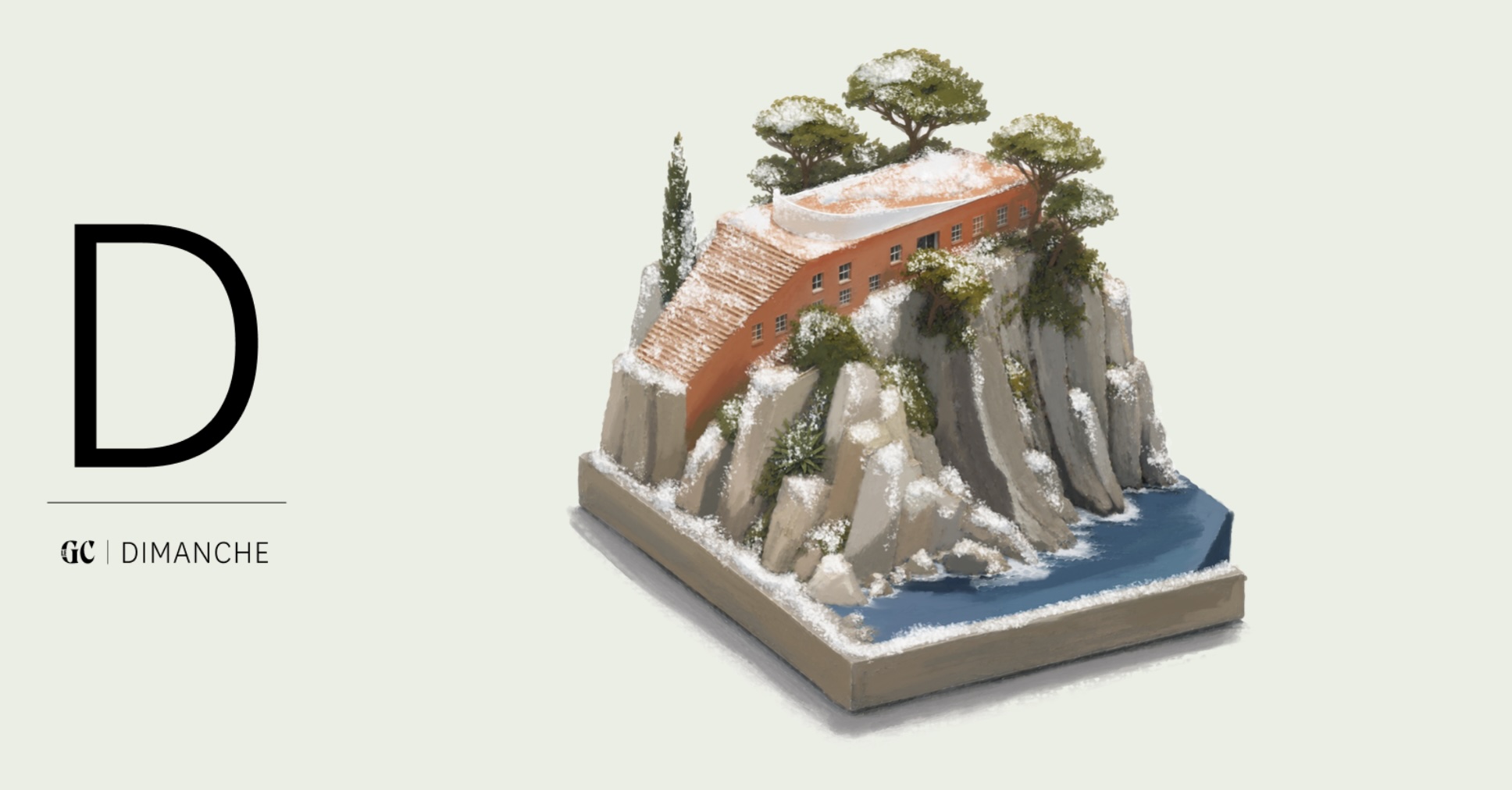
Leon Visconti has just died in Capri at the age of 103. The aquamation ceremony for the Franco-Italian, renowned for his voluntary service, at age fourteen against Russian troops in Berlin, will take place near the famous inverted-pyramid staircase of Villa Malaparte.
Visconti, who was also a novelist and a landed gentleman, but an active, productive, creative one, had acquired in 2042 the land and the building erected between 1938 and 1943, buying them back from the Rositani-Suckert, the descendants of the author of Kaputt. He regarded this writer as a brother: “Like Malaparte, I am a brilliant histrion, exasperating and terribly endearing,” he wrote in Autoportrait en plein soleil (Internetfr, 2067).
The house’s total exposure to the sun on the cliff’s edge, today often at water level, on the Capo Masullo facing the Gulf of Salerno, had rendered it uninhabitable from the 2040s onward. No one stepped foot inside for fear of frying.
A connoisseur of architecture and a self-taught engineer, Léon Visconti knew how to adapt the dwelling to the climatic turning. He oversaw monumental insulation works, installed solar panels and rainwater recovery basins, and, with his own hands, clad the villa in a cork skin thirty centimeters thick.
To know the original state of the house, one must look to Le Mépris, a film shot in 1963. Visconti had dedicated to the director a first‑person essay, Une croix dessus (2044), whose thesis rested on a single line: Jean-Luc Godard’s summation of his country’s ethos, Switzerland (“Le sang des autres, je fais une croix dessus”) should be read as prophecy.
“We live in an electric storm,” he wrote, “and neutrality is a lightning rod: it will attract the lightning.” And the thunder struck, less than five years later, on Lake Geneva. Several tactical nuclear weapons arriving from Russia during the height of Moscow’s transition troubles.
That was not all. Five years earlier, and almost word for word, the most discussed chapter of the essay predicted the annexation to France of an Alpine republic proudly independent since 1291, followed by a reconfiguration of the entire continent. Seen from Bern, the referendum was of course about something else: an expansion of the Confederation through the annexation of the canton of Paris. The two chanceries never agreed on who had annexed whom. Visconti dismissed this quarrel as a footnote, saying the continental federalization had rendered it moot.
And yet Switzerland, which had thus shared nuclear codes with France, had accorded him the secret of “the greatest achievement it had offered humanity.” The essay concluded: “Not the cuckoo, as Orson Welles would have it, a renowned calumniator of the Helvetians, but the Gruyère.”
Léon Visconti was born on August 2, 2026 in Paris, to a French mother and an Italian father, a wealthy heir to a pharmaceutical laboratory who traced his lineage to Luchino Visconti. The filmmaker had captured the splendor of fallen dynasties and the beings torn by their contradictions. They were many before artificial intelligence began to oversee, for the greatest possible profit, every facet of our inner lives. From the grandfather who became his AI guardian, Léon inherited a taste for beauty and a brooding, provocative, hysterical temperament, some would say.
It took no more than that to fall in love with a house lost at the edge of Capri, whose interior resembled a grim monastery. Malaparte had placed bars on the windows; Visconti kept them. The island was shaved bare, overwhelmed by heat. Across the water, the Amalfi coast wore away. Everything was melting, running down.
He knew what decadence was. The dark Enlightenment had sought to press upon Europe like a lid during his adolescence, only to be expelled by a democratic rebound. His six novels had inspired this episode as well, and they might have earned him the Nobel prize, if he hadn’t veered off a little too often and if the prize had not been reserved for women starting in 2064.
His melancholy had nothing to do with a lack of recognition. It stemmed from his name, from his grandfather, from his parents—these “great, great neurotics” he spoke of with tenderness. They followed a trade that had vanished: psychoanalysts. They took in patients in a small room, did not look at them, did not shake their hands, laid them on a couch and let them talk. This protocol cleansed the “unconscious,” a zone both dirty and strange in the mind. For lack of patients, the psychoanalysts died out, like dinosaurs.
Léon owed his first name to Léon Marchand, the champion who entered history by winning seventy-three gold medals at the 2032 Queensland Games, where, amid an embargo on air and sea travel, he was the only non‑Australian to compete: he swam there. His parents had met eight years earlier, at the Paris Games, when literally millions of liters of drinking water were still poured into artificial pools.
Contemplating this life full of stories, one cannot ignore the founding moment. In 2040, the year he turned fourteen, Léon went to Berlin to fight the Russians who had invaded, furious at a fresh Ukrainian breakthrough following the Odessa accord.
According to the legend he helped write, his decision took one hour. Before his parents, he invoked two precedents: Geneviève de Gaulle, a resistance fighter at nineteen, and, of course, Malaparte, who had joined the fight at sixteen in France. He wanted to do much better. His intervention, as we know now, was decisive in the Kurfürstendamm battle on September 23, 2040.
Everything that followed dates from those weeks. The front altered him. He dressed as Tintin: blue sweater, knee-length shorts, boots. He was at one time the patron of the “Bactéries,” a movement favorable to the extinction of the human species. He recounted the Berlin combats with a relish that was barely concealed. His most controversial work of fiction, Finito (2055), the contents of which we are not allowed to disclose, earned him a month’s detention following a complaint by the Council for the Oversight of Fictions.
After the death of his parents, he withdrew permanently to Capri. The island, stripped of its inhabitants and luxury shops, where the heat forbade meandering, became a sanctuary. Kaputt, the gigantic shopping gallery. He never spoke of romances, but he had a few friends, whom he valued from afar.
From red, the house turned brown—the color of cork. Supplied by his own drone company, Capriani, he financed high-altitude stays for children from the plains and vaccines against annual pandemics. He was defeated at chess by AI, watched films from the 2020s, and kept a diary on paper. Every night, he threw the day’s pages into the sea.
Sometimes, he made it snow. His drones seeded a cloud above Capo Masullo, and he watched from the top of the stairs as the flakes melted before reaching the sea.
“My only perfect work,” he would say, “leaves nothing behind.”
Sea levels rose in the Mediterranean. The authorities urged him to move to the continent and its dense cities. It was a torment for a person with a fear of contact, and he did not move. Yesterday, the president of Europe called for new patrons to carry on his work.
To this man, who imagined himself immortal—the Berlin adolescent had never quite left him—we owe a share of that free Europe that shines forth today.