
All summer long, The Grand Continent will stay in motion. Each day, wherever you are, we will bring you ideas you won’t find anywhere else (though they’ll be everywhere come fall), texts that are hard to come by or refreshing with our Sundays. To receive them directly in your inbox and support this momentum, consider subscribing to the magazine
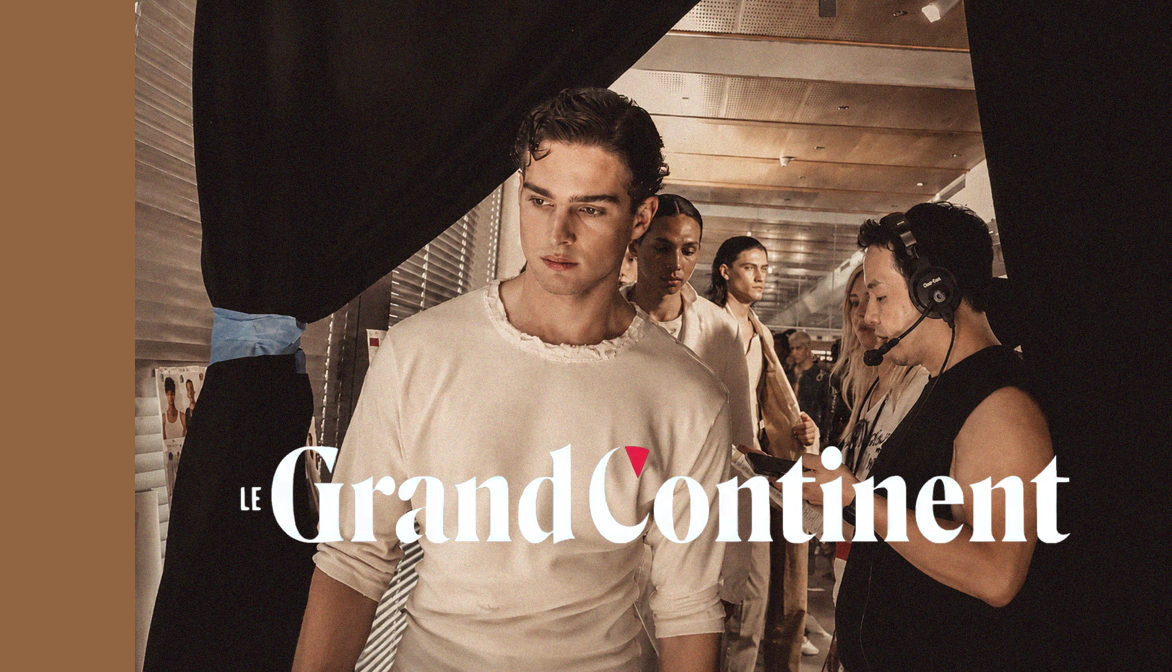
On June 23, 2026, in the courtyard of the National Archives Museum, a twenty-year-old man opens the Spring-Summer 2027 runway for the California label 424. His name is Braden Peters, but a little over a million people follow him online under the alias Clavicular, a pseudonym borrowed from the bone his community fetishizes—the clavicle, whose width is said to measure virility.
Clavicular embodies looksmaxxing, literally the maximization of one’s appearance. This movement emerged in the early 2010s within incel forums, communities of men described as “involuntarily celibate” who blame women for their emotional misery. Its live streams on the platform Kick bring in around $100,000 a month.
How to understand that a marginal figure, born from incel forums, can open a runway show in Paris? One temptation is to see it as just another fashion scandal, a calculated provocation in an industry that has witnessed plenty of them. But that would miss the point altogether.
Runway show of the California brand 424, in the courtyard of the National Archives Museum. Paris, June 23, 2026.
The Clavicular moment reveals how illiberalism today is becoming banal: less through adherence to a doctrine and more through everyday practices, images, and norms. The hierarchy of masculinity has become a real-life experience before it is a political conviction. Fashion, one of the spaces where this banal illiberalism gains prestige and desirability, plays a central role in that dynamic.
Looksmaxxing and the Aesthetics of Hierarchy
The cosmology of looksmaxxing is brutally straightforward: appearance determines desirability, and desirability dictates status. Beauty equals sovereignty; ugliness equals inferiority. The only way out is the “ascension”—to become more handsome, and thus more powerful. There exists a more polished version, softmaxxing (focus on diet, training, strategic haircut), and a radical version, hardmaxxing: driven by surgery, hormones, and assuming biomedical risks. Clavicular belongs to the latter school: he has injected testosterone since he was fourteen, he claims to be sterile due to anabolic steroids, and he urges his followers to strike their jaw with a hammer to densify it—a practice his community simply calls… bonesmashing.
Criminologists Anda Iulia Solea and Lisa Sugiura have shown how, on TikTok, content from the incel sphere is rechristened to dodge moderation: the stigmatized term “incel” yields to apparently more neutral categories, such as “Sub5.” The blackpill ideology, the belief that looks biologically condemn certain men to sexual failure and justify their resentment of women, is recoded as self-improvement tips, appearing on the surface far less extreme. The two researchers describe this process of “normiefication” as a gateway to harder content.
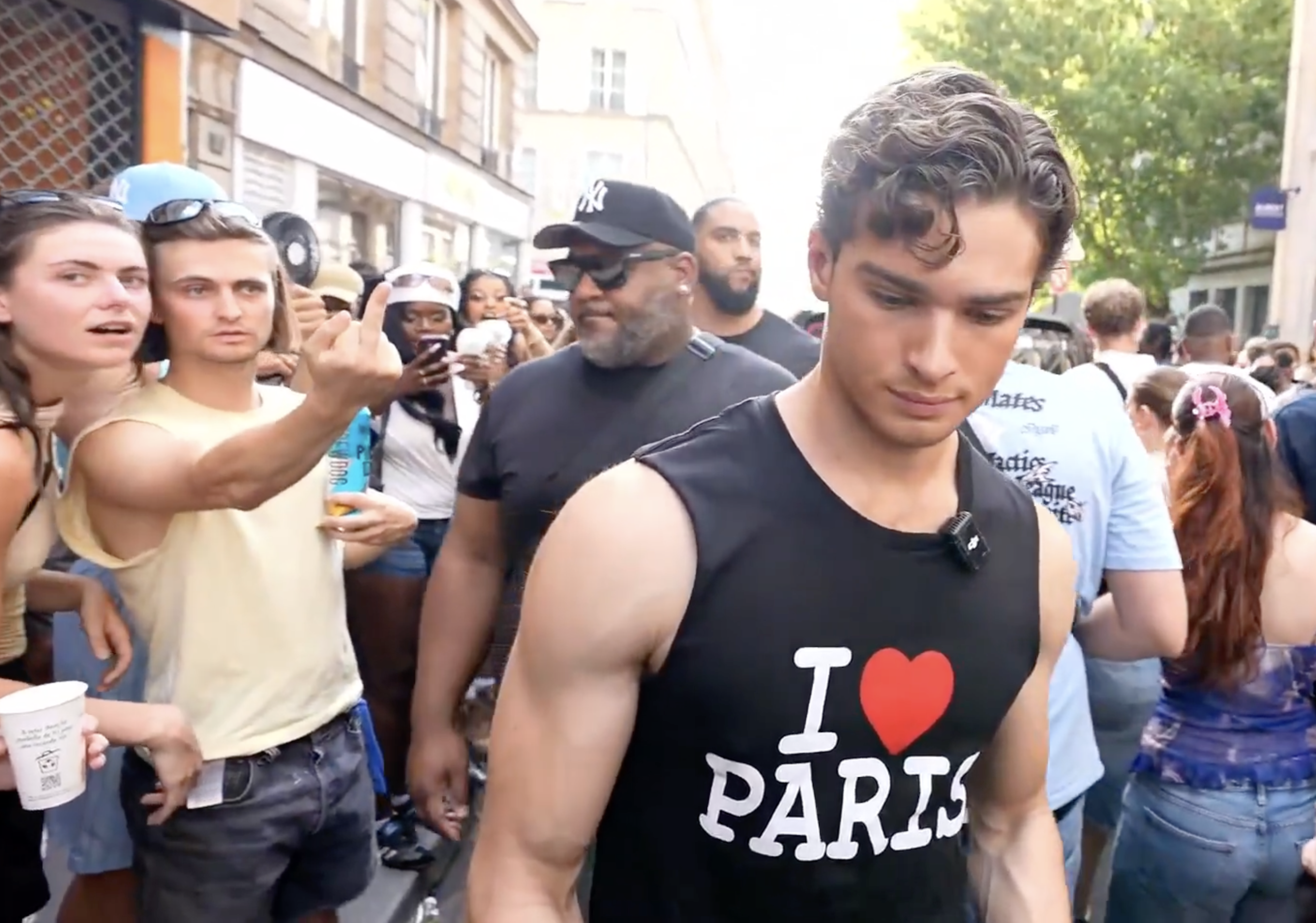
Clavicular is less a theorist than the ideal vehicle, precisely because he treats this universe as a question of visibility rather than a doctrine. Braden Peters is not an ideologue. Asked about his beliefs, he hints that his choices respond to financial and media opportunities. Politics, in the vocabulary of his community, is a matter of jesters, of buffoons. Yet: he was filmed in January in a Miami nightclub, singing Kanye West’s Heil Hitler, a major figure of online antisemitic provocation, alongside Andrew Tate, a radical masculinist influencer, and white supremacist Nick Fuentes. He had even told the New York Times that his interest in looksmaxxing originated from a desire to politically influence others by becoming more handsome.
So take this denial of the political seriously, for it is itself a political modality. When a teenager builds an audience around hierarchy, humiliation, sexual scarcity, and racially charged beauty standards, he is making politics, whether he declares it or not. The PSL scale—which claims to objectively measure physical attractiveness—explicitly privileges traits associated with a European ideal. The eugenic and misogynist substratum works even more effectively when it presents itself as personal development.
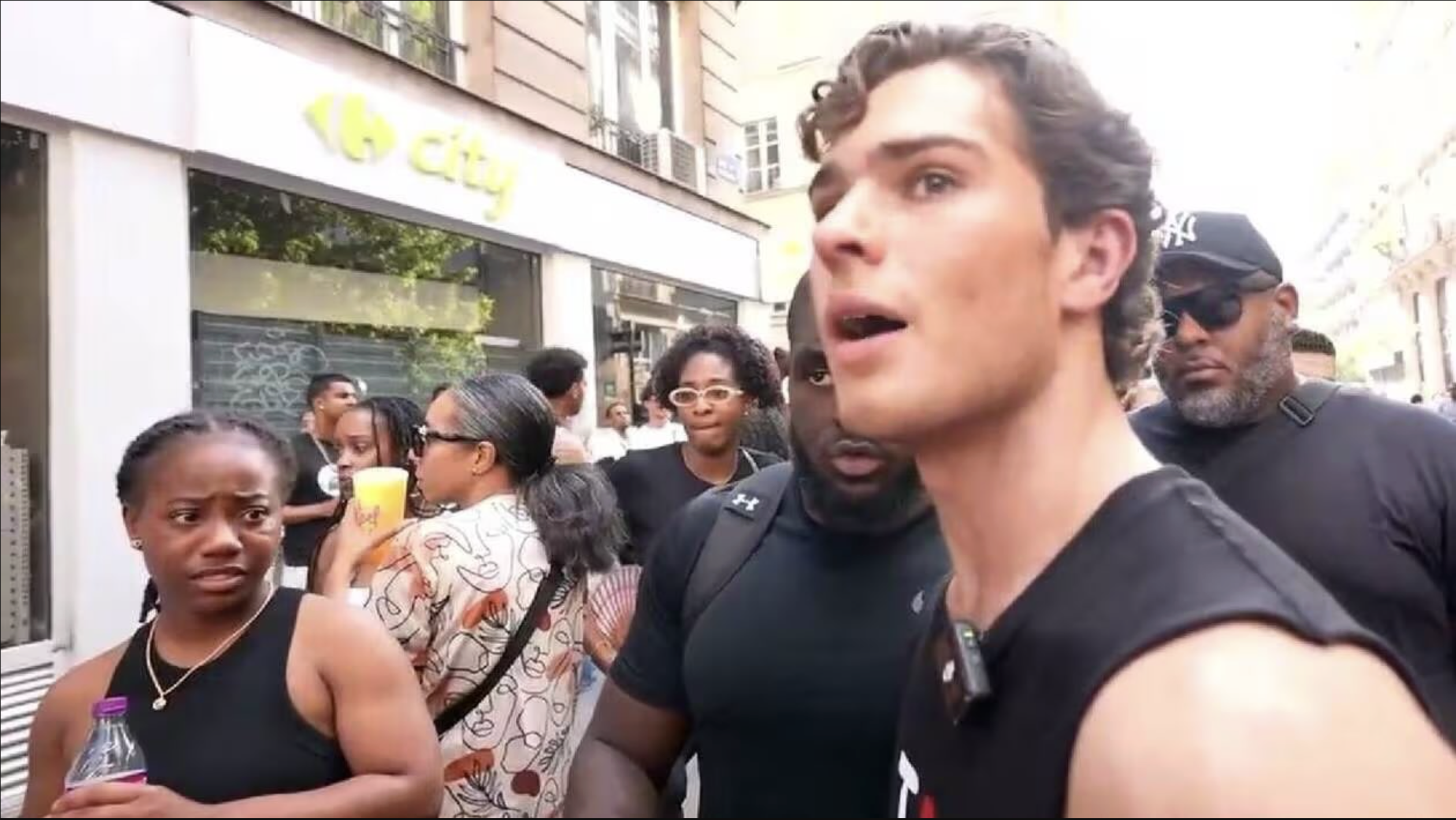
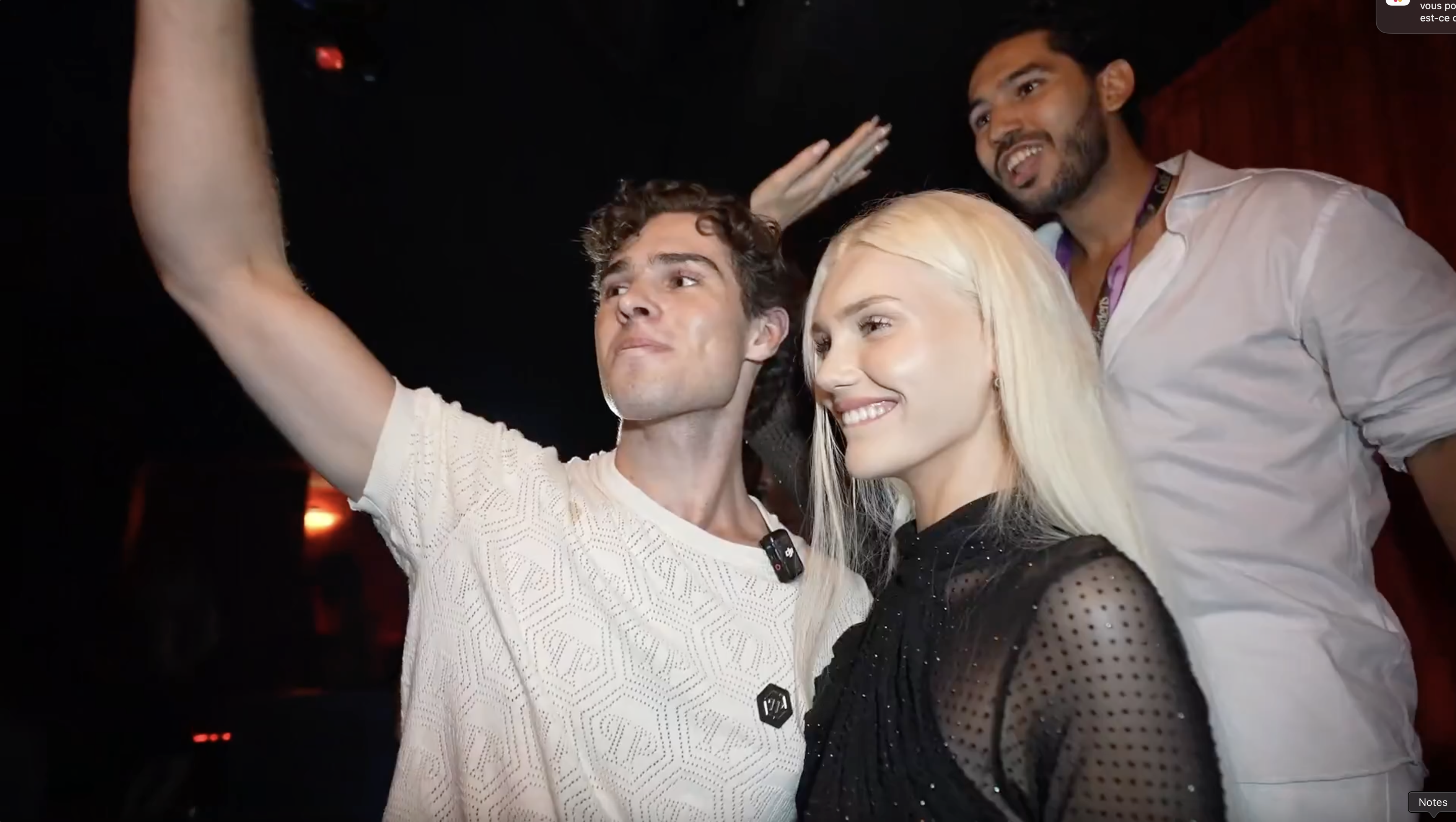
Video from a night out at a Miami nightclub, streamed live on Clavicular’s Kick account. Miami, January 17–18, 2026.
Then there is the paradox that explains Clavicular’s appeal: his sincerity. Unlike Silicon Valley biohackers who cloak their protocols in health and longevity rhetoric, Clavicular states his aims plainly: domination and desirability.
This bluntness becomes a form of authenticity when he films his injections, recounts his operations and recoveries. In April, when he collapses live in a Miami restaurant after a suspected overdose, in front of thousands of viewers, the accident itself enters the spectacle. For the content is not only the outcome of the transformation but the process itself, including when it derails.
A complaint filed at the end of April in Florida court by Aleksandra Mendoza, recruited at sixteen to become, she says, “the female face of looksmaxxing,” recalls that this theater of optimization can cause very real victims. She accuses Peters of exploiting her, of non-consensual relations, and of injecting in front of viewers, without medical qualification, a substance meant to dissolve fat. Peters denies these allegations, which remain unresolved at this stage.
Remilia, or the Reactionary Becoming the Avant-Garde
The passage of Clavicular onto the runways is not a mere eccentricity. His first show, in February in New York, for designer Elena Velez, was organized in collaboration with Remilia Corporation, the most advanced laboratory of contemporary reactionary aesthetization.
Remilia is a digital art collective founded in 2021 by a man operating under the female pseudonym Charlotte Fang, hailing from a forum of art-school graduates and dropouts. Its flagship creation, the Milady, is a collection of ten thousand avatars sold as NFTs—digital ownership certificates that fueled post-Covid speculative markets. Designed in a “neochibi” style, named after oversized-headed, wide-eyed anime figurines, these characters borrow their looks from Tokyo street tribes of the 2000s—gyaru with artificial tanning, Lolita in frilly dresses, the Harajuku eccentrics—various subcultures where identity is entirely about style. The collection reached a valuation of over $150 million and spawned an empire: meme-coins, a dietary supplement brand, an influencer agency, a record label, and an online art criticism quarterly.
This commercial proliferation is not a side note: it is, in the eyes of the collective, the work itself. Remilia conceptualizes itself as a “global art-industrial conglomerate,” a “corporation-as-artwork,” aligning itself with a twofold lineage: Warhol’s Factory, which turned the workshop into a business and business into an artistic gesture, and Bernadette Corporation, the 1990s–2000s New York collective that lampooned fashion branding to make it a medium. The idea is the same, scaled to the internet: everything—the sales, the speculation, the community, the marketing—enters the artwork.
Behind the conceptual veneer, the genealogy is explicit. At the heart of Remilia’s approach lies the thought of Nick Land, the British neoreactionary philosopher and author of The Dark Enlightenment, whose accelerationism has informed, for more than a decade, certain corners of Silicon Valley.
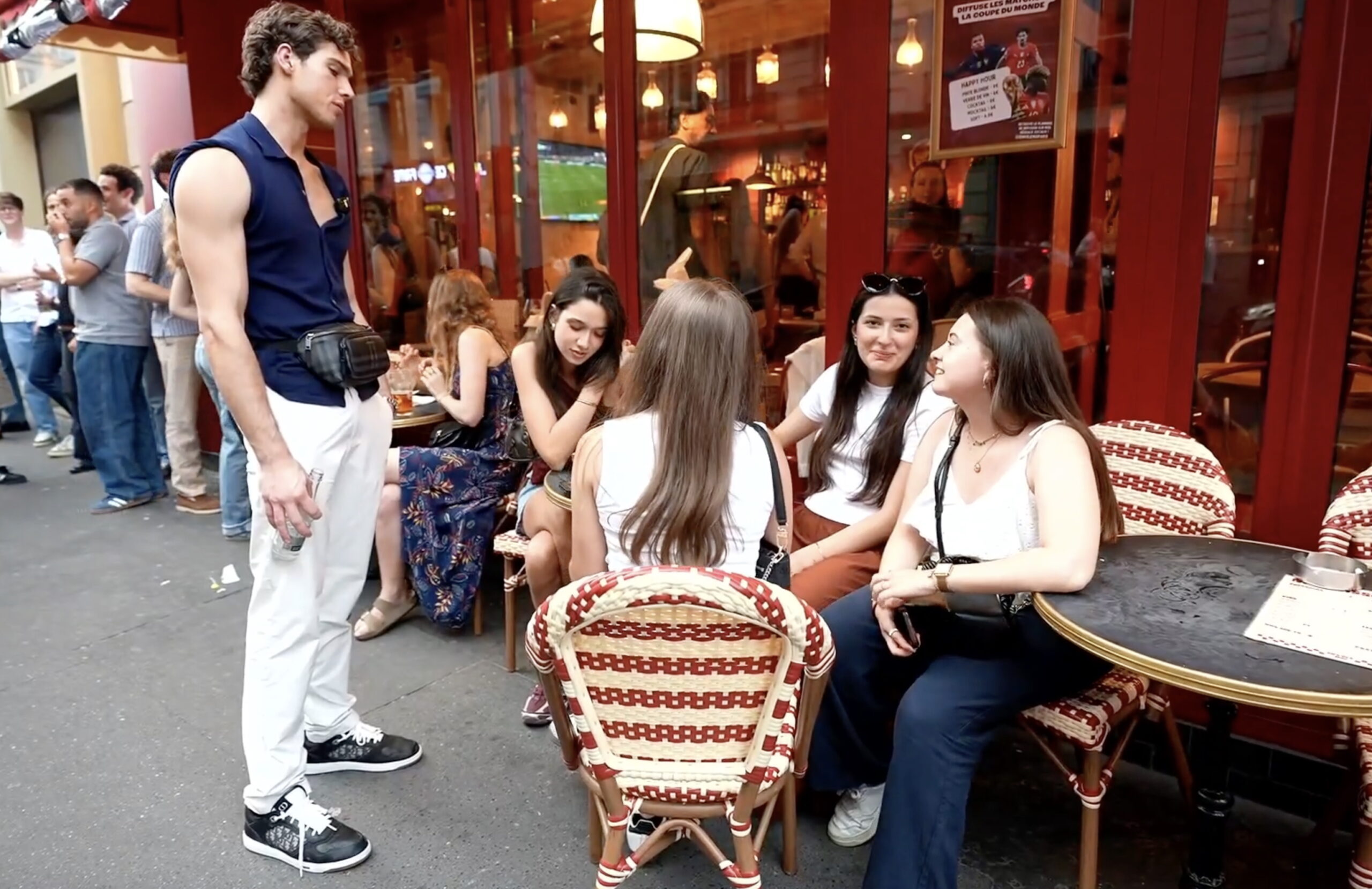
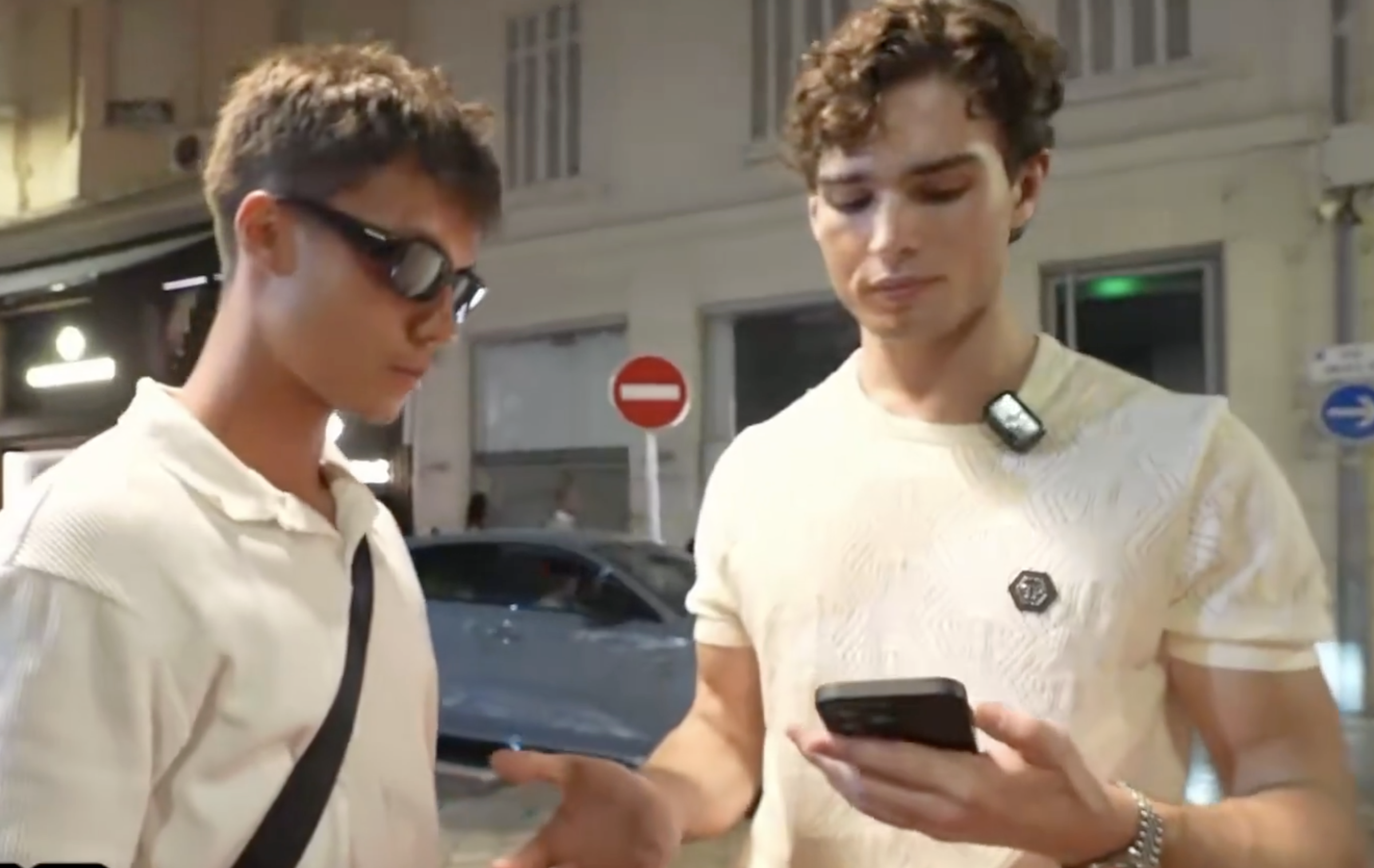
In 2022, the revelation that Charlotte Fang had previously operated under the alias Miya, associated with racist, homophobic, and antisemitic publications as well as with extremist online communities, could have doomed the group. It did not: the Milady’s value eventually rebounded beyond its pre-scandal levels, and the “post-cancelled” identity became the founding myth of the community. Three months after the affair, a derivative collection, marketed under the banner of a “schizophrenic reactionary aesthetic,” outpaced the original sales.
The political consolidation came next. On the eve of Donald Trump’s second inauguration, Remilia was the main sponsor of the Coronation Ball, the grand event of the movement, with Steve Bannon as the keynote speaker. After his speech, a Remilia-associated artist took the stage to unveil the project: remake the world, one meme at a time.
Observers looking for material gain—such as more favorable crypto regulation—see only part of the story. The alignment is as much aesthetic as strategic: a political movement defined by viral imagery meets a collective that has made memetic circulation into an art form.
The sociology of Remilia completes the portrait. The collective explicitly recruited outsiders: fashion students, online Catholics, cosplayers, and figures from Dimes Square in New York, a Lower East Side art-and-media scene that blends avant-garde with post-irony and a rejection of cultural progressivism. It is Landian accelerationism translated into a participatory lifestyle brand.
The Problem of Lived Ideologies
It remains to understand why fashion matters. Elena Velez, a LVMH prize finalist in 2024 and long celebrated for her metallic corsetry and sculptural work, gradually swapped strict styling for rage-bait—the provocation-driven strategy designed to turn outrage into visibility.
Her February show, explicitly devoted to looksmaxxing, placed at the front row figures from far-right and online right-wing spaces and featured, alongside Clavicular, an influencer associated with extreme thinness.
Several months earlier, in March at Paris Fashion Week, Marilyn Manson, the American shock-rock icon of the 1990s now facing multiple abuse allegations, opened the show for Enfants Riches Déprimés (ERD), a California luxury label whose French name translates as “Depressed Rich Kids,” turning punk imagery, nihilism, and provocation into marks of distinction.
Runway show of the California luxury label Enfants Riches Déprimés during Fashion Week at La Maison de la Chimie. Paris, March 8, 2026.
Reading these choices as mere commercial provocations would be a mistake. They show first that culture has become a central space for circulating and normalizing illiberal values, far beyond parties and political speeches. Body culture is a particularly effective vehicle: by influencing images and beauty norms, it renders these hierarchies tangible and desirable, and the attention economy reinforces the spiral.
Marketing the body is, of course, not new: women have long been subjected to norms that make beauty a criterion of value. What changes is the explicit extension of this to men. Masculine beauty becomes a resource of power precisely as the older markers of virility—salary, profession, the ability to support a family—become less accessible, less stable, or less distinctive.
The difficulty of reinventing masculinity thus creates fertile ground for an illiberal creed that promises to restore the hierarchy by re-inscribing it in the body.
The looksmaxxing is exemplary because it requires no doctrinal allegiance: it is first a practice: routines, metrics, and bodily transformations. In this sense, it is a lived ideology: beliefs do not precede practices; they are formed through them.
The looksmaxxing teaches to perceive the world as a hierarchy even before offering the words to justify it. The doctrinal moment may come, or not, but the ideology is already present, anchored in actions.
We can thus speak of banal illiberalism, extending Michael Billig’s notion of “banal nationalism.” It is not an illiberalism that declares itself, but one that is ingrained, reproduced less through persuasion and more because it makes sense as common sense.
Underestimating the power of attraction of this aesthetic would be a dangerous mistake. Illiberalism progresses not only through the ideas it defends but through the images that render its hierarchies desirable.