
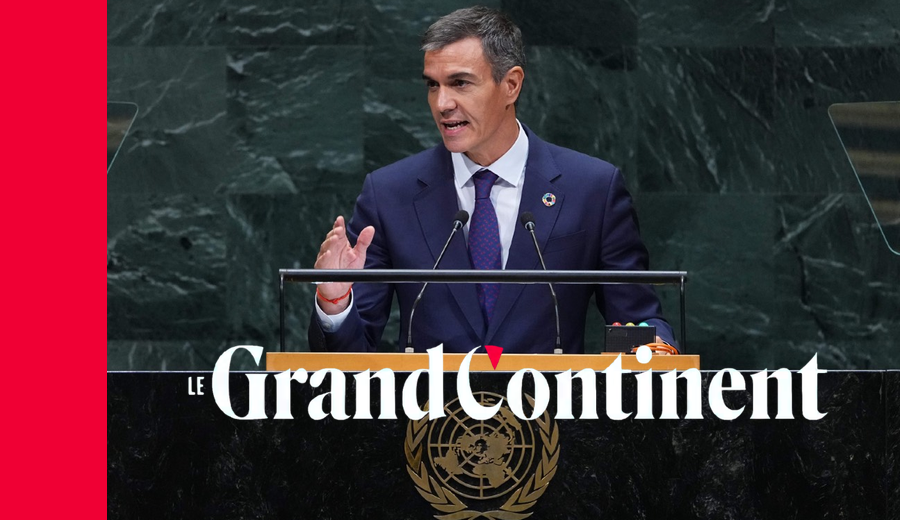
On September 24, from the rostrum of the United Nations General Assembly, Pedro Sánchez came to “defend what many are attempting to destroy.” Without naming Donald Trump, the Spanish prime minister denounced “a planned and coordinated bid to dismantle” the multilateral order, led by governments he chose not to name, for “we all know who they are and how they operate.”
Facing these forces that he described as “selfish, ignorant and cruel,” he defended the 1945 Charter and called for a remaking of the multilateral system: starting with the removal of the veto in the Security Council (“no country should be both judge and party”) and the election of a Latin American figure to the post of secretary-general, which he presents as “historic debt.”
“It took humanity centuries to replace the rule of the strongest with the force of the law, and we cannot be the generation that goes backwards,” he warned. In its scope, this intervention can be compared to Mark Carney’s Davos address in January 2026. We publish it in full.
Monsieur le Président, Mesdames et Messieurs,
I rise to this podium with a single objective: to defend what many are trying to destroy.
I come to assert the principles and the ambitions that inspired the creation of this organization 81 years ago. Principles and ambitions that some governments present here scorn or seek to dismantle.
Eight years have passed since I first addressed this Assembly, and in that time, many things have changed in the world. And alas, I must say that it has not been for the better, but for the worse.
A Return to the Past
In 2018, the 193 nations that compose this organization agreed to adopt the 2030 Agenda, and most of the leaders present proudly wore the symbol of the Sustainable Development Goals. And we did so not because it was fashionable, nor because we believed it would be an easy path.
We did it because most of us believed in that shared promise.
Because we were convinced that peace, sustainable development, and equal opportunity are not ideological positions but essential to humanity’s future.
Today, however, these ideas are not merely questioned. They are attacked by political actors, by governments that want to drag us back to a dark past.
And there is no need to name them. We all know who they are and how they operate.
They begin, first, by questioning the rules.
Then they break them, fully aware, moreover, that no one will hold them to account. And they shrink their contributions to multilateral bodies like this one. They point fingers at their leaders and staff. They paralyze their ability to act, only to describe them as useless entities from which one can do without.
Selfishness, Ignorance and Cruelty
Thus, it is a planned and coordinated demolition attempt, presented as unavoidable and necessary.
But in truth, it runs counter to the structural currents of history and rests on three flawed pillars.
The first is selfishness—the absurd belief that the world is a zero-sum game, where the gain of some necessarily implies the loss of others. The second is ignorance, because scientific evidence is scorned and the idea is entertained that there exist powers so strong they can abuse others and need no one to thrive.
And the third, the worst in my view, is cruelty. A cruelty that does not flinch at the sight of a starving child or a hospital reduced to rubble.
Over these eight years, I have watched these selfish, ignorant and cruel forces gain in scope.
I have seen them shed their masks and seize power in numerous places.
And from there, I have seen them unleash illegal wars and massacre innocent civilians.
They have treated millions of human beings as if they were livestock and withdrawn aid from those who suffer most from poverty and disease. I have seen them pollute the atmosphere and the ocean as though they owned them.
And they conspire to destroy this organization and everything it stands for.
In short, I say all of this because witnessing these events has changed the way I understand the world.
Not All Hope Is Lost
Yet this does not mean I have lost hope.
For in these eight years I have also seen marvelous things that allow me to keep faith in humanity.
For example, I have watched millions mobilize to defend nature, peace and civil rights.
I have seen thousands of activists and public servants oppose these reactionary powers, knowing they put their careers, even their lives, at risk.
I have witnessed scientists achieving breakthroughs we once deemed impossible, and many governments doing what was necessary: investing in cooperation, social justice and environmental sustainability.
All of this has taught me a fundamental truth I would share with you all: humanity is not inherently good or evil.
Humanity can be both. And every year, every day, in every crisis, it must decide how to act.
The United Nations is one of the forums where that decision is made at the highest level.
And it is not always for the better. Of course not.
I have repeatedly highlighted the contradictions and shortcomings of this organization.
Rebuilding and Strengthening Multilateralism
But with the same conviction, I must also denounce the fact that most voices stubbornly criticizing the UN system today do not describe its failure. What they seek is to precipitate its failure.
And I must also say that multilateralism is the best instrument humanity has to manage its diversity and interdependence, especially in a globalized, multipolar world like ours today.
That is why we must renew and reinforce faith in the multilateral framework.
We must renew and strengthen it. So that it can play the same central role this century that it played in the last.
This will of course not be easy. But the good news is that all the directions we need lie here. They are laid out in the United Nations Charter.
It is in this Charter that our ancestors wrote some of humanity’s finest chapters. Men and women who had seen the world go up in smoke and, despite that, found the courage to imagine a better future.
These men and women poured their wisdom and hope into this Charter. And they did not ask us to place it on a pedestal. They asked us to respect it, defend it and refer to it in moments like the one we are living now, marked by uncertainty and extraordinary difficulties.
Being True to the United Nations Charter
Today, we are passing through one of those moments.
It is therefore our duty to rise to the courage and the ambition that shine through the text of the UN Charter.
That is why, Ladies and Gentlemen, we must reform the Security Council. To ensure fair representation for all regions of the world. And to end the veto power of the permanent members. For, as the UN Charter states, no country should be both judge and party. No matter how powerful.
We must therefore strengthen the other main organs, reorganize the agencies, funds and programmes, providing them with additional resources and a greater capacity to act, so they can have a more decisive impact on the great challenges facing humanity.
We must bolster institutions such as the International Criminal Court, so they can investigate, prosecute and sanction those who break the rules. It took centuries for humanity to replace the law of the strongest with the force of the law, and we cannot be the generation that goes backwards.
For the same reason, we must rebuild the architecture of non-proliferation and nuclear disarmament, so that a poorly designed security policy does not drive us toward a new world conflict.
And we must also impose strict regulation on techno-oligarchs to govern how social networks operate and how artificial intelligence develops. Because, in the end, the future of our sons and daughters must take precedence over the financial interests of these techno-oligarchs.
Of course, delivering all of these actions will require commitments and time. And a strong leadership capable of forging agreements, listening, looking beyond the known reality, and imagining a better alternative.
Putting a Woman at the Helm of the United Nations
My choice for this leadership is clear.
Nine men have held the post of secretary-general in this Organization over its eighty-year existence. It is now the turn of a woman. A Latin American woman.
Because, Ladies and Gentlemen, how can an organization that claims to speak for all humanity have never had a woman at the head of the United Nations system? How can it represent all continents if for three decades we have not allowed the world’s third-most-populous continent to occupy this post?
The United Nations were born with the promise that every human being would have a place in this house.
It is therefore time to fulfill half of that promise. It is time for a Latin American woman to hold the post of United Nations secretary-general.
This is a historic debt we must settle.
Today more than ever, as feminism faces attacks and thousands of women endure sexism, violence and xenophobia, we must reaffirm this commitment even more strongly.
And I want to be clear: I am not saying this because I think women have something to prove.
I say it because the world itself must prove to itself that there is no turning back on the path to equality.
In my country, Ladies and Gentlemen, Spain, it was women who first showed that security does not come from force but from social progress.
It was courageous women, like Clara Campoamor, who were among the first to argue in Parliament that renouncing war ought to guide our relations with the world, and that the bet on empathy and peace should always be the preferred option.
If only many of the leaders who have spoken from this podium this week had only a fraction of the courage and clarity Clara Campoamor showed.
Feminism, Ladies and Gentlemen, is one of the main forces of transformation and progress the world has known over the last century, and it is high time its strength guides this institution in a far clearer and more decisive way.
For these reasons and many others, Ladies and Gentlemen, I believe that, to best usher in this new decisive stage in the history of the United Nations, the Organization would benefit from having a Latin American woman as secretary-general.
And I also believe that, so as not to stand alone, she will need the support of brave governments ready to do what is right, whatever the price.
Spain Has Shown the Way
And that is the path Spain has chosen, Ladies and Gentlemen.
Over the past eight years, my country has opposed all wars of aggression, wherever they have erupted. Be it in Ukraine, Lebanon or Iran.
We refused to raise our military spending to 5% of GDP. And we did everything in our power to prevent aggression contrary to the UN Charter, by sanctioning the Russian aggressors, by imposing an arms embargo on Netanyahu’s government in Israel, by preventing our territory from being used to undertake aggression contrary to international law, and by unequivocally condemning the genocide that Netanyahu continues to perpetrate in Gaza.
We have also mobilized resources to go further. And, faced with a chainsaw that slashed global development aid by almost a third in a mere two years, Spain doubled its investment in cooperation and increased its contribution to the multilateral system by no less than 60%.
And we did so while remaining faithful to our principles.
Even in moments as difficult as those now facing the Spanish city of Ceuta, where inequality, despair and misinformation have fed one of the largest irregular-migration crises in recent years.
I know that in such moments the temptation is strong to take the easy route. To give in to fear, to turn the migrant into an enemy and to break the law. But my country, Spain, will not do so. And, of course, Ceuta will not either. For its people demonstrate that a crisis can be faced without compromising dignity, while respecting the law and human rights.
And it is precisely for that reason that we will emerge stronger.
Because Spain does not choose the easiest path. It always chooses the fairest one. And I would add that the world knows this.
And the reactionary forces that want to destroy the multilateral order keep attacking us for this reason.
They want us to be intimidated. They want us to capitulate.
They want us to end up believing that the Sustainable Development Goals are a lost cause, that defending the common good is naive, that cooperation is an act of weakness.
Well. I am here and I rise to this podium to tell you—loudly and clearly—that they are wrong and that we will not stay quiet.
The Spaniards Will Not Back Down
We, the Spaniards, will not retreat a single step.
We will continue to believe that humanity can keep progressing and that together we can build a better world.
And we will do so because we want to live up to the dreams of our sons and daughters.
For we know that, in a few years, these future generations will look back, review this decisive decade, and ask what role each of us played.
They will rightly ask what we did when some countries started bending the rules and others chose to look the other way.
They will ask what we did when defending our convictions began to cost us a lot.
And when that day comes, we want to be able to tell them that we did not stop fighting. That we did not. We want to tell them that we gave it our all to leave them a world that is more peaceful, more sustainable and, of course, more just.
That is what we hope to tell them.
And that is the pledge I intend to take from this podium.
Not on my own behalf, of course, but in the name of the country I represent, Spain.
Thank you very much.